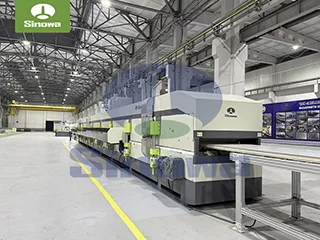
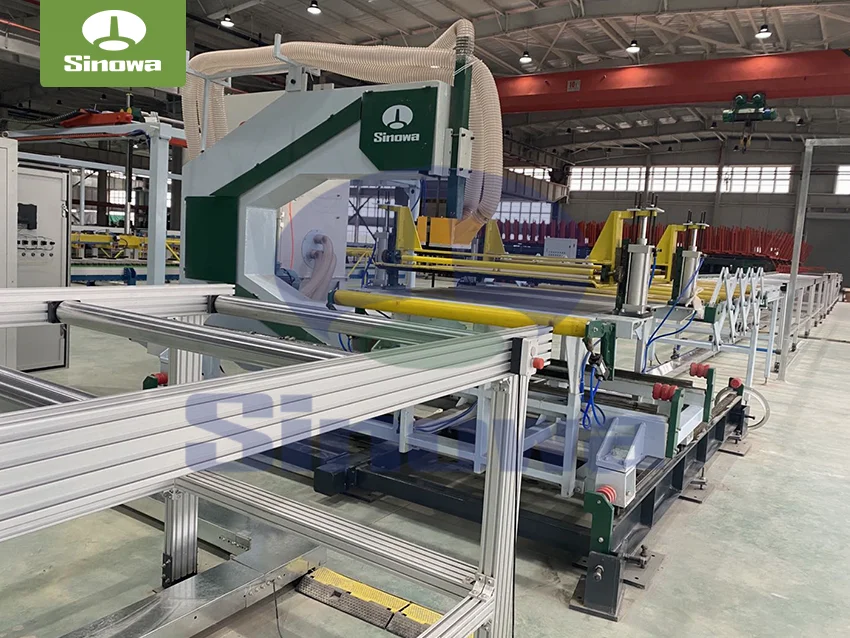
 sandwich panel line
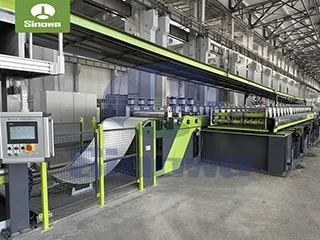
The overall structural design of the PIR sandwich panel production line follows modular and highly integrated industrial design concepts, arranging multiple functional processing units in a continuous and sequential production layout to realize uninterrupted automated production from raw material input to finished panel output. The complete production workflow covers surface material unwinding and leveling, precision roll forming, surface preheating treatment, multi-component high-pressure foaming and pouring, synchronous composite lamination, constant-temperature curing, gradual cooling shaping, fixed-length precision cutting, and automatic stacking and outputting. Each functional unit is closely coordinated through intelligent linkage control, eliminating intermittent production gaps and ensuring the continuity and stability of the entire production process. This streamlined production mode not only greatly improves production efficiency but also avoids product quality fluctuations caused by manual intervention and discontinuous processing, laying a solid foundation for the mass production of high-stability flame-retardant insulated panels.
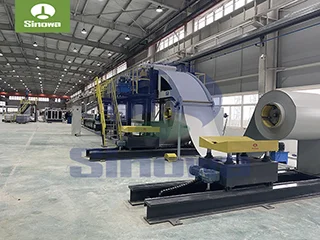
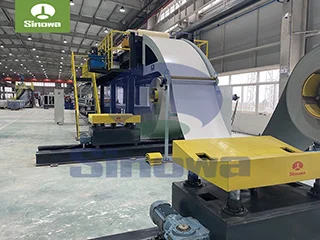
Surface material pretreatment serves as the initial core link of the entire production process, directly determining the flatness, bonding firmness, and surface texture of finished PIR sandwich panels. The PIR sandwich panel line is compatible with multiple mainstream surface materials commonly used in insulation panel manufacturing, including thin-gauge metal sheets with uniform thickness and smooth surface texture. In the unwinding stage, the automatic unwinding device stably releases coiled surface materials with constant tension, effectively avoiding material deviation, wrinkling, and stretching deformation that often occur in traditional unwinding processes. Equipped with precision leveling and calibration components, the system eliminates internal stress and surface irregularities of coiled materials, ensuring the flatness of surface materials before entering the forming process. The subsequent roll forming unit adopts multi-group precision rolling structures, which gradually shape the flat sheet materials into customized structural profiles according to preset panel specification requirements. The entire forming process adopts gradual pressure adjustment to prevent material fatigue and surface damage, maintaining the integrity of the surface material’s protective layer and structural performance. Before composite molding, the independent preheating system conducts uniform low-temperature heating on the formed surface materials, removing surface moisture and fine dust while activating the material surface molecular activity, which significantly enhances the bonding adhesion between surface materials and PIR foam core layers, preventing delamination and peeling during long-term service.
As the core functional section of the continuous sandwich panel production line, the PIR foaming and pouring system determines the fundamental thermal insulation and flame retardant performance of the finished panels. Different from ordinary polyurethane foaming equipment, this system is professionally optimized for PIR material polymerization reactions, adopting multi-component synchronous mixing and high-pressure foaming technology to realize precise proportional configuration and uniform mixing of raw materials. The system supports flexible adjustment of multiple raw material components, with an intelligent metering control module that accurately controls the mixing ratio, flow rate, and output speed of each component, ensuring stable reaction conditions for PIR foam polymerization. In the high-pressure mixing chamber, raw materials undergo intense and uniform mixing under constant pressure, realizing full fusion of components without local proportion deviation, which is the key to forming a uniform and dense closed-cell structure. The foaming medium used in the production process is environmentally friendly and low-volatile, which not only ensures the fine and consistent cell structure of PIR foam but also reduces volatile substance emissions during production, meeting modern industrial environmental protection production requirements.
The unique closed-cell structure formed by precise PIR foaming is the core source of the panels excellent comprehensive performance. The continuous sandwich panel line precise process control enables the PIR foam core layer to form a high-closed-rate cell structure, with most cells presenting a completely sealed state filled with low thermal conductivity gas. This structural characteristic endows the panel with extremely low thermal conductivity, effectively blocking heat conduction and achieving efficient thermal insulation and heat preservation effects. Compared with traditional expanded polystyrene and extruded polystyrene insulation materials, PIR foam formed by this professional production process has a more compact molecular structure and higher structural stability. More importantly, the optimized foaming and formula control process significantly enhances the material’s flame retardant performance, enabling the finished panels to reach stable B1-grade flame retardant effects. When exposed to high temperature or open flame, the PIR core layer will form a dense carbonaceous char layer on the surface rapidly. This char layer can effectively isolate oxygen and block heat transfer, inhibit flame spread and penetration, and avoid molten droplet generation and secondary combustion, greatly improving the fire safety performance of the panels in building application scenarios.
The synchronous composite molding and constant-temperature curing system is a key link to ensure the overall structural integrity of PIR sandwich panels. After the uniform PIR foam material is poured between the upper and lower formed surface materials, the integrated composite molding unit immediately conducts synchronous pressing and shaping. The system adopts intelligent pressure and temperature linkage control, maintaining constant molding pressure and uniform heating temperature in the molding cavity to ensure that the foam material expands evenly and fills the entire cavity without gaps or hollow areas. The real-time infrared temperature monitoring module tracks the molding temperature throughout the process, with precise temperature error control, ensuring that the PIR polymerization reaction proceeds under the most stable temperature conditions. The scientific curing process is divided into primary constant-temperature curing and secondary stress-relief curing stages. Primary curing promotes the complete polymerization and solidification of PIR foam, realizing stable bonding between the core layer and surface materials; secondary curing eliminates internal stress generated during foaming and pressing, preventing panel deformation, warping, and structural loosening in subsequent use and storage. The entire molding and curing process realizes one-time synchronous forming of upper and lower surface materials and PIR core materials, ensuring the overall flatness, compactness, and structural consistency of the composite panels.
The cooling and shaping system follows the curing process, adopting a gradual segmented cooling mode to avoid quality defects caused by rapid temperature change. Rapid cooling after high-temperature curing will easily lead to inconsistent internal and external shrinkage of the panel, resulting in surface cracking, core layer cracking, and bonding failure. The PIR sandwich panel machine segmented cooling unit gradually reduces the panel temperature through multi-stage low-speed air circulation, enabling the internal structure of the PIR foam and the composite interface to shrink uniformly, further stabilizing the overall structural performance of the panel. After sufficient cooling and shaping, the panel enters the precision cutting unit, which adopts laser positioning and hydraulic cutting technology to realize fixed-length cutting according to customized specification requirements. The cutting system has extremely high dimensional accuracy, ensuring consistent length and flatness of each finished panel, with smooth and burr-free cutting sections, effectively avoiding local structural damage caused by rough cutting. The automated cutting process can adapt to multiple panel thicknesses and length specifications, realizing flexible switching of production specifications and meeting the diversified customization needs of different application scenarios.
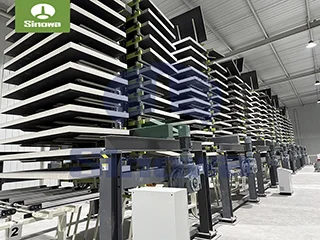
The final automatic stacking and output system realizes intelligent collection and arrangement of finished panels, completing the entire automated production cycle. The system can automatically adjust the stacking height and arrangement mode according to panel specifications, neatly stacking finished products without manual handling, which greatly improves production efficiency and reduces surface scratches and structural damage caused by human contact. Meanwhile, the PIR sandwich panel production line is equipped with a real-time quality monitoring and data recording system, which automatically collects and analyzes key production parameters such as foaming density, curing temperature, molding pressure, and cutting size in the production process. Once parameter deviation exceeding the standard range is detected, the system will automatically trigger adjustment prompts and fine-tune operating parameters in real time, realizing full-process quality traceability and intelligent control. This full-automated quality control mode effectively ensures that every batch of produced PIR insulated panels maintains stable flame retardant performance, thermal insulation performance, and structural quality.
The B1-grade flame-retardant PIR insulated panels produced by this professional production line have far superior comprehensive performance compared with traditional insulation panels, with prominent advantages in fire resistance, thermal insulation, structural stability, and service life. In terms of fire safety, the optimized PIR foam structure and stable material characteristics enable the panels to effectively resist flame erosion, limit flame spread speed, and reduce heat release during combustion, providing reliable fire protection guarantees for building envelopes and industrial insulation structures. In terms of thermal insulation, the high closed-cell rate and low thermal conductivity of the PIR core layer enable the panels to maintain efficient heat insulation performance in high and low temperature environments, effectively reducing building heating and cooling energy consumption, and helping to achieve energy-saving and emission-reduction goals in construction projects. In terms of structural performance, the integrated composite molding process makes the surface material and core layer closely integrated into a whole, with high overall structural strength, strong compression resistance and bending resistance, and no delamination or deformation during long-term load-bearing use.
In addition to core performance advantages, the automatic sandwich panel production line also has outstanding environmental protection and production adaptability. The entire production process adopts low-VOC raw materials and environmentally friendly foaming processes, with no harmful substance volatilization and pollution emissions during production, complying with green manufacturing standards. The produced PIR panels have stable chemical properties, no toxic and harmful components, and will not release harmful gases during long-term use or high-temperature combustion, meeting the environmental protection and safety requirements of modern buildings. Meanwhile, the modular structural design of the production line enables it to adapt to the production of panels with different thicknesses, densities, and surface specifications, with strong production flexibility. It can meet the manufacturing needs of insulated panels for different scenarios such as industrial plant enclosure structures, cold storage thermal insulation systems, commercial building exterior wall insulation, and prefabricated building enclosure components. The panels produced are also equipped with good sound insulation, moisture resistance, and weather resistance, able to adapt to complex outdoor and indoor environmental conditions, maintaining stable performance in high humidity, low temperature, and strong wind environments.
In practical industrial production and engineering applications, this continuous PIR sandwich panel production machinery has solved many quality pain points existing in traditional insulated panel production. Traditional intermittent production equipment often has problems such as uneven foaming density, inconsistent flame retardant performance of different panel batches, unstable bonding strength, and low dimensional accuracy, which lead to uneven product quality and short service life. The fully continuous intelligent production mode of this line realizes standardized control of every production link, unifies the process parameters of each production batch, and ensures the consistency and stability of panel flame retardancy, thermal insulation, and structural performance. At the same time, the high degree of automation reduces manual operation errors and labor costs, improves production capacity and product yield, and creates higher production benefits for manufacturing enterprises. The optimized mechanical structure and intelligent control system also reduce equipment failure rates and maintenance costs, realizing long-term stable and efficient operation of production equipment.
With the continuous upgrading of building energy conservation and fire safety standards in the construction industry, high-performance flame-retardant thermal insulation materials have become the mainstream development trend of the industry. As professional special equipment for producing B1-grade flame-retardant PIR insulated sandwich panels, this production line relies on mature process technology and intelligent manufacturing concepts to provide reliable equipment support for the standardized and large-scale production of high-quality building insulation materials. Its perfect integration of flame retardant performance optimization, thermal insulation performance improvement, and structural quality control makes the produced PIR sandwich panels widely applicable in various high-standard construction and industrial insulation projects. In the future, with the further development of green building and energy-saving building concepts, this type of high-efficiency, low-consumption, high-stability PIR sandwich panel production line will gain broader application space, continuously promote the technological upgrading and performance optimization of the building insulation material industry, and contribute to the development of safer, more energy-saving and environmentally friendly modern construction systems.
https://www.cnsinowa.com/sandwich-panel-machines/pir-sandwich-panel-line-for-insulated-panels-with-b1-grade-flame-retardancy.html