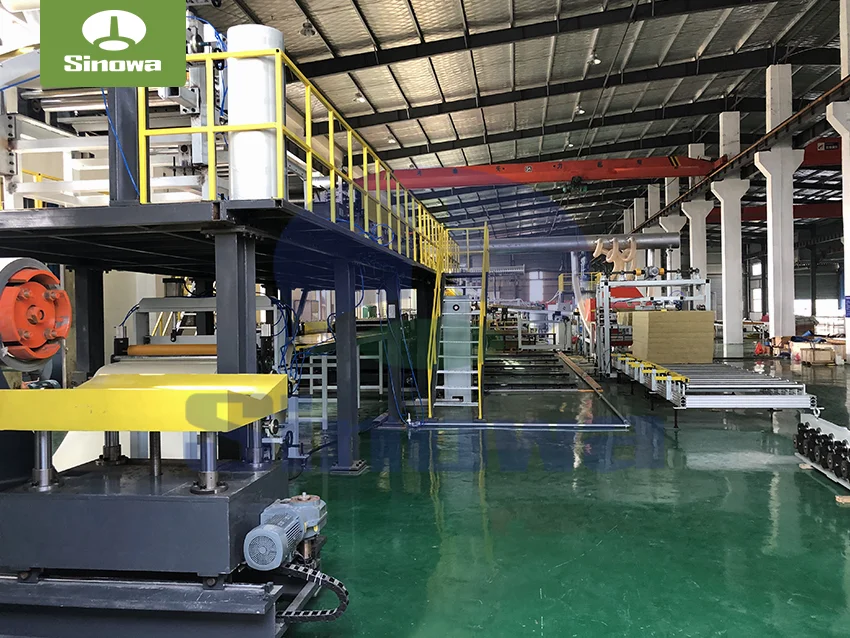
 sandwich panel machine
The overall structural design of the industrial rock wool sandwich panel production line follows modular integration principles, with each functional module independently optimized and mutually coordinated to form a complete closed-loop production system. The entire production line is mainly composed of raw material unwinding and preprocessing units, metal plate roll forming units, automatic glue spraying and laminating units, rock wool core material positioning and laying units, constant-temperature pressing and shaping units, precision fixed-length cutting units, and finished product conveying and stacking units. Every module is designed with targeted structural characteristics to adapt to the processing demands of rock wool composite panels. The front-end raw material processing module starts with the unwinding system, which adopts a stable continuous unwinding structure to support long-term uninterrupted feeding of coiled metal sheets. This structure effectively avoids production pause caused by coil replacement, ensuring the continuity of batch production. After unwinding, the metal sheets enter the leveling and surface treatment process, where professional leveling structures eliminate internal bending stress and surface unevenness generated during coil winding, while auxiliary cleaning components remove surface oil stains and impurities that may affect subsequent bonding effects, laying a solid foundation for tight lamination between metal sheets and rock wool cores.
The roll forming unit serves as the key molding component for metal outer plates, utilizing multi-group continuous rolling structures to gradually bend and shape flat metal sheets into standardized plate profiles that meet building application requirements. The rolling process adopts progressive molding logic, avoiding one-time excessive deformation that may cause metal plate cracking or surface damage. Each rolling group maintains precise spacing and angle matching to ensure uniform stress on the metal plate surface, consistent plate width and edge radian, and high overall flatness of the molded plate. This precise molding process ensures that the outer metal plates of finished sandwich panels have stable structural dimensions and neat appearance, eliminating the quality problems of irregular edges and uneven surfaces that often occur in manual or semi-automatic processing. Meanwhile, the equipment is designed with flexible parameter adjustment functions, allowing for fine-tuning of rolling speed and molding radian according to different plate thickness and usage scenarios, adapting to diversified production demands of various specification rock wool sandwich panels.
The core composite processing part of the sandwich panel equipment focuses on the bonding and compounding of metal plates and rock wool core materials, which directly determines the structural stability and service performance of finished panels. The automatic glue spraying system in this unit adopts uniform atomized glue application technology, realizing quantitative and even coating of adhesive on the inner surface of molded metal plates. The glue spraying range and dosage can be dynamically adjusted according to plate width and rock wool material characteristics, ensuring full coverage of the bonding surface without excess glue accumulation or local missing coating. This intelligent glue application mode effectively improves the bonding firmness between metal layers and rock wool cores, avoiding delamination, hollowing, and peeling defects that easily occur in traditional glue application processes. After glue spraying, the rock wool core materials are automatically positioned and laid by the precision feeding structure of the equipment. The laying mechanism can neatly arrange rock wool strips according to the set spacing and density, ensuring uniform core material distribution inside the panel and consistent overall thickness and structural strength of the finished product.
The pressing and curing process is a critical link to realize integral composite molding of sandwich panels. The industrial rock wool sandwich panel line is equipped with a constant-temperature double-belt pressing system, which provides stable pressure and temperature environment for the composite structure of metal plates and rock wool cores. During the pressing process, the equipment maintains continuous and uniform pressure on the entire panel surface, enabling the adhesive to fully infiltrate the tiny gaps between metal surfaces and rock wool fibers, and complete rapid curing and bonding under constant temperature conditions. The pressure and temperature parameters in the pressing area are precisely controlled through intelligent control components, avoiding quality fluctuations caused by uneven pressure or unstable temperature. Reasonable pressing time setting ensures that the adhesive reaches optimal bonding strength without causing thermal damage to rock wool materials or deformation of metal plates. After continuous pressing and curing, the metal outer layers and rock wool inner core form an integrated stable structure, with significantly improved overall rigidity, compression resistance, and structural integrity of the panel.
The post-processing module of the rockwool sandwich panel production line undertakes the finishing and sizing work of semi-finished composite panels, including fixed-length cutting, edge trimming, surface cleaning, and automatic stacking. The precision cutting unit adopts servo tracking and fixed-length positioning technology, which can complete real-time tracking and accurate cutting of continuously moving panels without stopping the production line. This non-stop cutting mode greatly improves production efficiency while ensuring that the length error of each panel is controlled within an extremely small range, realizing high-precision sizing production. The edge trimming structure further polishes the panel edges to remove burrs and uneven residual materials generated during cutting, making the panel edges neat and smooth, which facilitates subsequent on-site installation and assembly. After trimming and surface cleaning, the finished panels are automatically conveyed to the stacking area through the conveying system, and the intelligent stacking mechanism completes orderly stacking of finished products according to set specifications, reducing manual handling links and avoiding panel surface scratches and deformation caused by manual operation.
In terms of control system operation, the entire rock wool board production line adopts centralized intelligent control logic, with a human-machine interaction interface that realizes visual and digital management of the whole production process. Operators can complete parameter setting, speed adjustment, process switching, and equipment operation monitoring through the touch control terminal. The system supports real-time collection and feedback of production data such as operating speed, processing specifications, and equipment operating status, and has automatic early warning functions for abnormal conditions such as material shortage, parameter deviation, and equipment jitter. This intelligent control mode simplifies the operation threshold of the equipment, reduces dependence on experienced operators, and effectively avoids human operation errors affecting product quality. In addition, the equipment is equipped with linkage protection functions among various modules, realizing synchronous speed matching and coordinated operation of each processing unit, ensuring the stability and fluency of the entire production line operation, and avoiding production stagnation or product quality problems caused by asynchronous operation of front and rear modules.
The industrial rock wool sandwich panel production machine has significant technical advantages in adapting to material characteristics and improving product performance. Rock wool materials have excellent fire resistance, thermal insulation, and sound absorption properties, but their fiber structure determines that they have poor ductility and are prone to loose deformation during processing. The equipment is specially optimized for the physical characteristics of rock wool, adopting flexible feeding and pressing structures to avoid squeezing damage and fiber loose of rock wool cores during processing. At the same time, the targeted bonding and composite process solves the industry pain points of weak bonding force and easy delamination between rock wool and metal plates. The finished rock wool sandwich panels produced by this equipment not only retain the inherent fireproof, heat-insulating, and sound-insulating advantages of rock wool materials, but also obtain high structural strength and weather resistance through the protection of metal outer plates and integral composite molding, with stronger overall stability and longer service life compared with single insulation materials.
In terms of production efficiency and resource utilization, the fully automated integrated design of the equipment greatly optimizes the traditional production mode of rock wool sandwich panels. The continuous sandwich panel assembly line operation realizes uninterrupted production from raw material feeding to finished product output, greatly improving unit time output and meeting the large-scale production needs of construction material enterprises. The precise quantitative control of raw materials by the equipment effectively reduces the waste of metal plates, rock wool cores, and adhesives in the production process, improving the utilization rate of raw materials and reducing unnecessary production consumption. The highly automated production mode also greatly reduces manual intervention links, lowers labor input costs in the production process, and improves the standardization level and batch consistency of products. All finished panels produced by the same production line have consistent dimensional accuracy, bonding strength, and surface quality, which is conducive to standardized application and popularization in engineering construction.
In practical industrial application scenarios, the rock wool sandwich panels produced by this equipment are widely applicable to various modern building fields that require fire prevention, heat preservation, and sound insulation. In industrial plant construction, the panels are used for wall and roof enclosure structures, providing good thermal insulation and fire isolation effects for production workshops, reducing building energy consumption, and improving production safety. In clean workshops, pharmaceutical factories, and electronic manufacturing environments, the smooth and seamless surface of the panels after precision processing is not easy to accumulate dust, and the stable structural performance meets the high-standard environmental requirements of clean spaces. In cold chain logistics and constant-temperature storage buildings, the excellent thermal insulation performance of rock wool cores effectively isolates internal and external temperature exchange, maintaining stable internal temperature and reducing equipment operation energy consumption. In addition, the panels are also suitable for public buildings such as exhibition halls and stadiums, as well as temporary enclosure and rapid assembly buildings, relying on their lightweight, high-strength, and easy-installation characteristics.
The equipment also has good operational stability and maintenance convenience in long-term industrial operation. The main load-bearing and processing components are made of high-strength structural materials, with strong wear resistance and deformation resistance, adapting to long-term high-load continuous production work. The modular structural design facilitates daily inspection and maintenance of the equipment, with each functional module relatively independent, enabling targeted maintenance and component replacement without affecting the overall operation of the production line. The key transmission and control parts are equipped with dust-proof and protective structures, adapting to the complex production environment of building material processing, reducing equipment failure rates, and extending the overall service life of the production line. At the same time, the equipment supports flexible switching of production specifications, which can quickly adjust production parameters to process sandwich panels of different thicknesses and sizes according to market and engineering demands, with strong production flexibility and market adaptability.
With the continuous upgrading of the construction industry's energy-saving and environmental protection standards, the market demand for high-performance fire-resistant and heat-insulating building materials continues to grow, which further promotes the technical iteration and application promotion of industrial rock wool sandwich panel production machinery. Modern production equipment is gradually developing toward higher automation, higher precision, and more energy-saving operation, continuously optimizing composite molding processes and control systems, further improving product quality stability and production efficiency. As a key equipment for prefabricated building material production, the industrial rock wool sandwich panel machine not only solves the efficiency and quality bottlenecks of traditional rock wool panel processing, but also provides reliable equipment support for the popularization of energy-saving and fire-resistant green buildings. It plays an important role in promoting the standardized production of building enclosure materials, accelerating the construction speed of modern buildings, and reducing the overall energy consumption of the construction industry, with broad application prospects and important industrial value.
https://www.cnsinowa.com/sandwich-panel-machines/industrial-rock-wool-sandwich-panel-machine.html






