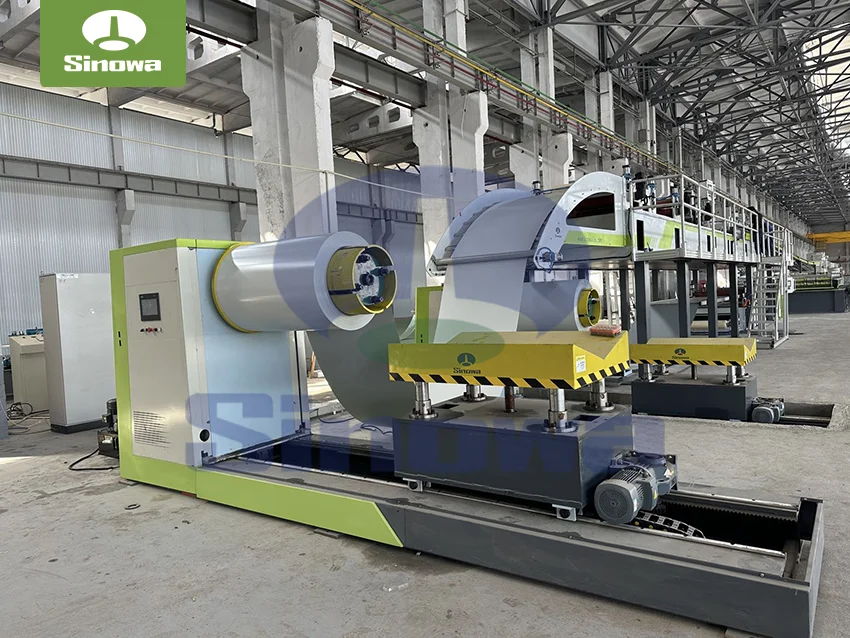
 sandwich panel machine
The core design logic of the PU foam production line with heavyweight foam core centers on adapting to the physical and chemical characteristics of high-density polyurethane foam materials. Heavyweight PU foam cores require accurate control of raw material mixing ratios, foaming speed, curing temperature, and molding pressure, as subtle deviations in any parameter will directly affect the compactness, uniformity, and adhesion of the finished foam core. This production system abandons the simplified material supply and foaming structures of ordinary equipment, adopting a fully enclosed and precisely calibrated raw material delivery system to handle the two core chemical components of polyurethane foam. The independent sealed storage and circulation units stabilize the temperature and activity of polyol and isocyanate raw materials in real time, avoiding material deterioration or uneven mixing caused by ambient temperature fluctuations, which is the fundamental guarantee for forming dense, pore-free heavyweight foam cores with consistent internal structure.
The entire production workflow of the foam core sandwich panel line follows a continuous, automated closed-loop process, covering raw material feeding, surface plate forming, precise foam injection, constant-pressure curing, composite lamination, and fixed-length cutting, with minimal manual intervention throughout the whole procedure. The production process starts with the automatic unwinding of metal surface materials, including color steel plates, galvanized steel sheets, and stainless steel plates, which are commonly used as the outer protective layers of heavy-duty sandwich panels. The unwinding system is equipped with tension adjustment and deviation correction functions to ensure flat and stable feeding of metal coils, eliminating wrinkles, misalignment, and overlapping defects in subsequent forming processes. After unwinding, the metal sheets enter the multi-station roll forming system, where precision-shaped rollers gradually bend and calibrate the flat plates into standardized panel profiles with accurate edge dimensions and flat surfaces, laying a solid foundation for tight composite bonding with the heavyweight foam core.
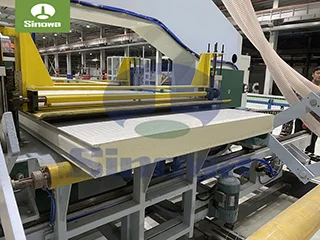
The foam mixing and injection unit stands as the most critical component distinguishing heavyweight foam core production machines from ordinary PU sandwich panel production line. For heavyweight foam core manufacturing, the machine adopts high-pressure dynamic mixing technology to fully blend the two polyurethane raw materials in strict proportion. Different from low-pressure mixing systems that are prone to uneven material fusion and sparse foam pores, the high-pressure mixing structure enables instantaneous and uniform fusion of raw materials, triggering a stable and controllable chemical foaming reaction. The adjustable injection flow and swinging nozzle structure ensure that the mixed foaming material is evenly paved between the upper and lower metal surface plates, effectively avoiding local material shortage or accumulation. This precise injection method allows the foam to expand steadily in a limited space, forming a high-density heavyweight core with compact internal structure, uniform pore distribution, and no hollow gaps after complete foaming and curing.
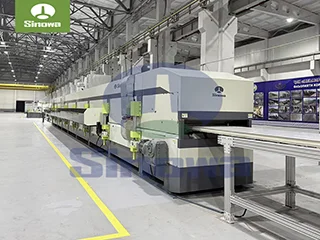
Following foam injection, the semi-finished composite panel enters the constant-temperature and constant-pressure double-belt conveying and curing system, the core functional area for shaping heavyweight foam cores. The heavyweight foam core requires a longer curing time and more stable pressure environment than lightweight foam to ensure full chemical reaction and tight bonding with metal surface layers. The double-belt conveyor maintains continuous and uniform mechanical pressure on the panel during the entire curing process, restricting excessive expansion of the foam and forcing the foam core to form a dense and solid structure. Meanwhile, the intelligent temperature control system keeps the internal curing environment within a constant temperature range, optimizing the molecular cross-linking reaction of polyurethane materials. This dual control of pressure and temperature eliminates loose core structures, poor adhesion, and uneven thickness defects common in ordinary panel production, ensuring the finished heavyweight foam core features high compression resistance and structural stability.
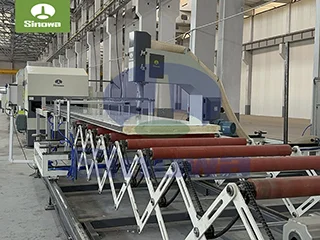
After completing curing and composite bonding, the integrated panel moves forward to the fixed-length cutting and finishing unit. Equipped with high-precision flying saw cutting technology, the polyurethane sandwich panel production line can complete stable cutting of high-rigidity composite panels without generating burrs, plate deformation, or core layer damage. The cutting system supports flexible adjustment of panel length according to production requirements, realizing flexible production of multiple specifications. Meanwhile, the automatic edge trimming and shaping structure calibrates the panel edges to ensure consistent overall dimensions and neat appearance of finished products. The entire cutting process is synchronized with the continuous production speed of the assembly line, avoiding production stagnation and ensuring the continuity and efficiency of mass production.
The structural optimization of the whole machine fully caters to the high-load operation requirements of heavyweight foam core production. The frame adopts thickened high-strength structural steel welding and integral annealing treatment, effectively resisting vibration and structural deformation generated during long-term high-pressure operation. Key transmission components are equipped with wear-resistant and fatigue-resistant structures to adapt to continuous high-intensity production work, greatly extending the service life of the equipment. In terms of intelligent control, the machine is equipped with a centralized operating system that integrates parameter setting, real-time monitoring, and fault self-detection functions. Operators can adjust core parameters such as raw material mixing ratio, injection volume, curing temperature, and conveying speed through the operating interface according to the required foam density and panel thickness of different projects. The system automatically records production data in real time, realizing traceable production quality and effectively reducing product quality fluctuations caused by human operation errors.
Panels produced by this professional heavyweight foam core polyurethane sandwich panel line possess far more outstanding comprehensive performance than ordinary lightweight PU sandwich panels in terms of structural strength and environmental adaptability. The high-density heavyweight foam core provides excellent compressive and impact resistance, enabling the panels to bear greater external loads without deformation or core layer collapse, making them suitable for building envelope structures, load-bearing partition walls, and industrial equipment insulation barriers that require high structural stability. In terms of thermal insulation performance, the compact and uniform foam core structure effectively blocks heat conduction, avoiding the heat loss problem caused by loose pores and hollow layers in ordinary foam cores, and maintains stable and efficient thermal insulation effect in long-term use.
In addition to mechanical and thermal performance advantages, the finished panels also show excellent stability in complex working environments. The integrated composite structure formed by high-pressure curing and tight bonding between the heavyweight foam core and metal surface layers effectively resists temperature difference deformation, humidity erosion, and aging damage. The polyurethane foam material after sufficient cross-linking reaction has low water absorption and strong weather resistance, and can maintain stable physical and chemical properties in high-temperature, low-temperature, and high-humidity environments for a long time, avoiding common problems such as core layer powdering, delamination, and thermal insulation performance attenuation of ordinary sandwich panels.
In terms of production efficiency and economic benefits, this dedicated heavyweight foam core sandwich panel production line achieves a perfect balance between product quality and production capacity. The fully automated continuous production mode eliminates the low-efficiency and low-precision problems of intermittent production equipment. The precise raw material proportioning and injection control effectively reduces raw material waste, improving material utilization rate. The stable and standardized production process greatly reduces the rate of defective products, lowering subsequent reprocessing costs and production losses. For industrial production enterprises, the equipment can realize large-scale standardized production of high-specification heavy-duty PU sandwich panels, meeting the batch supply demand of large industrial plants, cold storage facilities, special engineering buildings, and municipal supporting projects.
With the continuous upgrading of modern construction and industrial manufacturing standards, the market demand for high-strength, high-stability, and long-life composite insulation panels is constantly increasing, and ordinary lightweight sandwich panels can no longer meet the harsh usage requirements of special engineering scenarios. The polyurethane sandwich panel machine with heavyweight foam core fills the market gap in high-specification panel production, relying on its professional foaming control, high-pressure curing molding, and intelligent precision production technology. It not only improves the overall manufacturing level of heavy-duty PU sandwich panels but also provides reliable equipment support for the upgrading of building energy-saving and industrial insulation materials.
In practical industrial application, the continuous PU sandwich panel line also has strong production flexibility and adaptability. By adjusting the operating parameters of the system, it can produce heavyweight foam core panels with different densities and thicknesses, matching the usage requirements of different scenarios such as high-load bearing, ultra-low temperature insulation, and high-temperature heat preservation. The optimized sealing and circulating structure of the whole machine also reduces the volatilization of chemical materials during production, realizing environmentally friendly and low-pollution production while ensuring the health of on-site operating personnel. The reasonable mechanical layout and modular structural design facilitate daily maintenance and later equipment upgrading, reducing the operation and maintenance cost of production lines and improving the long-term operational value of the equipment.
In conclusion, the PU sandwich panel machine with heavyweight foam core is a highly professional and high-precision industrial production equipment tailored for high-performance heavy-duty composite panels. Through systematic optimization of raw material control, foaming reaction, constant-pressure curing, and automated molding processes, it solves the quality pain points of uneven density, insufficient strength, and poor stability of heavyweight foam cores in traditional production processes. The finished panels produced by the equipment have unique advantages in structural strength, thermal insulation stability, and environmental adaptability, and have become indispensable key materials in modern industrial construction, cold storage insulation, special engineering protection, and other fields. As the requirements for building energy efficiency and structural safety continue to rise globally, this professional sandwich panel production equipment will continue to play an important role in promoting the high-quality development of the composite panel manufacturing industry.
https://www.cnsinowa.com/sandwich-panel-machines/pu-sandwich-panel-machine-with-heavyweight-foam-core.html