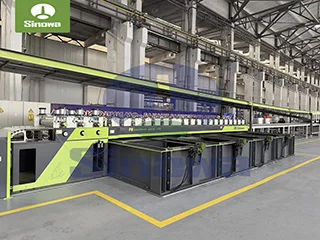
sandwich panel line
The structure of a PU sandwich panel making line is a sophisticated assembly of interconnected components, each contributing to a specific stage of the production process. At the starting end of the line, decoilers are installed to handle large coils of facing materials, typically metal sheets such as pre-coated steel or aluminum. These decoilers ensure smooth uncoiling and feeding of the facing materials into the subsequent stages, with tension control mechanisms to maintain flatness and prevent wrinkling or deformation. Following the decoilers, roll forming units are positioned to shape the facing materials into the desired profiles. These units consist of a series of tandem rolling stands, each equipped with precision rollers that progressively bend the metal sheets into structural profiles—such as corrugated, trapezoidal, or flat designs—based on the intended application of the panels. The roll forming process is a cold-working technique that preserves the mechanical properties of the facing materials while achieving consistent dimensional accuracy.
After the facing materials are formed, they move to the foam injection station, which is the core component of the production line. This station comprises a high-pressure mixing system that combines polyol and isocyanate—the two key components of PU foam—along with additives such as flame retardants, blowing agents, and catalysts. The mixing process occurs at controlled temperature and pressure conditions to ensure a homogeneous mixture with optimal foaming properties. The liquid mixture is then continuously injected into the gap between the two formed facing materials, which are held in position by guide rails to maintain uniform spacing. As the mixture moves along the line, it undergoes a chemical reaction that causes it to expand and fill the entire cavity between the facings. The expansion process is carefully regulated to achieve the desired foam density, which directly impacts the final panel’s performance.
Subsequent to foam injection, the composite structure enters a cooling and curing zone. This zone is equipped with temperature-controlled chambers or conveyor systems that facilitate the solidification of the PU foam. The curing process is critical, as it allows the foam to bond firmly with the facing materials and develop its full mechanical and thermal properties. The duration of curing depends on factors such as foam density, panel thickness, and ambient temperature, with the production line’s design ensuring that the panels are fully cured before proceeding to the next stage. After curing, a precision cutting system—often a flying saw or CNC cutter—trims the continuous panel into fixed lengths according to customer requirements. The cutting system operates in synchronization with the line’s speed to ensure clean, accurate cuts without damaging the panel structure. Additional optional components can be integrated into the line, such as embossing units for decorative surface patterns, punching machines for pre-drilled installation holes, or cleaning systems to remove debris from the facing materials before forming.
The performance of PU sandwich panels produced by these lines is determined by a combination of the core foam properties, facing material characteristics, and the quality of the bonding between the two. One of the most notable performance attributes is thermal insulation efficiency. PU foam has an extremely low thermal conductivity, typically ranging from 0.022 to 0.028 W/m·K, which makes it highly effective at reducing heat transfer between indoor and outdoor environments. This property is particularly valuable in applications where temperature control is critical, as it helps minimize energy consumption for heating or cooling. The closed-cell structure of PU foam also contributes to excellent waterproof and moisture-resistant performance, with a water absorption rate of less than 4%. This prevents moisture penetration into the panel core, which could degrade insulation performance and structural integrity over time.
Structural performance is another key advantage of PU sandwich panels. The combination of rigid PU foam core and high-strength facing materials creates a composite structure that exhibits excellent bending resistance, compressive strength, and load-bearing capacity while remaining lightweight. This lightweight nature reduces the overall structural load of buildings or structures where the panels are used, potentially lowering construction costs and simplifying transportation and installation. The bond between the foam core and facing materials is crucial for structural performance; high-quality production lines ensure a uniform bond that prevents delamination, even under harsh environmental conditions or mechanical stress. Additionally, PU sandwich panels offer good acoustic insulation properties, as the foam core absorbs sound waves and reduces noise transmission, making them suitable for applications in noise-sensitive environments.
Fire resistance is a performance characteristic that varies based on the formulation of the PU foam and the type of facing materials used. Standard PU foam typically achieves a fire rating of B1 (flame-retardant), which means it is difficult to ignite and does not propagate flames rapidly. For applications requiring higher fire safety, modified foam formulations or hybrid core designs—such as PU-edged rock wool cores—can be used. Hybrid panels combine the insulation efficiency of PU with the incombustible properties of rock wool, achieving a higher fire rating while maintaining good thermal performance. The durability of PU sandwich panels is also noteworthy; when properly produced and installed, they resist corrosion, UV degradation (with appropriate facing coatings), and chemical exposure, ensuring a long service life with minimal maintenance requirements.
PU sandwich panel making lines can produce a variety of panel types, each tailored to specific application needs based on core material, facing material, and structural design. The primary classification is based on the core material, with pure PU foam cores and hybrid cores being the two main categories. Pure PU foam core panels are the most common, valued for their balanced thermal insulation, waterproofing, and structural performance. They are available in different foam densities, ranging from low-density options for lightweight insulation to high-density variants for enhanced structural strength. Hybrid core panels, such as PU-edged rock wool panels, integrate a rock wool core with PU foam edging. This design addresses the moisture absorption issue of rock wool by sealing the edges with PU, while leveraging the incombustible nature of rock wool to achieve superior fire resistance.
Another classification is based on the type of facing material, which includes pre-coated steel, aluminum, stainless steel, and composite facings. Pre-coated steel is the most widely used due to its cost-effectiveness, corrosion resistance, and versatility in terms of color and finish. Aluminum facings are preferred for applications requiring lightweight panels or resistance to specific environmental conditions, such as coastal areas where saltwater corrosion is a concern. Stainless steel facings are used in applications demanding high hygiene standards, such as food processing facilities or clean rooms, as they are easy to clean and resistant to bacterial growth. Composite facings, which combine multiple materials, are used for specialized applications requiring unique properties such as enhanced impact resistance or decorative aesthetics.
Panels can also be categorized by their intended use, leading to specialized types such as roof panels, wall panels, cold room panels, and clean room panels. Roof panels are designed with profiles that facilitate water drainage and provide structural stability against wind and snow loads. They often feature hidden fastener systems to improve waterproofing and aesthetic appeal. Wall panels can be installed vertically or horizontally, with interlocking designs that ensure airtightness and thermal continuity. Cold room panels are engineered for low-temperature applications, with enhanced insulation properties and airtight joints to maintain consistent temperatures as low as -40°C. Clean room panels are designed to meet strict hygiene requirements, with smooth, non-porous surfaces that prevent dust accumulation and are compatible with sterile cleaning processes.
The versatility of PU sandwich panels produced by these lines translates to a wide range of applications across multiple industries. In the construction sector, they are extensively used in industrial buildings, commercial complexes, and residential structures. Industrial warehouses and factories often utilize PU sandwich panels for roofing and wall cladding due to their fast installation, thermal insulation, and structural efficiency. Large commercial buildings such as airports, railway stations, and shopping malls frequently adopt hybrid PU-rock wool panels to meet strict fire safety regulations while ensuring comfortable indoor temperatures and acoustic performance. In residential construction, these panels are used for exterior insulation and interior partitions, contributing to energy-efficient homes with reduced heating and cooling costs.
The cold storage and food processing industry is a major consumer of PU sandwich panels. Cold storage facilities, frozen food warehouses, and refrigerated trucks rely on the exceptional thermal insulation properties of these panels to maintain stable low temperatures, which is critical for preserving food quality and safety. The waterproof nature of PU foam also prevents moisture buildup inside cold storage units, avoiding frost formation and structural damage. Food processing plants use PU sandwich panels for wall and ceiling cladding, as they are easy to clean and maintain hygiene standards while providing thermal control for processing areas.
Specialized applications include clean rooms in pharmaceutical and electronic manufacturing facilities. These environments require strict control over dust, temperature, and humidity, and PU sandwich panels with smooth, non-particulating surfaces and excellent insulation properties are ideal for such settings. The panels’ airtight joints prevent the infiltration of contaminants, ensuring compliance with industry-specific environmental standards. Additionally, PU sandwich panels are used in modular construction, where prefabricated panels are assembled on-site to create temporary or permanent structures such as construction site offices, portable classrooms, and emergency shelters. Their lightweight and easy-to-install nature accelerates construction timelines, reducing labor costs and project completion time.
Renovation projects also benefit from the use of PU sandwich panels. When upgrading aging buildings, these panels can be installed as exterior insulation systems to improve energy efficiency without major structural modifications. Their lightweight nature minimizes additional load on existing structures, and their versatility in terms of design allows them to match the aesthetic of historic or traditional buildings. In transportation, beyond refrigerated trucks, PU sandwich panels are used in the construction of train carriages, ship cabins, and mobile homes, where weight reduction, insulation, and durability are key considerations.
The adaptability of PU sandwich panel making lines further expands their application scope. Manufacturers can adjust production parameters such as panel thickness, foam density, facing material, and profile design to meet the unique requirements of different projects. For example, panels used in high-wind areas can be produced with thicker facings and higher foam density to enhance structural resistance, while panels for decorative purposes can be customized with embossed patterns or specialized coatings. This flexibility makes PU sandwich panels a preferred choice for a diverse range of projects, from small-scale industrial warehouses to large-scale public infrastructure.
In summary, PU sandwich panel making lines are sophisticated industrial systems that enable the efficient production of high-performance composite panels. Their integrated structure ensures consistent quality and flexibility, while the resulting panels offer a balanced combination of thermal insulation, structural strength, durability, and versatility. The various types of PU sandwich panels, tailored to specific core materials, facing materials, and applications, cater to the diverse needs of industries ranging from construction and cold storage to pharmaceuticals and transportation. As the demand for energy-efficient, safe, and cost-effective building materials continues to grow, PU sandwich panel making lines and their products will remain integral to modern construction and industrial practices, driving innovation and sustainability in the built environment.
https://www.cnsinowa.com/sandwich-panel-machines/pu-sandwich-panel-making-line-for-composite-panels.html