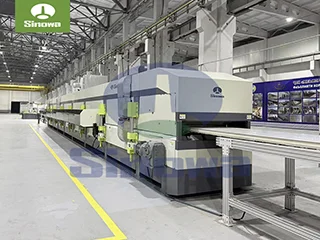
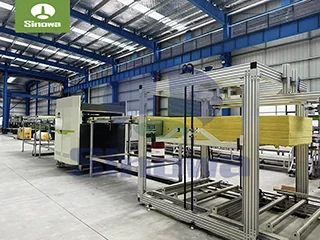
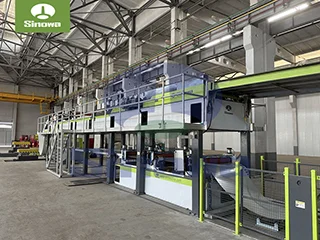
sandwich panel machine
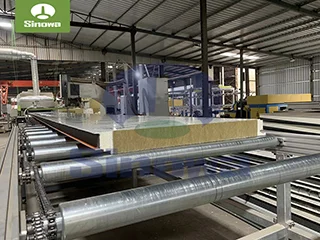
The structure of a PU sandwich panel making machine for corrugated composite boards is composed of several interconnected components, each playing a critical role in the production process. At the starting end of the production line, uncoilers are installed to hold and feed metal coils—typically steel or aluminum—into the system. These uncoilers are designed to unwind the coils smoothly and evenly, preventing material distortion or damage that could affect the final panel quality. The uncoiled metal sheets then move to the roll forming section, which consists of a series of tandem rolling stands equipped with precision rollers and gears. These stands gradually bend and shape the flat metal sheets into the desired corrugated profile through cold forming, a process that maintains the material’s structural integrity and mechanical strength without the need for high-temperature treatment. The corrugated profile can be adjusted according to specific requirements, allowing for the production of panels with different wave heights, widths, and spacing to suit various applications.
Following the roll forming process, the corrugated metal sheets are conveyed to the PU foam injection station, a core component of the machine. This station includes a metering system, mixing unit, and injection nozzles that work in tandem to deliver a homogeneous PU foam mixture between the two corrugated facings. The metering system ensures accurate control of the raw material ratios—polyol and isocyanate, the primary components of PU foam—to guarantee consistent foam density and performance. The mixing unit uses high-pressure impingement technology to blend the components thoroughly, creating a foam with uniform texture and optimal bonding properties. The injection nozzles are strategically positioned to distribute the foam evenly across the entire surface of the lower corrugated sheet, ensuring that the core fills all gaps and adheres firmly to both facings as it expands. After injection, the panels move through a laminating and pressing system, which applies controlled pressure to the composite structure. This system typically features rubber-coated composite shafts that are anti-wear and anti-skid, ensuring that the panels maintain their shape while promoting strong adhesion between the foam core and the metal facings.
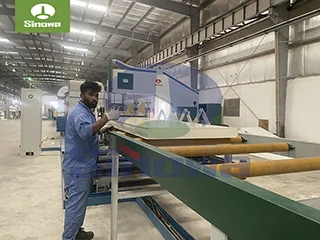
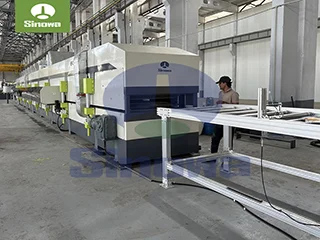
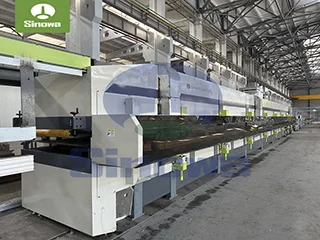
The cooling and curing section is another essential part of the machine’s structure, designed to facilitate the solidification of the PU foam core. As the composite panels move through this section, they are exposed to controlled temperature conditions that accelerate the foam’s curing process without compromising its structural or thermal properties. The cooling system may use air circulation or water cooling, depending on the production speed and foam formulation, ensuring that the foam hardens completely and forms a stable bond with the corrugated facings. Once cured, the panels proceed to the cutting unit, which uses automated cutting tools to trim the panels to the required length with high precision. Some advanced machines may also integrate additional inline processes, such as punching, embossing, or edge banding, to enhance the panels’ functionality and aesthetic appeal. The final section of the machine includes a conveying and stacking system that collects the finished panels and arranges them neatly for storage or further processing, completing the continuous production cycle.
The performance of PU sandwich panel making machines for corrugated composite boards is characterized by a combination of precision, efficiency, durability, and flexibility, making them suitable for large-scale industrial production. One of the key performance attributes is automation level, which significantly reduces the need for manual operation and minimizes human error. Advanced control systems regulate every stage of the production process, from uncoiling and roll forming to foam injection and cutting, ensuring consistent panel quality across the entire production run. The precision control over foam density and distribution is particularly notable, with most machines capable of maintaining foam density within a narrow range to ensure optimal thermal insulation and structural strength. This precision also contributes to the panels’ uniform thickness, which is crucial for their performance in building applications where consistency is essential.
Energy efficiency is another important performance feature of these machines. Optimized designs reduce power consumption by minimizing energy waste in processes such as heating, cooling, and material handling. The continuous production process also reduces material waste, as the automated systems ensure that raw materials are used efficiently without excessive trimming or scrapping. Durability is a further performance highlight, with the machines constructed from high-quality materials that can withstand the harsh conditions of industrial environments. The rolling stands, mixing units, and pressing components are built to resist wear and tear, ensuring long-term reliable operation with minimal maintenance requirements. Additionally, the machines offer excellent flexibility, allowing for customization of panel dimensions—including thickness, length, and width—to meet diverse application needs. Panel thickness can typically be adjusted within a wide range, and the roll forming section can be reconfigured to produce different corrugated profiles, making the machines adaptable to changing market demands.
The ability to maintain stable operation at high production speeds is another key performance advantage. Modern PU sandwich panel making machines can produce panels at speeds ranging from several meters to over a dozen meters per minute, enabling manufacturers to meet large-volume orders efficiently. Despite the high speed, the machines retain precision in every process, ensuring that the corrugated facings are accurately formed, the foam core is evenly distributed, and the finished panels meet strict quality standards. The machines also exhibit strong compatibility with various materials, supporting the use of different metal facings—such as galvanized steel, galvalume, or aluminum—and different PU foam formulations, including those with enhanced fire resistance or moisture resistance. This compatibility expands the range of panel types that can be produced, further enhancing the machine’s versatility.
PU sandwich panel making machines for corrugated composite boards can be categorized based on several factors, including production capacity, configuration, and the type of panels they produce. One common classification is based on production speed and line length, which determines the machine’s throughput. Compact machines, with shorter line lengths, are suitable for small to medium-scale manufacturers, offering lower production speeds but greater flexibility and lower space requirements. These machines are ideal for producing custom panels or small batches of products for specialized applications. In contrast, large-scale production lines feature longer lengths and higher production speeds, designed for mass production of standard panels for large construction projects or industrial facilities. These lines often integrate additional automated processes, such as stacking, packaging, and quality inspection, to streamline the production workflow and maximize efficiency.
Another classification is based on the type of foam core that the machine can produce. While most machines are designed for PU foam, some are capable of producing panels with polyisocyanurate (PIR) foam cores, which offer enhanced thermal stability and fire resistance compared to traditional PU foam. These dual-purpose machines can switch between PU and PIR formulations with minimal adjustments, providing manufacturers with greater flexibility to meet specific performance requirements. Machines can also be categorized by the type of corrugated profile they produce, with some specialized in producing specific wave patterns—such as trapezoidal or sinusoidal corrugations—while others offer adjustable profiles to accommodate multiple designs. Additionally, some machines are designed for producing single-layer corrugated panels, while others can manufacture double-corrugated or multi-layer composite panels for applications requiring enhanced structural strength.
Configuration-based classification includes standalone machines and integrated production lines. Standalone machines focus on a single process, such as roll forming or foam injection, and are typically used in existing production facilities to complement or upgrade existing equipment. Integrated production lines, on the other hand, combine all processes from uncoiling to stacking into a single continuous system, offering a turnkey solution for manufacturers looking to establish a complete panel production operation. These integrated lines are highly automated and require minimal manual intervention, making them ideal for large-scale production where efficiency and consistency are paramount. Some advanced integrated lines also feature smart control systems that allow for remote monitoring and operation, enabling manufacturers to optimize production processes and troubleshoot issues in real time.
The applications of PU sandwich panel making machines for corrugated composite boards are extensive, spanning across construction, industrial, agricultural, and commercial sectors, driven by the superior performance of the panels they produce. In the construction industry, the panels are widely used for roofing and wall systems in industrial buildings, warehouses, and prefabricated houses. The corrugated structure provides excellent structural strength, allowing the panels to withstand wind, snow, and other environmental loads, while the PU foam core offers exceptional thermal insulation, reducing energy consumption for heating and cooling. This combination of strength and insulation makes the panels ideal for buildings in both cold and hot climates, contributing to energy efficiency and sustainable construction practices.
Cold storage and refrigeration facilities represent another major application area. The PU foam core of the corrugated composite panels has low thermal conductivity, making it highly effective at retaining cold temperatures and preventing heat transfer. This property is crucial for cold storage warehouses, food processing plants, and refrigerated truck bodies, where maintaining a consistent low temperature is essential for preserving goods. The corrugated metal facings also provide resistance to moisture and corrosion, ensuring that the panels can withstand the humid conditions inside cold storage facilities without degrading. Additionally, the lightweight nature of the panels reduces the overall weight of the structure, which is particularly beneficial for refrigerated trucks, improving fuel efficiency and payload capacity.
Industrial facilities, such as factories and workshops, also benefit from the use of corrugated composite panels produced by these machines. The panels offer excellent sound insulation, reducing noise pollution from machinery and equipment, creating a more comfortable working environment. They are also resistant to wear, impact, and chemical exposure, making them suitable for use in harsh industrial settings where durability is a key requirement. The panels can be easily installed and customized to fit the layout of industrial buildings, allowing for quick construction and modification of facilities. In the agricultural sector, the panels are used for constructing greenhouses, livestock barns, and storage sheds. The thermal insulation properties help regulate temperature inside greenhouses, promoting plant growth, while the durable corrugated facings protect livestock barns from harsh weather conditions and pests.
Commercial buildings, including shopping malls, office complexes, and exhibition centers, also utilize corrugated composite panels for their aesthetic appeal and functional performance. The panels can be produced in a variety of colors and finishes, allowing architects and designers to create visually striking facades and interiors. The lightweight nature of the panels reduces the structural load of commercial buildings, enabling more flexible design options and reducing construction costs. Additionally, the panels’ fire resistance and thermal insulation properties contribute to the safety and energy efficiency of commercial buildings, meeting the high standards required for public spaces. In the transportation sector, beyond refrigerated trucks, the panels are used in the construction of train carriages, ship cabins, and modular housing units, where lightweight, durable, and insulated materials are essential.
The versatility of PU sandwich panel making machines for corrugated composite boards also extends to specialized applications, such as clean rooms in pharmaceutical and electronics manufacturing facilities. The panels’ smooth surface and excellent sealing properties prevent dust accumulation and ensure a sterile environment, while the thermal insulation helps maintain consistent temperature and humidity levels. In disaster relief and temporary construction, the panels are used to build quick-assembly shelters and temporary facilities, as they can be produced rapidly and installed with minimal equipment. The durability and weather resistance of the panels ensure that these temporary structures can withstand harsh conditions and provide a safe environment for those in need.
As the demand for energy-efficient, sustainable, and durable building materials continues to grow, the role of PU sandwich panel making machines for corrugated composite boards becomes increasingly important. These machines enable the production of panels that meet the evolving needs of various industries, combining structural performance, thermal insulation, and environmental sustainability. The continuous advancement in machine technology—including improved automation, enhanced precision control, and greater flexibility—further expands the potential applications of corrugated composite panels, making them a preferred choice for modern construction and manufacturing. Whether for large-scale industrial projects, commercial buildings, or specialized facilities, these machines provide a reliable and efficient solution for producing high-quality composite panels that deliver long-term performance and value.
https://www.cnsinowa.com/sandwich-panel-machines/pu-sandwich-panel-making-machine-for-corrugated-composite-boards.html