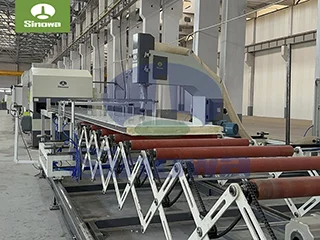
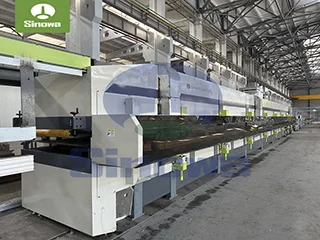
sandwich panel line
At the front end of the continuous sandwich panel line lies the raw material handling and facing preparation section, which serves as the foundation for the entire manufacturing process. This section is primarily responsible for unwinding, leveling, profiling and surface treatment of the outer facing materials that form the two rigid layers of the sandwich panel. Common facing materials include coated metal sheets, aluminum sheets and fiberglass-reinforced plastic, each selected for its mechanical strength, weather resistance and bonding compatibility with the polyurethane foam core. The equipment in this section includes precision unwinders, levelers, profiling machines and surface cleaning devices, which eliminate wrinkles, deformities and surface contaminants from the facings to ensure a flat, uniform base for subsequent foaming and lamination. The profiling process here can shape the facings into specific profiles, such as trapezoidal or flat designs, to enhance the structural rigidity and load-bearing capacity of the final panels, while also optimizing the fit between adjacent panels during installation. After surface treatment, the facings are fed steadily into the central foaming and lamination section at a controlled speed, maintaining consistent tension to avoid misalignment or uneven bonding with the foam core.
The central foaming and lamination section is the heart of the polyurethane sandwich panel production line, where the chemical reaction of polyurethane raw materials and the permanent bonding between the foam core and outer facings take place. This section consists of a high-precision polyurethane foaming system, a heating and temperature control unit, a double-belt laminator and a pressure control mechanism, all working in tandem to regulate the foaming speed, density, curing rate and bonding strength of the foam core. The foaming system precisely meters and mixes polyol and isocyanate components, the two primary raw materials for rigid polyurethane foam, injecting the mixed liquid uniformly between the two prepared facings. The temperature control unit maintains an optimal constant temperature throughout the foaming and curing process, as temperature fluctuations directly affect the cell structure of the foam, which in turn determines the thermal insulation, compressive strength and durability of the final panel. The double-belt laminator applies uniform, adjustable pressure to the entire panel assembly, ensuring the newly formed foam core fully adheres to both facings without gaps, voids or delamination, while also setting the exact thickness of the sandwich panel. This section is designed with closed-loop control systems to monitor and adjust key parameters in real time, such as material flow rate, temperature, pressure and line speed, guaranteeing that every panel produced has consistent internal structure and performance indicators across the entire production batch.
Following the central lamination section is the curing and shaping section, which completes the full curing of the polyurethane foam core and refines the panel's dimensions and edge details. The freshly laminated panels pass through a long, temperature-controlled curing tunnel, where the foam undergoes a complete chemical curing reaction to stabilize its cell structure and achieve maximum hardness and bonding strength. Insufficient curing can lead to soft foam, poor dimensional stability and reduced service life, while over-curing may cause brittleness and increased material waste, so the curing time and temperature are carefully calibrated based on the foam density and panel thickness. After curing, the panels move to the cutting and edge processing unit, where high-precision cutting tools trim the panels to the required length and width, and edge milling equipment shapes the panel edges into tongue-and-groove or flat profiles for tight, secure installation on site. This section also includes a cooling unit to bring the panels to room temperature before handling, preventing warping or dimensional distortion caused by residual heat. Finally, the finished panels are transported to the stacking and packaging section, where they are neatly stacked, protected from scratches and damage, and prepared for storage and transportation, completing the entire production cycle from raw materials to finished products.
The performance of polyurethane foam sandwich panels is directly shaped by both the structural design of the automatic sandwich panel production line and the inherent properties of the rigid polyurethane foam core and outer facings, making these panels stand out for their comprehensive performance advantages that meet the demands of diverse application scenarios. One of the most prominent performance features is exceptional thermal insulation, rooted in the closed-cell structure of rigid polyurethane foam, which contains a large number of tiny, independent air pockets that block heat transfer through conduction, convection and radiation effectively. This low thermal conductivity makes the panels far more efficient than traditional insulation materials, reducing energy consumption for heating and cooling in buildings and enclosed spaces significantly. In terms of mechanical performance, the sandwich structure combines the high tensile and flexural strength of the outer facings with the compressive strength of the foam core, creating a panel that is lightweight yet structurally rigid. Despite their low weight, which eases transportation, handling and installation and reduces the load-bearing pressure on building foundations, the panels can withstand wind loads, snow loads and minor mechanical impacts without deformation or damage, meeting the structural safety requirements of industrial and commercial buildings.
Additional key performance attributes include excellent sound insulation, moisture resistance and dimensional stability. The dense closed-cell foam core absorbs sound waves effectively, blocking airborne noise transmission between indoor and outdoor spaces, making the panels ideal for environments that require quiet and noise control. The closed-cell structure also prevents moisture and water vapor penetration, avoiding mold growth, material degradation and loss of insulation performance that often occur with porous insulation materials in humid environments. Dimensional stability is another critical performance indicator, as the panels resist expansion, contraction, warping or cracking under changes in temperature, humidity and external weather conditions, maintaining a perfect fit and structural integrity over long-term use. Unlike many single-layer building materials, polyurethane foam sandwich panels also offer good fire resistance when formulated with appropriate additives, slowing the spread of flames and reducing smoke emission in case of fire, enhancing the overall safety of the structures they are used in. All these performance properties are consistently replicated and guaranteed by the standardized, precision-controlled production line, ensuring that each panel meets the required performance benchmarks without batch-to-batch variations.
Polyurethane foam sandwich panels are classified into various types based on core material formulations, facing materials, panel functions and structural designs, each tailored to specific application needs, and the versatile foam core sandwich panel line can be easily adjusted to manufacture all these types without major equipment modifications. The most basic classification is based on core foam type, distinguishing between standard rigid polyurethane (PU) foam panels and modified polyurethane (PIR) foam panels; PIR panels feature enhanced fire resistance and thermal stability compared to standard PU panels, making them suitable for high-temperature or fire-safety-sensitive environments. Classification by facing material includes metal-faced panels (such as coated steel and aluminum), fiberglass-reinforced plastic-faced panels, and non-metal lightweight faced panels, with metal-faced panels dominating industrial and outdoor construction for their high strength and weather resistance, while non-metal faced panels are preferred for interior decoration and cleanroom environments due to their smooth, easy-to-clean surfaces. Structurally, panels are divided into wall panels, roof panels, cold storage panels and cleanroom panels, each with unique profiling and edge designs: roof panels have reinforced rib structures to withstand snow and wind loads, wall panels focus on flatness and aesthetic appeal, cold storage panels feature extra-thick foam cores for maximum thermal insulation, and cleanroom panels have seamless, non-porous surfaces to maintain hygienic, dust-free environments.
Another functional classification is based on insulation grade and load-bearing capacity, ranging from standard insulation panels for general construction to high-performance ultra-insulation panels for low-temperature environments, and load-bearing structural panels for large-span buildings. The flexibility of the production line allows for quick adjustments to foam thickness, facing material type, profiling shape and cutting dimensions, enabling manufacturers to switch between different panel types efficiently to meet market demand. This versatility is a key advantage of modern polyurethane sandwich panel line, as it eliminates the need for dedicated equipment for each panel type, reducing production costs and improving operational efficiency while maintaining consistent product quality across all classifications. Regardless of the type, all panels retain the core advantages of lightweight construction, high thermal efficiency and easy installation, making them a preferred choice over traditional building materials that often require multiple layers of insulation, structural support and finishing.
The combination of reliable production line technology, outstanding panel performance and diverse product types has led to the widespread application of polyurethane foam sandwich panels across nearly every sector of modern construction, industrial engineering and cold chain logistics. In the field of industrial and commercial construction, these panels are extensively used for the exterior walls and roofs of factories, warehouses, logistics centers, shopping malls and office buildings, where their fast installation speed significantly shortens construction cycles, reduces labor costs and allows for earlier project completion and operation. The lightweight nature of the panels also simplifies foundation design and construction, further cutting overall building costs, while their excellent thermal insulation reduces long-term energy expenses for heating, ventilation and air conditioning systems, delivering sustainable economic benefits throughout the building’s service life.
In the cold chain and refrigeration industry, polyurethane foam sandwich panels are the material of choice for cold storage warehouses, refrigerated trucks, constant-temperature storage rooms and food processing facilities, as their ultra-low thermal conductivity maintains stable low or constant temperatures with minimal energy consumption. This is critical for preserving perishable goods such as food, pharmaceuticals and agricultural products, preventing spoilage and ensuring product quality and safety during storage and transportation. The panels’ moisture resistance and seamless installation also prevent condensation and frost buildup inside cold storage spaces, maintaining a dry, stable internal environment and extending the service life of refrigeration equipment.
In specialized industrial and hygienic environments, including pharmaceutical cleanrooms, electronic product manufacturing workshops, food processing plants and medical facilities, the smooth, non-porous and easy-to-clean surfaces of polyurethane foam sandwich panels meet strict hygiene and dust-free requirements, resisting bacterial growth and chemical corrosion. These panels can be installed with seamless joints to prevent dust accumulation and air leakage, complying with the strict environmental standards of high-precision manufacturing and medical industries. Additionally, the panels are widely used in prefabricated and modular buildings, such as temporary housing, portable offices, construction site dormitories and emergency shelters, due to their easy disassembly, reusability and excellent thermal and sound insulation; prefabricated structures made with these panels are quick to assemble, durable and comfortable for long-term occupancy.
Beyond construction and industrial uses, polyurethane foam sandwich panels find applications in transportation and infrastructure projects, including insulated partitions for ships, trains and vehicles, and protective enclosures for outdoor equipment and electrical facilities, where their lightweight, weather-resistant and insulating properties protect equipment from extreme temperatures and environmental damage. As global demand for energy-efficient, sustainable and fast-constructed building materials continues to rise, the role of polyurethane foam sandwich panel production line becomes increasingly vital, as these lines enable large-scale, high-quality production of panels that align with global green building and energy conservation goals. The continuous optimization of production line technology further enhances panel performance, expands application scenarios and reduces production waste, making polyurethane foam sandwich panels a sustainable, cost-effective and versatile solution for current and future construction and industrial needs.
In summary, the polyurethane foam sandwich panel production line is a sophisticated, integrated manufacturing system that defines the structural integrity and performance consistency of the final panels, with its modular design and precision control ensuring the production of diverse panel types to meet every functional requirement. The unique sandwich structure of the panels delivers a rare combination of thermal insulation, mechanical strength, sound insulation and durability, setting them apart from traditional building materials. From industrial warehouses and cold storage facilities to cleanrooms, prefabricated buildings and infrastructure projects, the applications of these panels continue to expand, driven by their unmatched performance and the efficiency of modern polyurethane sandwich panel machine. As the construction industry evolves toward greater sustainability, energy efficiency and speed, polyurethane foam sandwich panels and their dedicated production lines will remain a cornerstone of modern material engineering, offering practical, high-performance solutions for a wide range of global building and industrial challenges.
https://www.cnsinowa.com/sandwich-panel-machines/polyurethane-foam-sandwich-panel-production-line.html