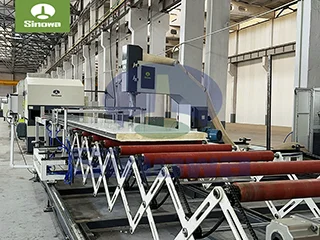
sandwich panel line
The overall structural layout of the continuous PIR sandwich panel production line follows the principle of linear continuous operation, with all functional modules arranged in an orderly sequence according to the production process flow. The whole system can be divided into multiple interlinked functional units, including facing material feeding and preprocessing unit, roller forming unit, surface preheating unit, high-pressure foaming and material distributing unit, double-belt pressing and constant-temperature curing unit, cooling shaping unit, fixed-length cutting unit, edge finishing unit and automatic stacking unit. All units are connected by high-precision synchronous conveying equipment, ensuring that the production speed of each link matches perfectly, avoiding production stagnation or quality deviation caused by asynchronous operation, and realizing truly continuous and non-stop industrial production.
The front-end feeding and preprocessing part of the continuous PIR sandwich panel line is the primary link to ensure the surface quality and bonding performance of finished panels. This unit is mainly responsible for the continuous supply of upper and lower facing materials, which are usually metal sheets with smooth surface and good structural rigidity, and can also be matched with other decorative and protective facing materials according to production demands. The coiled facing materials are installed on the uncoiling device, which adopts a tension-control unwinding mode to ensure stable and uniform material output without tensile deformation or wrinkling. During the unwinding process, the automatic deviation correction system operates in real time to accurately control the material conveying track, preventing lateral deviation of the facing materials in long-distance transmission, which is a key guarantee for the dimensional accuracy of subsequent panels. After unwinding, the facing materials enter the surface pretreatment station, where professional cleaning and dedusting structures remove surface dust, oil stains and oxide layers. These impurities will seriously affect the bonding strength between the facing material and the PIR foam core layer, leading to delamination and cracking of the panel in later use, so the pretreatment process is an indispensable basic link to improve the durability of composite panels.
Following the pretreatment process is the roller forming process, which shapes the flat raw facing materials into the required structural profiles. Different from simple flat panel production, building-used PIR sandwich panels need special edge structures such as tenon and groove to realize seamless assembly between panels during on-site installation. The roller forming unit is composed of multiple groups of precision profiling rollers arranged in stages. Through gradual rolling and extrusion, the flat metal sheet is slowly deformed into a standardized profile structure, avoiding structural damage and internal stress concentration caused by one-time strong forming. The number of roller groups and rolling gaps can be adjusted according to different panel specifications and profile requirements, realizing flexible switching of multiple product types. After roller forming, the dimensional tolerance of the panel edge profile is strictly controlled within a tiny range, ensuring the assembly accuracy and overall sealing performance of the finished panels in engineering application. At the same time, the roller forming process can optimize the surface flatness of the facing materials, eliminate minor surface wrinkles and unevenness generated in the unwinding process, and improve the appearance quality of the final product.
The preheating process after roller forming plays a vital role in optimizing the composite bonding effect of panels. The preheating unit adopts segmented constant-temperature heating design, which can uniformly heat the upper and lower facing materials to the optimal temperature range required for PIR foaming reaction. The PIR foaming and curing reaction is extremely sensitive to ambient temperature. Too low temperature will lead to insufficient foaming reaction, uneven cell structure and reduced bonding force between the core layer and the facing material; too high temperature will cause excessive foaming, local core layer hollowing and material performance attenuation. Through precise temperature control, the preheating system stabilizes the surface temperature of the facing materials, which not only accelerates the subsequent adhesion reaction speed, but also ensures that the PIR foam can form a tight and uniform bonding interface with the facing materials. In addition, preheating can effectively eliminate the internal stress generated during roller forming, improve the structural stability of the facing materials, and avoid panel deformation and warping in the subsequent curing and cooling processes.
The foaming and material distributing unit is the core functional module that determines the thermal insulation performance and structural strength of PIR sandwich panels, and is also the most technically demanding link in the continuous sandwich panel production line. Different from ordinary PU foaming materials, PIR materials have higher thermal stability, flame retardancy and structural compactness, and their foaming reaction process requires more precise ratio control and injection technology. The production line is equipped with a high-precision dynamic mixing system, which can automatically proportion various raw materials required for PIR foaming according to set parameters. All raw materials are fully and evenly mixed in the high-speed mixing head to avoid local material ratio deviation, which ensures the consistency of foam density and cell structure of the entire core layer. The mixed PIR raw materials are injected evenly between the upper and lower preheated facing materials through a multi-point uniform injection mode. The injection position, injection volume and injection speed can be dynamically adjusted according to the panel thickness and production speed, realizing full coverage of the material between the two layers of facing materials without dead angles.
After the completion of foam injection, the semi-finished panel enters the double-belt pressing and constant-temperature curing unit, which is the longest and most critical temperature-controlled section of the continuous sandwich panel line. The double-belt press is composed of two parallel circulating heat-conducting conveyor belts, which can apply uniform and stable static pressure to the upper and lower surfaces of the panel. The pressure acts on the entire width and length of the panel in real time, ensuring that the PIR foam expands steadily in the closed cavity formed by the two layers of facing materials. In this process, the foam gradually fills the entire gap of the cavity, and completes close bonding with the inner surface of the facing materials. The internal temperature of the curing unit is kept in a constant state through an intelligent temperature control system, providing a stable reaction environment for the polymerization and curing of PIR materials. With the progress of the curing reaction, the PIR foam completes cell molding, structural stabilization and performance strengthening, forming a dense and uniform microporous structure. This structure endows the panel with excellent thermal insulation, sound insulation and compression resistance, and the integrated composite structure formed by tight bonding effectively avoids the risk of delamination between layers.
The length of the curing section and the running speed of the conveyor belt form a precise matching relationship, which can ensure that the PIR core layer completes full curing reaction before leaving the pressing unit. Insufficient curing will lead to unstable physical properties of the core layer, easy deformation and poor bonding fastness; excessive curing will cause energy waste and material aging. The intelligent control system of the continuous PIR sandwich panel machine can automatically adjust the operating parameters of the curing unit according to the real-time production speed and panel thickness, realizing dynamic optimization of the curing process. In addition, the double-belt pressing structure can effectively correct minor deformation of the facing materials in the production process, further improve the flatness of the panel surface, and ensure the overall dimensional uniformity of the panel.
After curing and molding, the panel enters the cooling shaping unit to complete the final structural stabilization. The high-temperature panel just out of the curing unit has certain thermal residual temperature, and the internal material structure is still in a slightly unstable state. If it is directly cut and processed, it is easy to produce shrinkage deformation and dimensional deviation. The cooling unit adopts a graded natural cooling and air-assisted heat dissipation mode, which slowly reduces the surface and internal temperature of the panel, ensuring that the internal stress of the material is completely released and the structural size tends to be stable. The cooling section is equipped with a synchronous conveying structure, which keeps consistent with the production rhythm of the front-end process, ensuring continuous production without pause. After cooling, the overall rigidity, flatness and dimensional stability of the panel reach the standard requirements, laying a foundation for subsequent precision cutting and finishing processing.
The fixed-length cutting unit realizes the quantitative segmentation of continuous long-strip panels. This unit adopts high-precision servo cutting technology, which can set arbitrary cutting length parameters according to production orders. The cutting tool has high hardness and wear resistance, which can complete fast and smooth cutting of composite panels composed of metal facing and PIR foam core layer, without burrs, collapses and uneven cuts on the cutting surface. The cutting process is completed synchronously with the panel conveying process, realizing dynamic cutting without stopping the machine, which greatly improves production efficiency. At the same time, the system is equipped with a real-time dimensional detection function, which automatically detects the length and width of the cut panel, and automatically corrects the parameter deviation once dimensional error is found, ensuring that the dimensional accuracy of each finished panel meets the production standards.
The edge finishing process is an important link to optimize the assembly performance and appearance quality of panels. After cutting, the edges of individual panels may have minor burrs, residual foam and uneven sections. The edge finishing unit polishes and trims the four sides of the panel, removes residual impurities and uneven structures, and makes the panel edges smooth and flat. For panels used for wall and roof assembly, the finishing process can further optimize the precision of the tenon and groove structure at the edges, ensure the tightness of the splicing gap between panels, improve the overall sealing and heat preservation effect of the building enclosure structure, and avoid air leakage and heat loss caused by poor assembly clearance.
The final stage of the continuous PIR sandwich panel manufacturing line is automatic detection and stacking output. The finished panels after finishing will pass through the quality inspection station of the production line, which automatically detects the surface flatness, bonding integrity, core layer compactness and dimensional accuracy of the panels. Panels with minor defects will be automatically screened out and processed separately, and qualified products will be transported to the automatic stacking platform. The stacking device adopts intelligent counting and layered stacking mode, which can neatly stack the panels according to the set number and height, realizing standardized finished product output. The whole process from raw material feeding to finished product stacking is completed automatically by the production line, with minimal manual intervention, which effectively reduces the error rate and labor cost caused by manual operation.
Compared with the traditional intermittent production mode, the automatic PIR sandwich panel production line has outstanding advantages in production efficiency and product quality stability. The continuous operation mode eliminates the frequent start-stop and debugging links in intermittent production, realizes 24-hour uninterrupted production, and the single-line production capacity is far higher than that of traditional equipment. The whole production process is controlled by an integrated intelligent system, and all key parameters such as material ratio, heating temperature, pressing pressure, conveying speed and cutting size are precisely digitally controlled, which avoids the quality fluctuation caused by manual experience operation. The produced panels have uniform foam core layer density, consistent thickness, stable bonding performance and excellent overall structural uniformity, which can meet the high-standard application requirements of various engineering scenarios.
In terms of product performance optimization, the PIR sandwich panel machinery precise foaming and curing process endows PIR sandwich panels with unique superior properties. The uniformly formed closed-cell microporous structure of the PIR core layer gives the panel extremely low thermal conductivity, excellent heat insulation and heat preservation performance, which can effectively reduce the energy consumption of building temperature regulation and meet the increasingly stringent building energy-saving requirements. At the same time, the integrated composite structure formed by high-pressure curing and bonding has high structural strength and good compression resistance, which can resist external wind pressure, snow pressure and other external loads in the application process, and maintain stable structural performance for a long time. In addition, the PIR material itself has good thermal stability and anti-aging performance, and the panels produced by the continuous process have more durable service life and more stable long-term performance.
The flexible adjustment performance of the continuous production line enables it to adapt to diversified market production demands. The equipment parameters can be quickly adjusted according to different production requirements, realizing the production of panels with different thicknesses, different facing materials and different edge structures. Whether it is thin lightweight panels for interior partition walls or thick high-strength thermal insulation panels for exterior wall and roof enclosure, the PIR sandwich panel production machine can complete efficient and standardized production. The modular functional design of the production line also facilitates daily maintenance and later function upgrading. Each functional unit is relatively independent while maintaining synchronous operation, which can realize targeted maintenance and partial function optimization without affecting the overall production rhythm, reducing equipment maintenance cost and downtime loss.
In the context of the global promotion of green building and energy-saving environmental protection concepts, the continuous PIR sandwich panel production equipment has important industrial application value. The efficient and low-consumption production mode of the equipment reduces the waste of raw materials in the production process, and the produced PIR sandwich panels have the characteristics of light weight, high strength, energy saving and environmental protection. Compared with traditional building materials such as concrete and brick walls, PIR sandwich panels have lighter self-weight, which can effectively reduce the load of building structures and reduce the construction cost of foundation and main structures. At the same time, the modular assembly construction mode of sandwich panels greatly shortens the construction cycle of buildings, improves the construction efficiency of engineering projects, and is widely used in industrial factory buildings, logistics warehouses, clean workshops, cold storage buildings, temporary engineering buildings and other fields.
The intelligent level of the continuous PIR sandwich panel making machine is constantly improved with the development of industrial manufacturing technology. The modern production line is equipped with a complete data monitoring and feedback system, which can collect and record all production data in real time, including raw material consumption, production speed, parameter changes and product qualification rate. The system can analyze the production data in real time, automatically identify abnormal production states, and send early warning prompts for parameter deviation, equipment failure and other problems, which helps production management personnel quickly locate and solve problems. The digital production management mode realizes the traceability of the whole production process of products, provides effective data support for product quality control and production process optimization, and promotes the standardized and intelligent development of the sandwich panel manufacturing industry.
In terms of production safety and environmental protection, the continuous PIR sandwich panel manufacturing machine has carried out comprehensive optimization design. The closed foaming and curing structure avoids the leakage of raw materials and volatile substances in the production process, reducing the impact on the production environment. The automated operation reduces the contact between personnel and mechanical moving parts and chemical materials, effectively reducing the risk of production safety accidents. At the same time, the efficient thermal cycle utilization system of the heating and curing unit reduces energy waste in the production process, realizing energy-saving and environmentally friendly production. The stable and standardized production process also reduces the generation of defective products, improves the utilization rate of raw materials, and further enhances the economic and environmental benefits of production.
With the continuous development of the construction industry towards lightweight, modular and energy-saving direction, the market demand for high-performance PIR sandwich panels continues to grow, which also puts forward higher requirements for the performance and production capacity of production equipment. The continuous PIR sandwich panel production line will continue to develop in the direction of higher automation, higher production efficiency, more flexible production adjustment and more intelligent quality control. Through continuous technological optimization and process innovation, the equipment can further improve product performance consistency and production economic benefits, meet the diversified and high-standard application demands of the construction industry, and provide more reliable equipment support for the popularization and application of green energy-saving building materials. In the future, with the integration of more advanced industrial technologies, the continuous PIR sandwich panel production plant will become more intelligent and efficient, and play a more important role in promoting the upgrading and development of the modern construction material manufacturing industry.
https://www.cnsinowa.com/sandwich-panel-machines/continuous-pir-sandwich-panel-production-line.html