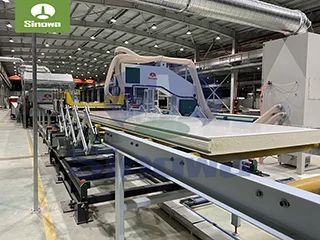
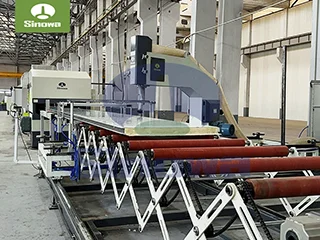
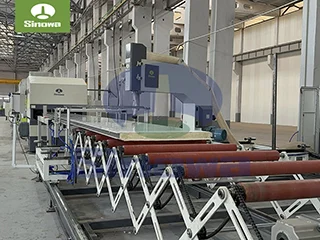
sandwich panel machine
The overall structural design of metal exterior wall sandwich panel production equipment follows the principles of mechanical stability, production continuity, and functional diversification, adopting a heavy-duty frame structure processed through precision machining to ensure long-term stable operation under continuous high-load working conditions. The whole production line consists of multiple interconnected functional units, each undertaking independent processing tasks while maintaining precise synchronous coordination to avoid production stagnation or product quality deviation caused by asynchronous operation. The core functional modules include raw material unwinding and leveling unit, surface pretreatment unit, roll forming unit, core material laying and composite bonding unit, constant temperature pressure curing unit, fixed-length cutting unit, and automatic finishing and stacking unit. Every module is optimized according to the structural characteristics and performance requirements of exterior wall panels, distinguishing it from ordinary interior partition panel production equipment in terms of processing precision, pressure control, and curing process parameters.
The initial stage of the production process focuses on the precise treatment of metal surface materials, which is the foundation for ensuring the flatness, durability, and bonding performance of finished exterior wall panels. Metal coil raw materials are fixed on the unwinding device, which adopts a buffered feeding structure to avoid tension fluctuation and material deformation during high-speed feeding. After unwinding, the metal sheet enters the leveling unit, where multiple groups of precision pressing rollers eliminate the internal stress and surface wrinkles of the coiled material, ensuring the flatness of the sheet surface. Subsequently, the sheet undergoes systematic surface pretreatment, including dust removal, degreasing, and surface texture adjustment. This process removes surface impurities and oxide layers that may affect bonding strength, creating a clean and uniform bonding interface for subsequent composite processing. Unlike interior panel production, the pretreatment process for exterior wall panel raw materials pays more attention to surface uniformity and anti-oxidation treatment, laying a solid foundation for the outdoor weather resistance of finished panels.
After surface pretreatment, the metal sheet enters the roll forming unit, which shapes the flat metal sheet into the specific cross-sectional structure required for exterior wall panels through gradual rolling and bending. The roll forming system is equipped with adjustable roller groups, which can flexibly adjust the forming radian, edge folding size, and structural groove parameters according to different exterior wall panel design standards. The gradual forming process avoids local stress concentration and surface scratching caused by one-time stamping, effectively protecting the integrity of the metal surface coating. The structural grooves and folded edges formed in this stage are designed to enhance the assembly tightness and overall structural stability of on-site installed panels, reducing the gap between adjacent panels and improving the overall airtight and waterproof performance of the building exterior wall enclosure system. The precision of roll forming directly determines the assembly accuracy of finished panels, so the equipment adopts closed-loop parameter control to maintain consistent forming dimensions in long-term continuous production.
The core composite processing stage is the most critical link in the entire production process of metal exterior wall sandwich panels, which determines the thermal insulation performance, structural strength, and overall integrity of finished products. After the upper and lower metal sheets are formed and positioned, the equipment automatically and evenly lays the insulating core material between the two layers of metal sheets. Common core materials include lightweight foamed materials and mineral fiber materials, each with unique thermal insulation, sound absorption, and fire resistance characteristics. The sandwich panel machine is designed with a flexible core material laying structure, which can adapt to the laying and composite processing of different core materials by adjusting feeding speed, material distribution density, and pre-compression parameters. For loose core materials, the equipment is equipped with uniform spreading and leveling devices to avoid local hollowing or uneven density; for plate-shaped core materials, the automatic trimming and positioning structure ensures accurate docking between core materials and metal sheets, eliminating gaps and deviations in the composite interface.
The double-belt pressing and curing system serves as the core functional component of the sandwich panel making equipment, undertaking the integrated bonding and shaping task of metal sheets and core materials. The upper and lower circulating belts are made of high wear-resistant and heat-conductive special materials, which can provide uniform and stable pressure and temperature conditions for the composite structure. The gap between the upper and lower belts can be precisely adjusted according to the preset panel thickness, realizing the production of exterior wall panels with different thickness specifications to adapt to different building energy-saving and structural load requirements. During the pressing and curing process, the equipment adopts segmented constant temperature control technology to form a gradient temperature field inside the curing area. This controllable thermal environment enables the bonding adhesive to fully react and solidify, forming a tight and integrated composite structure between the metal layer and the core material. The uniform pressure distribution ensures that the core material will not be compressed and deformed unevenly, maintaining consistent overall thickness and internal structural uniformity of the panel, and effectively avoiding quality problems such as panel warping, hollowing, and delamination in subsequent use.
In view of the harsh outdoor service environment of metal exterior wall panels, the sandwich panel manufacturing equipment is optimized in the composite curing process to enhance the outdoor adaptability of finished products. The extended constant-temperature curing section ensures that the bonding system achieves the best curing effect, improving the peel strength and shear resistance of the composite interface. For panels requiring edge sealing treatment, the equipment is equipped with automatic edge sealing auxiliary structures, which fill and seal the gaps on both sides of the panel during the composite process. This treatment effectively blocks external moisture and air from entering the core layer, avoids thermal bridge effects and core material aging caused by air and moisture penetration, and significantly improves the long-term weather resistance and structural stability of exterior wall panels. Compared with post-processing edge sealing technology, in-mold synchronous edge sealing integrated processing has better overall sealing performance and higher production efficiency, which is an important technical feature of high-end exterior wall panel production equipment.
After the composite curing is completed, the continuous integrated panel enters the fixed-length cutting and finishing stage. The cutting unit adopts high-precision servo positioning and automatic cutting technology, which can set arbitrary cutting lengths according to production requirements and complete flat and smooth cutting of the panel end face in an instant. The sandwich panel line is equipped with an automatic dust removal device during the cutting process, which timely collects processing debris and dust generated by cutting, maintaining the cleanliness of the production environment and avoiding debris adhesion affecting the surface quality of finished panels. After cutting, the edge trimming mechanism performs fine trimming on the panel end face to remove burrs and irregular edges, ensuring that the size and flatness of the panel end face meet the installation standards. The whole cutting and finishing process is completed automatically without manual intervention, which not only improves production efficiency but also ensures the consistency of product dimensional accuracy and surface quality.
The final stage of production is automatic stacking and finished product sorting. The sandwich panel production line uses photoelectric sensing positioning technology to accurately identify the position and quantity of finished panels, and cooperates with a stable mechanical handling structure to stack the cut panels neatly according to preset specifications. The automatic stacking system can adjust the stacking height and arrangement mode according to product types and storage requirements, ensuring neat and orderly finished products, which is convenient for subsequent transportation and centralized management. The entire production process from raw material feeding to finished product output forms a fully automated closed-loop operation, which greatly reduces manual operation links, lowers the impact of human factors on product quality, and realizes continuous and uninterrupted batch production.
The technical advantages of metal exterior wall sandwich panel manufacturing machine are fully reflected in production stability, product performance consistency, and functional adaptability. The equipment adopts an integrated mechanical structure and synchronous control system, which can maintain stable operating parameters during long-term high-intensity production, avoid production parameter drift and product quality fluctuation, and ensure that every batch of finished panels has consistent structural strength, thermal insulation performance, and appearance quality. The modular functional design enables the equipment to realize rapid switching of production specifications, meeting the personalized production requirements of different thicknesses, different core materials, and different structural types of exterior wall panels. This flexible production capability enables manufacturers to respond quickly to the differentiated market demands of building exterior wall engineering and improve the comprehensive utilization rate of production equipment.
In terms of energy consumption and environmental protection, modern metal exterior wall sandwich panel making machine has achieved significant optimization compared with traditional processing equipment. The segmented temperature control and circulating heat conduction structure reduce invalid heat loss in the curing process, realizing efficient energy utilization. The closed production space and matching dust and debris collection devices effectively control the generation and diffusion of production waste, meeting the clean production requirements of the building material industry. At the same time, the precise material distribution and composite molding technology reduce the scrap rate of raw materials, maximize the utilization rate of metal sheets and core materials, and reduce resource waste in the production process. These environmental protection and energy-saving characteristics not only reduce the comprehensive operating cost of production enterprises but also conform to the development trend of green and low-carbon construction industry.
The finished panels produced by this professional equipment have outstanding comprehensive performance, fully adapting to the complex and changeable outdoor service environment. The integrated composite structure formed by precise pressing and curing has excellent overall rigidity and impact resistance, which can resist external wind pressure and daily mechanical friction without local deformation or damage. The uniform internal core structure provides stable thermal insulation and sound insulation effects, effectively reducing building energy consumption for temperature regulation and isolating external noise interference. The tight composite interface and professional edge sealing structure have good moisture-proof and waterproof performance, which can prevent core material mildew, aging and performance attenuation caused by humid air erosion in long-term outdoor use. In addition, the metal surface after professional pretreatment and molding has good weather resistance, which can resist ultraviolet radiation, temperature difference change and atmospheric erosion, and maintain stable appearance and performance for a long time.
In practical industrial application, metal exterior wall sandwich panel machinery plays an important role in promoting the standardized and industrialized development of building exterior wall materials. Traditional exterior wall building methods mostly adopt on-site scattered construction, which has problems such as long construction cycle, difficult quality control and large environmental impact. The factory prefabricated production mode supported by this equipment centralizes all processing links in the factory, realizes standardized production of exterior wall panels, and greatly improves the construction efficiency of building exterior walls. The prefabricated panels can be quickly assembled on the construction site, shortening the project construction cycle, reducing on-site construction waste and labor input, and improving the overall economic and environmental benefits of building projects.
With the continuous development of modern architectural design concepts, the functional requirements and aesthetic standards for building exterior walls are constantly improving, which also puts forward higher technical requirements for metal exterior wall sandwich panel equipment. The current equipment development trend is towards higher automation intelligence, more precise processing control and richer functional expansion. The upgraded control system can realize real-time monitoring and automatic adjustment of production parameters, automatically identify abnormal production states and trigger early warning protection, further improving production stability and product yield. The optimized composite process can realize more diversified core material composite matching, develop multi-functional composite panels with fire resistance, heat insulation, sound absorption and decoration integration, and meet the application demands of high-standard public buildings, industrial plants and special environmental buildings.
In addition, the structural optimization of the equipment itself also improves the convenience of daily maintenance and operation. The modular component design facilitates daily inspection, maintenance and partial replacement of wearing parts, reduces equipment failure rate and maintenance cost, and ensures the long-term stable operation of the production line. The humanized operation interface simplifies parameter setting and production operation steps, reduces the professional threshold for equipment operation, and is suitable for large-scale popularization and application in various building material production enterprises. As an important supporting equipment for prefabricated building materials, metal exterior wall sandwich panel production machinery will continue to iterate and upgrade with the progress of construction technology, providing more efficient, stable and environmentally friendly production solutions for the manufacturing of high-performance building exterior wall materials, and promoting the high-quality development of the modern construction industry.
https://www.cnsinowa.com/sandwich-panel-machines/metal-exterior-wall-sandwich-panel-equipment.html