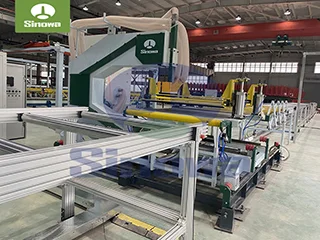
sandwich panel line
The overall structural design of the metal insulated sandwich panel assembly line follows the logic of continuous production process flow, consisting of multiple interconnected and coordinated functional modules, each undertaking independent and mutually supportive production tasks. The entire system can be divided into raw material preprocessing module, metal surface forming module, core material treatment and laying module, composite bonding and curing module, precision cutting and shaping module, and centralized intelligent control module. Every module is optimized for mechanical coordination and parameter matching, ensuring that each production link maintains stable operating status and consistent processing standards. The modular design not only facilitates daily equipment maintenance and partial function upgrading but also endows the production line with flexible adjustability, allowing it to adapt to the production requirements of sandwich panels with different thicknesses, core materials, and surface profile specifications.
Raw material preprocessing serves as the initial and foundational link of the entire sandwich panel line production process, directly determining the bonding quality and service performance of finished panels. The main raw materials involved include thin metal sheets used as panel surface layers and various lightweight thermal insulation core materials. Metal sheets, usually made of high-toughness metal substrates with anti-corrosion coatings, will undergo systematic surface treatment in this stage, including degreasing, dust removal, and surface uniformity inspection. This series of treatments removes residual oil stains, dust particles, and oxide layers on the metal surface, eliminating barriers that may affect the adhesion between metal layers and core materials. For different types of thermal insulation core materials such as polyurethane, polyisocyanurate, expanded polystyrene, and mineral wool, targeted preprocessing procedures are adopted. Sheet-shaped core materials undergo fixed-length cutting, surface smoothing, and impurity removal to ensure uniform specification and flat surface, while liquid foaming core materials need precise raw material ratio debugging and preliminary mixing treatment to prepare for subsequent continuous foaming and filling operations.
The metal surface forming module is responsible for processing flat metal sheets into structured surface profiles that meet panel design requirements. Through multi-pass continuous roll forming equipment, flat metal sheets are gradually pressed into diversified shapes such as flat plates, corrugated plates, and tongue-and-groove plates. The roll forming process adopts gradual pressure adjustment, avoiding local deformation or structural damage of metal materials caused by one-time heavy pressure. Each group of rolling rollers is precisely calibrated in position and gap, ensuring consistent dimensional accuracy and surface flatness of formed metal plates. In addition, the forming module is equipped with auxiliary leveling and trimming devices, which can correct minor bending deformation generated during the rolling process and trim irregular edges of metal plates, ensuring that the size and shape of metal surface layers fully match the laying requirements of subsequent core materials. The diversified forming functions enable the sandwich panel production line to manufacture panels applicable to different usage scenarios, including flat panels for interior partition walls and profiled panels for exterior wall enclosure and roof systems.
Core material treatment and laying is a key link to realize the thermal insulation function of sandwich panels, and its processing accuracy directly affects the thermal insulation performance and overall structural uniformity of finished products. For solid core materials such as mineral wool and expanded polystyrene, the sandwich panel machine adopts automatic arrangement and laying equipment to evenly spread the cut core materials between upper and lower metal surface layers, with automatic gap adjustment and dense arrangement functions to avoid hollow gaps or uneven core material distribution inside the panels. For foaming core materials such as polyurethane and polyisocyanurate, the high-pressure continuous foaming system of the production line accurately mixes multi-component raw materials according to fixed proportions, and evenly sprays and injects the mixed liquid materials onto the surface of the lower metal plate. With the forward movement of the insulated sandwich panel production line, the liquid materials undergo continuous foaming and expansion, automatically filling the space between upper and lower metal layers, and forming a dense and uniform thermal insulation core layer. The whole foaming and laying process realizes closed automatic operation, which not only ensures the consistency of core material density and thickness but also avoids material waste and environmental pollution caused by manual operation.
Composite bonding and curing is the core process that determines the overall structural strength and service stability of metal insulated sandwich panels. After the metal surface layers and thermal insulation core materials are initially compounded, the semi-finished panels enter the constant-pressure heating curing system of the sandwich panel manufacturing line. The core equipment of this link is the double-belt laminating and curing device, which uses wear-resistant and heat-conductive circulating belts to apply uniform and stable pressure up and down the composite panels. The gap between the upper and lower belts can be accurately adjusted according to the designed thickness of the panels, realizing flexible production of panels with different specifications. At the same time, the matching infrared heating and constant temperature curing system provides a stable temperature environment for the bonding process, promoting the rapid and full curing of adhesives and foaming materials. Scientific pressure and temperature parameter settings enable tight integration between metal layers and core materials, forming a unified whole with high bonding strength. This processing mode effectively solves the problems of layer separation, hollow bulging, and insufficient bonding force that are prone to occur in traditional manual or semi-automatic production, ensuring that the finished panels can maintain stable structural performance under long-term external force and temperature change conditions.
Precision cutting and shaping is the final processing link of panel forming, which standardizes the size and appearance of finished products. After curing and forming, the continuous long-strip composite panels are transported to the automatic cutting station through the conveyor system. The intelligent cutting system can automatically identify and set cutting dimensions according to production parameters, realizing fixed-length precision cutting of continuous panels. The cutting equipment adopts high-speed and stable cutting tools, which can complete flat and smooth cutting of metal layers and core layers at one time, without burrs, cracks or core material shedding at the cutting edge. In addition, the sandwich panel machinery is equipped with edge trimming and groove processing auxiliary devices, which can carry out fine processing on the panel edges according to usage requirements, facilitating subsequent on-site assembly and splicing of panels. The whole cutting and shaping process realizes automatic positioning, cutting and discharging, with extremely high dimensional accuracy, ensuring that the specifications of each batch of finished panels are highly unified, which provides a solid foundation for standardized engineering construction.
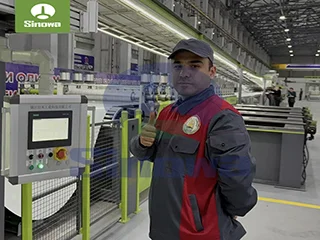
The centralized intelligent control module is the brain of the entire metal insulated sandwich panel making machine, realizing unified scheduling and precise control of all functional modules. The system adopts integrated programming control technology, which can centrally set, adjust and monitor key production parameters such as feeding speed, forming pressure, foaming ratio, curing temperature, bonding pressure and cutting size. During the production process, the control system can real-time collect operating data of each equipment unit, automatically identify abnormal operating conditions such as equipment jitter, parameter deviation and material shortage, and trigger early warning and automatic protection mechanisms in time. Operators can complete the switching of production modes, parameter adjustment and production data statistics through a simple human-computer interaction interface, realizing centralized management of the whole production process. The intelligent control mode not only greatly reduces the dependence on manual operation skills but also ensures the continuity and stability of the production process, effectively improving product qualification rate and production operational efficiency.
The metal insulated sandwich panel production machine has significant technical and production advantages compared with traditional panel production equipment. First of all, it realizes full-process continuous automated production, integrating multiple discrete processing procedures such as surface treatment, forming, compounding, curing and cutting into a unified assembly line, greatly shortening the production cycle and realizing large-scale batch production. Secondly, the whole-process parameterized precision control effectively eliminates the quality fluctuation caused by human factors, making the bonding strength, thickness uniformity, thermal insulation performance and dimensional accuracy of finished panels maintain a high stable level. In addition, the modular flexible design enables the sandwich panel manufacturing machine to quickly switch production specifications, meeting the diversified production needs of different core materials, different thicknesses and different profile panels, with strong market adaptability. At the same time, the closed production structure effectively reduces material loss and dust pollution in the production process, realizing energy-saving and environmentally friendly production mode.
In practical industrial application, the panels produced by the metal insulated sandwich panel production machinery have excellent comprehensive performance, covering multiple core advantages such as light weight, high strength, good thermal insulation, sound insulation, fire resistance and weather resistance. The composite structure of metal layer and thermal insulation core layer makes the panels have strong compression resistance and bending resistance, which can adapt to complex outdoor environmental conditions and long-term load-bearing use. The uniform and dense internal core structure endows the panels with excellent thermal insulation performance, which can effectively block indoor and outdoor heat transfer, reduce building energy consumption, and meet the energy-saving and environmental protection requirements of modern buildings. At the same time, the integrated forming process makes the panels have good overall sealing performance, with outstanding effects in sound insulation, heat preservation and moisture resistance, which can be widely used in industrial factory buildings, warehouse buildings, cold storage engineering, public building enclosure structures and temporary building facilities.
With the continuous upgrading of modern building industry standards and the increasing demand for energy-saving and environmentally friendly building materials, the metal insulated sandwich panel assembly line is also evolving towards higher intelligence, higher efficiency and more diversified functions. The new generation of assembly line equipment further optimizes the matching operation logic of each module, improves the synchronization accuracy of continuous production, and further enhances production efficiency and product stability. At the same time, combined with digital production technology, the equipment can realize real-time monitoring, data analysis and remote debugging of the production process, helping enterprises realize refined production management. In terms of functional expansion, the optimized production line can adapt to more new thermal insulation materials and composite processes, meet the higher performance requirements of the construction industry for sandwich panels, and provide more reliable equipment support for the innovation and upgrading of modern building enclosure materials.
In conclusion, the metal insulated sandwich panel assembly line, as a highly integrated and intelligent modern production equipment system, relies on scientific structural design, precise processing technology and perfect automatic control system to realize efficient and standardized production of high-quality metal insulated sandwich panels. It not only improves the production level and product quality of the sandwich panel manufacturing industry but also promotes the popularization and application of energy-saving and high-performance composite building panels in the construction field. With the continuous development of the construction industry towards energy saving, environmental protection and high efficiency, the metal sandwich panel line will continue to play an important role in the field of building material production, providing solid technical and equipment support for the upgrading of modern building industrialization.
https://www.cnsinowa.com/sandwich-panel-machines/metal-insulated-sandwich-panel-assembly-line.html