 sandwich panel machine
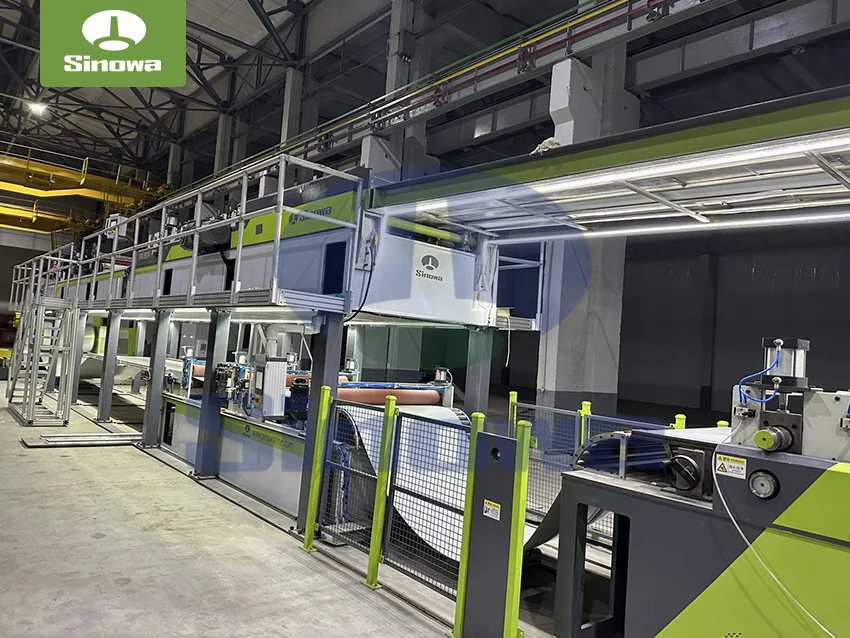
The overall operation logic of the PU sandwich panel machine for soundproof board production follows a continuous and systematic industrial production mode, with every functional module closely linked to ensure the consistency and uniformity of each finished soundproof board. The entire production process starts with the automatic feeding and pretreatment of surface and core layer raw materials. The equipment is compatible with a variety of surface materials suitable for soundproof boards, including metal sheet materials with good vibration damping performance and flexible non-metal decorative and protective materials. All surface materials are automatically uncoiled and conveyed at a constant speed through a servo-controlled feeding system, and the built-in edge correction and deviation adjustment device ensures that the materials remain flat and centered during the conveying process, avoiding edge deviation and dimensional errors that affect the assembly effect and sound insulation performance of the finished board. Before compounding, the surface materials will go through a uniform preheating process. Reasonable preheating treatment can eliminate the internal stress of the surface materials and improve the surface activity, which greatly enhances the bonding force between the surface layer and the PU foam core layer, preventing delamination and cracking caused by long-term vibration and noise impact in subsequent use, and effectively maintaining the long-term stable sound insulation structure of the board.
The foaming and core material pouring system is the core functional part of the sandwich panel equipment and the key link to determine the sound insulation performance of the finished board. Unlike ordinary thermal insulation PU foam formula and pouring process, the soundproof board production process requires the foam core layer to have uniform and dense microporous structure, moderate hardness and excellent vibration absorption capacity. The equipment is equipped with a high-precision raw material metering and mixing system, which can accurately proportion polyol, isocyanate and auxiliary raw materials according to the formula requirements of soundproof boards. The fully enclosed dynamic mixing mechanism ensures that all raw materials are evenly fused without dead angles, avoiding local uneven density, empty holes or loose structures inside the foam. These defective structures will form sound transmission channels and seriously reduce the sound insulation effect of the board. The optimized movable pouring and distributing device can uniformly spray the mixed polyurethane raw materials on the surface of the lower layer material at a stable flow rate and spacing. The spraying range and material output density can be adaptively adjusted according to the required thickness and sound insulation grade of the soundproof board, realizing flexible matching of different product specifications.
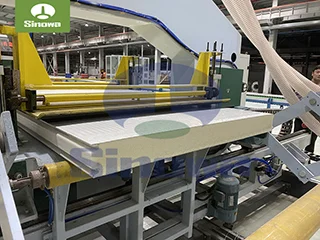
After the raw material pouring is completed, the board body enters the constant-pressure laminating and curing molding stage, which is a crucial process for shaping the overall structure of the soundproof board and solidifying the sound insulation performance. The PU sandwich panel production line adopts a double-belt constant-pressure conveying structure, which can provide continuous and uniform vertical pressure for the composite board body. This stable pressure environment can limit the irregular expansion of polyurethane foam, so that the foam expands and fills the space between the upper and lower surface layers in an orderly manner, forming a dense and uniform integral core structure. The internal constant-temperature curing system of the laminating section accurately controls the curing temperature and conveying speed, so that the polyurethane foam completes foaming, curing and bonding reaction in the most suitable temperature environment. Sufficient and stable curing reaction enables the foam core layer to form a tight integrated structure with the upper and lower surface layers. This integral composite structure can effectively weaken the vibration transmission of sound waves. When external noise and vibration act on the board surface, the dense microporous foam core layer can absorb and consume sound wave energy layer by layer, while the tightly bonded surface and core layer structure avoids resonance and vibration amplification caused by structural looseness, thereby achieving efficient sound insulation and noise reduction effects.
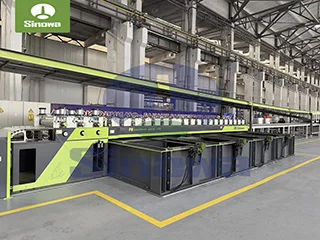
The automated cutting and post-processing module further guarantees the finished product quality and usability of the soundproof board. After continuous curing and molding, the integrated long strip board is automatically conveyed to the fixed-length cutting station. The high-precision cutting system adopts stable mechanical cutting technology, which can complete flat and smooth cutting according to the preset dimensional parameters. The cutting section is neat and burr-free, avoiding structural gaps at the board joints during on-site installation. These gaps are important hidden dangers of sound leakage in sound insulation engineering. The polyurethane sandwich panel production line can flexibly adjust the cutting length and width to adapt to the dimensional requirements of soundproof boards used in different scenarios such as building wall sound insulation, equipment room noise reduction, pipeline sound insulation and industrial workshop sound absorption. After cutting, the finished boards will go through natural cooling and automatic stacking procedures. The fully automated stacking method avoids surface scratches and structural damage caused by manual handling, maintains the flatness and structural integrity of the board, and facilitates subsequent packaging, transportation and on-site construction.
The structural design and process optimization of the professional PU sandwich panel line fully adapt to the special performance requirements of soundproof boards, showing significant technical advantages compared with traditional ordinary sandwich panel production equipment. In terms of structural precision control, the whole machine adopts full servo linkage control, and the parameters of feeding speed, material pouring volume, laminating pressure, curing temperature and cutting size are intelligently synchronized. This highly integrated control mode ensures that the thickness, density and bonding strength of each batch of soundproof boards remain highly consistent. Stable product consistency is the premise to ensure the overall sound insulation effect of the engineering project, because any local structural difference may lead to sound leakage and reduce the overall noise reduction level. In terms of product performance optimization, the equipment can adjust the foaming density and core layer structure through parameter debugging, producing soundproof boards with different sound insulation grades to meet the noise control needs of different decibel ranges. The flexible parameter adjustment function makes the production line have strong product adaptability and can meet the personalized production requirements of diversified sound insulation engineering projects.
In terms of production efficiency and resource utilization, this automated sandwich panel production equipment completely changes the inefficient production mode of traditional soundproof board manufacturing that relies on manual intervention. The continuous assembly line operation realizes uninterrupted production from raw material input to finished product output, greatly shortening the production cycle of single board products and effectively improving the overall production capacity. The precise metering and feeding system avoids excessive consumption of raw materials caused by manual operation errors, reduces the waste of polyurethane raw materials and surface materials, and improves the utilization rate of production resources. At the same time, the closed production environment reduces the volatilization of auxiliary materials and the generation of production waste, making the entire production process more environmentally friendly and in line with the development trend of green industrial manufacturing.
The finished soundproof boards produced by this professional polyurethane sandwich panel line have excellent comprehensive performance in actual application scenarios. The integral composite structure formed by high-pressure lamination and constant-temperature curing has high structural rigidity and impact resistance, which can resist long-term environmental vibration and external impact in the use environment, and will not produce structural deformation, delamination and other problems that affect sound insulation performance. The internal dense microporous polyurethane foam has good sound absorption and damping characteristics, which can effectively isolate medium and low-frequency noise that is difficult to control in most industrial and building environments. At the same time, the board retains the lightweight advantage of traditional PU sandwich panels, which reduces the load of building and equipment structures during installation and construction, and reduces the difficulty of on-site construction operation. In addition, the stable composite structure also gives the board good weather resistance, enabling it to maintain stable sound insulation performance and structural state in different temperature and humidity environments for a long time, with low later maintenance cost and long service life.
With the continuous improvement of social requirements for noise environmental governance, the application scenarios of high-performance soundproof sandwich boards are constantly expanding, covering civil building sound insulation, industrial noise reduction, public facility noise control and many other fields. The market demand for customized, high-precision and high-stability soundproof boards is increasing day by day, which puts forward higher requirements for production equipment and production technology. The professional polyurethane sandwich panel machine for soundproof board production, relying on its professional process design, intelligent control system and flexible production capacity, can continuously output high-quality soundproof board products that meet engineering standards. It provides reliable equipment support for the standardized and large-scale development of the sound insulation material industry, and also promotes the continuous upgrading of the overall technical level of the noise control industry.
In the future, with the continuous innovation of industrial automation technology and new material formula technology, this type of sandwich panel production equipment will further develop towards higher precision, higher intelligence and more energy-saving. The continuous optimization of foaming control technology, lamination molding process and intelligent monitoring system will further improve the compactness and uniformity of the internal structure of soundproof boards, and enhance the sound insulation performance and service stability of products. At the same time, the equipment will realize more flexible personalized production adaptation, meet the more refined and diversified noise control needs of different scenarios, and play a more important role in improving environmental noise quality and promoting the healthy development of modern construction and industrial supporting industries.
https://www.cnsinowa.com/sandwich-panel-machines/pu-sandwich-panel-machine-for-soundproof-board-production.html