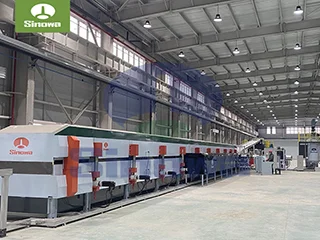
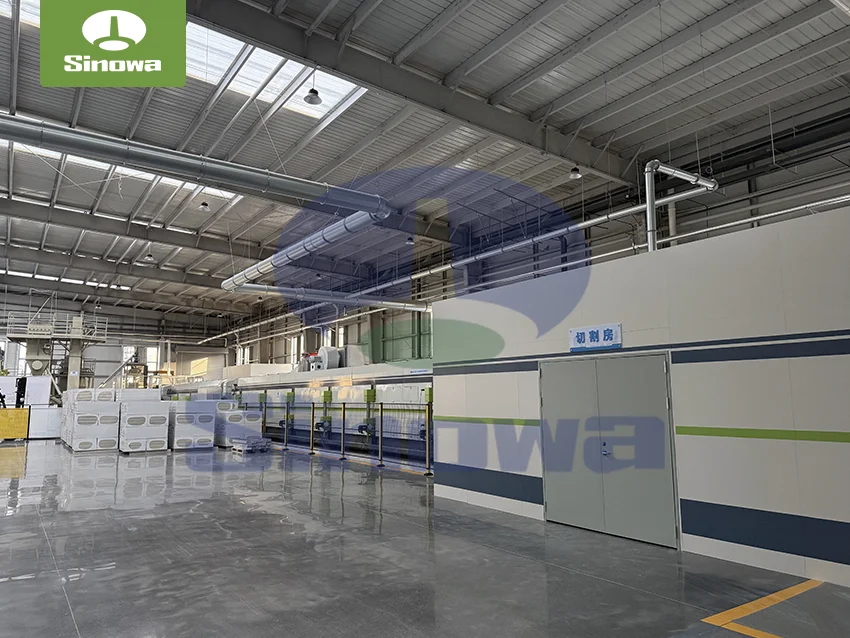
 sandwich panel line
Different from single-purpose panel production equipment, this multi-functional PU sandwich panel production line features highly flexible production configuration and adaptive process adjustment capabilities, enabling the seamless switching of production parameters to meet the differentiated performance and structural requirements of wall panels and roofing panels. In actual production operations, the equipment can adjust the foaming density of the polyurethane core layer, the bonding strength between the core layer and the surface layer, the overall thickness of the panel, and the surface molding effect according to the practical application scenarios of building panels. Wall panels produced by the line focus on flatness, thermal insulation stability, and assembly convenience, adapting to the vertical enclosure structure of buildings, while roofing panels prioritize bending resistance, waterproof adaptability, and structural load-bearing performance, matching the slope and pressure-bearing environment of building roofs. This dual-scenario production capability fundamentally improves the utilization rate of production equipment and expands the market application scope of finished panels.
The overall operation logic of the multi-functional PU sandwich panel line is based on the precise reaction principle of rigid polyurethane foam materials and the continuous composite molding technology of multi-layer structural materials. The entire production process realizes automated closed-loop operation from raw material feeding to finished product output, with no excessive manual intervention in the core link, which greatly reduces the error rate caused by human operation and ensures the consistency of batch product quality. At the initial stage of production, various surface layer raw materials for building panels are conveyed to the pretreatment station through an automated feeding system, where the equipment completes surface leveling, tension adjustment, and impurity removal treatment. This pretreatment process is crucial for enhancing the bonding performance between the surface layer and the PU foam core layer, avoiding delamination, warping, and other quality defects of finished panels during long-term use.
After the surface layer pretreatment is completed, the polyurethane raw materials are accurately proportioned and injected through a high-pressure foaming system. The core advantage of the PU sandwich panel equipment foaming system lies in its adjustable injection volume and foaming speed, which can precisely control the density and pore structure of the PU foam core. Uniform and fine closed-cell foam structure is the key to the excellent thermal insulation and mechanical properties of sandwich panels. The closed-cell rate of the PU core layer produced by this multi-functional line can reach an extremely high level, which effectively blocks the heat conduction path and avoids heat loss caused by air convection inside the core layer. Meanwhile, the equipment can adjust the foaming formula and molding parameters according to different regional climatic conditions and building energy-saving standards, producing panels with different thermal insulation grades to adapt to high-temperature, low-temperature, and humid and rainy diverse application environments.
In the continuous composite molding stage, the PU sandwich panel machine adopts a multi-stage constant-temperature curing and pressure-maintaining system. The upper and lower surface layers and the foaming PU core layer enter the molding unit together, and under stable pressure and constant-temperature environment, the three-layer structure completes integrated bonding and curing molding. The intelligent pressure control system of the equipment can dynamically adjust the molding pressure according to the thickness and structural design of wall panels and roofing panels. For thin-type wall panels used for building interior and exterior enclosure, low-pressure uniform molding is adopted to ensure flat and smooth panel surface and stable overall size; for thickened roofing panels that need to bear wind pressure, snow pressure and other external loads, segmented high-pressure curing is used to enhance the compactness of the core layer and the overall structural strength of the panel, ensuring that the roofing panels have excellent compression resistance and bending resistance.
The fixed-length cutting and post-processing unit of the polyurethane sandwich panel production line further reflects its multi-functional advantages. The intelligent cutting system supports arbitrary adjustment of panel length and width, and can produce standard-sized conventional panels and special-sized customized panels according to architectural design requirements. After cutting, the equipment automatically completes edge trimming, burr removal, and surface finishing of the panels, ensuring that the finished panels have neat edges and smooth surfaces, which is convenient for on-site assembly and construction. In addition, the production line can be equipped with adaptive grooving and embossing modules according to production needs, realizing diversified surface treatment of panels. Wall panels can be processed with decorative textures to improve the aesthetic effect of building facades, while roofing panels can be grooved to enhance drainage and waterproof performance, further optimizing the practical adaptability of finished products.
Finished PU sandwich panels produced by this professional continuous PU sandwich panel line have outstanding comprehensive performance, becoming ideal materials for modern building wall and roof systems. In terms of thermal insulation performance, the rigid polyurethane foam core has extremely low thermal conductivity, which can effectively isolate indoor and outdoor heat transfer, significantly reduce the energy consumption of building heating and cooling, and meet the high-standard energy-saving requirements of modern green buildings. Compared with traditional brick and concrete structures and ordinary insulation board composite structures, PU sandwich panels can reduce building energy loss by a large margin, creating a stable and comfortable indoor thermal environment. This performance advantage makes the panels widely applicable to energy-saving buildings, industrial workshops, cold storage warehouses, and constant-temperature workshops that have strict requirements on temperature control.
In terms of structural performance, the composite structure formed by the high-strength surface layer and the compact PU foam core endows the panels with a high strength-to-weight ratio. The overall weight of the panel is far lower than that of traditional building materials, which can effectively reduce the self-weight load of the building structure, lower the requirements on the foundation and main frame of the building, and reduce the overall construction cost of the project. At the same time, the integrated composite molding process makes the overall structural stability of the panel excellent, with good wind resistance, seismic performance and impact resistance. Wall panels can maintain stable structural performance under long-term static load, while roofing panels can resist external forces such as strong wind, rain erosion and snow pressure, adapting to complex outdoor working conditions and ensuring long-term safe operation of building enclosure structures.
Weather resistance and durability are also core advantages of panels produced by this multi-functional continuous PU sandwich panel production line. Through optimized foaming process and composite bonding technology, the finished panels have strong resistance to temperature difference aging, moisture erosion and ultraviolet radiation. They can maintain stable physical and chemical properties in the temperature range of extreme low temperature to high temperature, without phenomena such as foaming, cracking, deformation and performance attenuation. The excellent moisture-proof and waterproof performance of the PU closed-cell structure can effectively block the penetration of rainwater and humid air, avoid the mildew and corrosion of the building enclosure structure caused by moisture accumulation, and greatly extend the service life of building walls and roofs. In conventional use environments, the comprehensive service life of the panels can reach a long cycle, reducing the frequency of building maintenance and renovation.
In terms of construction practicability, the standardized and modular production mode of the polyurethane sandwich panel line makes the finished panels have unified size accuracy and assembly compatibility. The panels are lightweight and easy to handle, transport and install, and the on-site assembly construction method can greatly shorten the construction cycle compared with traditional wet construction processes. The dry construction mode of PU sandwich panels does not require a large amount of water and auxiliary building materials on site, reduces construction waste and on-site pollution, and conforms to the development concept of green and low-carbon construction. Whether it is new building construction, old building renovation, or temporary prefabricated building construction, the panels can realize rapid construction and effectively improve the construction efficiency of the project.
The multi-functional characteristics of the polyurethane sandwich panel machine also bring flexible economic benefits for production and processing enterprises. One equipment can meet the mass production needs of wall panels and roofing panels at the same time, avoiding the repeated investment of purchasing multiple single-function production lines, reducing the equipment occupancy space and daily maintenance cost of the production workshop. The automated continuous production mode realizes uninterrupted large-scale production, with high production efficiency and low unit energy consumption, which significantly improves the production output and economic benefits of the enterprise. Meanwhile, the equipment’s strong product customization ability can meet the personalized needs of different construction projects for panel thickness, performance parameters and surface effects, helping processing enterprises expand product coverage and adapt to more market demand scenarios.
From the perspective of industry development, the popularization and application of this multi-functional PU sandwich panel production machinery have promoted the standardized and intelligent development of the building insulation panel manufacturing industry. The traditional panel production process is relatively backward, with large manual operation errors, uneven product quality, and single product function, which is difficult to adapt to the rapid development of modern prefabricated buildings. This integrated production line realizes the whole-process precise control from raw material proportioning to finished product molding, realizes standardized production of products, and ensures the stability and reliability of product quality in batch production. At the same time, the equipment’s multi-functional switching capability breaks the product boundary between wall panels and roofing panels, enriches the product system of building enclosure materials, and provides more high-performance material choices for architectural design and engineering construction.
In the field of practical engineering application, wall and roofing panels produced by this composite sandwich panel production line cover almost all types of modern construction scenarios. In industrial construction, they are widely used in the wall and roof enclosure of large industrial workshops, logistics warehouses, and factory auxiliary buildings, providing stable thermal insulation and structural protection for industrial production and material storage. In commercial construction, they are applied to shopping malls, exhibition halls, office buildings and other public buildings, meeting the dual needs of building energy conservation and facade aesthetics. In the field of cold chain and constant-temperature engineering, the excellent thermal insulation performance of the panels ensures the stable operation of cold storage, constant-temperature warehouses and fresh-keeping workshops, reducing the operational energy consumption of temperature control equipment. In addition, they are also suitable for prefabricated residential buildings, temporary engineering buildings, agricultural breeding buildings and other scenarios, with extremely high market adaptability and application value.
With the global construction industry moving towards greenization, energy conservation and prefabrication, the market demand for high-performance, multi-functional and low-carbon building enclosure materials continues to grow, which also puts forward higher requirements for sandwich panel production equipment. This multi-functional PU sandwich panel line keeps pace with the development trend of the industry, and its intelligent control system can realize real-time monitoring and adaptive adjustment of production parameters. The equipment can optimize the foaming formula and production process according to different environmental protection and energy-saving standards, reduce energy consumption and material waste in the production process, and realize low-carbon and environmentally friendly production. The recyclable characteristics of PU materials themselves, combined with the low-loss production process of the equipment, make the whole industrial chain of panel production and application more in line with the sustainable development concept of the construction industry.
In terms of equipment operation and maintenance, the modular structural design of the multi-functional PU sandwich panel manufacturing line makes the daily operation and later maintenance more convenient. Each functional unit of the equipment is independently arranged and reasonably distributed, which is convenient for operators to conduct daily inspection, parameter adjustment and fault troubleshooting. The automated monitoring system can real-time feed back the operating status of each production link, quickly locate abnormal problems, reduce equipment failure rate and downtime, and ensure the continuity and stability of production. The durable mechanical structure and stable electrical control components enable the equipment to maintain long-term efficient operation in high-intensity production environments, providing reliable technical guarantee for enterprise mass production.
In conclusion, the multi-functional PU sandwich panel production line for wall and roofing panels is a comprehensive and high-efficiency manufacturing equipment integrating intelligent production, multi-scenario adaptation, high-quality output and green production. It not only solves the pain points of single function, low efficiency and unstable quality of traditional panel production equipment, but also produces building panels with excellent thermal insulation, structural stability, weather resistance and construction convenience. With its flexible production performance, stable product quality and wide application coverage, this production line has become an important driving force for the upgrading of the building composite material industry, providing high-quality material support for the high-quality development of modern prefabricated construction, green energy-saving buildings and various industrial and civil engineering projects, and will continue to play an important role in the iterative innovation and market popularization of building enclosure materials in the future.
https://www.cnsinowa.com/sandwich-panel-machines/multi-functional-pu-sandwich-panel-line-for-wall-and-roofing-panels.html