 sandwich panel line
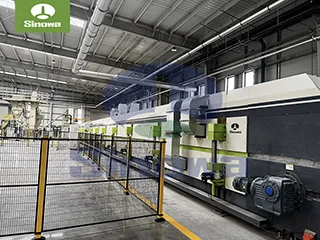
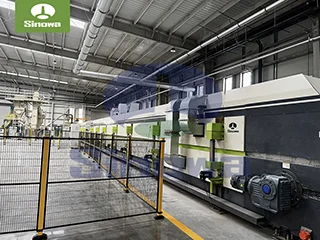
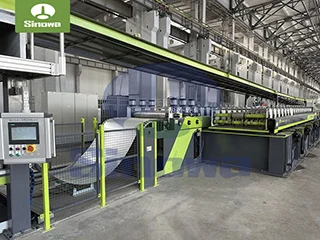
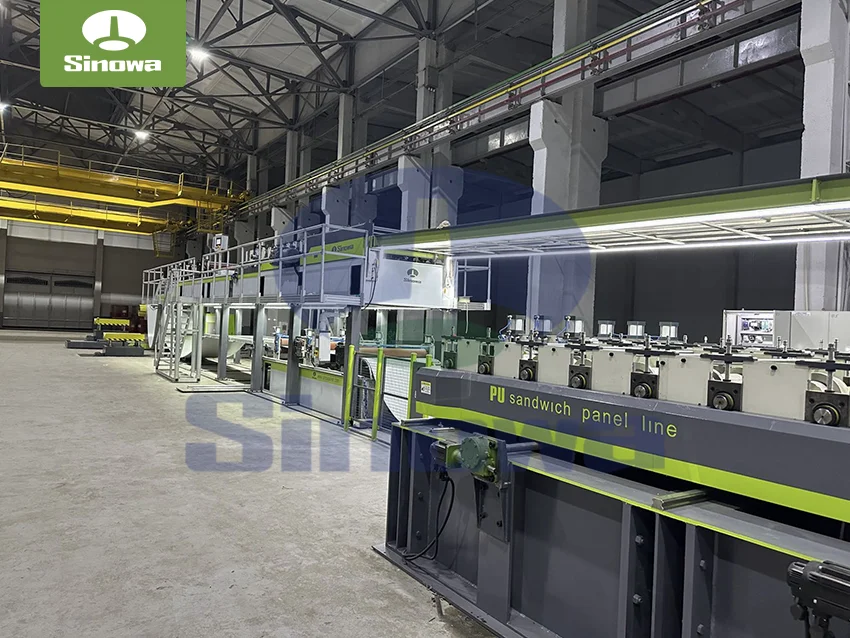
The overall structural layout of a complete continuous PUR sandwich panel line follows a scientific linear production logic, with each functional unit closely connected and coordinated in sequence to ensure uninterrupted material transportation, processing, and forming from raw material input to finished panel output. The entire production system can be divided into several core functional sections according to production sequence, including raw material unwinding and surface pretreatment section, continuous sheet leveling and shaping section, PUR raw material mixing and high-pressure foaming pouring section, double-layer composite laminating and pressure forming section, constant-temperature thermal curing and foam shaping section, continuous traction and stable conveying section, fixed-length cutting and edge trimming section, as well as finished panel stacking and automatic discharging section. Each section is equipped with specially designed mechanical components and linkage control systems, realizing full automation of the entire production process without excessive manual intervention, effectively reducing human error in production and ensuring that every batch of produced sandwich panels maintains consistent structural performance and surface quality. The rational layout of the production line not only saves factory floor space and optimizes production site management but also shortens material transfer time between different processing links, greatly improving overall production efficiency and realizing large-scale continuous manufacturing of PUR sandwich panels.
The initial stage of the entire production process starts with the unwinding and surface pretreatment of the upper and lower surface facing materials, which are the outer protective layers of the finished sandwich panels and directly determine the surface appearance, weather resistance, and mechanical protection performance of the final products. The production line is configured with multi-station unwinding devices that can hold multiple rolls of facing materials for continuous alternate feeding, avoiding production shutdown caused by raw material roll replacement and ensuring the continuity of the overall production rhythm. After the facing materials are unwound, they first enter the surface leveling and tension adjustment mechanism, which precisely controls the tension of the metal or non-metal sheets through multi-group tension sensing and automatic adjustment devices. This step is crucial to prevent problems such as sheet wrinkling, stretching deformation, and uneven flatness in subsequent composite processing, ensuring that the surface materials are always kept in a flat and stable conveying state during the entire production process. Following tension adjustment, the facing materials pass through a professional surface pretreatment unit, which removes surface dust, oil stains, and residual impurities generated during raw material processing through physical cleaning and surface activation treatment. This subtle but vital pretreatment process effectively enhances the bonding adhesion between the outer facing materials and the PUR foam core layer, avoiding delamination, peeling, and poor bonding between layers during the long-term use of the sandwich panels. After completing pretreatment and leveling, the upper and lower facing materials are respectively conveyed to the upper and lower layers of the composite forming area, waiting for the filling and compounding of the polyurethane foam core material in the subsequent process.
The PUR raw material mixing and high-pressure foaming pouring section is the most critical core link of the entire sandwich panel production line, directly determining the thermal insulation performance, mechanical strength, dimensional stability, and overall durability of the PUR foam core layer, which is the key to distinguishing high-quality sandwich panels from ordinary products. The polyurethane foam used for sandwich panel production is formed by the chemical reaction and rapid foaming of two main raw materials, combined with a variety of functional auxiliary materials, and the production line is equipped with a fully automatic raw material proportioning and high-pressure circulating feeding system to ensure the accurate ratio of all raw materials. The precision metering devices in the system can precisely control the feeding volume and flow rate of each raw material in real time according to the set production process parameters, avoiding product quality defects caused by unreasonable raw material ratios, such as insufficient foam foaming, uneven internal density, excessive brittleness, or poor thermal insulation effect. After precise metering, all raw materials are transported to the high-pressure mixing head through a closed circulating pipeline, where rapid and uniform mixing is completed under high-pressure conditions to ensure that various raw materials are fully fused without local uneven mixing. The uniformly mixed polyurethane raw material is then evenly poured between the upper and lower facing materials through an automatic reciprocating pouring device. The pouring speed, pouring range, and pouring thickness can be intelligently adjusted according to the required specifications and thickness of different sandwich panels, ensuring that the mixed raw materials can completely and uniformly fill the gap between the upper and lower sheets without material accumulation or missing pouring in any area. The instantaneous chemical reaction of the mixed PUR raw material starts immediately after pouring, and it begins to foam and expand rapidly to form a continuous and dense foam core structure.
After the PUR raw material is poured and starts preliminary foaming, the semi-finished panel immediately enters the double-layer composite laminating and pressure forming section, which undertakes the important task of compounding the upper and lower facing materials with the foaming foam core layer and calibrating the overall thickness and flatness of the sandwich panel. This section is composed of upper and lower multi-group precision pressing rollers and a synchronous pressure adjustment system, which can apply uniform and stable pressing force to the semi-finished panel during the foam foaming and curing process. As the polyurethane foam continues to foam and expand, the pressing rollers always maintain a constant pressure and fixed spacing, effectively controlling the final thickness of the sandwich panel to ensure that the thickness of each position of the panel is consistent and meets the set production standards. At the same time, the continuous pressure effect promotes the close bonding between the foam core layer and the inner surface of the upper and lower facing materials, making the composite structure of the entire panel integrated as a whole, rather than a simple mechanical fit between layers. The synchronous transmission design of the pressing rollers ensures that the conveying speed of the upper and lower facing materials and the foaming core material is completely synchronized, avoiding relative displacement and layer deviation between the surface materials and the core material during the pressing process, which would affect the structural integrity of the finished panel. The structural design of the laminating section also takes into account the fluidity and foaming characteristics of the PUR material in the reaction process, reserving a reasonable foaming and expansion space to ensure that the foam can form a fine and uniform cellular structure inside, without internal voids, bubbles, or uneven density distribution.
The constant-temperature thermal curing and foam shaping section is an indispensable post-forming processing link, which plays a decisive role in stabilizing the internal structure of the PUR foam, solidifying the bonding performance between layers, and improving the overall mechanical stability of the sandwich panel. Although the polyurethane foam completes preliminary foaming and shaping in the laminating and pressing stage, the internal chemical reaction of the foam is not completely finished, and the internal molecular structure and bonding state are still in an unstable state. If subsequent processing is carried out directly without constant-temperature curing, the foam core layer is prone to later shrinkage, deformation, or bonding loosening, affecting the long-term service performance of the finished sandwich panel. The curing section of the production line is equipped with a fully enclosed constant-temperature temperature control system, which can maintain a stable internal temperature environment according to the optimal curing temperature requirements of PUR materials. The semi-finished sandwich panels after composite pressing are slowly and continuously conveyed through the curing tunnel at a constant speed, ensuring that each panel stays in the constant-temperature environment for a sufficient curing time. During the curing process, the internal chemical reaction of the polyurethane foam is fully completed, the cellular structure is completely solidified and shaped, the bonding force between the foam core layer and the upper and lower facing materials reaches the optimal state, and the overall hardness, compression resistance, and dimensional stability of the panel are fully improved. The temperature control system of the curing section has high-precision temperature adjustment and temperature uniform distribution functions, avoiding local overheating or low temperature in the curing tunnel, preventing quality problems such as inconsistent foam curing degree and local panel deformation.
The continuous traction and stable conveying system runs through the entire production line, coordinating the operating speed of all functional sections to ensure the synchronous operation of each link and the stability of the overall production rhythm. The production line adopts multi-group servo-driven traction devices, which can realize stepless speed regulation according to different production speeds and panel specification requirements. The traction devices maintain stable tension and conveying speed for the sandwich panels in each production stage, avoiding panel stretching, extrusion deformation, or position deviation caused by unstable conveying speed. The conveying rollers of the traction and conveying system are designed with anti-slip and anti-pressure damage structures, which can protect the surface of the outer facing materials from scratches, indentations, and other surface quality problems during the conveying process. The intelligent linkage control system can automatically adjust the operating speed of each section according to the production progress, realizing seamless connection between unwinding, pretreatment, pouring, pressing, curing, and subsequent cutting processing, ensuring that the entire production process is carried out in an orderly and continuous manner without material accumulation or production line stagnation. The excellent coordination performance of the traction and conveying system is the basis for the long-term stable and efficient operation of the entire continuous production line, ensuring both production efficiency and product processing quality.
After the sandwich panels are completely cured and shaped, they enter the fixed-length cutting and edge trimming section for final finishing processing to meet the dimensional specification requirements of actual engineering applications. The production line is equipped with automatic fixed-length cutting equipment, which can accurately set the cutting length according to customer engineering needs, and complete precise fixed-length cutting of continuous long sandwich panels in a fully automatic manner. The cutting equipment adopts stable and efficient cutting structures, which can complete the cutting operation quickly and smoothly without causing edge deformation, foam cracking, or surface material damage at the cutting position, ensuring flat and neat cutting sections of the finished panels. After fixed-length cutting, the edge trimming process is carried out to trim the excess edge materials and irregular parts on both sides of the panels, making the overall dimensions of the panels more accurate and the edges more flat and smooth, facilitating subsequent on-site assembly and installation construction. All cutting and trimming processes are completed automatically under the control of the system, with high processing accuracy and stable processing quality, avoiding dimensional errors and edge damage caused by manual cutting. The finished sandwich panels after cutting and trimming have standardized overall dimensions and perfect surface and edge quality, fully meeting the installation and use requirements of various construction projects.
The final stage of the entire production process is finished panel automatic stacking and discharging, which realizes automatic collection, arrangement, and output of qualified finished sandwich panels, completing the entire closed-loop production process from raw material input to finished product output. The automatic stacking device can neatly stack the cut and trimmed finished panels according to the set stacking quantity and stacking specifications, with stable stacking arrangement and no panel extrusion or collision damage during the stacking process. After stacking is completed, the automatic discharging device conveys the stacked finished panels out of the production line, facilitating subsequent packaging, storage, and transportation and delivery. The automatic stacking and discharging link reduces the demand for manual handling and stacking, effectively improving production efficiency, reducing labor costs in the production process, and avoiding panel surface damage and safety hazards caused by manual handling. The entire production line realizes full-process automated operation, from raw material unwinding to finished product discharging, with minimal manual participation, realizing modern intelligent and efficient production of PUR sandwich panels.
The advantages of the continuous PUR sandwich panel production line in actual production operation are reflected in many aspects, covering production efficiency, product quality stability, production cost control, and production operation flexibility. In terms of production efficiency, the continuous integrated production mode completely breaks the production bottleneck of traditional intermittent production equipment, realizing uninterrupted continuous production, with far higher daily and annual output than traditional equipment, which can meet the large-scale and centralized procurement demand of large construction projects. In terms of product quality, the full-process automatic control and precise parameter adjustment of the production line ensure that the foam density, bonding strength, panel thickness, flatness, and other core indicators of each batch of sandwich panels are kept within a stable range, with small product quality differences and high overall consistency, avoiding quality fluctuations caused by manual operation differences. In terms of production cost control, the precise raw material proportioning system effectively reduces raw material waste, the automated production mode reduces labor input, and the stable production operation reduces product repair and scrap losses, effectively lowering the comprehensive production cost per unit of finished panels. In terms of operation flexibility, the production line can quickly adjust production process parameters and production specifications, and can produce sandwich panels of different thicknesses, different surface material types, and different structural specifications according to different application needs, meeting the diversified product production needs of the market.
With the continuous advancement of green building concepts and building energy conservation policies in various regions, the market application prospects of PUR sandwich panels will become broader, and the market requirements for the performance and quality of sandwich panels will continue to increase, which also puts forward higher upgrading requirements for continuous PUR sandwich panel production lines. In the future, the development direction of such production lines will be more inclined to intelligent control refinement, energy-saving and low-carbon production optimization, and multi-product flexible production adaptation. The continuous upgrading of production line technology will further improve the thermal insulation performance, structural durability, and environmental protection performance of produced PUR sandwich panels, better adapting to the construction needs of various high-standard energy-saving buildings and special industrial facilities. As the core production equipment of the sandwich panel manufacturing industry, the continuous PUR sandwich panel production line will continue to play an irreplaceable important role, supporting the high-quality development of the building thermal insulation and composite building materials industry, and contributing more to the promotion of green, energy-saving, and sustainable development of the global construction industry.
https://www.cnsinowa.com/sandwich-panel-machines/pur-sandwich-panel-line.html