sandwich panel line
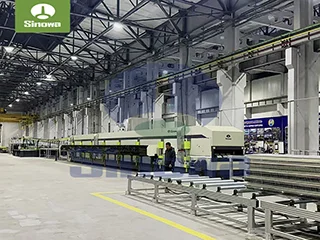
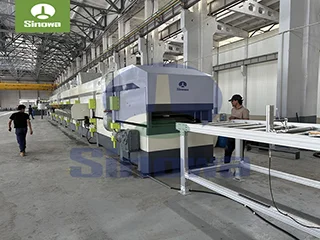
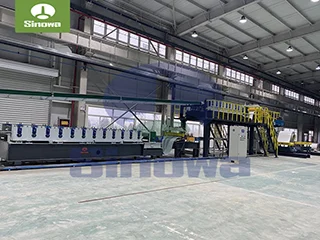
The core competitiveness of Chinese insulation sandwich panel production line manufacturing lies in the complete and integrated equipment system design. A standard continuous production line is composed of multiple interconnected functional units, realizing one-stop processing from raw material feeding to finished product packaging without intermediate manual intervention, which greatly improves production consistency and operational efficiency. The entire production workflow starts with the surface material feeding and pretreatment stage. Metal coil materials, the common outer protective layer of sandwich panels, are stably unwound through automatic unwinding devices, with built-in leveling and trimming structures to eliminate material deformation and edge burrs generated during coil storage and transportation. This pretreatment process ensures the flatness and dimensional uniformity of the surface layer materials, laying a solid foundation for subsequent composite bonding and forming. Meanwhile, the equipment is equipped with adaptive preheating modules, which adjust the surface temperature of the outer layer materials according to different material characteristics, effectively enhancing the bonding tightness between the surface layer and the core insulation material and avoiding delamination and peeling problems of finished panels in long-term use.
The foaming and core material composite forming unit is the key core part of the continuous sandwich panel production line, determining the thermal insulation performance, structural density, and overall stability of finished sandwich panels. Chinese manufacturers have carried out in-depth structural optimization for different types of insulation core materials, forming universal and targeted production solutions for organic and inorganic core materials. For polyurethane and polyisocyanurate foam core materials, the equipment adopts high-precision metering and mixing systems to proportion raw materials evenly, realizing uniform and fine foaming reactions between upper and lower surface layers. The foaming process is precisely controlled through dynamic parameter adjustment, which can effectively balance the foaming expansion speed and curing speed of materials, ensuring that the foam core layer forms a dense and uniform pore structure without hollowing or uneven density. For inorganic core materials such as rock wool and glass wool, the production line is equipped with professional material spreading and pressing auxiliary structures, which can evenly lay fluffy core materials and conduct constant-pressure composite shaping to ensure the overall flatness and structural firmness of composite panels.
The constant-temperature curing and pressure shaping system further improves the structural stability of semi-finished panels. After the composite bonding of surface materials and core materials, the panels enter the fully insulated closed curing channel, where distributed heating components and real-time temperature sensing elements form a closed-loop temperature control system. The system can dynamically adjust the internal temperature of the curing channel according to production speed and material types, maintaining a constant and stable curing environment. This intelligent curing mode enables the adhesive and foaming materials to complete sufficient chemical reaction and structural shaping, significantly improving the bonding strength, aging resistance, and structural durability of the composite interface. Compared with traditional intermittent production equipment, the continuous curing design adopted by Chinese production lines avoids unstable product quality caused by temperature fluctuation and inconsistent curing time, realizing continuous and stable online production.
The subsequent cutting, trimming and finishing processes reflect the refined manufacturing advantages of domestic equipment. The continuous sandwich panel line is equipped with automatic tracking cutting devices, which can accurately cut continuous long panels into customized lengths according to set parameters. The high-sensitivity tracking system can adapt to slight speed changes in the production process, ensuring the dimensional accuracy of each finished panel within a tiny error range. At the same time, the edge trimming unit automatically processes the edges of the panels to remove excess residual materials, making the panel edges neat and smooth, which facilitates subsequent on-site installation and assembly. Some optimized equipment models are also equipped with surface protection film laminating structures, which can complete surface protection treatment during the production process, effectively avoiding scratches and abrasions during panel transportation and stacking and improving the surface finish of finished products.
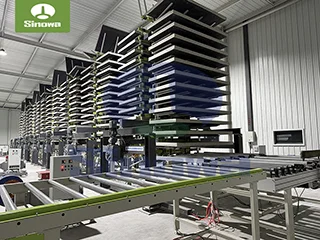
The final automatic stacking and packaging unit realizes unmanned finishing of the entire production process. The finished panels after cutting and finishing are automatically conveyed to the stacking platform through the conveyor system, and the mechanical stacking structure neatly arranges the panels according to fixed specifications. The automatic packaging device wraps the stacked panels with protective materials to achieve dustproof, moisture-proof and collision-proof protection, which is convenient for long-distance transportation and long-term storage. The integrated design of the whole line minimizes manual operation links, reduces human error and labor cost, and greatly improves the overall production efficiency, which can meet the large-scale production needs of industrial manufacturing enterprises.
Chinese insulation sandwich panel line manufacturers have obvious advantages in equipment adaptability and scenario matching. In view of the diverse application scenarios of insulation sandwich panels in the global market, domestic equipment has realized flexible parameter adjustment and modular functional combination. The production line can switch production modes according to different raw material formulas, panel thicknesses, and usage environments, efficiently producing various types of insulation panels suitable for industrial workshops, logistics cold storage facilities, medical clean rooms, residential building exterior walls, and agricultural greenhouses. The modular design allows users to independently match functional units according to their own production scale and product positioning. Small and medium-sized production configurations are suitable for small-batch and multi-specification production demands, while large-scale full-automatic continuous production lines can meet the high-output production needs of large building material manufacturers, realizing flexible adaptation from small-scale workshop production to large-scale industrial standardized production.
In terms of equipment operation and energy consumption optimization, Chinese manufacturing enterprises have integrated intelligent control and energy-saving technologies into the whole equipment design. The production line adopts a centralized intelligent control system, which integrates all functional units such as feeding, foaming, curing, cutting, and packaging into a unified operation platform. Operators can complete parameter setting, production monitoring, and equipment operation control through a simple human-computer interaction interface. The system has real-time data monitoring and abnormal early warning functions, which can automatically identify equipment operation abnormalities and production parameter deviations, effectively reducing equipment failure rates and product defective rates. In terms of energy saving and consumption reduction, the equipment optimizes the heating structure and power distribution system, adopts high-efficiency thermal insulation materials to reduce heat loss during the curing process, and optimizes the operation logic of transmission and power components to reduce invalid energy consumption, realizing low-energy and high-efficiency production operation.
The industrial supporting advantage is an important foundation for the rapid development of Chinese insulation sandwich panel machine manufacturing industry. Relying on the perfect domestic mechanical processing, electrical supporting, and material supply industrial chains, manufacturers can realize independent research and development, processing, and assembly of core equipment components. From precision mechanical transmission parts and intelligent control components to special functional accessories, all links have stable and high-quality supply channels, which not only ensures the manufacturing precision and operational stability of the equipment but also realizes effective control of equipment production cost. At the same time, the centralized industrial cluster effect promotes technical communication and iterative innovation among manufacturers, continuously optimizing equipment structure, improving production performance, and narrowing the gap with international advanced equipment in core technical indicators, and even realizing partial technical surpassing in adaptive optimization and intelligent control.
In terms of equipment durability and maintenance convenience, Chinese-made insulation sandwich panel production machine is designed with full consideration of long-term industrial operation scenarios. The key load-bearing and operating components of the equipment are made of high-strength and wear-resistant materials, and undergo precise processing and anti-corrosion treatment, which can adapt to long-term continuous high-load operation and reduce component wear and failure probability. The equipment adopts a standardized and modular structural design for easily worn and damaged parts, which is convenient for daily inspection, maintenance, and parts replacement by users. The reasonable structural layout reduces the difficulty of equipment daily maintenance, prolongs the overall service life of the production line, and reduces the long-term operation and maintenance cost for users, bringing higher economic benefits to production enterprises.
With the global emphasis on energy conservation, emission reduction, and green building development, the market demand for high-performance insulation sandwich panels continues to grow, which also puts forward higher requirements for the performance and functionality of supporting production equipment. Chinese insulation sandwich panel production line manufacturers have always focused on market demand orientation, continuously carrying out technical upgrading and product iteration. In recent years, more environmentally friendly foaming process technologies and low-carbon production designs have been applied to equipment manufacturing, reducing the generation of waste materials and energy consumption during the production process, and matching the development trend of global green and low-carbon buildings. At the same time, the equipment's intelligent level has been continuously improved, realizing automatic parameter optimization, production data statistics, and remote operation and maintenance functions, promoting the sandwich panel production industry to develop in the direction of intelligence, automation, and greening.
In the global market layout, Chinese insulation sandwich panel manufacturing line products have won wide recognition from global customers with stable performance, flexible adaptability, and cost-effective configuration. The equipment has been exported to many regions around the world, serving local building material production enterprises and engineering construction projects. Manufacturers provide customized equipment design, installation and commissioning, and technical guidance services according to the regional climate characteristics, local building standards, and market demand differences of different regions, ensuring that the equipment can efficiently adapt to local production and application environments. Long-term technical accumulation and market service experience have made Chinese manufacturers important participants and promoters in the global insulation building material equipment industry.
Looking ahead, Chinese insulation sandwich panel production line manufacturing industry will continue to focus on technological innovation and product upgrading, further improving the intelligent manufacturing level, green production performance, and equipment integration of production lines. With the continuous development of new building materials and new construction technologies, manufacturers will continue to explore innovative applications in equipment technology, develop more efficient, energy-saving, and intelligent production equipment, and provide more reliable and diversified production solutions for the global insulation sandwich panel manufacturing industry. Relying on strong industrial chain advantages and continuous technical innovation capabilities, Chinese manufacturers will further consolidate their leading position in the global market and continuously empower the high-quality development of the global green building industry.
https://www.cnsinowa.com/sandwich-panel-machines/insulation-sandwich-panel-production-line-manufacturer-in-china.html