sandwich panel machine
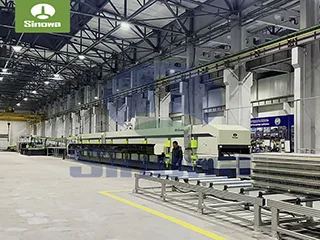
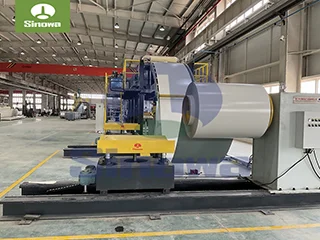
The overall structural composition of the complete PU sandwich panel machine follows a linear production layout, which conforms to the forward flow logic of raw material processing and finished product forming, greatly simplifying production management and daily maintenance work. The front-end part of the entire production line is equipped with an automatic raw material unwinding and feeding unit, which is responsible for stably releasing coiled surface materials used for the upper and lower layers of sandwich panels. This unit is designed with a tension adjustment structure that can adapt to surface materials of different thicknesses and textures, ensuring that the released sheet materials maintain flat and uniform tension without wrinkling, stretching, or offsetting during high-speed conveying. The guiding and positioning auxiliary devices installed on the feeding track can correct the lateral deviation of sheet materials in real time, laying a solid foundation for the subsequent precise forming and composite processing of panels. The feeding speed of the unit can be adjusted steplessly according to production demands and product specifications, realizing flexible matching with the operating speed of subsequent processing links and avoiding material accumulation or production pause caused by speed mismatch.
Following the feeding unit is the roll forming unit, a key module that shapes the flat surface sheet into the required panel profile. This unit adopts multi-station rolling forming technology, with high-strength alloy rolling shafts arranged in an orderly manner according to product forming standards. Through gradual rolling and pressure shaping, the flat sheet completes edge folding, corrugation, and flat calibration processes in sequence, achieving standardized profile forming. The structural rigidity of the roll forming stand is fully optimized to withstand long-term continuous rolling pressure, ensuring stable forming accuracy after long hours of operation. All rolling parameters, including rolling gap and forming radian, can be fine-tuned according to different product design requirements, enabling the equipment to produce sandwich panels with diverse surface profiles and structural specifications. The whole forming process is completed through mechanical extrusion without cutting damage to the surface material, which effectively guarantees the integrity and surface flatness of the panel outer layer, improving the overall appearance quality and structural strength of finished products.
The core functional module of the entire PU sandwich panel production line is the PU foam metering, mixing and injection system, which directly determines the thermal insulation performance, structural compactness and service stability of the finished sandwich panels. Polyurethane foam is formed by the chemical reaction of two main liquid raw materials, and this system realizes the precise proportional metering and high-speed uniform mixing of the two raw materials. Equipped with high-precision metering components, the system can accurately control the output ratio and flow rate of raw materials, avoiding quality problems such as uneven foam density, incomplete foaming and local hollowing caused by raw material proportion deviation. The internal structure of the mixing device is optimized for fluid dynamics, which can fully stir and blend liquid raw materials in an instant, ensuring that the mixed foam raw materials have uniform components and stable activity. After mixing, the foam material is evenly injected between the upper and lower formed surface sheets through a movable injection head. The injection head can move horizontally along the panel width direction, realizing full coverage and uniform distribution of foam materials, so that the foam core layer of each position of the panel maintains consistent thickness and density.
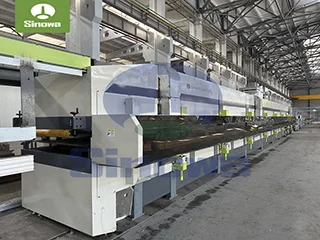
After foam injection, the semi-finished panels enter the double-belt laminating and curing unit for composite forming and solidification treatment, which is a crucial link to determine the bonding strength and overall flatness of sandwich panels. This unit adopts a double-layer circulating belt pressing structure, which can provide continuous and uniform pressure for the composite panel during the conveying process. The pressure value is kept within a stable and reasonable range through mechanical constant pressure control, ensuring that the expanding foam can fully fill the gap between the upper and lower plates without causing excessive extrusion deformation of the surface plates. At the same time, the unit is equipped with a constant-temperature heating system, which maintains a stable temperature environment inside the curing channel to accelerate the chemical curing reaction of polyurethane foam. Under the dual action of constant pressure and constant temperature, the foam completes expansion, filling and solidification molding in a short time, and forms a firm integrated bonding structure with the upper and lower surface plates. The length of the curing channel is scientifically designed according to the foaming and curing cycle of polyurethane materials, ensuring that the foam core layer is completely cured when the panel exits the unit, avoiding subsequent deformation, degumming and other quality defects.
The rear-end functional modules of the PU sandwich panel line include fixed-length cutting, edge trimming and finished product conveying units, which are responsible for finishing and outputting the cured integrated sandwich panels. The fixed-length cutting system supports flexible setting of cutting dimensions according to user production needs, and realizes precise fixed-length cutting through high-sensitivity sensing and automatic positioning technology. The cutting tool adopts high-hardness structural design, which can complete smooth cutting of composite panels with different thicknesses, ensuring neat and burr-free cutting sections. The edge trimming device can finely trim the edges of the cut panels to eliminate uneven edges and residual foam burrs generated in the production process, further improving the finish and dimensional standardization of finished products. The finished product conveying unit operates synchronously with the front-end processing speed, realizing automatic output of finished panels, and can be matched with manual or automatic stacking operations to complete the final collection and arrangement of products.
The complete set of foam core sandwich panel line is equipped with a centralized automatic control system, which integrates the operation parameters of all functional modules of the production line into a unified control interface. Operators can complete the setting of production speed, product specifications, foaming parameters, temperature and pressure values through simple parameter adjustment, and realize one-click start and stop of the entire production line. The system has a real-time operating data monitoring function, which can track the operating status, production progress and parameter changes of each module in real time. Once abnormal parameter fluctuations or equipment operating faults occur, the system will trigger real-time reminders, helping operators quickly locate and solve problems. In addition, the control system supports parameter memory function, which can store the parameter settings of conventional product specifications, realizing rapid switching of different production schemes and greatly improving the flexibility and convenience of production scheduling. The highly automated control mode reduces manual operation links, lowers the dependence on skilled workers, and effectively reduces human error in the production process.
In terms of production performance advantages, the full-automatic continuous production mode of PU sandwich panel forming complete set of equipment greatly improves production efficiency compared with traditional intermittent production equipment. The synchronized operation of all modules realizes seamless connection of all processes from raw material feeding to finished product output, avoiding production waiting time caused by process docking. The precise parameter control system ensures that the dimensional error, foam density and bonding strength of each batch of finished products are kept within a tiny stable range, realizing high consistency of product quality. The polyurethane sandwich panel production line has strong production adaptability, and can produce sandwich panels with different thicknesses, surface materials and structural profiles by adjusting process parameters and replacing simple auxiliary parts, covering the production needs of thermal insulation panels, enclosure panels, decorative insulation panels and other diversified products.
In terms of operational stability and energy consumption control, the complete set of equipment adopts optimized mechanical transmission structure and energy-saving heating design. The transmission components are made of wear-resistant and fatigue-resistant materials, which can maintain long-term stable operation and reduce the frequency of equipment failure and maintenance costs. The heating and thermal insulation system adopts targeted energy-saving design, which can effectively reduce heat loss during the curing process, improve thermal energy utilization efficiency, and reduce overall production energy consumption. The foam injection and metering system avoids raw material waste caused by uneven proportion and excessive injection, realizing precise control of raw material consumption. In addition, the polyurethane sandwich panel line is designed with a safe and closed production structure, which can effectively control the volatilization of raw material gases during the foaming process, maintain a clean and safe production environment, and meet the operational safety requirements of industrial production workshops.
The products manufactured by PU sandwich panel forming complete set of equipment have excellent comprehensive performance, relying on the precise molding and foaming process of the equipment itself. The uniformly distributed closed-cell structure of the polyurethane foam core layer endows the panel with excellent thermal insulation and heat preservation performance, which can effectively block heat transfer and reduce energy consumption for building temperature regulation. The integrated composite structure formed by high-pressure and high-temperature curing makes the panel have high overall structural strength, good compression resistance and bending resistance, and can adapt to complex installation and use environments. At the same time, the standardized molding process makes the finished panel have flat surface, accurate size and good assembly compatibility, which is convenient for rapid on-site installation and construction, greatly shortening the construction cycle of projects.
In practical industrial application scenarios, this complete set of sandwich panel equipment has strong market adaptability. The panels produced by it are widely used in the enclosure and thermal insulation of industrial plants, warehouse buildings, logistics cold storage, and clean workshops, as well as the thermal insulation and decorative engineering of civil buildings. With the continuous improvement of social energy-saving and environmental protection requirements, the demand for high-efficiency thermal insulation and low-energy-consumption building materials is increasing day by day, which further drives the technical iteration and market promotion of PU sandwich panel production equipment. The equipment’s ability of high-efficiency, standardized and flexible production can well meet the personalized and large-scale production needs of different manufacturers, and provide stable and high-quality material support for the construction industry’s energy-saving upgrading and industrial development.
In terms of equipment maintenance and service life design, the complete PU sandwich panel forming production line adopts modular assembly structure, which is convenient for daily inspection, component replacement and equipment maintenance. Each functional module is relatively independent in structure, and the failure of a single module will not affect the overall operation of the production line in a short time, reducing the impact of equipment failure on production progress. The key operating components are equipped with protective structures to isolate dust, moisture and mechanical wear in the production environment, extending the service life of core parts. The simple and reasonable structural design reduces the difficulty of daily maintenance, enabling production enterprises to complete routine maintenance work without complex professional technology, effectively reducing the later operation and maintenance cost of the equipment.
With the continuous development of industrial manufacturing technology, PU sandwich panel forming complete set of equipment is constantly evolving towards higher automation, higher precision and more energy-saving operation. The continuous optimization of metering and mixing technology further improves the uniformity and stability of foam core materials; the upgrading of lamination and curing technology enhances the bonding fastness and weather resistance of composite panels; the intelligent control system realizes more accurate process parameter adjustment and more efficient production schedule management. As a key core equipment in the field of energy-saving building material production, the PU sandwich panel production machinery will continue to rely on technological innovation to improve production level, provide more reliable and efficient production solutions for the sandwich panel manufacturing industry, and make continuous contributions to the popularization and application of high-performance energy-saving building materials in the construction field.
https://www.cnsinowa.com/sandwich-panel-machines/pu-sandwich-panel-forming-complete-set-of-equipment.html