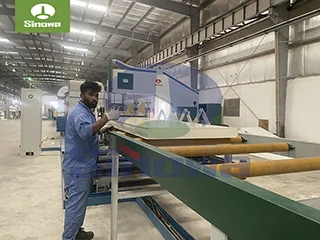
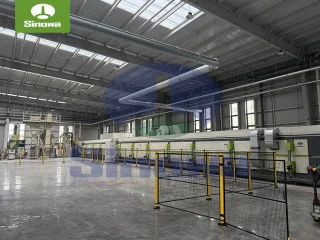
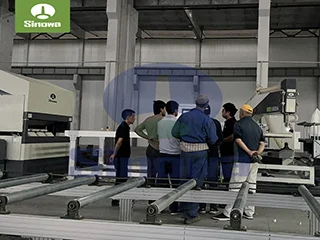
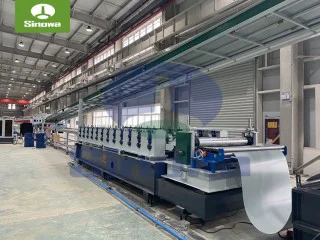
 sandwich panel line
The core competitiveness of the PUF sandwich panel production line originates from the integrated automatic PU mixing head and injection system, which serves as the functional heart that determines the physical performance and structural uniformity of finished PUF panels. Polyurethane foam, the core insulating layer of sandwich panels, is formed through the rapid chemical reaction of multiple liquid raw materials, primarily including polyether polyol, isocyanate, and auxiliary additives such as foaming agents and stabilizers. The precision of raw material proportioning and the uniformity of mixed fluid directly dictate the closed-cell structure, density stability, thermal insulation efficiency, and adhesive performance of the final foam core. The automatic mixing head abandons traditional manual or semi-automatic mixing modes that suffer from proportion deviation and incomplete blending. It is matched with high-precision metering pump groups that implement dynamic fixed-ratio delivery of all raw materials, automatically adjusting flow rates according to preset process parameters to eliminate material ratio errors caused by human operation or equipment aging. All raw material components are transported to the high-speed mixing cavity of the mixing head through independent sealed pipelines, where high-pressure turbulent mixing is completed in an instant. This high-efficiency mixing method ensures that every component is evenly dispersed at the molecular level, avoiding local insufficient reaction or excessive foaming that often occurs in low-precision mixing processes.
Coordinated with the intelligent mixing structure, the supporting automatic injection system further optimizes the fluid distribution and laying effect of polyurethane foam materials in the sandwich panel interlayer. After uniform mixing, the liquid PU composite material is continuously and quantitatively injected into the gap between the upper and lower surface materials through the precision injection port of the system. The injection process features stable pressure and uniform flow, enabling the liquid foam material to spread horizontally and cover the entire width of the panel surface material in a short time. This seamless injection and spreading mode effectively prevents material accumulation, blank areas, and uneven thickness distribution of the foam core. In addition, the injection system supports adaptive adjustment of injection volume and injection speed according to different panel thickness specifications and production speeds, realizing flexible matching of process parameters. When producing panels with thicker foam cores, the system automatically increases the single-point injection volume and optimizes the material spreading trajectory to ensure full filling of the interlayer space; for thin-specification panels, it precisely reduces the injection flow to avoid material overflow and excessive foaming expansion. The linkage operation of the mixing head and injection system ensures that the polyurethane raw materials always maintain the best reaction state during the injection and laying stage, laying a solid foundation for the formation of a fine and uniform closed-cell foam structure.
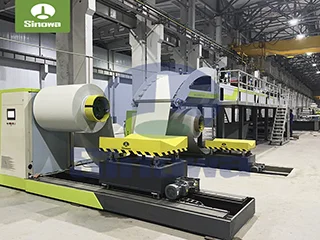
The overall operation logic of the PUF sandwich panel line follows a continuous and closed-loop automated production process, with each functional unit closely linked and synchronized to ensure uninterrupted production and consistent product quality. The front-end part of the production line is equipped with an automatic surface material feeding and preprocessing mechanism, which can stably unreel and straighten coiled metal sheets or other composite surface materials. Before foam injection, the surface materials will undergo uniform preprocessing treatment to remove surface impurities and adjust surface tension, effectively enhancing the bonding force between the surface material and the polyurethane foam core. This preprocessing step is crucial for avoiding delamination and peeling of the panel interlayer in long-term use. After the surface material pretreatment is completed, the materials are accurately conveyed to the injection station at a constant speed, and the automatic PU mixing and injection system starts synchronous material supply according to the real-time operating speed of the production line, realizing dynamic matching between material supply and line speed.
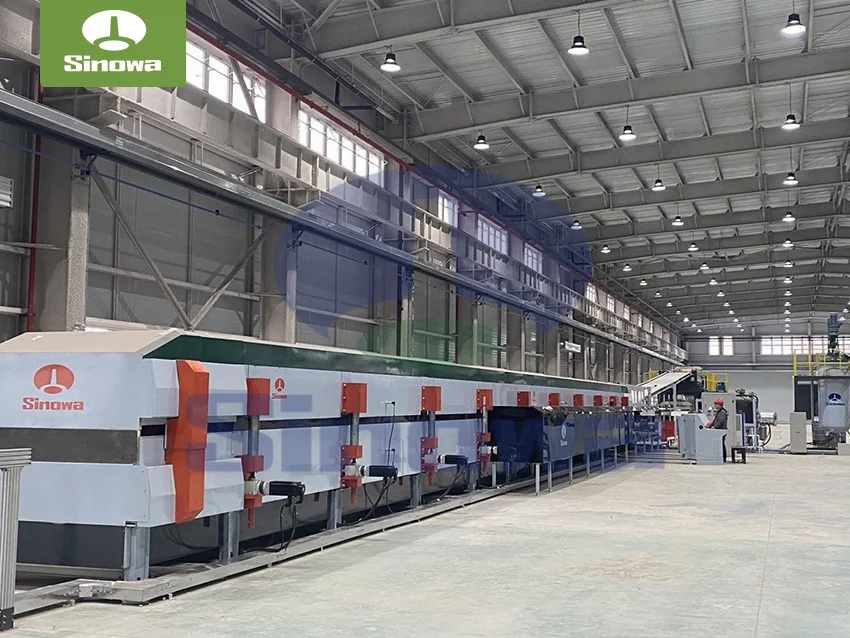
After the liquid PU material is injected and spread evenly, the upper surface material is automatically guided and covered by the line's pressing and positioning mechanism, forming a complete sandwich composite structure composed of upper and lower surface materials and intermediate liquid foam. Subsequently, the composite structure enters the double-belt continuous laminating and curing station, which is a key unit for shaping and solidifying the sandwich panel. The double-belt laminating system provides stable and uniform vertical pressure and horizontal traction, restricting the free expansion of polyurethane foam during the chemical reaction and foaming process, so that the foam expands and solidifies in a limited space to form a dense and regular core structure. At the same time, the laminating station is equipped with a constant-temperature heating system that provides a stable reaction temperature environment for polyurethane foaming and curing. The controllable temperature field accelerates the cross-linking reaction of PU raw materials, shortens the curing cycle, and ensures that the foam core and the upper and lower surface materials form an integrated bonding structure without gaps or loose layers. The entire curing process is completed continuously with the operation of the conveyor belt, avoiding the quality differences of intermittent curing such as insufficient local curing or over-burning.
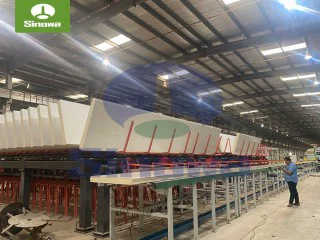
After full curing and shaping, the continuous integrated sandwich panel is conveyed to the precision cutting and trimming unit. This unit automatically identifies the production length and carries out fixed-length cutting and edge trimming according to preset specifications, ensuring that the dimensional parameters of each finished panel such as length, width, and edge flatness meet unified standards. The cutting process adopts high-speed and stable cutting technology, with smooth and burr-free cutting sections, which avoids secondary processing and improves the finished product yield. After cutting, the qualified panels are transported to the cooling and stacking station, where the panels are naturally cooled to room temperature through slow air cooling to stabilize the internal structural stress of the foam core and prevent panel deformation caused by rapid temperature change. Finally, the automated stacking mechanism neatly arranges the finished panels, realizing orderly collection of products and facilitating subsequent transportation and storage.
The full-process automation design of the continuous sandwich panel production line centered on the automatic PU mixing head and injection system brings comprehensive improvements in product performance, production efficiency, and production stability. In terms of product performance, the precise ratio control and uniform mixing technology enable the PUF foam core to form a complete closed-cell structure with extremely low thermal conductivity. This dense closed-cell structure can effectively lock static air inside the cells, greatly reducing heat conduction and convection heat transfer, endowing the panel with excellent long-term thermal insulation performance. Meanwhile, the closed-cell structure also gives the panel outstanding moisture resistance and water impermeability, preventing external moisture from penetrating into the core layer, avoiding mold growth and structural deterioration caused by moisture absorption, and significantly extending the service life of the panel. In terms of structural strength, the integrated foaming and bonding process makes the foam core and surface materials form an integral composite structure, which has high overall rigidity and load-bearing capacity. The panels can resist external wind pressure, impact force, and structural deformation, maintaining stable structural performance in complex outdoor and industrial environments.
In terms of production efficiency and operational cost control, the highly automated integrated design greatly reduces manual participation links. The entire production process from feeding, mixing, injection, lamination, curing to cutting and stacking is automatically linked by the system, which not only greatly improves the continuous production capacity of the line but also eliminates quality fluctuations caused by human error. The intelligent metering and injection system realizes precise control of raw material usage, avoiding material waste caused by inaccurate proportioning and excessive injection in traditional production processes, and effectively improving the utilization rate of polyurethane raw materials. In addition, the synchronous operation of all functional units optimizes the production rhythm, reduces equipment idle time and process waiting time, and achieves higher unit-time output compared with traditional semi-automatic production lines. The stable and standardized production process also greatly reduces the rate of defective products, further lowering the comprehensive production cost of finished panels.
The adaptive performance of the production line also enables it to meet the diversified production needs of the market. By adjusting the operating parameters of the automatic PU mixing head and injection system, producers can flexibly produce PUF sandwich panels with different foam densities and different thickness specifications. Panels with high-density foam cores are suitable for industrial facilities requiring high structural strength and wind resistance, while low-density and ultra-thick panels can meet the ultra-low temperature insulation needs of cold storage and refrigeration engineering. At the same time, the production line can adapt to different types of surface materials, including conventional metal color steel plates and various lightweight composite plates, realizing the flexible production of multi-specification and multi-type sandwich panels. This strong production flexibility allows manufacturers to quickly respond to the personalized needs of different engineering projects and market customers, improving market adaptability and operational competitiveness.
In practical industrial application scenarios, PUF sandwich panels produced by this automated production line have irreplaceable application advantages. In industrial factory construction, the panels high thermal insulation and sound insulation performance can effectively adjust the indoor working temperature, reduce the energy consumption of factory heating and cooling equipment, and create a stable and comfortable production environment. In cold storage and fresh-keeping warehouse engineering, the ultra-low thermal conductivity of the PUF core layer can minimize the cold air loss of the warehouse, maintain a stable low-temperature environment inside the warehouse, and greatly reduce the long-term operating energy consumption of refrigeration equipment. In clean room and pharmaceutical workshop construction, the compact and seamless integral structure of the panels avoids dust accumulation and bacterial growth, and the stable physical and chemical properties meet the high cleanliness and high stability requirements of clean environments. In addition, the lightweight and high-strength characteristics of the panels also reduce the overall load of building structures, shorten the construction cycle of modular buildings, and are widely used in temporary engineering buildings, prefabricated integrated houses, and other fields.
From the perspective of long-term production and industry development, the PUF sandwich panel machine with automatic PU mixing head and injection system represents the mainstream development direction of modern composite building material manufacturing technology. Its core automatic mixing and injection technology solves the fundamental quality pain points of traditional panel production, realizes the standardization, refinement, and high efficiency of panel manufacturing, and promotes the upgrading of the overall production level of the PUF sandwich panel industry. With the continuous improvement of energy-saving and environmental protection requirements in the construction industry, high-performance insulated composite panels have become an important material for green building energy conservation and emission reduction. The automated production line can stably produce high-energy-efficiency and long-life PUF panels, providing reliable material support for the construction of energy-saving buildings and low-carbon industrial facilities. Meanwhile, the intelligent and continuous production mode of the equipment also conforms to the development trend of industrial intelligent manufacturing, helping the composite material manufacturing industry realize transformation and upgrading from extensive production to refined and efficient production.
In conclusion, the perfect combination of the automatic PU mixing head, precision injection system, and continuous forming production line builds an efficient, stable, and flexible intelligent manufacturing platform for PUF sandwich panels. The PUF sandwich panel production equipment not only achieves qualitative leaps in production efficiency, product consistency, and raw material utilization but also endows finished sandwich panels with superior thermal insulation, structural stability, and environmental adaptability. As a mature and advanced production system in the field of composite building materials, it will continue to play an important role in promoting the popularization of high-performance insulated sandwich panels, supporting the high-quality development of modern construction, industrial manufacturing, and modular building industries, and creating greater economic and application value for the entire industrial chain.
https://www.cnsinowa.com/sandwich-panel-machines/puf-sandwich-panel-line-with-automatic-pu-mixing-head-and-injection-system.html