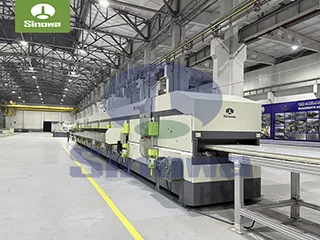
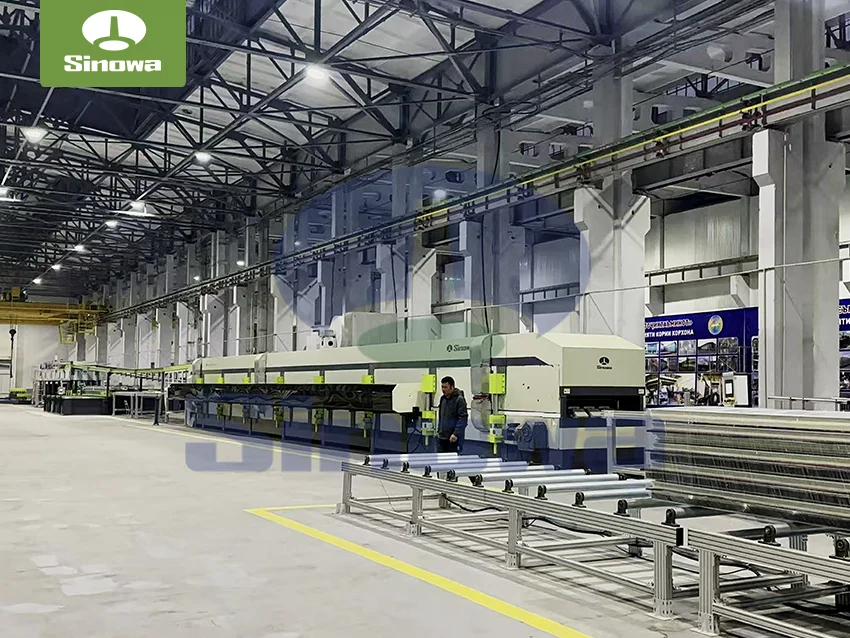
 sandwich panel machine
The overall structural design of PU sandwich panel production line follows the logic of streamlined industrial production, with each functional unit closely connected and coordinated to form an uninterrupted production chain. The front-end part of the equipment is dominated by the raw material feeding and pretreatment system, which undertakes the basic preparation work for panel production. The coil feeding unit is responsible for unwinding the coiled surface materials used for the upper and lower layers of the panel. Through stable mechanical transmission, the coiled materials are evenly unfolded and leveled, eliminating folds, warps and surface tension differences generated during coiling and storage. This stable feeding mode ensures that the surface materials maintain consistent flatness and feeding speed in the subsequent processing links, which is the basic premise for avoiding deviations in panel thickness and structural asymmetry. Equipped with precise guiding and deviation correction structures, the feeding system can always keep the upper and lower surface materials aligned during the conveying process, preventing dislocation problems that may affect the bonding quality and overall flatness of finished panels.
Following the feeding unit is the surface pretreatment and preheating system, a key functional module that determines the bonding firmness between the surface layer and the polyurethane core material. Before contacting the foam raw materials, the surface materials will pass through the constant-temperature preheating area of the sandwich panel equipment to complete uniform heating. Appropriate preheating treatment can effectively activate the surface activity of the materials, remove tiny moisture and residual impurities attached to the surface, and greatly enhance the interface adhesion between the surface layer and the polyurethane foam. In addition, the preheating process can balance the internal stress of the surface materials, avoid local deformation and warping caused by temperature differences during the subsequent foaming and curing reaction, and lay a foundation for the flat and stable structure of the finished panels. The temperature of the preheating system can be dynamically adjusted according to different surface material types and production environmental conditions, adapting to the processing requirements of various metal and non-metal surface materials.
The roll forming system is responsible for the precise contour processing of the panel surface layer. The flat surface materials are gradually pressed, bent and shaped through multiple groups of precision roller sets arranged in an orderly manner. Each group of rollers is designed with accurate forming radian and spacing, which can process the flat sheet materials into various standardized groove and edge-sealing profiles required for sandwich panels. The progressive forming process avoids the problem of local stress concentration caused by one-time bending, ensures the structural integrity of the surface materials, and makes the formed profiles have uniform dimensional accuracy and stable mechanical properties. The structural parameters of the roll forming system can be flexibly adjusted to produce panels with different edge-sealing structures and surface specifications, meeting the diverse structural needs of panels for different application scenarios.
The polyurethane high-pressure foaming and pouring system is the core functional component of the polyurethane sandwich panel production line, directly determining the thermal insulation performance, structural density and bonding quality of the sandwich panel core layer. This system consists of a raw material metering unit, a high-pressure mixing unit and a reciprocating pouring unit. The two-component polyurethane raw materials are stored in independent constant-temperature storage tanks, and the precision metering pump group accurately conveys the raw materials to the mixing head according to the optimal proportion matching required by the foaming reaction. The high-pressure mixing mechanism realizes instantaneous and uniform mixing of different raw materials through high-speed impact and turbulence, ensuring that the chemical components are fully fused without dead angles, which is the key to forming fine and uniform foam pores.
The mixed polyurethane raw materials are evenly sprayed on the surface of the lower layer material through the reciprocating pouring device. The automatic reciprocating movement of the pouring nozzle covers the entire width of the panel, realizing uniform distribution of the raw materials in the transverse direction. With the continuous forward conveying of the lower surface material, the raw materials form a continuous and flat liquid material layer. Immediately after pouring, the upper layer material is accurately covered through the laminating guiding structure, forming a closed composite space between the upper and lower surface layers for the polyurethane foaming reaction. This closed composite environment can effectively control the expansion range and direction of the foam, avoid local hollowing or uneven thickness, and ensure that the foam core layer is closely bonded to the upper and lower surface layers as an integrated structure.
The double-belt laminating and curing system is a key link to complete foam expansion, gelation and solidification molding. The system is composed of upper and lower circulating conveyor belts and a constant-temperature heating tunnel, which can provide a stable temperature and pressure environment for the polyurethane foaming and curing reaction. After the composite semi-finished panels enter the double-belt pressing area, the constant pressure maintained by the upper and lower belts limits the free expansion of the foam, forcing the foam to expand evenly in the set thickness space, so as to form a core layer with uniform thickness and dense structure. The heating system of the tunnel provides continuous and stable heat energy, which accelerates the cross-linking reaction of polyurethane molecules, promotes the rapid gelation and solidification of the foam, and enables the foam to form a stable three-dimensional porous structure in a short time.
The curing process is a gradual structural stabilization process. In the early stage of curing, the polyurethane raw materials complete foaming expansion and initial bonding; in the middle and late stages, the internal molecular cross-linking reaction is further completed, the structural strength of the foam core layer is continuously improved, and the bonding force between the core layer and the surface layer is further enhanced. The length of the curing tunnel and the temperature gradient setting are scientifically designed according to the reaction characteristics of polyurethane materials, which can avoid quality problems such as incomplete curing, insufficient bonding strength or excessive internal stress caused by too fast or too slow reaction speed. After full curing, the composite panel forms an integrated structure with light weight, high strength and excellent thermal insulation performance.
The cooling and shaping system is arranged at the rear end of the curing tunnel, mainly used to complete the temperature reduction and structural stabilization of the panels after high-temperature curing. The newly cured panels still have high surface and internal temperature, and the internal foam structure is in a slightly unstable state, which is prone to secondary expansion or local deformation. The cooling system adopts balanced air cooling or water cooling heat dissipation structures to evenly reduce the temperature of the panels to the ambient temperature, effectively fix the internal porous structure of the foam, eliminate residual internal stress, and ensure that the dimensional accuracy and structural stability of the panels will not change in the subsequent processing and use links. The graded cooling mode can avoid panel cracking or bonding layer separation caused by excessive temperature difference and rapid cooling.
The fixed-length cutting and trimming system realizes the precise sizing and edge finishing of continuous molded panels. The PU sandwich panel line is equipped with a high-precision tracking and cutting mechanism, which can automatically identify the production progress and panel length, and complete synchronous cutting according to the set dimensional parameters. The cutting tool adopts high-precision structural design, which can realize flat and smooth cutting sections without burrs and cracks, ensuring the flatness and regularity of the panel ends. At the same time, the edge trimming device can finely trim the edges of the panels to remove excess foam and residual edge materials, making the overall dimensions of the finished panels more accurate and the edge structure more neat, which facilitates the seamless assembly and installation of subsequent engineering applications.
The final link of the polyurethane sandwich panel line is the automatic stacking and discharging system. The cut finished panels are stably conveyed to the stacking station through the conveying device, and the mechanical stacking mechanism automatically completes the orderly stacking and arrangement of the panels according to the set rules. The automatic stacking mode can ensure the flat placement and consistent spacing of the panels, avoid surface scratches, extrusion deformation and messy stacking problems caused by manual operation, and greatly improve the neatness of finished product storage and the convenience of subsequent handling and transportation. The entire production process from feeding to stacking is automatically controlled by the system, with few manual intervention links, which effectively reduces the impact of human factors on product quality.
The core advantages of polyurethane sandwich panel machine are reflected in its high integration, high production efficiency and stable product quality. The integrated streamlined design realizes the organic combination of mechanical molding, chemical reaction and thermal processing, breaking the discrete operation mode of traditional manual or semi-automatic processing. The continuous production mode enables the production line to operate stably for a long time, effectively improving the output efficiency of panels and meeting the large-scale procurement and construction needs of industrial plants, cold storage buildings, public building insulation and enclosure projects. At the same time, the precise parameter control system of the equipment can realize accurate adjustment of raw material ratio, reaction temperature, molding pressure and processing speed, ensuring that the thermal insulation performance, mechanical strength and dimensional accuracy of each batch of panels are highly consistent.
In terms of product performance control, the professional foaming and curing system of the equipment can make the polyurethane foam form a closed-cell porous structure with high density and uniformity. This structural feature endows the sandwich panel with excellent thermal insulation, heat preservation and sound insulation effects, and effectively reduces the heat transfer efficiency of the building enclosure structure. The integrated composite molding process makes the surface layer and the foam core layer form a firm bonding interface, which is not easy to peel off and delaminate during long-term use, ensuring the structural durability of the panel. In addition, the equipment can adapt to the production of panels with different thicknesses, densities and surface materials by adjusting operating parameters, realizing the flexible production of diversified products and covering the application needs of different environmental scenarios such as high-temperature resistance, low-temperature resistance and weather resistance.
From the perspective of industrial production and environmental protection, modern PU sandwich panel machine has been continuously optimized in energy consumption and environmental protection performance. The constant-temperature circulating heating system reduces invalid heat loss and improves thermal energy utilization efficiency. The closed raw material conveying and mixing structure avoids the volatilization and leakage of chemical raw materials during the production process, reducing the generation of waste gas and waste residues. The optimized foaming process adopts environmentally friendly reaction components, which will not produce harmful substances during production and use, and the produced panels have the characteristics of stable chemical properties, aging resistance and long service life, meeting the green and low-carbon development requirements of the modern building materials industry.
With the continuous upgrading of the construction industry's requirements for building energy conservation, structural safety and construction efficiency, continuous PU sandwich panel production line is also developing towards higher automation, intelligence and precision. The intelligent control system can realize real-time monitoring and automatic adjustment of various production parameters, automatically identify and early warn abnormal conditions such as raw material shortage, parameter deviation and equipment failure in the production process, effectively reducing production failure rate and product defect rate. The optimized mechanical structure design further improves the operational stability and service life of the equipment, reduces maintenance costs and downtime, and provides more reliable technical support for stable and efficient industrial production.
In practical industrial applications, the excellent processing performance of continuous PU sandwich panel line makes its products occupy an important position in many fields. The lightweight and high-strength characteristics of the panels reduce the self-weight of building enclosure structures, reduce the load-bearing pressure of building foundations and main structures, and save overall construction costs. The excellent thermal insulation performance can significantly reduce the energy consumption of building heating and refrigeration, realizing the energy-saving and consumption-reducing goals of buildings. At the same time, the standardized and integrated panel products produced by the equipment are convenient for on-site assembly and construction, greatly shortening the construction cycle of projects and improving the overall construction efficiency, which is in line with the rapid development trend of modern prefabricated buildings.
In conclusion, PU sandwich panel plant is a comprehensive and high-precision industrial production system that integrates multiple advanced technologies. Through scientific structural layout and precise process control, it realizes efficient, stable and standardized production of polyurethane sandwich panels. Each functional module of the equipment cooperates and restricts each other, jointly ensuring the excellent performance and stable quality of finished products. With the continuous progress of building energy-saving technology and prefabricated building industry, this type of production equipment will continue to carry out technological innovation and performance optimization, provide more high-quality and efficient core equipment support for the building materials manufacturing industry, and make important contributions to the development of green, energy-saving and efficient modern construction engineering.
https://www.cnsinowa.com/sandwich-panel-machines/pu-sandwich-panel-plant.html