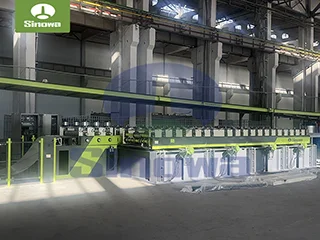
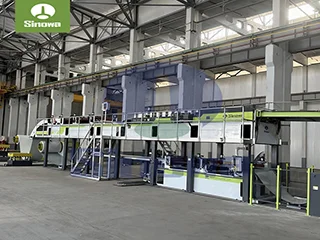
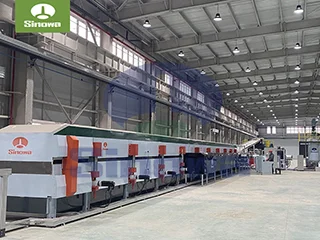
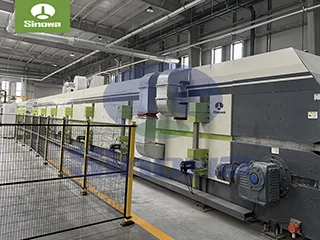
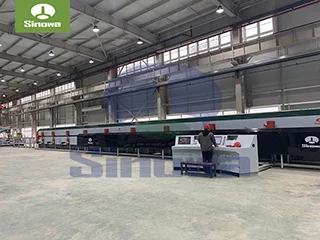
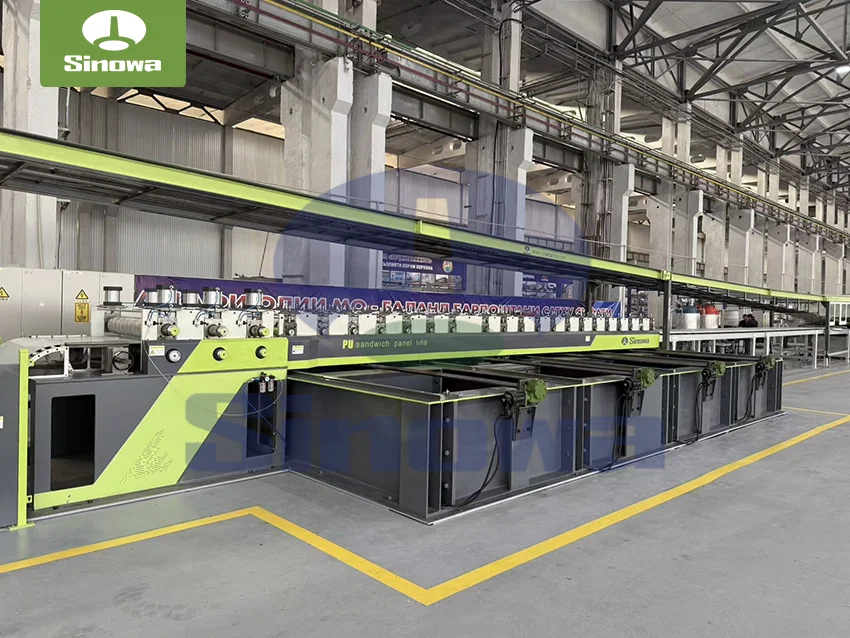
 sandwich panel line
The structure of a PIR sandwich panel making line is a sophisticated combination of mechanical, electrical, and chemical processing units, each designed to perform specific functions in the production workflow. The line typically starts with unwinding units, which handle the continuous supply of facing materials. These units are equipped with tension control systems to maintain stability and prevent wrinkling or deformation of the facings during processing. Common facing materials for fire-proof partition panels include metal sheets, which offer excellent structural support and fire resistance enhancement. The unwinding units can accommodate different widths and thicknesses of facing materials, allowing for flexibility in panel dimensions to meet diverse project requirements.
Following the unwinding stage, the facing materials undergo pre-treatment processes to improve adhesion with the PIR core. This pre-treatment may involve surface cleaning to remove dust, oil, or other contaminants, as well as chemical or mechanical activation to create a rough surface texture that promotes stronger bonding. The pre-treated facings then move to the adhesive application unit, where a precise amount of adhesive is evenly distributed on the inner surface of the lower facing. Advanced adhesive application systems, such as roller coaters or spray nozzles with computerized control, ensure uniform coverage and consistent adhesive thickness, which is critical for maintaining the structural integrity of the final panel. Some production lines are equipped with rotating brushes that transfer a portion of the adhesive from the lower facing to the upper facing, optimizing the bonding effect between both facings and the PIR core.
The core component of the production line is the PIR foam mixing and pouring system, which is responsible for generating the fire-resistant foam core. This system consists of storage tanks for raw materials (including isocyanates, polyols, catalysts, blowing agents, and additives), high-pressure mixers, and pouring heads. The raw materials are precisely metered and mixed at controlled temperatures to initiate the foaming reaction. The mixing process must be highly efficient to ensure homogeneous distribution of all components, as any inconsistency can affect the foam’s density, fire resistance, and thermal performance. The blowing agents and catalysts play a pivotal role in controlling the foaming kinetics, including the start time, gel time, and final cell structure of the foam. The optimized foam mixture is then continuously poured onto the pre-treated lower facing, where it begins to expand and fill the space between the two facings.
After the foam is poured, the assembly moves to the laminating and pressing unit, which shapes the panel and ensures proper bonding between the facings and the foam core. This unit typically consists of twin belts or roller presses that apply uniform pressure and temperature to the panel assembly. The pressure is carefully controlled to achieve the desired panel thickness and density, while the temperature is regulated to accelerate the curing of the PIR foam and the adhesive. The laminating unit may also incorporate rubber-coated rollers to protect the surface finish of the facing materials and prevent damage during the pressing process. Some advanced production lines feature frequency-controlled cutting systems integrated with the laminating unit, allowing for automatic cutting of panels to pre-set lengths without interrupting the continuous production flow.
The final stages of the production line include edge trimming, cooling, and stacking. Edge trimming units use precision cutters to remove excess material and ensure clean, straight edges, which facilitates easy installation of the panels in partition systems. The panels then pass through a cooling zone, where they are gradually cooled to room temperature to complete the curing process and stabilize their structural properties. Once cooled, the panels are automatically stacked by conveyor systems or robotic arms, ready for packaging and transportation. The entire production line is controlled by a central computer system that monitors and adjusts key parameters such as temperature, pressure, mixing ratio, and production speed, ensuring consistent quality across all panels produced.
The performance of PIR sandwich panel making lines is defined by their ability to produce panels with superior fire resistance, structural strength, thermal insulation, and durability. Fire resistance is one of the most critical performance attributes of these panels, and the production line is designed to optimize this property through precise control of the PIR foam formulation and density. PIR foam inherently exhibits excellent fire resistance due to its compact cell structure and the formation of a carbonaceous char layer when exposed to fire, which inhibits flame spread and heat transfer. Production lines ensure that the foam density is maintained within a specific range, typically around 40 kg/m³, to balance fire resistance with structural lightness. The panels produced by these lines can achieve various fire resistance ratings, depending on their thickness and configuration, providing effective protection against fire propagation for different durations.
Structural performance is another key advantage of PIR sandwich panels produced by these lines. The combination of rigid PIR foam core and high-strength facing materials creates a composite structure with excellent load-bearing capacity, bending strength, and compression strength. The production process ensures strong adhesion between the facings and the core, preventing delamination even under mechanical stress or temperature fluctuations. Advanced production technologies can enhance the structural parameters of the panels, with some configurations offering up to 40% higher load-bearing capacity compared to standard insulation panels. This structural integrity allows the panels to be used in both vertical and horizontal partition applications, supporting their own weight and external loads without excessive deflection.
Thermal insulation performance is a significant benefit of PIR sandwich panels, and the production line plays a crucial role in optimizing this property. The closed-cell structure of PIR foam, achieved through precise control of the foaming process, minimizes thermal conductivity, resulting in low U-values. Typical U-values for PIR sandwich panels range from 0.14 to 0.18 W/(m²·K), depending on panel thickness, making them highly efficient for energy conservation in buildings. The production line ensures that the foam core is free of gaps or voids, which could compromise thermal insulation efficiency. By reducing heat transfer through partitions, these panels help lower heating and cooling costs, contributing to the sustainability of buildings.
Durability and weather resistance are also enhanced by the production process. The facing materials are treated to resist corrosion, moisture, and UV radiation, while the PIR foam core is inherently resistant to rot, mold, and insect infestation. The production line’s precise curing and bonding processes ensure that the panels can withstand harsh environmental conditions, temperature variations, and long-term use without degradation. This durability extends the service life of the partition systems, reducing maintenance and replacement costs over time.
PIR sandwich panels for fire-proof partitions can be categorized into different types based on their facing materials, core density, thickness, and application requirements. The most common type features metal facings, which provide excellent structural support and fire resistance. These metal-faced panels can be further classified by the type of metal, such as galvanized steel or aluminum, each offering specific advantages in terms of weight, corrosion resistance, and cost. Another type uses non-metallic facings, such as fire-resistant gypsum board or fiber-reinforced cement board, which are suitable for interior partitions where aesthetic considerations or additional fire protection are prioritized.
Based on core density, PIR panels can be divided into standard-density and high-density variants. Standard-density panels are suitable for general fire-proof partition applications, offering a balance between performance and cost. High-density panels, with a core density exceeding 50 kg/m³, provide enhanced structural strength and fire resistance, making them ideal for high-traffic areas, industrial facilities, or applications requiring higher load-bearing capacity. Thickness is another key classification criterion, with panels ranging from 50 mm to 250 mm in thickness. Thicker panels offer superior fire resistance and thermal insulation, while thinner panels are preferred for space-constrained applications.
Specialized types of PIR sandwich panels include those designed for sound insulation, which incorporate additional sound-absorbing materials in the core or between the facings to improve acoustic performance. These panels are suitable for partition systems in offices, schools, hospitals, and other buildings where noise control is essential. Other specialized variants include moisture-resistant panels, which are treated to prevent water absorption and are used in humid environments such as food processing facilities, laboratories, or underground structures.
The applications of PIR sandwich panels produced by these making lines are diverse, spanning industrial, commercial, residential, and institutional sectors. In industrial buildings, such as factories, warehouses, and logistic centers, these panels are widely used for internal partitions to separate different production areas, storage zones, and office spaces. Their excellent fire resistance helps contain fires within specific zones, minimizing property damage and ensuring the safety of personnel and equipment. The high structural strength of the panels also makes them suitable for industrial environments where they may be exposed to heavy machinery or mechanical impacts.
In commercial buildings, including shopping malls, office complexes, hotels, and restaurants, PIR sandwich panels are used for interior partitions, corridor walls, and fire-rated enclosures. Their thermal insulation properties help maintain comfortable indoor temperatures, reducing energy consumption for heating and cooling. The panels can be easily finished with paints, wallpapers, or other decorative materials to match the interior design of commercial spaces. In addition, their quick installation speed contributes to shorter construction timelines, which is crucial for commercial projects aiming to open for business promptly.
Residential buildings benefit from PIR sandwich panels in partition walls, especially in multi-family dwellings, apartments, and modular homes. The panels provide effective fire separation between units, enhancing the overall safety of the building. Their thermal insulation performance helps improve energy efficiency, reducing utility bills for homeowners. The lightweight nature of the panels also reduces the overall load on the building structure, allowing for more flexible design options. In modular construction, PIR sandwich panels are particularly advantageous due to their prefabricated nature, enabling fast assembly and reducing on-site construction time and labor costs.
Institutional buildings, such as schools, hospitals, and government facilities, require high levels of fire safety and durability, making PIR sandwich panels an ideal choice. In hospitals, the panels are used for partitions in patient rooms, operating theaters, and storage areas, where fire resistance and hygiene are critical. The panels’ resistance to mold and bacteria growth helps maintain a clean environment, which is essential for healthcare settings. In schools, the panels provide safe partitions between classrooms, corridors, and auditoriums, protecting students and staff in case of fire. The acoustic insulation variants of the panels are also used in classrooms and lecture halls to improve sound quality and reduce noise disturbance.
Other specialized applications include cold storage facilities, where PIR sandwich panels’ excellent thermal insulation properties help maintain low temperatures efficiently. The panels’ fire resistance also adds an extra layer of safety to these facilities, which often store flammable materials or use refrigerants. Sports halls and recreational facilities use the panels for partitions and wall claddings, benefiting from their structural strength and durability to withstand heavy use and crowd pressure. Agricultural buildings, such as barns and greenhouses, also utilize PIR sandwich panels for partitions, as they provide thermal insulation to protect livestock or crops from extreme temperatures and offer fire resistance to safeguard agricultural assets.
The continuous advancement of PIR sandwich panel making lines has led to improved production efficiency, product performance, and sustainability. Modern lines are designed to minimize energy consumption and waste generation, with optimized raw material usage and recycling systems for excess materials. The development of eco-friendly blowing agents and additives has reduced the environmental impact of PIR foam production, making the panels a more sustainable choice for construction projects. Additionally, the integration of automation and digital technologies has enhanced the precision and consistency of production, allowing for the customization of panels to meet specific project requirements.
In conclusion, PIR sandwich panel making lines are essential for the production of high-quality fire-proof partition panels that offer superior fire resistance, structural strength, thermal insulation, and durability. The sophisticated structure of these production lines, with their integrated units for unwinding, pre-treatment, foam mixing, laminating, and finishing, ensures efficient and consistent manufacturing. The diverse types of PIR sandwich panels cater to a wide range of applications across industrial, commercial, residential, and institutional sectors, providing safe, energy-efficient, and durable partition solutions. As construction standards for fire safety and sustainability continue to evolve, PIR sandwich panel making lines will play an increasingly important role in meeting these demands, driving innovation and improving the performance of fire-proof partition systems worldwide.
https://www.cnsinowa.com/sandwich-panel-machines/pir-sandwich-panel-making-line-for-fire-proof-partition-panels.html