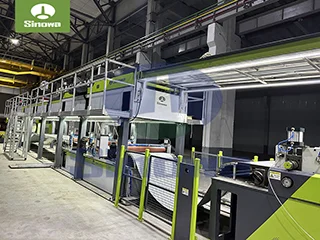
sandwich panel line
A fundamental feature of PU foam production lines is their advanced raw material handling and metering system, which forms the basis for consistent foam quality. PU foam production relies on the precise mixing of polyol and isocyanate, along with additives such as catalysts, blowing agents, flame retardants, and surfactants. The metering system is responsible for delivering each component in exact proportions, as even minor deviations can lead to defects such as inconsistent density, poor cell structure, or shrinkage. Production lines are equipped with specialized metering pumps tailored to the pressure requirements of the process—low-pressure systems typically use gear metering pumps or annular piston pumps, while high-pressure systems employ multi-plunger pumps, either vertical or axial in design. Gear metering pumps in low-pressure lines adjust discharge volume through speed control mechanisms, such as frequency conversion, ensuring flexibility in flow rates. Annular piston pumps, by contrast, simplify the system by adjusting discharge volume via the eccentric distance between the piston cylinder and drive shaft, eliminating the need for complex speed regulation. High-pressure multi-plunger pumps operate at pressures ranging from 1.0 to 15.0 MPa, with a multi-cylinder structure (usually 4 to 10 piston cylinders) that minimizes flow pulsations. Vertical plunger pumps adjust output through plunger stroke changes, while axial plunger pumps control flow by modifying the axial angle between the rotor and drive shaft, making them suitable for high-volume applications with flow rates from tens to hundreds of kilograms per minute. This precision in metering ensures that the chemical reactions between components proceed uniformly, laying the groundwork for high-quality foam.
Complementary to the metering system is the mixing unit, which ensures thorough blending of raw materials to trigger consistent chemical reactions. The mixing head is a critical component here, engineered to prevent premature reactions while achieving uniform dispersion of all components. Modern production lines utilize impingement mixing technology in high-pressure systems, where streams of polyol and isocyanate collide forcefully at high velocity, creating a homogeneous mixture in an instant. This immediate blending is essential to initiate polymerization at the precise moment, ensuring consistent foam properties across the entire batch. Low-pressure systems may use mechanical mixing with rotating elements, but both high and low-pressure designs prioritize the elimination of mixing dead zones—areas where materials fail to blend fully, which can cause local reaction delays and surface defects like depressions or collapses. Some advanced lines can handle up to 12 different raw materials simultaneously, allowing for the formulation of specialized foams such as flame-retardant, anti-static, high-resilience, or memory foam. This multi-component blending capability expands the versatility of the production line, enabling manufacturers to cater to a wide range of application needs without significant reconfiguration.
Flexibility in production processes is another key feature of modern PU foam production lines, allowing them to adapt to different foam types, formulations, and production scales. This flexibility is achieved through modular design and compatible processing capabilities. Modular construction enables components to be easily integrated, reconfigured, or upgraded based on evolving production needs. For example, a line designed for flexible foam can be adapted to produce rigid insulation foam by swapping out mixing heads, adjusting curing parameters, or adding specialized additive metering units. This modularity also simplifies maintenance and expansion, as individual components can be serviced or replaced without shutting down the entire line. Additionally, production lines are compatible with both continuous and batch foaming processes, offering adaptability to different production volumes and product requirements. Continuous foaming is ideal for high-volume, uniform products such as mattress foam or insulation panels, operating at consistent speeds to deliver continuous foam blocks. Batch foaming, by contrast, suits low-volume, custom formulations or specialized products, allowing for precise control over each batch’s reaction conditions. Some lines also support vertical foaming technology, which reduces floor space requirements significantly—nearly half the area of traditional horizontal lines—and minimizes material waste. Vertical foaming processes produce foam blocks with regular dimensions, reducing trimming waste to as low as 4% to 6%, while ensuring uniform physical properties across the foam cross-section due to the consistent effect of gravity on the foaming material.
Automation and control systems are integral to the efficiency and reliability of PU foam production lines, reducing manual intervention, minimizing errors, and enabling real-time process optimization. Most modern lines are equipped with programmable logic controllers (PLC) and human-machine interface (HMI) touch screens, providing centralized control over all operational parameters. The PLC system manages raw material metering, mixing speeds, temperature regulation, curing times, and cutting operations, ensuring that each step adheres to preset parameters. The HMI offers an intuitive interface for operators to monitor production in real time, adjust formulations, and access process data. One of the standout advantages of this automation is the ability to switch between different formulations quickly with minimal downtime—a critical feature for facilities producing multiple product types or catering to custom orders. Operators can store numerous recipes in the system, recalling them instantly and making minor adjustments as needed, eliminating the need for manual reconfiguration of each component. The control system also includes real-time monitoring of key process indicators, such as material flow rates, temperature, and pressure, alerting operators to deviations before they lead to defects. Some advanced systems integrate fault self-diagnosis and remote communication capabilities, allowing for proactive maintenance and troubleshooting without on-site presence. This level of automation not only improves production efficiency but also reduces labor costs and human error, contributing to consistent product quality batch after batch.
Temperature and curing control are essential features that directly impact the structural integrity and performance of the final foam product. PU foam formation relies on a delicate balance between foaming reactions (which generate gas and expand the material) and gelation reactions (which form the foam’s structural skeleton). Any imbalance between these reactions can result in defects like shrinkage, under-curing, or excessive expansion. Production lines address this through precise temperature regulation of raw materials, mixing equipment, and curing zones. Each raw material component is heated or cooled to a specific temperature before mixing, as material temperature affects reaction rates—even a 5°C drop in temperature can double curing time. The mixing head and reaction chambers are also temperature-controlled to maintain optimal reaction conditions. Curing zones, whether in continuous or batch processes, use insulated chambers and heating systems to ensure that the foam completes its chemical reactions fully. In vertical foaming lines, a preheated heating barrel maintains a consistent temperature of around 65°C, using the heat generated by the foaming reaction to sustain operation after startup. Proper curing ensures that the foam develops sufficient structural strength to support its own weight, preventing collapse or shrinkage after demolding or cutting. The control system monitors curing temperatures and times continuously, adjusting as needed to accommodate different foam formulations and thicknesses.
Waste reduction and operational efficiency are core design principles of modern PU foam production lines, addressing both economic and environmental considerations. Automation of metering and mixing processes minimizes raw material waste by ensuring precise proportions and reducing spillage or overuse. The modular design and recipe switching capabilities reduce downtime between batches, maximizing production output. Vertical foaming technology further reduces waste by producing foam blocks with minimal irregularities, requiring less trimming compared to horizontal processes. Additionally, production lines are engineered to optimize energy consumption, with insulated curing chambers and efficient heating/cooling systems that reduce energy loss. Some systems operate continuously around the clock with minimal energy input, while others recover and reuse heat generated by the foaming reactions. For low-density foam production, which uses low-boiling physical blowing agents, lines may incorporate recovery systems to capture and reuse these agents, reducing both waste and environmental impact.
Environmental protection and safety features are increasingly important in PU foam production lines, addressing the handling of potentially hazardous materials and byproducts. The foaming process generates gases such as isocyanates, small amounts of amine catalysts, and volatile blowing agents, which require effective ventilation to ensure worker safety and compliance with environmental standards. Production lines are equipped with ventilation systems that cover key areas from the mixing head to the cutting station, using enclosed or semi-enclosed conveyor belts and exhaust ducts to capture gases. Localized ventilation at the cutting station targets gas release during trimming, where foam dust and volatile compounds are most concentrated. The extracted gases are treated appropriately—hydrolyzable compounds like isocyanates may be neutralized with sodium carbonate or sodium hydroxide solutions, while activated carbon adsorption systems purify remaining contaminants. In areas near residential zones, fully enclosed foaming channels are used to enhance gas capture and treatment, minimizing environmental impact. Safety features also include emergency shutdown systems, leak detection sensors, and protective enclosures around high-pressure components, ensuring worker safety during operation and maintenance.
Quality control integration is a feature that ensures consistency across production batches and identifies defects early in the process. Production lines incorporate in-line monitoring tools to assess foam properties such as density, cell structure, and compressive strength in real time. Density measurement devices check uniformity across the foam block, alerting operators to inconsistencies caused by mixing ratio deviations or uneven curing. Visual inspection systems, often enhanced by machine vision technology, detect surface defects like depressions, cracks, or irregularities, allowing for immediate adjustment of process parameters. The control system logs all process data, including raw material batches, temperature profiles, and mixing parameters, enabling traceability of each production batch. This data is invaluable for troubleshooting defects—if shrinkage or density issues occur, operators can review historical data to identify deviations in raw material quality, process parameters, or environmental conditions (such as ambient temperature and humidity). By integrating quality control into the production process, lines reduce the number of defective products, minimize waste, and ensure that the final foam meets the required performance specifications for its intended application.
The adaptability of PU foam production lines to diverse applications is further enhanced by their ability to produce foams with a wide range of densities and properties. Lines can be configured to produce foams with densities from 5 kg/m³ to 90 kg/m³, catering to needs from lightweight packaging foam to high-density structural foam. For flexible foam applications like mattresses and automotive seating, lines optimize cell structure to ensure comfort and resilience, while rigid foam production for insulation prioritizes closed-cell content and thermal resistance. Specialized additives can be integrated through the multi-component metering system, enabling the production of flame-retardant foam for construction, anti-static foam for electronics packaging, or memory foam for medical devices. This versatility makes PU foam production lines a flexible solution for manufacturers operating in multiple industries, as a single line can be reconfigured to produce different foam types with minimal investment in additional equipment.
Durability and reliability are inherent features of well-designed PU foam production lines, ensuring long-term operational stability even under continuous use. Components such as metering pumps, mixing heads, and conveyors are constructed from high-wear materials—hard chrome-coated rollers, corrosion-resistant metals for chemical contact parts, and robust mechanical components—to withstand the demands of industrial production. Regular maintenance is simplified by the modular design, allowing for easy access to critical components and reducing downtime. The PLC control system also supports predictive maintenance by monitoring equipment performance metrics, such as pump pressure, motor temperature, and mixing speed, and alerting operators to potential issues before they result in equipment failure. This reliability is essential for manufacturers seeking to maintain consistent production schedules and meet customer delivery deadlines, as unplanned downtime can lead to significant losses in productivity and revenue.
In summary, PU foam production lines are characterized by their precision, flexibility, automation, and commitment to quality and sustainability. From the precise metering of raw materials to the integrated control of chemical reactions, each feature works to ensure that foam products meet the highest standards of consistency and performance. The modular design and multi-component blending capabilities enable adaptability to diverse production needs, while automation and real-time monitoring enhance efficiency and reduce waste. Environmental and safety features address regulatory requirements and worker well-being, making these lines suitable for modern industrial operations. As industries continue to demand specialized foam products with enhanced properties, PU foam production lines will evolve further, integrating advanced technologies to improve precision, reduce environmental impact, and expand their application range. Whether for large-scale continuous production or small-batch custom formulations, these lines remain a cornerstone of the polyurethane foam industry, driving innovation and efficiency in material manufacturing.
https://www.cnsinowa.com/sandwich-panel-machines/features-of-pu-foam-production-line.html