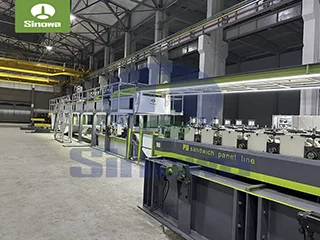
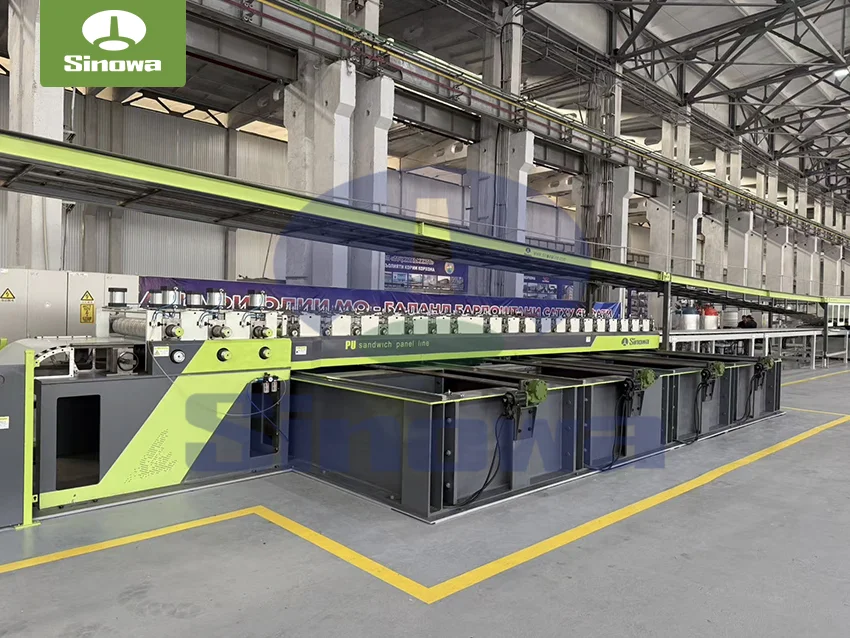
 sandwich panel machine
A complete polyurethane roof sandwich panel machine is assembled by multiple interconnected functional modules that operate in synchronous coordination, forming a closed-loop uninterrupted production system without manual intervention in core processing links. The overall structural layout follows a linear forward conveying route adapted to continuous panel forming, covering raw material unwinding and surface pretreatment, metal sheet roll forming, polyurethane raw material metering and high-pressure mixing, online foaming injection, double-layer sheet constant-temperature lamination, natural curing and cooling, fixed-length automatic cutting, finished panel conveying and automatic stacking modules. Every module is matched with independent frequency conversion speed regulation systems to realize synchronous speed matching across the whole sandwich panel production line, avoiding dislocation, foam core delamination, surface sheet wrinkling and other common product defects caused by asynchronous operation between front-end and back-end equipment. Unlike discontinuous batch production equipment, this continuous production line integrates all processing procedures into one integrated unit, eliminating intermediate manual transferring links between separate machines and greatly improving overall production continuity.
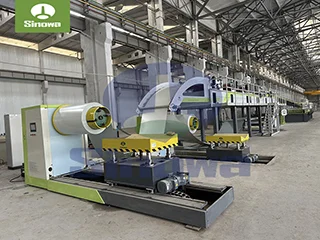
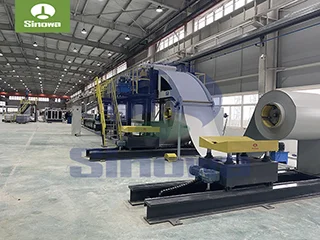
The front-end part of the sandwich panel line starts with the metal coil unwinding and pretreatment module, which is responsible for providing qualified surface base materials for subsequent composite processing. Metal coils used for roof sandwich panels usually adopt color-coated metal sheets with good weather resistance and surface hardness, which can adapt to long-term outdoor exposure, ultraviolet radiation and temperature alternation without obvious color fading or surface corrosion. The unwinding unit adopts hydraulic automatic unwinding structures to support large-diameter raw material coils, and it is equipped with tension buffering devices to maintain stable sheet conveying tension all the time. Stable tension control is critical in the initial production stage: excessive tension will lead to irreversible stretching deformation of thin metal sheets, while insufficient tension will cause sheet accumulation and folding in subsequent forming processes. After unwinding, the metal sheets will pass through an automatic surface cleaning unit to remove surface dust, oil stains and tiny metal debris generated during coil slitting. These surface impurities will severely damage the bonding force between polyurethane foam core and metal sheets if not cleaned thoroughly, leading to core separation and reduced overall structural strength of finished roof panels in later outdoor service. Meanwhile, this module is equipped with deviation correction sensors to dynamically adjust the conveying track of metal sheets in real time, ensuring that upper and lower metal sheets maintain complete alignment in the whole follow-up composite process.
Following the pretreatment process is the roll forming module specially designed for roof panel profiles, which differentiates roof sandwich panel production equipment from common wall sandwich panel production machine. Roof panels need special trapezoidal rib structures and side seam lock structures to enhance overall roof drainage performance, wind resistance and lap joint sealing effect during on-site installation, so the roll forming roller sets are customized with targeted profile designs. Multiple groups of high-precision alloy forming rollers are arranged in progressive sequence, bending and pressing flat metal sheets into standard roof plate profiles step by step without damaging the surface protective coating of color-coated sheets. All forming rollers adopt integrated machining technology to ensure consistent forming accuracy of each sheet, and the gap between upper and lower rollers can be finely adjusted according to different thicknesses of metal raw materials. After roll forming, the shaped upper and lower metal sheets are conveyed separately to the middle composite station of the polyurethane sandwich panel production line, with the lower sheet kept horizontal and the upper sheet suspended above at a fixed spacing reserved for polyurethane foam filling. The spacing between the two sheets directly determines the thickness of the finished sandwich panel, and the whole spacing parameter can be digitally set on the central control panel to adapt to different thermal insulation thickness requirements for roof structures in different climatic zones.
The polyurethane high-pressure foaming and injection system is the core functional unit that determines the thermal insulation performance, bonding strength and dimensional stability of finished roof panels, acting as the heart of the entire sandwich panel machine. Polyurethane foam is formed by the chemical reaction between two liquid raw materials: isocyanate and combined polyether. This system adopts closed-loop precision metering pumps to independently control the output flow of the two raw materials, maintaining a strict raw material mixing ratio throughout production. Accurate ratio control is the key to qualified foam performance: improper proportion will lead to incomplete chemical reaction, resulting in loose foam core structure, reduced compressive strength, increased thermal conductivity or residual chemical substances inside the panel. Before mixing, both liquid raw materials are kept at constant temperature through independent heating and heat preservation units, because material temperature directly affects reaction speed, foaming expansion ratio and foam curing time. After precise metering and constant temperature treatment, two kinds of liquid materials are sent into a high-pressure mixing head for instantaneous intensive stirring to achieve uniform molecular mixing without material stratification. The well-mixed polyurethane composite liquid is evenly sprayed onto the surface of the lower formed metal sheet through a moving injection nozzle that travels horizontally back and forth at a constant speed. The reciprocating injection mode ensures even distribution of raw materials across the full width of the panel, preventing partial hollow areas or uneven foam density inside the sandwich core.
Right after raw material injection, the upper formed metal sheet is quickly covered on the liquid polyurethane material, and the whole semi-finished panel enters the constant-pressure laminating and curing module. This module uses circulating rubber belt pressing structures instead of rigid steel plate pressing, which can provide uniform soft pressure covering the entire panel surface without crushing the initial foaming polyurethane material or damaging the molded roof profile on metal sheets. The internal temperature of the laminating chamber is kept within a stable constant-temperature range to match the optimal curing temperature of polyurethane chemical reaction. In the continuous forward conveying process inside the laminating machine, liquid polyurethane gradually completes foaming expansion, filling the entire gap between upper and lower metal sheets, and realizes tight chemical bonding with the inner surfaces of two metal sheets. The integrated composite structure formed after curing combines the high tensile strength and impact resistance of metal sheets with the excellent thermal insulation, sound insulation and shock absorption performance of closed-cell polyurethane foam. The closed-cell structure of polyurethane foam also endows roof panels with low water absorption performance, effectively avoiding rainwater penetration inside the roof panel core and preventing internal mold growth and structural corrosion in long-term outdoor use. The length of the laminating section is scientifically designed according to the foaming reaction cycle of polyurethane materials, ensuring that the foam core achieves complete curing before leaving the pressing section without secondary deformation after cutting.
Subsequent cooling and fixed-length cutting processes further finish the final molding of roof sandwich panels. Although polyurethane foam completes basic curing in the laminating section, the whole panel still retains residual reaction heat. A natural air cooling section is arranged after lamination to gradually dissipate internal heat stress of composite panels, avoiding panel bending, warping and size deviation caused by uneven internal and external temperature during rapid cutting. After full cooling, the integrated composite panels are sent to the flying saw cutting unit, which supports non-stop dynamic cutting in the running state of the polyurethane sandwich panel line. Compared with static cutting equipment that needs to stop conveying, flying saw cutting technology guarantees uninterrupted continuous production and greatly improves production efficiency. Operators only need to input target panel length parameters through the central control system in advance, and the cutting unit can automatically track the conveying speed of panels and complete vertical precise cutting synchronously. The cutting blade adopts high-hardness alloy tools to ensure smooth cutting sections without metal sheet burrs and foam core collapse, so that finished panels can be directly used for on-site lap installation without secondary trimming processing.
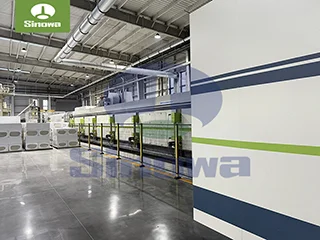
The final end of the PU sandwich panel production line is equipped with automatic finished panel conveying, sorting and stacking devices. Cut standard roof panels are conveyed out stably, and surface defect detection sensors are installed above the conveying platform to automatically screen out unqualified products with surface scratches, core delamination, uneven thickness and incomplete foaming. Qualified finished panels are automatically stacked layer by layer according to set stacking heights, replacing traditional manual stacking modes. This automatic post-processing module reduces manual contact with finished panels, avoiding artificial surface damage and improving overall production automation level of the whole line. Meanwhile, the production line is matched with a centralized waste collection system to uniformly recover tiny foam debris and metal cutting waste generated during production, which reduces material waste and optimizes the on-site production environment of the workshop.
In terms of intelligent control and energy-saving optimization, modern roof polyurethane sandwich panel machine has achieved comprehensive upgrading compared with early-generation mechanical equipment. The whole PU sandwich panel line adopts a unified PLC central control system, realizing one-screen integrated management of all operating parameters including conveying speed, raw material flow rate, lamination pressure, curing temperature and cutting length. The system supports real-time data monitoring, automatic parameter adjustment and abnormal fault alarm functions. When material flow interruption, sheet deviation, temperature abnormality or pressure fluctuation occurs in any module, the system will send alarm prompts in real time and perform self-protection shutdown actions to avoid large-scale defective products and equipment collision failures. In terms of energy consumption optimization, the continuous PU sandwich panel line adopts frequency conversion motor groups for all power driving components, which automatically adjust operating power according to real-time production speed requirements, avoiding constant high-power operation and reducing overall electric energy consumption during low-load production periods. In addition, the heat generated by polyurethane chemical reaction is partially recycled and reused for preheating raw material storage tanks, realizing waste heat recycling and further reducing additional energy consumption of supporting heating equipment.
Reasonable daily operation maintenance and regular equipment inspection are essential to maintain long-term stable operating efficiency and extend the service life of roof PU sandwich panel machine. Daily maintenance focuses on cleaning residual polyurethane foam attachments on mixing heads, injection nozzles and laminating rubber belts, because cured polyurethane foam has strong adhesion and will affect subsequent injection uniformity and lamination surface flatness if accumulated for a long time. Regular inspection needs to check the synchronization of conveying motors, the abrasion degree of forming rollers and cutting blades, the sealing performance of raw material delivery pipelines and the sensitivity of correction and detection sensors. Timely replacement of vulnerable parts and regular lubrication of transmission bearings can effectively reduce equipment failure rates and avoid unexpected production shutdown losses. Different from processing machinery for general metal materials, this type of composite sandwich panel production line involves chemical fluid raw materials, so pipeline sealing inspection is particularly important to prevent liquid raw material leakage and ensure safe and stable workshop production.
Driven by the global dual-carbon goal and the booming development of prefabricated construction industry, the market demand for high-performance insulated roof panels keeps rising, which also puts forward higher upgrading requirements for matching polyurethane roof sandwich panel machinery. The future development direction of such equipment mainly focuses on three dimensions: higher production intelligence, diversified panel profile compatibility and greener production process. Firstly, artificial vision detection technology will be further embedded into the continuous PU sandwich panel production line to realize full-surface full-automatic quality inspection without manual assistance, achieving zero missing detection of tiny panel defects. Secondly, the roll forming module will adopt quick-change roller set structures, enabling the production line to switch between different roof panel profiles and thickness specifications in a short time, meeting personalized customized production needs of construction projects. Thirdly, matching production processes will be optimized to adapt to new low-carbon and flame-retardant modified polyurethane raw materials, supporting the production of higher fire-performance roof panels while maintaining original production efficiency. Moreover, digital twin technology will be applied to equipment operation management, realizing remote real-time monitoring, remote parameter debugging and predictive maintenance of production lines, reducing on-site operation and maintenance costs for manufacturers.
In conclusion, polyurethane roof sandwich panel production machine is a highly integrated intelligent manufacturing equipment that crosses mechanical engineering, chemical reaction engineering and automatic control technology. It completes the whole process from raw metal coil and liquid polyurethane materials to finished integrated roof panels in one continuous line, providing stable, efficient and standardized production support for the prefabricated building envelope industry. With superior production flexibility, reliable product quality control and obvious energy-saving production advantages, this equipment adapts to the construction needs of different architectural scenarios and different climatic environments. As the global construction industry continues to transform towards energy conservation, emission reduction and prefabrication, this professional sandwich panel production machinery will continue to iterate and upgrade, becoming core manufacturing equipment that promotes the high-quality development of modern green building materials and low-carbon construction systems.
https://www.cnsinowa.com/sandwich-panel-machines/polyurethane-roof-sandwich-panel-machine.html