 sandwich panel line
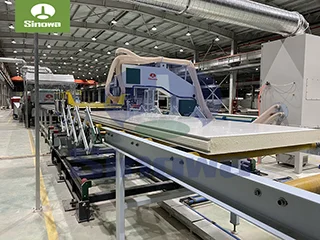
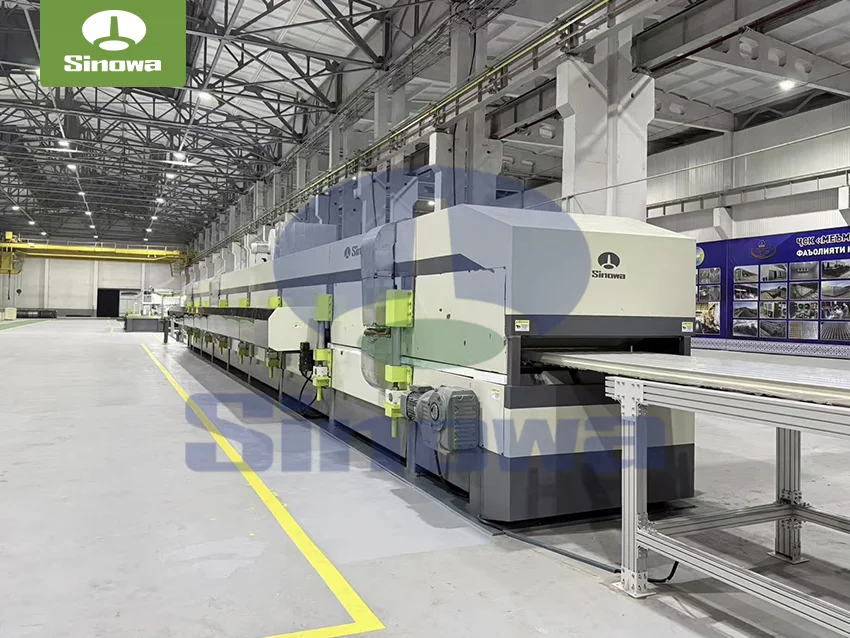
The automatic PU sandwich panel making line is a sophisticated integrated system that combines mechanical engineering, electrical control, chemical reaction technology, and material processing. Its core working process involves a series of continuous and automated operations, starting from raw material feeding to the final product output. Typically, the production line begins with the uncoiling and feeding of surface materials, which are usually metal coils such as galvanized steel or aluminum. These metal coils are loaded onto decoilers, which unroll and feed the flat metal sheets into the subsequent roll forming section. In the roll forming process, the metal sheets pass through a series of tandem rolling stands, where they are progressively bent and shaped into the desired profiles under the guidance of precision rollers and gears. This step is crucial for ensuring the structural strength and dimensional accuracy of the final PU sandwich panels.
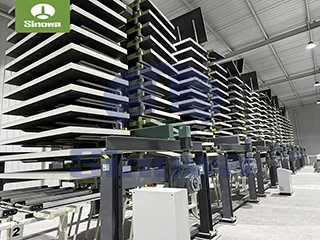
After roll forming, the two profiled metal sheets (top and bottom facers) are conveyed to the PU foam injection station. At this stage, liquid polyurethane chemicals are mixed in a precise ratio and undergo a chemical reaction to form foam. The foaming mixture is then continuously injected into the gap between the two moving metal facers. The injected PU foam expands rapidly to fill the entire space and adheres tightly to the inner surfaces of the metal facers. The panels with the expanding foam then move into the cooling and curing section, where the foam is cooled and solidified under controlled temperature and pressure conditions. This curing process ensures the stability of the foam structure and the firm bonding between the foam core and the metal facers. Finally, the fully cured continuous PU sandwich panel is cut into fixed lengths by an automatic cutting machine and then conveyed to the collection and stacking area for subsequent packaging or direct use. In addition to these core processes, the production line can also be integrated with additional functions such as punching, embossing, or spraying according to specific application requirements, enhancing its versatility.
The integration of remote monitoring function into the automatic PU sandwich panel making line represents a significant leap forward from traditional production modes. This function is built on a multi-layered architecture, including the perception layer, network layer, data processing layer, and application layer, which work together to achieve real-time monitoring, data analysis, and remote management of the production line. The perception layer is the foundation of the remote monitoring system, consisting of a variety of sensors installed at key positions of the production line. These sensors are responsible for collecting real-time data on equipment operation status, production process parameters, and environmental conditions. Common sensors include temperature sensors to monitor the temperature of the PU foam reaction and cooling process, vibration sensors to detect abnormal vibrations of motors and rolling stands, pressure sensors to measure the injection pressure of PU foam, and speed sensors to track the conveying speed of the production line. In addition, position sensors and photoelectric sensors are used to monitor the position of materials and the operation status of moving parts, ensuring the smooth progress of the production process.
The network layer serves as the communication bridge between the perception layer and the data processing layer, responsible for transmitting the collected data to the remote monitoring center. This layer adopts a combination of wired and wireless communication technologies to ensure stable and efficient data transmission. Within the factory premises, industrial Ethernet is commonly used for high-bandwidth and low-latency data transmission, which is suitable for core production links that require high real-time performance. For remote data transmission, wireless technologies such as 5G, Wi-Fi, or LoRa are employed. 5G technology, with its advantages of low latency, wide coverage, and large capacity, enables real-time data transmission between the production line and the remote monitoring center even in remote areas. To ensure data security during transmission, encryption technologies and redundant design are adopted to prevent data leakage, loss, or tampering. The edge computing gateway is another key component of the network layer, which performs local data processing, filtering, and standardization conversion, reducing the amount of data transmitted to the cloud and improving the response speed of the system. In the event of network interruption, the edge gateway can also store data locally and continue to execute preset control logic, ensuring the continuity of production.
The data processing layer, often referred to as the "neural center" of the remote monitoring system, is responsible for storing, analyzing, and processing the large amount of data collected from the production line. This layer is typically built on cloud computing or local server platforms, utilizing distributed storage technology to classify and store real-time and historical data. Advanced algorithms, including machine learning and data mining, are applied to analyze the data and extract valuable insights. For example, by analyzing the historical data of equipment vibration and temperature, the system can establish a normal operation model of the equipment and identify potential faults such as bearing wear, motor overload, or gear damage in advance. In the production process, the system can analyze parameters such as PU foam injection amount, foaming time, and curing temperature to optimize the production process and improve product quality. The data processing layer also includes a safety management module that implements full-life-cycle data encryption, access control based on user roles, and operation log auditing to ensure the security and reliability of the system.
The application layer is the interface through which users interact with the remote monitoring system, providing personalized services for different user roles such as operators, maintenance personnel, and managers. This layer offers a user-friendly visual interface that can be accessed through computers, mobile phones, or tablets. Operators can real-time monitor the running status of the production line, including equipment operating parameters, production progress, and fault alarms. Maintenance personnel can receive real-time fault notifications and access detailed equipment running data to conduct remote diagnosis and formulate maintenance plans. Managers can obtain comprehensive reports on production efficiency, product quality, and equipment utilization, providing data support for decision-making. In addition, the application layer supports remote control functions, allowing authorized personnel to remotely start or stop the production line, adjust production parameters, and update equipment programs, thereby reducing the need for on-site operations.
The integration of remote monitoring function brings numerous benefits to the operation and management of automatic PU sandwich panel making lines. One of the most significant advantages is the realization of predictive maintenance, which transforms the traditional "post-fault maintenance" mode into a "pre-fault prevention" mode. By continuously monitoring the vibration, temperature, and other parameters of key equipment components, the system can detect early signs of equipment failure, such as loose parts, worn bearings, or aging circuits. Once an abnormal condition is detected, the system immediately sends an alarm to relevant personnel through short messages, emails, or mobile app notifications, along with corresponding maintenance suggestions. This allows maintenance personnel to address potential issues before they lead to equipment breakdowns, significantly reducing unplanned downtime and maintenance costs. For example, vibration sensors installed on the roll forming machine can detect subtle changes in vibration frequency, enabling maintenance personnel to replace worn rollers in a timely manner, avoiding production interruptions caused by roller failure.
Another major benefit is the improvement of overall equipment efficiency (OEE). OEE is a key indicator of manufacturing process efficiency, considering three factors: availability, performance, and quality. The remote monitoring system collects and analyzes real-time data from the production line, providing a comprehensive understanding of OEE. By identifying the sources of inefficiency, such as equipment idle time, production speed fluctuations, or product defects, managers can take targeted measures to optimize the production process. For instance, data from the system may show that the production line frequently slows down during the PU foam injection stage due to unstable injection pressure. Based on this insight, operators can remotely adjust the injection pressure parameters to stabilize the production speed and improve performance efficiency. Additionally, the system can monitor the quality of finished products by tracking parameters such as foam density and panel thickness, reducing the rate of defective products and improving quality efficiency.
Remote monitoring also enhances the flexibility and convenience of production management, breaking the limitations of time and space. Managers and operators no longer need to be on-site to monitor and control the production line; they can access the system from anywhere at any time. This is particularly beneficial for enterprises with multiple production bases or remote factories, as it allows for centralized management of all production lines. For example, a manager can monitor the operation status of PU sandwich panel production lines in different regions through a single dashboard, facilitating unified scheduling and resource allocation. In case of a production problem, technical experts can provide remote support to on-site personnel by accessing the real-time data and operation interface of the production line, reducing the response time and travel costs associated with on-site troubleshooting.
Furthermore, the remote monitoring system contributes to the improvement of production safety and the reduction of labor costs. In the production process of PU sandwich panels, the handling of chemical materials and the operation of large mechanical equipment pose potential safety risks. The remote monitoring system can monitor the concentration of harmful gases in the production environment and the operation status of safety protection devices in real time. If a safety hazard is detected, such as a leak of PU chemicals, the system can immediately trigger an alarm and even automatically activate emergency measures such as ventilation or shutdown, ensuring the safety of personnel and equipment. At the same time, the high degree of automation and remote management reduces the need for on-site operators. A single operator can monitor and manage multiple production lines through the remote system, significantly reducing labor costs and improving labor efficiency.
The application of automatic PU sandwich panel making lines with remote monitoring function has been widely recognized in various industries. In the cold storage construction industry, for example, the quality and performance of PU sandwich panels directly affect the thermal insulation effect and energy efficiency of cold storage facilities. The remote monitoring system ensures that the production process of PU sandwich panels is strictly controlled, with parameters such as foam density and curing time maintained within the optimal range, thereby ensuring the thermal insulation performance of the panels. In the modular building industry, where the demand for customized PU sandwich panels is high, the remote monitoring system allows for quick adjustment of production parameters to meet the specific requirements of different projects, improving production flexibility and delivery efficiency. In the refrigerated transportation industry, the high-strength and lightweight PU sandwich panels produced by the automatic line with remote monitoring ensure the structural stability and thermal insulation effect of refrigerated truck bodies, reducing energy consumption during transportation.
As the industrial Internet of Things (IIoT) technology continues to evolve, the remote monitoring function of automatic PU sandwich panel making lines will be further upgraded and optimized. Future systems may integrate more advanced technologies such as digital twin and artificial intelligence (AI). The digital twin technology will create a virtual simulation model of the production line, which can synchronize with the physical production line in real time, enabling more accurate monitoring and prediction of equipment status and production processes. AI algorithms will be more widely used in data analysis, enabling the system to learn and adapt to different production conditions automatically, optimizing production parameters and improving the intelligence level of the system. In addition, the integration of 5G technology will further enhance the real-time performance and reliability of data transmission, supporting more complex remote control and collaborative operations.
In conclusion, the automatic PU sandwich panel making line with remote monitoring function represents the development trend of the panel manufacturing industry. By integrating advanced sensing technology, communication technology, and data processing technology, it realizes the real-time monitoring, intelligent analysis, and remote management of the production process. This not only improves production efficiency, product quality, and equipment reliability but also reduces maintenance costs, labor costs, and safety risks. With the continuous advancement of intelligent manufacturing technology, the function and performance of such production lines will be further improved, providing stronger support for the sustainable development of industries that rely on PU sandwich panels. As more enterprises adopt this advanced production equipment, the PU sandwich panel manufacturing industry will move towards a more efficient, intelligent, and sustainable future.
https://www.cnsinowa.com/sandwich-panel-machines/automatic-pu-sandwich-panel-making-line-with-remote-monitoring-function.html