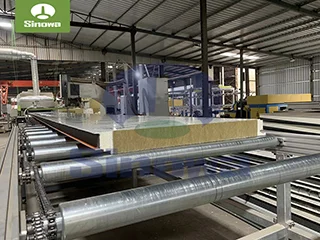
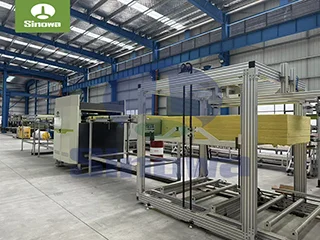
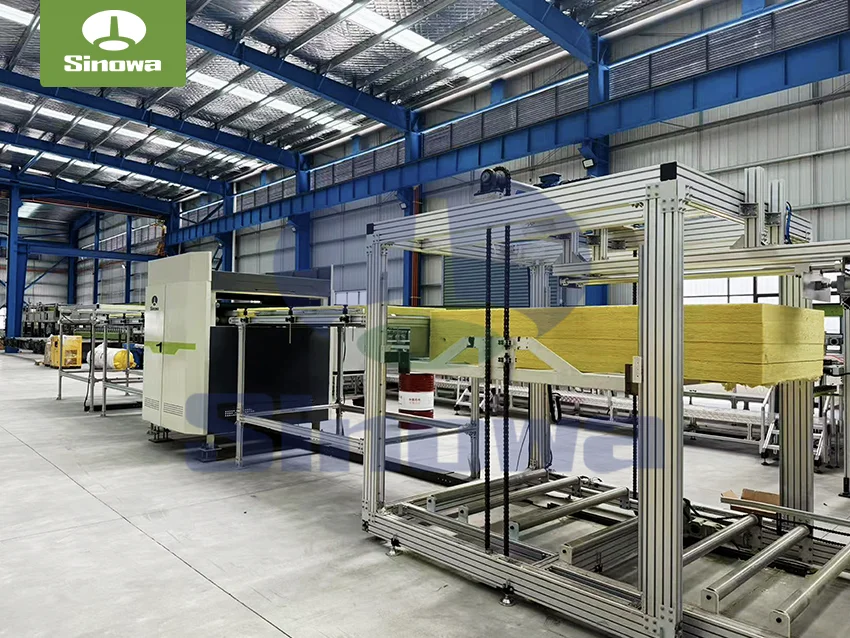
 sandwich panel machine
Rock wool sandwich panel making machines are integrated production equipment that combines mechanical, electrical control, hydraulic systems and chemical reaction technologies. Their core working principle is to accurately compound the surface layer materials (usually color-coated steel sheets) with the core material (rock wool) through a series of continuous processes such as uncoiling, shaping, gluing, compounding, pressing, cutting and stacking. The entire production process is highly automated, which not only ensures the stability of product quality but also greatly improves production efficiency. Unlike traditional manual production methods, the automated production line can avoid errors caused by human operations, ensuring that each rock wool sandwich panel has consistent dimensions, uniform bonding and reliable performance.
The structure of a typical rock wool sandwich panel making machine is composed of multiple functional modules that are closely linked to form a continuous production flow. The uncoiling system is the starting part of the production line, which is responsible for stably uncoiling the coiled color-coated steel sheets. The uncoiling process needs to maintain a constant speed and tension to avoid deformation of the steel sheets, which lays a good foundation for subsequent shaping. After uncoiling, the steel sheets enter the roll forming system, where they are gradually formed into the required cross-sectional shape through a series of precision rollers. The roll forming technology adopts advanced digital control methods, which can accurately adjust the forming parameters according to the different requirements of the panels, ensuring that the surface layer has good rigidity and flatness.
The gluing system is a key link affecting the bonding quality of rock wool sandwich panels. The making machine is usually equipped with a fully automatic bidirectional gluing device, which can evenly apply the adhesive to the inner surface of the formed steel sheets. The amount and thickness of the adhesive can be precisely controlled through the electrical control system to ensure that the surface layer and the core material have sufficient bonding strength without excessive glue overflow, which not only saves the amount of adhesive but also ensures the appearance quality of the panels. After gluing, the steel sheets enter the compounding area, where the rock wool core material is evenly laid between the two layers of steel sheets. The rock wool core material needs to go through the processes of opening, carding and cutting before entering the compounding area to ensure that its density and thickness meet the requirements. The vertical rock wool slivering device in the production line can make the rock wool fibers arranged vertically, which helps to improve the compressive strength and thermal insulation performance of the finished panels.
After the compounding of the surface layer and the core material, the composite board enters the pressing and shaping system. This system uses a double-belt pressing device, which applies uniform pressure to the composite board through upper and lower pressure belts. At the same time, the heating device in the pressing system can appropriately heat the composite board to accelerate the curing of the adhesive and enhance the bonding effect. The pressure and temperature in the pressing process are strictly controlled. Excessive pressure may cause damage to the rock wool core material, while insufficient pressure will affect the bonding strength. Proper heating temperature can ensure that the adhesive reaches the best curing state, ensuring the long-term stability of the panel's performance. After pressing and shaping, the continuous composite board enters the cutting system. The cutting system usually adopts three-axis vertical cutting technology and servo-controlled automatic reciprocating cutting device, which can accurately cut the continuous board into panels of the required length. The cutting process is fast and precise, and the length can be arbitrarily adjusted according to the production requirements, which greatly improves the flexibility of the production line.
The stacking system is the end part of the production line, which is responsible for automatically stacking the cut rock wool sandwich panels. The automatic stacking device can adjust the stacking height and mode according to the size and weight of the panels, and can realize the automatic lifting and transportation of the panels, reducing manual handling and improving the safety and efficiency of the production line. In addition, advanced making machines are also equipped with a centralized control system, which integrates digital servo technology, frequency conversion vector technology and hydraulic control technology. Operators can complete the setting and monitoring of production parameters through a man-machine interface. The centralized control system can realize the linkage control of the entire production line, collect production data in real time, and have a fault self-diagnosis function, which can promptly alarm and display faults, greatly reducing the difficulty of equipment maintenance.
Rock wool sandwich panel making machines have a number of outstanding advantages that make them widely used in the production of lightweight steel structure building materials. First of all, they have high production efficiency. The fully automatic production line can achieve a continuous production speed of 3 to 15 meters per minute, and the annual production capacity can reach hundreds of thousands of square meters, which can meet the large-scale production needs of the construction industry. Compared with traditional manual production, which requires a lot of labor and has low efficiency, automatic making machines only need 5 to 8 operators to complete the entire production process, which greatly saves labor costs and improves production efficiency.
Secondly, the making machines have good product quality stability. The entire production process is controlled by a precision electrical system, which can ensure the uniformity of the panel's thickness, the flatness of the surface and the firmness of the bonding. The rock wool sandwich panels produced have consistent performance indicators, such as thermal conductivity, fire resistance rating and sound insulation effect, which can better meet the design requirements of lightweight steel structure buildings. In addition, the making machines have strong adaptability. Through modular design, the same production line can produce different types of rock wool sandwich panels by replacing some components or adjusting parameters, such as roof panels, wall panels, partition panels and cold storage panels. This modular design also makes the equipment easy to install, maintain and upgrade, and the core components can be easily replaced, which reduces the maintenance cost of the equipment.
Energy conservation and environmental protection are another important advantage of modern rock wool sandwich panel making machines. The equipment adopts advanced energy-saving technologies, such as high-power and low-energy consumption motor design, full-closed internal insulation structure, etc., which can reduce energy consumption by 40% compared with traditional equipment. At the same time, the production line is equipped with dust removal devices, which can effectively control dust pollution during the production process, meeting the environmental protection requirements of the construction industry. In addition, the making machines can make full use of raw materials, reducing the waste of rock wool and steel sheets, and realizing the recycling of resources to a certain extent, which is in line with the development concept of green and low-carbon construction.
The application of rock wool sandwich panel making machines is closely linked to the development of lightweight steel structure buildings. These machines are widely used in the production of rock wool sandwich panels for various lightweight steel structure buildings, such as industrial plants, warehouses, workshops, movable board houses, purification rooms and cold storage. In industrial plants, the rock wool sandwich panels produced by these machines can provide good thermal insulation and fire resistance, ensuring a stable working environment inside the plant and improving the safety of production. In warehouses, especially those storing flammable and explosive materials, the fire-resistant performance of rock wool sandwich panels is particularly important, and the high-quality panels produced by professional making machines can effectively delay the spread of fire and reduce property losses.
In movable board houses and temporary buildings, rock wool sandwich panels have the advantages of light weight and easy installation, which can greatly shorten the construction period. The making machines can produce panels of different specifications according to the needs of the buildings, improving the flexibility of the construction. In purification rooms, such as pharmaceutical, food processing and electronic manufacturing workshops, the rock wool sandwich panels need to have good airtightness and cleanliness. The making machines can ensure the smoothness and flatness of the panel surface, avoiding dust accumulation and meeting the purification requirements of the workshops. In cold storage, the rock wool sandwich panels produced by the making machines have excellent thermal insulation performance, which can effectively reduce the energy consumption of refrigeration equipment and maintain a stable low-temperature environment inside the cold storage.
With the continuous improvement of the construction industry's requirements for building energy efficiency and safety, rock wool sandwich panel making machines are also facing new development trends. One of the main trends is the further improvement of automation and intelligence. Future production lines will be more closely integrated with technologies such as the Internet of Things, big data and artificial intelligence. Through real-time monitoring and analysis of production data, the production process can be automatically optimized, and predictive maintenance of equipment can be realized. For example, the system can predict potential faults of the equipment according to the operating data, and remind maintenance personnel to carry out maintenance in advance, reducing downtime and improving production efficiency. At the same time, the intelligent control system will be more user-friendly, and operators can realize remote control and monitoring of the production line through mobile devices, which greatly improves the convenience of operation.
Another development trend is the enhancement of environmental protection and energy-saving performance. With the increasingly strict environmental protection policies, making machines will adopt more environmentally friendly materials and processes, further reducing energy consumption and pollutant emissions. For example, the use of water-based adhesives instead of traditional solvent-based adhesives can reduce the emission of volatile organic compounds (VOCs), and the optimization of the heating system can improve energy utilization efficiency. In addition, the recycling of production waste will be further strengthened, realizing the resource utilization of waste rock wool and steel sheets, and promoting the sustainable development of the industry.
The diversification of product functions is also an important direction for the development of making machines. In addition to meeting the basic requirements of thermal insulation, fire resistance and sound insulation, future rock wool sandwich panels may also need to have functions such as corrosion resistance, moisture resistance and electromagnetic shielding to adapt to different application environments. To this end, making machines will need to be upgraded in terms of material compatibility and process adjustability, enabling the production of multi-functional rock wool sandwich panels. For example, by adding a surface treatment process, the corrosion resistance of the panel surface can be improved; by adjusting the density and structure of the rock wool core material, the moisture resistance and electromagnetic shielding performance of the panel can be enhanced.
In addition, the modularization and customization of making machines will be further developed. Different customers have different requirements for the specifications and performance of rock wool sandwich panels. Modular making machines can be flexibly combined according to customer needs, reducing the cost of equipment transformation and shortening the production preparation cycle. At the same time, manufacturers can provide customized equipment solutions according to the specific production conditions and product requirements of customers, improving the adaptability and competitiveness of the equipment. For example, for small and medium-sized enterprises with small production scales, semi-automatic or small-scale fully automatic production lines can be provided; for large-scale enterprises with large production demands, high-speed and large-capacity production lines can be customized.
The development of rock wool sandwich panel making machines has also promoted the progress of the entire lightweight steel structure building industry. By improving the production quality and efficiency of rock wool sandwich panels, these machines have reduced the construction cost and cycle of lightweight steel structure buildings, making them more competitive in the construction market. At the same time, the upgrading of making machines has also driven the development of related industries, such as the production of precision mechanical parts, electrical control systems and adhesives, forming a complete industrial chain. In the context of global energy conservation and emission reduction, lightweight steel structure buildings with rock wool sandwich panels as the core insulation material have broad development prospects, and rock wool sandwich panel making machines, as the key equipment, will also usher in greater development space.
However, there are still some challenges in the development of rock wool sandwich panel making machines. On the one hand, the core technologies of some high-end components still need to be broken through. For example, some precision sensors, servo motors and control systems still rely on imports, which restricts the improvement of the independent innovation capability and competitiveness of domestic making machines. On the other hand, the uneven level of technical personnel in the industry also affects the popularization and application of advanced making machines. Some small and medium-sized enterprises lack professional operators and maintenance personnel, which makes it difficult to give full play to the performance of high-end making machines. To address these challenges, it is necessary for enterprises to increase investment in research and development, strengthen the independent innovation of core technologies, and at the same time strengthen the training of technical personnel to improve the overall quality of the industry.
In conclusion, rock wool sandwich panel making machines are an important part of the modern lightweight steel structure building material production system. Their advanced performance and stable production capacity provide a strong guarantee for the high-quality development of the lightweight steel structure building industry. With the continuous advancement of technology, these making machines will move towards a more intelligent, environmentally friendly, modular and customized direction, bringing new changes to the production of rock wool sandwich panels. In the future, as the construction industry continues to pursue green, low-carbon and efficient development, rock wool sandwich panel making machines will play an increasingly important role, contributing more to the sustainable development of the construction industry.
https://www.cnsinowa.com/sandwich-panel-machines/rock-wool-sandwich-panel-making-machine-for-lightweight-steel-structure-building.html