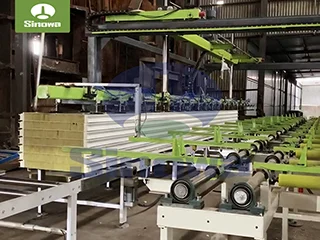
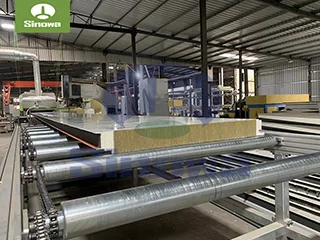
sandwich panel line
Different from single-layer rock wool board production equipment and pure PU foam sandwich panel production line, the specialized production line for PU composite rock wool sandwich panels adopts a hybrid composite forming process. It organically combines the rigid thermal insulation characteristics of polyurethane foam and the high-temperature fire resistance of rock wool fiber materials, overcoming the single performance limitations of traditional single-material sandwich panels. Traditional rock wool panels often suffer from poor overall structural tightness, weak surface bonding performance, and insufficient thermal insulation uniformity, while pure PU sandwich panels have obvious shortcomings in high-temperature fire resistance. The innovative composite process of this production line perfectly complements the performance advantages of the two materials, endowing the finished panels with comprehensive capabilities of fire prevention, heat preservation, sound absorption, and structural bearing, making them adaptable to complex and diverse construction application environments.
The overall operation logic of the continuous sandwich panel production line follows a fully continuous closed-loop production mode, covering raw material feeding, surface plate pretreatment, PU raw material proportional mixing and spraying, rock wool material laying and positioning, double-layer plate alignment and lamination, constant-pressure thermal curing, fixed-length cutting, edge finishing, and automatic stacking. Each processing link is closely connected through synchronous transmission systems, avoiding intermittent shutdowns and manual intervention gaps in traditional segmented production equipment. This highly integrated operation mode not only greatly improves the continuity and stability of panel production but also ensures the consistency of panel thickness, bonding strength, and overall flatness in batch production, laying a solid foundation for the standardized application of finished panels in engineering construction.
The front-end processing module of the continuous sandwich panel line focuses on the pretreatment and forming of metal surface plates, which is the basic link to ensure the flatness and structural accuracy of composite panels. The metal coil raw materials are stably unwound through a precision unwinding system, with the feeding speed and tension dynamically adjusted in real time to avoid plate deviation, wrinkling, and uneven stress. After unwinding, the metal plates enter the leveling and trimming unit, where multiple groups of precision roller sets correct tiny deformations generated during coil storage and transportation, and trim the plate edges to ensure consistent width of each plate. Subsequently, the plates undergo surface pretreatment and micro-shape forming, creating a specific structural profile on the plate surface. This profiling treatment effectively enhances the contact area and bonding firmness between the metal plate and the intermediate composite material, while improving the overall mechanical strength and structural rigidity of the finished panel, enabling the panel to withstand greater external pressure and deformation in actual use.
As the core functional unit of the continuous PU sandwich panel production line, the PU foaming and metering system determines the thermal insulation performance and internal bonding quality of the composite panels. This system adopts a high-precision dynamic metering and mixing technology, which can accurately proportion the two core raw materials of polyurethane according to the set process parameters. The raw materials are fully stirred and mixed at high speed in a closed mixing chamber to form a uniform liquid reaction material, which is then continuously and evenly sprayed on the surface of the pretreated lower metal plate through a special atomizing and spraying head. The entire spraying process realizes full coverage and uniform thickness distribution, avoiding local material accumulation or missing spraying. Before PU material spraying, the lower metal plate will be preheated to a fixed temperature through the constant-temperature preheating unit of the production line. Appropriate preheating treatment can accelerate the initial reaction speed of polyurethane materials, enhance the wetting effect between the liquid material and the metal plate surface, and significantly improve the initial bonding force between the foam layer and the metal base plate.
The rock wool laying and positioning process is a key step to realize the fireproof performance of composite panels. After the completion of PU material spraying on the lower plate, the rock wool sandwich panel production line automatic feeding system will stably and evenly lay the processed rock wool fiber felt on the surface of the uncured PU foam layer. The rock wool material is precisely positioned through a limiting and correcting device to ensure consistent laying thickness and overall flatness, avoiding offset, stacking, or sparse laying. The rock wool raw materials used in the production process are processed by fiber carding and shaping, with uniform fiber distribution and stable structural density, which can maintain stable fire resistance and structural integrity after compounding and curing. In the composite structure, the rock wool layer undertakes the main high-temperature fireproof and flame-retardant function, while the PU foam layer fills the fiber gaps of rock wool, optimizes the internal compactness of the composite layer, and makes up for the poor thermal insulation performance and easy air permeability of single rock wool materials. The layered composite structure formed by this process realizes the organic integration of fire resistance and thermal insulation functions.
After the laying of rock wool materials is completed, the upper metal plate after leveling and forming is precisely aligned and covered through the automatic plate alignment system of the rockwool sandwich panel production line. The high-synchronization transmission technology ensures that the upper and lower plates are completely aligned in the width and length directions, with no deviation or misalignment, which guarantees the regular overall structure and uniform stress of the finished composite panel. Subsequently, the initially compounded semi-finished panels are sent to the double-belt constant-pressure thermal pressing and curing unit, which is the core equipment for realizing material reaction molding and firm bonding. The double-belt press is equipped with a fully covered constant-temperature heating system and uniform pressure control system, which can maintain stable temperature and pressure environment in the entire curing area.
Inside the closed curing space of the double-belt press, the polyurethane material undergoes continuous foaming, polymerization, and cross-linking reactions. The foam gradually expands and fills all the gaps between the metal plates and the rock wool layer, forming a dense and integrated composite whole. The stable pressure environment ensures that the foaming density of PU materials is uniform, the bonding interface between each layer is closely fitted, and no hollowing, delamination, or uneven thickness occurs. The precise temperature control system accurately matches the reaction temperature required for PU material curing and rock wool composite molding, promoting the complete progress of chemical reactions and enabling the composite material to obtain stable physical properties. The curing time is dynamically adjusted according to the panel thickness and process requirements, ensuring that the internal structure of the panel is fully shaped and the bonding strength reaches the optimal state.
The post-processing module of the PU sandwich panel production line undertakes the finishing and shaping work of the cured composite panels, including fixed-length cutting, edge trimming, surface cleaning, and automatic stacking. The fixed-length cutting unit adopts non-stop dynamic cutting technology, which can complete accurate cutting of panels in the continuous transmission state of the production line, effectively improving production efficiency while ensuring that the cutting size error is controlled within a tiny range. The edge trimming process removes excess composite materials and irregular burrs on the panel edges, making the panel edges neat and smooth, which facilitates seamless assembly and docking in subsequent engineering installation. The surface cleaning device automatically cleans residual floating materials and dust on the panel surface, ensuring the flatness and aesthetics of the finished panel surface.
The final automatic stacking system can neatly stack the processed finished panels according to the set specifications, realizing automated output and storage of products, reducing manual handling links, and avoiding panel surface damage and structural deformation caused by manual operation. The entire post-processing process is highly automated, with coordinated operation of each unit, which not only ensures the dimensional accuracy and surface quality of the finished panels but also improves the overall production rhythm of the line, realizing seamless connection from raw material input to finished product output.
This professional PU sandwich panel line for rock wool composite panels has significant technical advantages in production stability and product performance optimization compared with traditional composite panel production equipment. First of all, it realizes the integrated composite molding of rigid PU foam and fibrous rock wool materials, breaking through the technical bottleneck that traditional equipment can only realize single material composite or simple layered fitting. The interpenetrating composite structure formed by PU foaming and filling rock wool fibers greatly improves the overall compactness and structural integrity of the panel, making the panel have better wind pressure resistance, compression resistance, and structural stability in long-term use.
Secondly, the sandwich panel production line adopts full-process synchronous control technology, and the operating speed, temperature parameters, pressure parameters, and feeding parameters of each functional unit are centrally coordinated and dynamically matched. This intelligent control mode avoids the product quality fluctuation caused by parameter mismatch in segmented production, ensuring that the thermal insulation coefficient, fire resistance level, structural strength, and dimensional accuracy of each batch of finished panels remain highly consistent. For large-scale industrial building supporting projects and standardized prefabricated building projects, this high-consistency batch production capability is crucial to ensure the overall engineering quality.
In terms of product performance, the composite panels produced by this sandwich panel line have dual core advantages of material complementation. The rock wool layer with high fiber density provides excellent high-temperature resistance, flame retardancy, and smoke suppression performance, which can effectively block flame spread and resist high-temperature baking in case of fire, meeting the safety requirements of building fire protection. The tightly foamed PU filling layer provides ultra-low thermal conductivity, effectively reducing indoor and outdoor heat transfer, achieving efficient building energy saving effect. At the same time, the integrated composite structure greatly improves the sound insulation and absorption performance of the panel, which can effectively isolate external noise and reduce indoor sound resonance, providing a quiet and comfortable environment for industrial workshops, public buildings, and special functional spaces.
In terms of production efficiency and cost control, the fully continuous automated production mode of the sandwich panel machine greatly reduces manual operation links and labor investment. The streamlined production process realizes uninterrupted mass production, with a wide adjustable range of production speed, which can adapt to the production needs of small-batch customized panels and large-batch standardized panels. The precise metering system of PU raw materials avoids raw material waste caused by excessive proportioning, and the efficient curing process shortens the material molding cycle, effectively improving material utilization rate and overall production efficiency. In the long-term production operation, this efficient and energy-saving production mode can effectively reduce the comprehensive production cost of enterprises and improve the market competitiveness of products.
The application scenarios of rock wool PU composite sandwich panels produced by this production line cover multiple fields of modern construction and industrial manufacturing. In industrial factory buildings, warehouse buildings, and cold storage projects, the panels rely on excellent thermal insulation and structural stability to meet the long-term thermal insulation and wind and pressure resistance needs of industrial buildings. In public buildings such as shopping malls, hospitals, and schools, the excellent fireproof and flame-retardant performance of the panels effectively improves the overall fire safety level of buildings. In special environments such as clean workshops and constant-temperature workshops, the high compactness and stable physical properties of the composite panels can avoid dust accumulation and thermal performance attenuation, meeting the strict environmental control requirements of special functional spaces.
With the continuous development of prefabricated building technology and building energy conservation policies, the market demand for high-performance composite thermal insulation and fireproof panels is constantly upgrading, which also puts forward higher requirements for the technical level and intelligent degree of supporting production equipment. This professional PU sandwich panel line for rock wool composite panels, with its mature composite process, stable operation performance, and flexible production capacity, can continuously produce high-quality composite panels that meet the needs of modern building energy conservation and safety standards. In the future, with the further optimization of intelligent control technology and composite molding technology, such production lines will develop towards higher automation, more precise parameter control, and more diversified product customization, providing more reliable equipment support for the upgrading of the building materials industry and the high-quality development of construction engineering.
https://www.cnsinowa.com/sandwich-panel-machines/pu-sandwich-panel-line-for-rock-wool-composite-panels.html