 sandwich panel machine
The fundamental advantage of energy-saving rockwool sandwich panel production machines lies in their scientific integration of production processes and energy conservation technologies, which fundamentally reduces energy consumption without compromising production efficiency and product quality. Unlike traditional production equipment that relies on scattered processes and high-energy-consuming components, modern energy-saving machines adopt a continuous integrated production mode, covering all key links from raw material feeding, forming, compounding, curing, cooling to cutting and stacking. This integrated design not only minimizes energy loss caused by process interruptions and material transfer but also optimizes the energy allocation among various functional modules, ensuring that each part of the equipment operates at the most energy-efficient state.
The working principle of energy-saving rockwool sandwich panel production machines is a sophisticated combination of mechanical transmission, electrical control, and thermal processing technology. The entire production process starts with the feeding of surface materials, which are usually metal sheets of different specifications. These sheets are uncoiled, leveled, and preheated through a dedicated system. The preheating process adopts a hot air circulation design, which recycles waste heat generated during production to heat the surface materials, reducing the need for additional heating energy. Meanwhile, the rockwool core material, after being crushed, melted, and fibrosis through a centrifuge, is evenly laid on the lower surface material by a pendulum cotton device. The vertical silk arrangement technology ensures the uniformity and compactness of the rockwool core, which not only enhances the thermal insulation and mechanical properties of the final product but also reduces material waste during production.
After the rockwool core is laid, the upper and lower surface materials and the core are compounded through a lamination system. The compounding process uses a precision servo lifting mechanism instead of the traditional hydraulic system, which not only achieves accurate control of the panel thickness but also eliminates energy waste and maintenance troubles caused by hydraulic oil leakage and pressure loss. The servo mechanism can adjust the pressing force and thickness parameters in real-time according to production requirements, with fast response speed and high control precision, ensuring the consistency of product specifications. During the compounding process, the bonding between the surface materials and the rockwool core is completed through an automatic spraying system, which precisely controls the amount of adhesive to avoid excessive use while ensuring strong bonding performance, further reducing material consumption and environmental pollution.
Curing is a key link affecting the performance of rockwool sandwich panels, and energy-saving production machines have made targeted innovations in this link. Traditional curing processes often require independent insulation rooms and long-term high-temperature heating, resulting in significant energy consumption. In contrast, modern energy-saving machines adopt a full-closed internal insulation design, integrating the curing zone with the entire production line. The hot air generated during the curing process is recycled through a heat exchange system, and the temperature inside the curing zone is maintained at the optimal level through intelligent temperature control. This design not only shortens the curing time—usually, the heating and insulation system can reach the required process temperature within one hour when the room temperature is above 5°C—but also reduces energy consumption by up to 60% compared with traditional equipment. The closed structure also prevents heat loss to the external environment, avoiding the need for additional heating equipment in cold seasons and further reducing production costs.
Automation and intelligent control are important pillars of the energy-saving performance of these production machines. The entire production line is equipped with a highly integrated control system that centralizes all control points in a main control center, realizing parameter linkage, automatic adjustment, and fault self-diagnosis. Operators can set production parameters such as panel specifications, production speed, and temperature through a human-machine interface, and the system will automatically adjust the operation of each module according to the set values. For example, when the production speed changes, the system will synchronously adjust the feeding speed of raw materials, the amount of adhesive sprayed, and the temperature of the curing zone to maintain the stability of product quality. The fault self-diagnosis function can quickly identify abnormal conditions such as component failures and parameter deviations, and issue early warnings to avoid prolonged shutdowns and energy waste caused by equipment malfunctions. In addition, remote control and monitoring functions allow operators to manage the production line in real-time without being on-site, further optimizing human resource allocation and reducing labor costs.
Modular design is another prominent feature of energy-saving rockwool sandwich panel production machines, which contributes significantly to energy conservation, maintenance convenience, and production flexibility. The entire production line is divided into multiple independent functional modules, such as uncoiling module, rockwool laying module, compounding module, curing module, cutting module, and stacking module. Each module adopts a standardized design, enabling flexible combination and replacement according to different production needs. For example, by replacing the surface material feeding module, the machine can produce rockwool sandwich panels with different surface materials such as color steel sheets, stainless steel sheets, and aluminum sheets. The modular structure also facilitates maintenance and repair—when a certain module fails, it can be disassembled and replaced independently without stopping the entire production line, reducing production downtime and energy waste caused by long-term shutdowns. Moreover, the standardized components of the modules have high interchangeability, reducing the inventory of spare parts and maintenance costs.
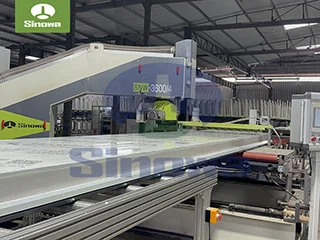
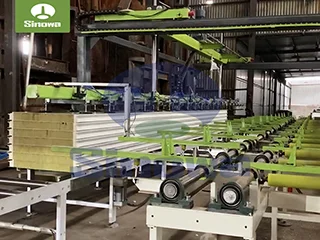
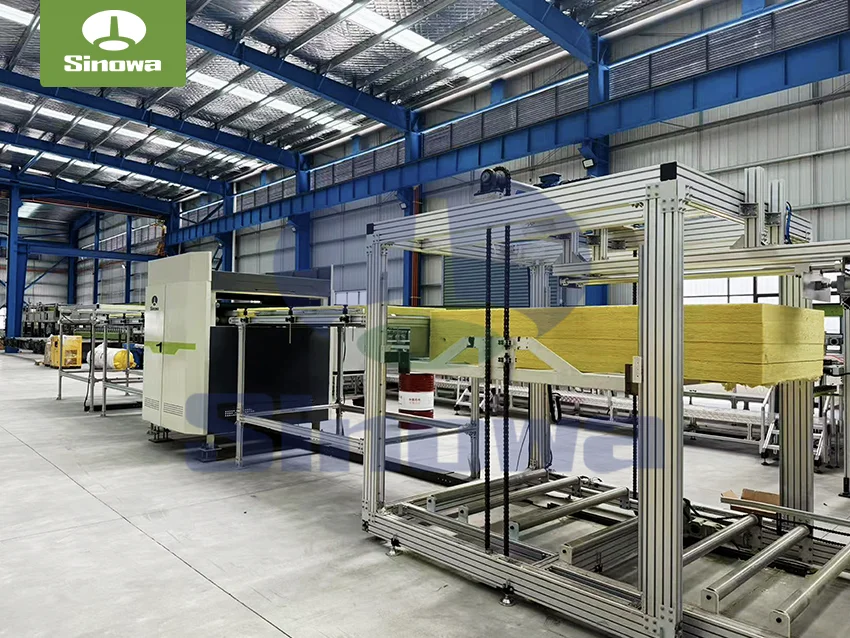
The cutting and stacking modules of energy-saving rockwool sandwich panel production machines also incorporate energy-saving and high-precision technologies. The cutting module adopts a three-axis vertical cutting system driven by a servo motor, which realizes fully automatic reciprocating cutting with high cutting accuracy and stable operation. The cutting speed can be synchronized with the production line speed, avoiding material waste caused by uneven cutting. Compared with traditional mechanical cutting, servo-driven cutting reduces noise pollution and energy consumption, creating a more environmentally friendly production environment. The stacking module uses an automatic lifting and conveying device, which can stack the cut panels neatly according to preset specifications without manual operation. This not only improves stacking efficiency and reduces labor intensity but also avoids panel damage caused by manual stacking, reducing product scrap rates.
The application scope of energy-saving rockwool sandwich panel production machines is extremely wide, covering almost all fields where rockwool sandwich panels are used. In industrial buildings, the panels produced by these machines are widely used in factory workshops, warehouses, and steel structures due to their excellent fire resistance and thermal insulation properties, helping to reduce indoor temperature fluctuations and save energy for heating and cooling. In the cold storage industry, the high-precision control of panel thickness and density by energy-saving production machines ensures the excellent thermal insulation performance of the panels, maintaining stable low temperatures inside the cold storage with lower energy consumption. For exterior wall insulation and fire barriers in residential and commercial buildings, the panels produced by these machines meet strict fire safety standards and energy-saving requirements, effectively improving the energy efficiency of buildings and reducing carbon emissions.
In addition to direct energy savings in production, energy-saving rockwool sandwich panel production machines also contribute to the green development of the industry through indirect environmental benefits. The high-precision production process reduces material waste, minimizing the environmental impact of raw material extraction and processing. The closed production design and waste heat recycling system reduce air pollution and energy waste, complying with global environmental protection policies. Moreover, the rockwool sandwich panels produced by these machines have a long service life and good recyclability, further promoting the circular economy in the construction industry. As countries around the world strengthen environmental protection regulations and promote low-carbon development strategies, the demand for energy-saving production equipment will continue to grow, driving the continuous upgrading and innovation of rockwool sandwich panel production technology.
The future development of energy-saving rockwool sandwich panel production machines will focus on further improving energy efficiency, enhancing intelligent levels, and expanding production flexibility. With the development of digital technology, artificial intelligence will be more deeply integrated into production equipment, enabling predictive maintenance, adaptive production parameter adjustment, and full-process digital management. This will not only further reduce energy consumption and production costs but also improve product quality and production efficiency. In terms of energy conservation, new energy technologies such as solar energy and wind energy may be integrated into the production line, realizing cleaner energy supply. In addition, the development of lightweight and compact equipment designs will reduce the occupied space of the production line and further optimize energy utilization efficiency.
In conclusion, energy-saving rockwool sandwich panel production machines represent the development direction of the rockwool panel manufacturing industry, integrating energy conservation, automation, intelligence, and modularization. Through scientific process design, advanced energy-saving technologies, and intelligent control systems, these machines not only reduce production energy consumption and costs but also improve product quality and production efficiency, providing strong support for the green and sustainable development of the construction and industrial material industries. As the demand for energy-saving and environmentally friendly materials continues to increase, energy-saving rockwool sandwich panel production machines will play an increasingly important role in promoting industrial upgrading, reducing carbon emissions, and building a low-carbon society. Their continuous innovation and popularization will bring more opportunities for the development of the rockwool sandwich panel industry and make greater contributions to global energy conservation and environmental protection causes.
https://www.cnsinowa.com/sandwich-panel-machines/energy-saving-rockwool-sandwich-panel-production-machine.html