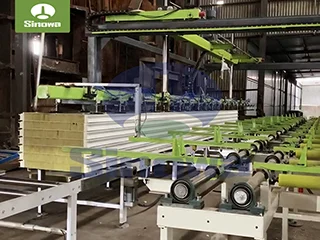
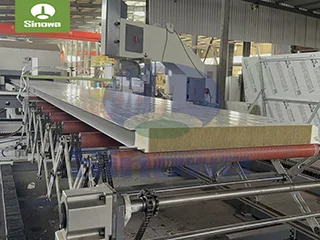
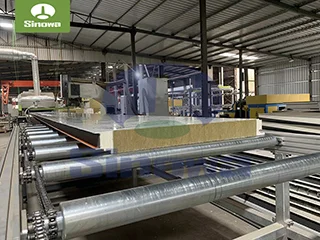
sandwich panel machine
The entire production workflow of the mineral wool composite polyurethane sandwich panel machine operates in a continuous automated cycle, starting with the pretreatment of surface facing materials. Metal coil materials, the most commonly used facing layers for composite panels, are loaded into the automated uncoiling system, which supports uninterrupted material supply through adaptive coil splicing functions. This design eliminates production downtime caused by raw material replacement, maintaining the continuity of the entire production line. After uncoiling, the metal sheets undergo multi-stage leveling and surface cleaning processes to eliminate surface wrinkles, oxide layers, and residual contaminants. A smooth and clean surface is essential for enhancing the bonding force between the metal facing and polyurethane foam, preventing delamination and peeling during the long-term service of finished panels. Following pretreatment, the metal sheets proceed to preheating stations, a key process tailored for mineral wool composite production. Preheating homogenizes the surface temperature of the facing materials, which accelerates the subsequent polyurethane chemical reaction and avoids inconsistent foaming density caused by temperature differences between the core material and facing layers.
Parallel to the facing material pretreatment, the system completes the preparation and arrangement of mineral wool core materials. Mineral wool boards, with their lightweight fibrous structure, require orderly arrangement and gap adjustment through automated material distribution equipment to ensure uniform thickness and continuous coverage across the panel width. The mineral wool sandwich panel machine is designed to fine-tune the spacing and alignment of mineral wool units, effectively avoiding hollow areas or uneven core material distribution in finished panels. This precision arrangement lays a solid foundation for the overall structural uniformity and mechanical stability of composite panels. After positioning, the surface of the mineral wool core material undergoes micro-treatment to optimize its porous structure state, enabling better penetration and adhesion of liquid polyurethane materials. Unlike dense foam core materials, mineral wool’s fibrous pores allow polyurethane foam to form embedded bonding structures rather than simple surface adhesion, significantly improving the overall structural integrity and shear resistance of composite panels.
The polyurethane foaming and spraying stage constitutes the core functional module of the entire PU sandwich panel machine. The system adopts a high-precision proportional mixing unit to blend two-component polyurethane raw materials, achieving stable chemical reaction conditions through strict flow and proportion control. The precisely mixed liquid polyurethane is evenly sprayed on the surface of the pre-treated mineral wool core material and the inner side of the lower metal facing via a reciprocating spraying mechanism. The spraying trajectory and flow rate are dynamically adjusted according to panel width and production speed, ensuring full coverage without excess accumulation or missing areas. During the spraying process, the liquid polyurethane gradually infiltrates the surface pores of the mineral wool, forming a transitional bonding layer after foaming and curing. This transitional structure perfectly connects the rigid metal facing and the fibrous mineral wool core, solving the technical problem of weak interfacial bonding in traditional mineral wool composite panels.
Subsequent lamination and pressure forming processes determine the overall flatness and structural compactness of composite panels. The upper and lower facing materials with sprayed polyurethane materials and the intermediate mineral wool core material enter the double-belt lamination system synchronously for composite pressing. The double-belt structure provides uniform and continuous pressure across the entire panel surface, avoiding local deformation, thickness deviation, or material dislocation caused by uneven pressure. The internal temperature of the lamination zone is kept within a constant range through a circulating thermal control system, providing stable thermal conditions for polyurethane foaming, expansion, and cross-linking curing. In this closed temperature and pressure environment, polyurethane undergoes complete physical foaming and chemical cross-linking reactions, fully filling the gaps between mineral wool fibers and the gaps between core material and facing layers. The foamed polyurethane forms a dense closed-cell isolation layer on the surface of mineral wool, which not only enhances the waterproof and moisture-proof performance of the composite panel but also further strengthens the interfacial bonding strength of the multi-layer structure.
The curing process after lamination is critical for stabilizing the physical properties of finished panels. The integrated curing channel of the sandwich panel production machine extends the thermal reaction time of polyurethane, ensuring thorough completion of molecular cross-linking and solidification. Moderate and continuous heat treatment eliminates internal stress generated during foaming and pressing, preventing panel warping, deformation, or interfacial separation during subsequent use and processing. The length and temperature gradient of the curing zone are scientifically designed to adapt to the foaming characteristics of mineral wool composite structures. Excessively fast curing easily leads to incomplete internal reaction, while overly slow curing reduces production efficiency. The adaptive temperature regulation system of the machine can adjust the internal temperature gradient in real time according to production speed and panel thickness, achieving a perfect balance between curing quality and production efficiency.
After full curing and structural stabilization, the continuous long strip composite panel enters the precision cutting and finishing stage. The flying cutting system equipped on the machine realizes dynamic cutting in the continuous production state without stopping the production line, effectively improving overall production continuity. The cutting mechanism maintains high-precision dimensional control to ensure consistent length and flatness of each finished panel, with smooth and neat cutting sections without burrs or material collapse. After cutting, the panels pass through edge trimming and surface finishing units to remove residual edge materials and fine surface imperfections, optimizing the overall appearance and dimensional accuracy of products. Some production configurations also include automatic panel turnover and conveying systems, which facilitate subsequent stacking, packaging, and transportation operations, realizing a fully automated closed-loop production process from raw material feeding to finished product output.
The structural design and functional optimization of the polyurethane sandwich panel production line for mineral wool composite production endow the equipment with unique technical advantages in building material manufacturing. First, the integrated composite process of polyurethane foaming and mineral wool bonding perfectly combines the fireproof and sound-insulating advantages of mineral wool with the waterproof, adhesive, and thermal insulation advantages of polyurethane foam. The composite structure avoids the defects of single mineral wool panels, such as poor waterproof performance and easy fiber shedding, while overcoming the insufficient fire resistance of pure polyurethane sandwich panels. Second, the automated continuous production mode greatly reduces manual intervention, stabilizing product quality consistency and effectively lowering labor costs and human error rates in the production process.
In terms of production adaptability, the sandwich panel equipment supports the production of composite panels with different thicknesses and specifications by adjusting parameters such as spraying flow, lamination pressure, and curing temperature. It can match mineral wool core materials of different densities and fiber structures, as well as various metal facing materials with different thicknesses and surface treatments, meeting the personalized product needs of different application scenarios. The dynamic parameter adjustment function enables the production line to switch product specifications efficiently without major mechanical debugging, greatly improving production flexibility and market adaptability.
The operational stability and energy-saving performance of the equipment are also key optimization highlights of the system. The entire PU sandwich panel production line adopts modular mechanical transmission structures and intelligent electrical control units, which reduce mechanical wear and operational failure rates through synchronous linkage control of each functional module. The circulating thermal control system recycles waste heat generated during the curing process, reducing energy consumption while maintaining stable temperature conditions in the production zone. The optimized mechanical transmission design reduces friction loss during material conveying and processing, further improving the overall energy utilization efficiency of production. In long-term industrial production, these energy-saving and stable design features effectively reduce production operating costs and improve the economic benefits of production enterprises.
The finished mineral wool composite polyurethane sandwich panels produced by this professional machine have excellent comprehensive performance and are widely applied in industrial plant construction, public building enclosure, clean room engineering, cold chain insulation, and other fields. The composite panels retain the excellent non-combustible performance and high-temperature resistance of mineral wool, providing reliable fire safety guarantee for building enclosure structures. At the same time, the compact polyurethane bonding layer optimizes the overall thermal insulation and waterproof performance of the panels, solving the problem of easy moisture absorption and heat conduction of traditional mineral wool materials. In terms of mechanical performance, the integrated composite structure formed by polyurethane embedding and bonding significantly improves the overall compressive strength, bending resistance, and structural stability of the panels, enabling the products to adapt to complex installation and service environments.
With the continuous upgrading of modern building energy-saving standards and industrial material performance requirements, the technical advantages of professional mineral wool sandwich panel production line has become increasingly prominent. Compared with traditional manual composite or semi-automatic production equipment, fully automated integrated production lines achieve qualitative leaps in production efficiency, product consistency, and structural performance stability. The precise foaming control and uniform composite pressing technology eliminate common quality problems such as inconsistent core material density, weak interfacial bonding, and uneven panel thickness in traditional products. The standardized and automated production process also promotes the standardized development of mineral wool composite panel products, providing high-quality basic materials for high-standard green buildings and industrial facilities.
In practical production applications, the sandwich panel production equipment intelligent monitoring system can track and record key production parameters in real time, including polyurethane mixing ratio, spraying volume, lamination pressure, curing temperature, and production speed. The real-time data feedback enables production personnel to quickly adjust abnormal parameters, ensuring that each batch of products maintains stable and qualified performance. The modular structural design of the equipment also facilitates daily maintenance and later functional upgrading. Each functional module is relatively independent, which can realize targeted maintenance and partial function optimization without affecting the overall operation of the production line, greatly improving the convenience of equipment operation and maintenance.
In conclusion, the professional PU sandwich panel machine for mineral wool composite panel production is a highly integrated and intelligent industrial production system that perfectly combines chemical foaming technology, mechanical precision processing, and thermal curing molding technology. It solves the technical bottlenecks in the composite molding of mineral wool fibrous materials, realizes efficient, stable, and standardized mass production of high-performance composite insulation panels, and provides reliable equipment support for the development of energy-saving, fireproof, and high-strength building enclosure materials. With the continuous progress of building industrialization and green building technology, this type of composite production equipment will continue to be optimized and upgraded, playing a more important role in the field of modern building material manufacturing and promoting the iterative upgrading of composite insulation panel products.
https://www.cnsinowa.com/sandwich-panel-machines/pu-sandwich-panel-machine-for-mineral-wool-composite-panel-production.html