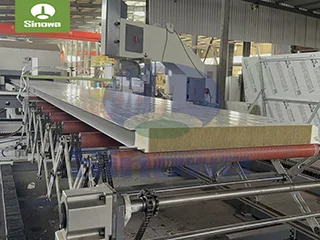
sandwich panel line
The structure of the rock wool sandwich panel production line with automatic width adjustment is a modular integrated system, consisting of core functional units that work in coordination to complete the entire production process from raw material feeding to finished product stacking. Each module is designed with high compatibility and adjustability, laying a foundation for automatic width adjustment and multi-specification production. The uncoiling module is the starting point of the production line, responsible for stably feeding the surface and bottom base materials—usually color steel plates, galvanized sheets or aluminum coils—into the subsequent process. Equipped with tension control devices and deviation correction mechanisms, this module ensures that the base materials remain flat and aligned during feeding, avoiding wrinkles or offset that could affect product quality. The tension control system adjusts the feeding force in real time according to the thickness and hardness of the base material, while the deviation correction mechanism uses sensors to detect the edge position of the material and automatically adjusts the uncoiling angle, ensuring precise alignment with the production line center.
The automatic width adjustment module is the core component that distinguishes this production line from traditional fixed-width equipment, integrating mechanical adjustment, sensor detection and electrical control technologies to achieve real-time, precise width regulation. This module mainly includes width detection sensors, servo drive systems, adjustable side baffles and control units. The width detection sensors—installed at key positions of the production line—continuously collect the width data of the base material and the rock wool core, transmitting real-time signals to the control unit. The control unit, based on preset product specifications and real-time detection data, issues adjustment commands to the servo drive system, which drives the adjustable side baffles to move horizontally. The side baffles are designed with high-precision guide rails and positioning structures, ensuring that the width adjustment process is stable and accurate, with an adjustment error within a small range. In addition, the module is equipped with a memory function, which can store the width parameters of common product specifications, enabling quick switching when changing production models, reducing adjustment time and improving production efficiency. The width adjustment range of the production line can be customized according to enterprise needs, usually covering a wide spectrum to meet the production requirements of panels for different scenarios, from small-width partition panels to large-width roof and wall panels.
The rock wool processing module is responsible for cutting, spreading and laying the rock wool core material according to the required width and thickness, matching the adjusted width of the base material. This module includes a rock wool uncoiling device, a cutting mechanism and a spreading mechanism. The rock wool uncoiling device feeds the bulk rock wool roll into the cutting mechanism, which uses high-speed rotating blades to cut the rock wool into strips of the required width under the control of the automatic width adjustment system. The cutting mechanism is equipped with a dust collection device to collect the rock wool dust generated during cutting, reducing environmental pollution and protecting the health of operators. The spreading mechanism then evenly lays the cut rock wool strips on the bottom base material, ensuring that the core material is evenly distributed without gaps or accumulation. The thickness of the rock wool core can also be adjusted according to product requirements, with the spreading mechanism adjusting the feeding amount in real time to ensure consistent core thickness, which directly affects the thermal insulation and soundproofing performance of the finished panel.
The bonding and compounding module is responsible for bonding the surface base material, rock wool core and bottom base material into an integrated sandwich panel. This module includes an adhesive spraying system, a preheating device and a double-belt pressing mechanism. The adhesive spraying system evenly sprays environmentally friendly, high-adhesion adhesive on the surface of the base material and the rock wool core, with the spraying amount adjustable according to the product specifications and bonding requirements. The preheating device heats the base material and the adhesive to an appropriate temperature, accelerating the curing speed of the adhesive and improving the bonding strength. The double-belt pressing mechanism uses upper and lower pressure belts to apply uniform pressure to the composite material, ensuring that the three layers are closely bonded without delamination. The pressure and speed of the pressing mechanism are adjustable, adapting to different thicknesses and material combinations of sandwich panels. Some advanced production lines also integrate a PU side sealing system, which fills the gaps on both sides of the sandwich panel with polyurethane foam, preventing moisture penetration and improving the overall structural stability and waterproof performance of the panel.
The cutting and shaping module completes the cutting of the composite sandwich panel into fixed-length products, while ensuring the flatness of the cutting surface and the accuracy of the length. This module is equipped with a flying cutting mechanism, which can cut the moving composite panel without stopping the production line, ensuring continuous production and improving efficiency. The cutting length is controlled by the electrical system, with high precision to meet the installation requirements of the finished products. The shaping mechanism after cutting corrects the edge and surface of the panel, removing burrs and uneven parts, ensuring that the appearance and size of the finished panel meet the standard specifications. Finally, the stacking module uses automatic stacking equipment to arrange the finished panels in an orderly manner, reducing manual labor intensity and avoiding damage to the panels during manual stacking. The stacking height and spacing can be adjusted according to the storage and transportation needs, improving the efficiency of storage and transportation.
The performance of the rock wool sandwich panel production line with automatic width adjustment is reflected in multiple aspects, including production efficiency, adjustment precision, product quality stability, energy conservation and environmental protection, and operational reliability, which together determine the production capacity and market adaptability of the equipment. In terms of production efficiency, the automatic width adjustment function eliminates the need for manual disassembly and adjustment of equipment when changing product specifications, reducing the downtime between production batches. The continuous production mode from raw material feeding to finished product stacking, combined with the high-speed operation of each module, enables the production line to achieve a high output rate. The production speed can be adjusted according to product requirements, usually ranging from several meters to tens of meters per minute, and the annual production capacity can reach hundreds of thousands of square meters, meeting the large-scale production needs of enterprises. The modular design of the production line also facilitates later maintenance and expansion, and enterprises can add or upgrade functional modules according to their own development needs, extending the service life of the equipment.
Adjustment precision is a key performance indicator of this type of production line, directly affecting the size accuracy of the finished panels. The automatic width adjustment system adopts high-precision sensors and servo drive technology, with a width adjustment precision that can reach a high level, ensuring that the width error of the finished panels is within the allowable range of industry standards. The real-time detection and feedback mechanism of the system can quickly respond to changes in raw material size or production parameters, making timely adjustments to avoid product waste caused by size deviation. In addition, the synchronization control of each module ensures that the base material, rock wool core and adhesive are accurately matched during the production process, improving the overall size precision and structural consistency of the panels.
Product quality stability is another important performance advantage of the production line. The full automatic control mode reduces the impact of human factors on production quality, ensuring that the parameters of each production link—such as tension, pressure, temperature, adhesive spraying amount and width adjustment—remain stable, thus making the performance of the finished panels consistent. The deviation correction mechanism and tension control system in the uncoiling module ensure the flatness and alignment of the base material; the uniform spreading of the rock wool core ensures the consistency of thermal insulation and soundproofing performance; the precise bonding and pressing process ensures that the panels do not delaminate or deform during use. The production line is also equipped with multiple quality detection points, which can detect the thickness, width, bonding strength and appearance of the panels in real time, automatically removing unqualified products, further ensuring the stability of product quality.
Energy conservation and environmental protection have become important considerations in modern industrial production, and the rock wool sandwich panel production line with automatic width adjustment has obvious advantages in this regard. The equipment adopts energy-saving motors and frequency conversion control technology, which can adjust the power output according to the production load, reducing energy consumption. The preheating device uses efficient thermal insulation materials and temperature control technology to reduce heat loss, improving energy utilization efficiency. In terms of environmental protection, the dust collection device in the rock wool cutting link collects rock wool dust in a centralized manner, avoiding air pollution; the adhesive spraying system adopts closed-loop control, reducing adhesive waste and environmental pollution caused by excessive spraying. Some advanced production lines also integrate waste recycling modules, which can recycle and reuse the leftover materials generated during production, reducing resource waste and conforming to the concept of green production.
Operational reliability is the guarantee for the long-term stable operation of the production line. The key components of the equipment—such as servo motors, sensors, bearings and pressure belts—are made of high-quality materials, with high wear resistance and corrosion resistance, reducing the frequency of equipment failures. The integrated control system has a fault self-diagnosis function, which can quickly detect faults in each module and issue alarm signals, while providing fault location and handling suggestions, reducing maintenance time and costs. The modular design of the production line also makes maintenance more convenient; when a module fails, it can be disassembled and maintained independently without affecting the operation of other modules, ensuring the continuity of production.
The types of rock wool sandwich panel production lines with automatic width adjustment can be classified according to different standards, including production capacity, width adjustment range, and product application scenarios, to meet the diverse needs of different enterprises and markets. According to the production capacity, they can be divided into small, medium and large-scale production lines. Small-scale production lines are suitable for small and medium-sized enterprises or enterprises with small production demand, with a relatively small width adjustment range and low output, and the equipment investment and operating costs are relatively low, which is conducive to enterprises to enter the market and carry out trial production. Medium-sized production lines have a moderate output and width adjustment range, suitable for enterprises with stable production demand, and can balance production efficiency and investment costs, meeting the production needs of most conventional specifications of rock wool sandwich panels. Large-scale production lines are designed for large enterprises with large-scale production demand, with a wide width adjustment range, high production speed and large annual output, and are usually equipped with more advanced automatic control systems and auxiliary functional modules, such as automatic quality inspection, waste recycling and intelligent storage, realizing full-process intelligent production.
According to the width adjustment range, they can be divided into narrow-width, medium-width and wide-width adjustable production lines. Narrow-width adjustable production lines are mainly used for the production of small-width panels, such as partition panels, interior decoration panels, and small-sized cold storage panels, with a width adjustment range usually suitable for small specifications. Medium-width adjustable production lines are the most common type, suitable for the production of conventional width roof panels, wall panels and industrial workshop panels, meeting the needs of most general construction and industrial scenarios. Wide-width adjustable production lines are used for the production of large-width panels, such as large-span roof panels, large-scale cold storage wall panels and industrial plant exterior wall panels, which can reduce the number of joints during installation, improve construction efficiency and the overall structural stability of the building. The width adjustment range of such production lines is relatively large, and the equipment requires higher precision and stability in the width adjustment process.
According to the product application scenarios, they can be divided into general-purpose and special-purpose production lines. General-purpose production lines are suitable for the production of rock wool sandwich panels for various conventional scenarios, such as civil buildings, industrial workshops, warehouses and cold storages, with strong versatility and can produce multiple types of panels by adjusting parameters. Special-purpose production lines are designed for specific application scenarios, such as high-temperature resistant, corrosion-resistant or waterproof rock wool sandwich panels, and are usually equipped with special functional modules. For example, the production line for high-temperature resistant panels is equipped with a special preheating and cooling system to improve the high-temperature resistance of the panels; the production line for corrosion-resistant panels uses special base materials and adhesives, and is equipped with a surface treatment module to enhance the corrosion resistance of the panels. In addition, there are production lines specially used for the production of curved rock wool sandwich panels, which are equipped with a shaping module that can process curved panels to meet the needs of special-shaped building designs.
The wide range of applications of the rock wool sandwich panel production line with automatic width adjustment is closely related to the excellent performance of the rock wool sandwich panels it produces and the flexibility of the production line itself. These production lines are widely used in construction, industrial, cold chain logistics, municipal engineering and other fields, providing high-quality composite materials for various projects. In the construction field, rock wool sandwich panels produced by the production line are widely used in the exterior walls, roofs and interior partitions of civil buildings, industrial workshops and warehouses. The panels have excellent thermal insulation performance, which can reduce the energy consumption of building heating and cooling, conforming to the national energy conservation and emission reduction policies. Their good fire resistance can effectively delay the spread of fire, improving the fire safety level of buildings. In addition, the panels are lightweight and easy to install, which can reduce the weight of the building structure and improve construction efficiency. For example, in the construction of industrial workshops, large-width rock wool sandwich panels produced by the production line can be quickly installed, shortening the construction period and reducing construction costs.
In the cold chain logistics field, rock wool sandwich panels are important materials for the construction of cold storage, refrigerated warehouses and refrigerated trucks, thanks to their excellent thermal insulation and moisture-proof performance. The production line with automatic width adjustment can produce cold storage panels of different widths and thicknesses according to the size of the cold storage and the required thermal insulation effect, ensuring that the cold storage can maintain a stable low temperature environment, reducing cold loss and energy consumption. The PU side sealing function of some production lines can further improve the moisture-proof performance of the panels, avoiding the decline of thermal insulation performance caused by moisture penetration into the rock wool core, which is crucial for the long-term stable operation of cold storage facilities. In addition, the panels have good structural strength, which can bear a certain load, adapting to the storage and transportation needs of cold chain goods.
In the industrial field, the production line is used to produce rock wool sandwich panels for industrial equipment insulation, boiler insulation and workshop noise reduction. The high-temperature resistant rock wool sandwich panels can be used for the insulation of high-temperature equipment and boilers, reducing heat loss and improving energy utilization efficiency, while also protecting the safety of operators. The soundproof rock wool sandwich panels can effectively reduce the noise generated by industrial production, improving the working environment of the workshop and reducing the impact of noise on the surrounding environment. The production line can adjust the thickness and density of the rock wool core according to the insulation and soundproofing requirements, producing panels with targeted performance, meeting the diverse needs of industrial production.
In municipal engineering field, rock wool sandwich panels are used in the construction of public facilities such as municipal buildings, stadiums, airports and stations. These public facilities usually have large space and high requirements for fire safety, thermal insulation and soundproofing. The rock wool sandwich panels produced by the automatic width adjustment production line can meet these requirements, and the large-width panels can adapt to the large-span design of public facilities, improving the overall aesthetics and structural stability of the buildings. For example, in the construction of stadiums, the rock wool sandwich panels used for the roof and exterior walls not only have good thermal insulation and soundproofing performance, but also have strong wind resistance and durability, adapting to the outdoor harsh environment.
With the continuous development of the construction industry and industrial production, the demand for rock wool sandwich panels is constantly increasing, and the requirements for product specifications and performance are becoming more and more diverse. The rock wool sandwich panel production line with automatic width adjustment, with its flexible width adjustment, high production efficiency, stable product quality and wide application range, has become the mainstream equipment in the industry. In the future, with the integration of intelligent technologies such as the Internet of Things, big data and artificial intelligence, the production line will realize more intelligent functions, such as remote monitoring, intelligent fault diagnosis and automatic production scheduling, further improving production efficiency and reducing operating costs. At the same time, the development of environmentally friendly materials and energy-saving technologies will promote the production line to move towards a more green and low-carbon direction, meeting the sustainable development needs of the society. For enterprises, choosing a suitable automatic width adjustment rock wool sandwich panel production line according to their own production needs and market positioning is an important way to enhance core competitiveness and achieve long-term development.
https://www.cnsinowa.com/sandwich-panel-machines/rock-wool-sandwich-panel-production-line-with-automatic-width-adjustment.html