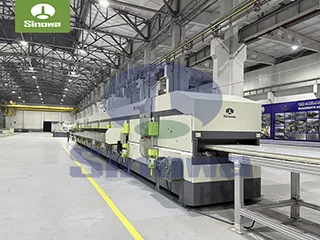
sandwich panel line
The production of PIR sandwich panels for lightweight structures relies on a continuous, automated manufacturing line that orchestrates multiple sequential processes to form a cohesive composite panel. The line typically comprises uncoiling, roll forming, preheating, high-pressure foaming, curing, cooling, cutting, and stacking systems, each playing a critical role in determining the final product’s quality. The process begins with the uncoiling of facing materials, which are commonly thin-gauge metal sheets—such as galvanized steel or aluminum—or non-metallic substrates, depending on the intended application. These facing materials are fed into a roll forming system, where they are shaped into desired profiles, with the outer layer often designed for structural strength and aesthetic appeal, while the inner layer is kept flat to accommodate diverse installation needs. The roll forming process ensures that the facings have the necessary rigidity to support the core material and withstand external loads once installed.
After roll forming, the facing materials undergo preheating to optimize the adhesion between the facings and the PIR core. This preheating step is crucial, as it ensures that the foam core bonds uniformly with the facings, preventing delamination and enhancing the overall structural integrity of the panel. The preheated facings are then fed into a foaming station, where a high-pressure foaming system injects a PIR foam mixture between the two layers. The PIR foam is derived from a reaction between polyols and isocyanates, often with the addition of blowing agents—such as pentane—to achieve a closed-cell structure. The use of high-pressure foaming ensures precise mixing of the components, resulting in a homogeneous foam core with consistent density and structural properties. The foaming process is closely controlled in terms of temperature and pressure, as these parameters directly influence the cell structure, thermal conductivity, and mechanical strength of the core.
Once the foam is injected, the panels move through a curing zone, where the foam undergoes polymerization and solidification. The curing process is typically facilitated by heated air circulation ovens, which maintain a consistent temperature range to ensure complete curing without defects. Proper curing is essential to unlock the PIR core’s full performance potential, including its fire resistance, thermal insulation, and compressive strength. After curing, the panels pass through a cooling system to stabilize the structure and prepare them for cutting. A precision band saw or CNC cutting system trims the panels to customized lengths, with the line capable of producing panels of varying dimensions to meet specific project requirements. Finally, the cut panels are stacked and packaged, ready for transportation and installation. The entire manufacturing process is controlled by a PLC system, ensuring automation, precision, and repeatability, which minimizes human error and maintains consistent product quality across batches.
The structural design of PIR sandwich panels for lightweight applications is centered around the composite action between the facings and the core, leveraging the strengths of each component to achieve optimal performance. The facings serve as the primary load-bearing elements, responsible for resisting tensile and compressive forces, while the PIR core acts as a shear transfer medium, distributing loads evenly across the facings and preventing buckling. This composite structure mimics the functionality of an I-beam, where the facings correspond to the flanges (carrying bending loads) and the core corresponds to the web (resisting shear forces). The core also provides continuous support to the facings, ensuring that they can reach their yield strength without wrinkling or deforming, thereby maximizing the panel’s structural efficiency. The bond between the facings and the core is critical to this composite action, with the bond strength typically meeting or exceeding industry standards to ensure long-term performance.
The structural performance of PIR sandwich panels is defined by a range of key attributes that make them suitable for lightweight structural applications. One of the most notable characteristics is their high strength-to-weight ratio, which allows them to provide significant load-bearing capacity while remaining lightweight. This attribute is particularly valuable in construction projects where reducing dead load is essential, such as modular buildings, roof systems, and partitions, as it can reduce the need for heavy supporting structures, lowering overall construction costs and improving structural efficiency. The compressive strength of PIR sandwich panels is primarily determined by the density of the foam core, with typical core densities ranging from 30 to 45 kg/m³, resulting in compressive strengths of at least 0.22 MPa. This allows the panels to withstand vertical loads, such as those from roofing materials or equipment, without permanent deformation.
Shear strength is another critical structural performance metric, as it measures the panel’s ability to resist forces that cause sliding between the facings and the core. PIR sandwich panels exhibit excellent shear strength due to the strong bond between the core and facings, with bond strength values typically exceeding 0.09 MPa. This ensures that the panel behaves as a single unit under lateral loads, such as wind or seismic forces, making them suitable for use in areas prone to such stresses. Additionally, the panels offer good flexural strength, allowing them to span moderate distances without excessive deflection. The flexural performance is influenced by the thickness of the facings, the density of the core, and the panel’s overall thickness, with thicker panels and higher-density cores providing greater flexural capacity.
Beyond their structural strength, PIR sandwich panels offer exceptional thermal insulation performance, which is a key advantage in energy-efficient construction. The closed-cell structure of the PIR core—with a closed-cell content of at least 90%, and often as high as 97%—effectively traps air, minimizing heat transfer through conduction, convection, and radiation. This results in extremely low thermal conductivity values, typically ranging from 0.018 to 0.023 W/m·K, one of the lowest among common insulation materials. Compared to other insulation core materials, such as expanded polystyrene (EPS), PIR panels offer superior thermal efficiency: a 100 mm thick PIR panel provides the same insulation performance as a 160 mm thick EPS panel. This reduced thickness not only saves material but also increases the usable interior space of buildings, making PIR panels a space-efficient choice for insulation. The thermal performance of PIR panels is further enhanced by the absence of gaps or joints in the core, which eliminates thermal bridges that can reduce insulation efficiency in traditional construction systems.
Fire resistance is another critical performance attribute of PIR sandwich panels, making them suitable for use in buildings where fire safety is a priority. Unlike traditional polyurethane (PU) foam, PIR foam undergoes a chemical reaction during combustion that forms a char layer, which acts as a barrier to flame spread and heat transfer. This char layer prevents the foam from melting or dripping, reducing the risk of fire propagation. PIR sandwich panels typically achieve low combustibility ratings, making them suitable for use in a wide range of fire-sensitive applications, including commercial buildings, industrial facilities, and healthcare centers. The fire performance can be further optimized by selecting appropriate facing materials, with metal facings providing additional fire resistance compared to non-metallic alternatives.
Moisture resistance is also a key performance feature of PIR sandwich panels, thanks to their closed-cell core structure. The closed cells prevent the absorption of water vapor and liquid water, with typical water absorption rates of less than 1%. This resistance to moisture prevents mold growth, rot, and degradation of the core material, ensuring long-term durability even in humid or wet environments, such as cold storage facilities, swimming pools, or coastal areas. Additionally, the facings—especially metal ones—are often treated with protective coatings to resist corrosion, weathering, and UV radiation, further enhancing the panel’s durability and lifespan.
PIR sandwich panels for lightweight structures can be classified based on several criteria, including facing material, core density, panel thickness, and intended application. The most common classification is based on the facing material, which divides the panels into metal-faced and non-metal-faced types. Metal-faced PIR panels are the most widely used, with facings made from galvanized steel, aluminum, or stainless steel, ranging in thickness from 0.4 to 1.2 mm. Galvanized steel facings offer excellent corrosion resistance due to their zinc coating, making them suitable for outdoor applications, while aluminum facings are lighter and more resistant to chemical corrosion, ideal for coastal or industrial environments. Stainless steel facings are used in applications requiring high hygiene standards, such as food processing facilities or clean rooms, due to their easy-to-clean surface and resistance to bacterial growth. Non-metal-faced panels use substrates such as fiberglass, plywood, or composite materials, offering advantages such as enhanced corrosion resistance, non-conductivity, or improved aesthetic flexibility, depending on the material.
Another classification is based on core density, with panels available in low-density (30-35 kg/m³), medium-density (35-40 kg/m³), and high-density (40-45 kg/m³) variants. Low-density panels are suitable for applications where weight reduction is the primary concern, such as temporary structures or modular buildings, while high-density panels are used in load-bearing applications, such as roofing or flooring, where greater compressive and shear strength is required. Panel thickness is also a key classification factor, with standard core thickness ranging from 40 mm to 300 mm, and overall panel thickness adjusted based on the facings and core. Thicker panels offer superior thermal insulation and structural strength, making them suitable for heavy-duty applications, while thinner panels are used for lightweight partitions or interior cladding.
The versatility of PIR sandwich panels is reflected in their wide-ranging applications across various sectors, driven by their lightweight nature, structural performance, and functional attributes. In the construction industry, they are extensively used for roofing, wall cladding, and partitions in both residential and commercial buildings. For roofing applications, PIR sandwich panels provide a lightweight, durable solution that combines structural support with thermal insulation, reducing the load on the building’s frame and lowering energy costs for heating and cooling. The panels can be installed with interlocking joints, ensuring a watertight seal that prevents leaks, making them suitable for flat or low-slope roofs. In wall cladding applications, they offer an aesthetically flexible option, with a variety of profiles and finishes available to match architectural designs, while providing thermal and acoustic insulation to improve indoor comfort.
Industrial facilities represent another major application area for PIR sandwich panels, where they are used in the construction of warehouses, factories, and production facilities. These environments often require materials that can withstand heavy loads, resist harsh conditions, and provide thermal insulation—all of which PIR panels deliver. For example, in manufacturing plants that require temperature control, such as food processing or pharmaceutical facilities, PIR panels help maintain stable internal temperatures, ensuring product quality and reducing energy consumption. In warehouses, the lightweight nature of the panels allows for faster installation, minimizing downtime during construction or expansion, while their load-bearing capacity supports overhead equipment and storage systems. Additionally, their fire resistance makes them suitable for industrial facilities where flammable materials are present.
Cold storage and refrigeration facilities rely heavily on PIR sandwich panels due to their exceptional thermal insulation and moisture resistance. The low thermal conductivity of the PIR core helps maintain low internal temperatures, reducing the energy required to operate refrigeration systems, while the closed-cell structure prevents moisture absorption and mold growth, which can compromise the integrity of the facility and the quality of stored goods. PIR panels are used for both the walls and roofs of cold storage units, as well as for partition walls to create separate temperature zones. Their lightweight nature is particularly beneficial in cold storage construction, as it reduces the structural load on the foundation and supporting beams, which is critical in facilities that may be built on unstable ground or require modular expansion.
Modular and prefabricated buildings are another key application area for PIR sandwich panels, as their lightweight design and quick installation align with the efficiency goals of prefabrication. Modular buildings—such as temporary offices, construction site accommodations, and emergency shelters—benefit from the panels’ low weight, which simplifies transportation and assembly. The panels can be pre-cut to precise dimensions during manufacturing, allowing for rapid on-site assembly without the need for extensive on-site cutting or finishing work. Additionally, the thermal and acoustic insulation properties of PIR panels ensure that modular buildings are comfortable and energy-efficient, making them suitable for long-term use as well as temporary structures. In emergency situations, such as natural disasters, the quick deployment of PIR-based modular shelters can provide safe, insulated housing for displaced populations.
Specialized applications of PIR sandwich panels include clean rooms, healthcare facilities, and transportation infrastructure. Clean rooms—used in industries such as electronics, pharmaceuticals, and biotechnology—require materials that are non-porous, easy to clean, and resistant to bacterial growth. PIR panels with stainless steel or specialized non-metallic facings meet these requirements, providing a hygienic surface that maintains the sterile environment of the clean room. Healthcare facilities, such as hospitals and clinics, use PIR panels for wall cladding and partitions, as they offer fire resistance, moisture resistance, and easy maintenance, which are critical in environments where infection control is a priority. In transportation infrastructure, PIR panels are used in the construction of railway stations, airports, and bus terminals, where their lightweight nature and structural strength help reduce the overall weight of the structure, while their thermal insulation improves passenger comfort.
The growing demand for sustainable and energy-efficient construction materials has further expanded the applications of PIR sandwich panels. Their lightweight design reduces the carbon footprint associated with transportation and installation, as less energy is required to move and assemble the panels. Additionally, their superior thermal insulation properties reduce energy consumption for heating and cooling, lowering greenhouse gas emissions over the building’s lifecycle. The closed-cell structure of the PIR core also makes the panels recyclable in some cases, depending on the facing materials, contributing to circular economy principles in construction. Unlike materials that degrade over time, PIR sandwich panels have a long lifespan, reducing the need for frequent replacement and minimizing waste.
In conclusion, PIR sandwich panels for lightweight structural applications represent a versatile, high-performance composite material, whose quality and functionality are shaped by a sophisticated automated manufacturing line. Their unique combination of structural strength, lightweight design, thermal insulation, fire resistance, and moisture resistance makes them suitable for a wide range of applications across construction, industrial, and specialized sectors. From modular buildings to cold storage facilities, from clean rooms to transportation hubs, PIR sandwich panels continue to replace traditional materials due to their efficiency, durability, and sustainability. As construction practices evolve to prioritize energy conservation and structural efficiency, the role of PIR sandwich panels is set to grow, driven by ongoing advancements in manufacturing technology that further enhance their performance and expand their potential applications. The integration of PIR sandwich panels into lightweight structural design not only improves the performance and sustainability of buildings but also contributes to the development of more efficient, cost-effective, and resilient construction solutions for the future.
https://www.cnsinowa.com/sandwich-panel-machines/pir-sandwich-panel-manufacturing-line-for-lightweight-structural-panels.html