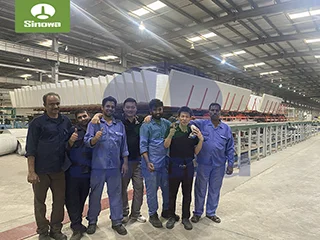
sandwich panel line
Foam core sandwich panels are composite structural materials composed of upper and lower surface layers and a lightweight foam core layer, featuring a unique layered structure that combines the high strength of surface materials with the excellent thermal insulation and shock absorption properties of foam core materials. Compared with traditional single-layer building and industrial plates, these panels boast outstanding advantages such as low density, high specific strength, good thermal and sound insulation performance, and convenient installation. The quality of sandwich panels is largely determined by the precision and stability of the production process, making the automatic production line the core equipment to ensure consistent structural integrity, stable performance, and uniform specifications of finished panels. Unlike discrete production equipment that completes single processes independently, the fully automatic foam core sandwich panel line realizes seamless connection of all production links, with each process unit operating in synchronous coordination to eliminate process gaps and human-induced errors.
The overall structural design of the automatic foam core sandwich panel production line follows the principles of continuous production, modular combination, and intelligent control. The entire production system consists of multiple functional modules arranged in a linear sequence, including a raw material unwinding and conveying module, surface layer pretreatment module, automatic glue coating module, foam core material positioning and laying module, high-precision lamination and pressing module, constant-temperature shaping and curing module, fixed-length cutting and trimming module, and finished product conveying and stacking module. Each module is independently equipped with precise transmission and control components, and the whole line adopts a unified servo linkage system to realize synchronous speed adjustment and dynamic parameter matching. This modular design not only facilitates daily maintenance and fault detection of the equipment but also supports flexible adjustment of production specifications, enabling the line to adapt to panels of different thicknesses, widths, and material combinations without major equipment modification.
Raw material feeding and conveying is the starting link of the entire production process, responsible for stable and orderly input of surface layer materials and foam core materials. For coiled surface materials such as metal sheets and composite color plates, the production line is equipped with automatic unwinding devices with tension control functions. These devices maintain constant material tension during the unwinding process through dynamic torque adjustment, effectively avoiding material deviation, wrinkling, and stretching deformation caused by uneven tension. For plate-shaped surface materials and block foam core materials, the system adopts automatic material feeding racks and conveyor belts with positioning baffles, which realize automatic material sorting and directional conveying. The conveying speed of all feeding units is synchronously linked with the operating speed of the subsequent processing modules, ensuring that the supply speed of raw materials always matches the processing speed of the production line, preventing material accumulation or supply interruption, and maintaining the continuity of production.
Surface pretreatment is a critical pre-process to ensure the bonding firmness between the surface layer and the foam core material, directly affecting the overall structural stability and service life of the finished sandwich panel. During long-term storage and transportation, surface materials are prone to adhering to dust, oil stains, and fine impurities, and the surface will form a dense oxide layer or passive film, which will reduce the bonding force between the surface layer and the core material. The automatic production line is equipped with integrated pretreatment units, including high-efficiency dust removal equipment and surface finishing devices. The dust removal unit adopts multi-stage air circulation dust removal technology, which can thoroughly remove floating dust and particulate impurities on the surface of the material through high-pressure airflow and static adsorption. For materials with surface stains and uneven textures, the fine finishing process is completed through mechanical fine grinding and leveling, which optimizes the surface flatness and roughness of the material, creating a clean and uniform bonding interface for the subsequent adhesive coating process. All pretreatment processes are completed automatically without manual intervention, ensuring consistent pretreatment effects for each batch of materials.
Adhesive coating is the core process to realize the composite bonding of surface layer and foam core material, and the uniformity and accuracy of glue coating directly determine the bonding quality of the sandwich panel. The automatic sandwich panel production line is equipped with high-precision roller coating glue supply systems, which can realize quantitative and uniform coating of environmental composite adhesives on the inner surface of the upper and lower surface layers. Different from traditional manual glue spraying and single-sided glue coating processes, the automated system supports double-sided synchronous glue coating, and the glue coating thickness and glue supply amount can be intelligently adjusted according to the material type, panel thickness, and production speed. The internal glue supply pipeline adopts a constant-temperature circulation design to ensure the stability of adhesive viscosity during the coating process, avoiding glue accumulation, glue shortage, and uneven coating caused by adhesive solidification or excessive fluidity. The precision roller coating structure can control the glue layer thickness within a tiny error range, making the adhesive layer form a dense and uniform bonding film between the surface layer and the foam core material, which not only improves the bonding strength but also avoids the performance defects such as hollowing and degumming caused by uneven glue application.
Foam core material positioning and laying is a key process to ensure the neat structure and uniform thickness of the sandwich panel. Foam core materials have the characteristics of low density, large compressibility, and easy deformation, and manual laying is prone to problems such as offset, overlapping, and gap distribution, resulting in inconsistent local thickness and unstable structural performance of the panel. The automatic production line is equipped with intelligent core material laying and positioning systems, which complete automatic cutting, conveying, and precise laying of foam core materials through servo drive and encoding positioning technology. After the foam core material is cut into fixed specifications by the precision cutting unit, it is stably transported to the composite station through the special conveying mechanism. The dynamic positioning device conducts real-time correction of the position of the core material, ensuring that the core material is completely aligned with the upper and lower surface layers, with no offset or gap in the horizontal direction. At the same time, the system can adjust the laying density and flatness of the core material according to the production process requirements, effectively avoiding core material accumulation and compression deformation, and ensuring that the internal structure of each sandwich panel is uniform and consistent.
Lamination and pressing are important processes to realize the integral composite forming of sandwich panels. After the surface layer with uniform adhesive coating and the precisely laid foam core material are initially compounded, they enter the high-precision lamination pressing unit for integral pressing and bonding. The pressing unit adopts multi-group synchronous pressing rollers with pressure balance control function, which can provide uniform and stable pressing force for the composite plate body. The system realizes stepless adjustment of pressing pressure according to the thickness of the panel, the hardness of the foam core material, and the curing characteristics of the adhesive, avoiding core material crushing, surface layer depression caused by excessive pressure, or insufficient bonding tightness caused by too little pressure. All pressing rollers maintain parallel operation through precise mechanical calibration and synchronous servo control, ensuring that the pressure on the entire plate surface is uniform, and the thickness error of the pressed plate body is controlled within a very small range. The continuous rolling pressing mode replaces the traditional intermittent static pressing process, which greatly improves production efficiency while ensuring the flatness and structural compactness of the composite panel.
Constant-temperature shaping and curing processes determine the final bonding strength and structural stability of sandwich panels. After lamination and pressing, the adhesive between the surface layer and the core material needs a stable temperature environment to complete the curing reaction and form a firm bonding structure. The automatic production line is equipped with closed constant-temperature curing channels, which adopt multi-stage temperature zoning control technology to form a gradient curing temperature field. The low-temperature pre-curing area preliminarily stabilizes the bonding state to prevent plate body displacement and glue layer flowing; the medium-temperature curing area accelerates the molecular reaction of the adhesive to realize rapid bonding and fixing; the constant-temperature shaping area eliminates the internal stress of the plate body and optimizes the overall flatness of the panel. The internal temperature of the curing channel is monitored in real time by high-precision temperature sensors, and the intelligent control system dynamically adjusts the heating power and air circulation speed to maintain constant temperature stability in the channel. The integrated design of curing and shaping enables the plate body to complete adhesive curing and stress relief in the continuous conveying process, effectively avoiding plate warping, deformation, and degumming defects caused by uneven curing and incomplete stress release.
Fixed-length cutting and edge trimming are the finishing processes of panel forming, which realize the specification shaping and appearance optimization of finished products. After curing and shaping, the continuous integral plate body is conveyed to the cutting unit, and the intelligent length measurement system automatically identifies and records the conveying length of the plate body. When the plate body reaches the preset production specification size, the high-speed precision cutting mechanism automatically completes fixed-length cutting. The cutting tool adopts high-hardness wear-resistant materials and is equipped with a stable damping structure, which can ensure smooth and burr-free cutting sections without causing extrusion deformation of the plate body. For the irregular edges on both sides of the plate body formed in the composite process, the automatic edge trimming unit performs synchronous trimming treatment to ensure that the width of the finished panel is consistent and the edges are neat and smooth. All cutting and trimming parameters are intelligently adjustable, which can quickly adapt to the production requirements of panels of different specifications, realizing flexible switching of production sizes and meeting the diversified specification needs of different application scenarios.
Finished product conveying and automatic stacking are the final links of the continuous sandwich panel production line, realizing automatic collection and arrangement of finished panels. The qualified panels after cutting and trimming are stably output through the finished product conveyor belt, and the intelligent stacking mechanism automatically completes sorting and stacking according to the preset stacking specifications. The servo-driven stacking device can accurately control the lifting height and horizontal displacement, ensuring that each panel is stacked neatly with consistent spacing, no offset or tilting. The automated stacking mode replaces manual carrying and stacking, not only reducing labor input and labor intensity but also avoiding surface scratches, plate deformation, and stacking disorder caused by manual operation. The stacked finished products form standard material stacks, which can be directly connected to the subsequent packaging and warehousing links, realizing the full-process automated operation from raw material input to finished product output.
The core advantages of the automatic foam core sandwich panel machine are reflected in its high production efficiency, stable product quality, strong production flexibility, and low comprehensive operating cost. In terms of production efficiency, the continuous uninterrupted production mode of the assembly line realizes synchronous operation of multiple processes, with the production speed far exceeding that of traditional semi-automatic equipment. The integrated process arrangement eliminates the waiting and handling time between discrete processes, realizing streamlined and intensive production and greatly improving the hourly output and annual output of panels. In terms of product quality control, the full-process automated operation reduces human intervention to the greatest extent, and all process parameters such as glue coating amount, pressing pressure, curing temperature, and cutting size are precisely controlled by the system with high repeatability, ensuring that the structural performance, appearance size, and bonding quality of each batch of panels remain highly consistent, effectively reducing the defective rate caused by human operation errors.
In terms of production flexibility, the modular and intelligent design of the continuous sandwich panel line enables it to adapt to diverse production needs. By adjusting the system parameters and replacing a small number of auxiliary fixtures, the line can produce sandwich panels with different foam core materials, different surface layer materials, and different thickness specifications. This flexible production capability enables manufacturers to quickly respond to market demand changes, meet the customized production requirements of different industries and different projects, and improve the market adaptability of production equipment. In terms of operating cost control, the highly automated production mode greatly reduces the number of on-site operators, saving long-term labor costs. At the same time, the precise quantitative control of raw materials such as adhesives and core materials reduces material waste, and the intelligent energy-saving control system optimizes the energy consumption of each equipment unit, realizing low-energy and high-efficiency production operation and reducing the comprehensive production cost of finished panels.
In terms of production stability and safety, the automatic foam core sandwich panel manufacturing line is equipped with a complete intelligent monitoring and fault protection system. The whole line is equipped with real-time monitoring sensors for speed, pressure, temperature, and material status, which collect production data in real time and feed it back to the central control system. The system realizes dynamic adjustment of process parameters according to the production status, ensuring that each process is always in the optimal production state. When abnormal conditions such as material blockage, equipment overload, and parameter deviation occur, the system will automatically trigger early warning and protective shutdown procedures to avoid equipment damage and product batch defects caused by abnormal operation. In addition, the equipment is designed with fully enclosed protective structures and safe operating intervals, which effectively avoid potential safety hazards in the production process and ensure the safety and stability of long-term continuous operation of the production line.
Foam core sandwich panels produced by automatic production lines have excellent comprehensive performance and are widely used in multiple fields such as industrial plant construction, commercial building enclosure, cold storage and fresh-keeping engineering, transportation facilities, and indoor decoration. In the field of building construction, the lightweight and high-strength characteristics of the panels can reduce the self-weight of buildings, optimize the structural design of buildings, and shorten the construction cycle. The excellent thermal insulation and heat preservation performance can effectively reduce the energy consumption of building heating and cooling, realizing energy-saving and low-carbon building operation. In cold storage and logistics facilities, the low thermal conductivity of the foam core material ensures stable internal temperature of the cold storage, reduces cold air loss, and improves the operational efficiency of cold chain equipment. In transportation and mobile facility manufacturing, the shock absorption and heat insulation properties of the panels can meet the lightweight and functional requirements of mobile buildings and transportation equipment.
With the continuous progress of industrial manufacturing technology and the continuous improvement of market requirements for composite material performance, the automatic foam core sandwich panel line is also developing in the direction of higher intelligence, higher precision, and more environmental protection. The upgraded production line introduces intelligent visual detection technology, which can realize real-time online detection of panel surface defects, internal hollowing, and bonding gaps, accurately identifying tiny defects that are difficult to distinguish by human eyes, and realizing full-quality inspection of products. At the same time, the production line adopts more environmentally friendly adhesive coating systems and low-energy heating and curing technologies, which reduce the emission of volatile substances in the production process, realize green and environmentally friendly production, and meet the increasingly stringent environmental protection production standards of the industry.
In addition, the intelligent data management function of the new generation of sandwich panel machinery realizes real-time recording, statistics, and analysis of production data such as output, yield, material consumption, and equipment operating status. Production managers can grasp the production progress and equipment operation status in real time through the data platform, realize refined production management and equipment maintenance, further optimize production processes, improve production efficiency and product quality, and provide reliable data support for enterprise production decision-making. The continuous technological iteration of the production line also promotes the upgrading of the overall manufacturing level of the sandwich panel industry, driving the industry to develop from extensive manual production to intensive intelligent manufacturing.
In conclusion, the automatic foam core sandwich panel production line is an indispensable key equipment in the modern composite material manufacturing industry. It integrates advanced mechanical manufacturing technology, servo control technology, and intelligent detection technology, realizing standardized, efficient, and stable mass production of foam core sandwich panels. Through precise control of each production link, the equipment ensures the excellent and consistent comprehensive performance of finished panels, provides high-quality composite material products for multiple downstream industries, and promotes the rapid development of related fields such as building energy conservation and industrial lightweight manufacturing. With the continuous expansion of the application scope of sandwich panels and the continuous improvement of industrial manufacturing standards, the automatic foam core sandwich panel line will continue to play an important role in the industrial chain, and its technological innovation and application optimization will further inject strong impetus into the high-quality development of the composite material manufacturing industry.
https://www.cnsinowa.com/sandwich-panel-machines/automatic-foam-core-sandwich-panel-line.html