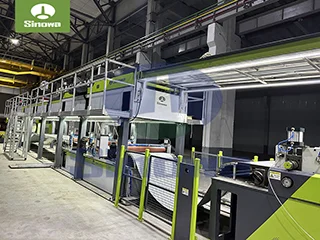
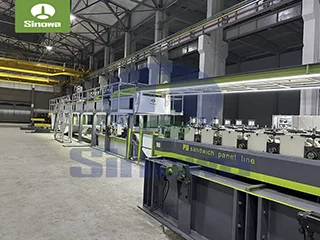
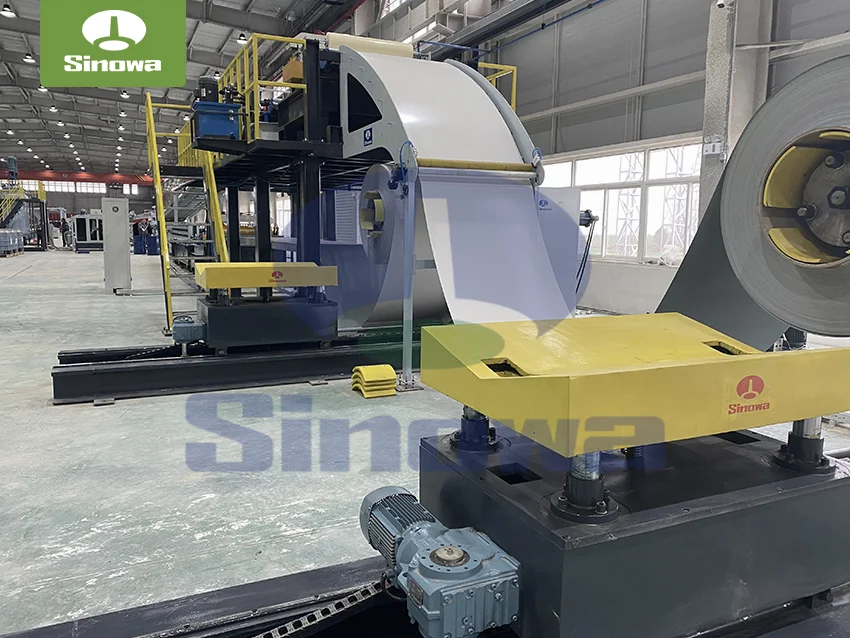
 sandwich panel machine
Different from ordinary sandwich panel production equipment used for common factory buildings and simple enclosure structures, the cold storage sandwich panel machine is professionally optimized and upgraded in structural design, foaming control system, composite pressing process, and dimensional precision adjustment according to the special low-temperature working environment and high thermal insulation requirements of cold storage facilities. ordinary architectural sandwich panels only need to meet basic wind resistance, rainproof, and simple heat insulation functions for conventional ambient temperature environments, while cold storage sandwich panels need to withstand long-term low-temperature internal working conditions, frequent temperature differences between internal and external environments, and even harsh environmental factors such as high humidity and frost condensation inside the cold storage for many years. Therefore, the production equipment for cold storage panels must strictly control the uniformity of the core thermal insulation material foaming density, the bonding firmness between the outer metal surface layer and the inner thermal insulation core material, the flatness of the overall panel surface, and the consistency of overall dimensional specifications during the entire production process. Any subtle deviation in production parameters or unstable operation of equipment components will lead to problems such as uneven thermal insulation performance of finished panels, weak delamination between layers, structural deformation after long-term use, and poor on-site assembly sealing effect, which will directly cause cold air leakage inside the cold storage, increased energy consumption of refrigeration systems, and even local icing and structural damage to the cold storage enclosure in severe cases, seriously affecting the safe storage of goods and the normal service life of the cold storage. It is precisely based on these rigorous industry application requirements that the structural design and operating logic of cold storage sandwich panel machines are completely centered on high precision, high stability, high composite strength, and consistent thermal insulation performance, realizing integrated automated production from raw material feeding to finished panel output.
The complete composition of a cold storage sandwich panel line covers multiple functional and interconnected mechanical and control sections, each undertaking an irreplaceable key production link, and all sections cooperate synchronously through a unified intelligent control system to ensure the continuity and stability of the entire production line operation. The front-end part of the whole equipment is the raw material unwinding and preliminary processing area, which is mainly responsible for placing and orderly outputting the metal coiled materials used for the upper and lower surface layers of the sandwich panels. These metal coiled materials are the outer protective structure of the finished cold storage panels, needing good surface flatness, corrosion resistance, and structural pressure resistance to adapt to the long-term humid and low-temperature external environment of the cold storage and the external wind and snow load pressure. The unwinding device is designed with automatic tension adjustment and deviation correction functions, which can always maintain the stable conveying state of metal coiled materials in the horizontal and vertical directions during continuous production operation, avoiding material deviation, wrinkling, or uneven feeding speed that may affect the subsequent composite processing effect. After the metal coiled materials are unwound and output, they will enter the surface pretreatment and leveling link, where special leveling rollers and surface fine-tuning components are used to eliminate the internal stress of the metal materials generated during coiling and storage, ensuring that the metal surface layer maintains a flat and smooth state in the subsequent composite process, laying a good foundation for the tight bonding between the metal surface layer and the thermal insulation core material in the later stage.
Following the metal surface layer pretreatment section is the core raw material feeding and high-pressure foaming injection section, which is the most critical functional part of the entire cold storage sandwich panel machine and the core link that determines the thermal insulation performance and overall bonding quality of the finished panels. The thermal insulation core material of cold storage sandwich panels is mostly made of high-efficiency foamed thermal insulation materials with excellent low-temperature resistance and low thermal conductivity, and the foaming raw materials are accurately proportioned and transported to the high-pressure foaming machine inside the equipment through a professional raw material conveying system. The equipment is equipped with an independent automatic batching and metering control module, which can precisely control the mixing ratio, flow rate, and output speed of different foaming raw materials according to the preset production process parameters. Accurate proportioning is extremely important for foaming effect, because slight changes in the ratio will directly lead to fluctuations in foaming density, uneven internal cell structure of the core material, and reduced thermal insulation effect. After the raw materials are fully mixed in the high-pressure foaming equipment, they are evenly and continuously injected between the upper and lower metal surface layers that are being conveyed synchronously. The entire injection process is carried out in a closed and stable environment to avoid external air mixing or raw material splashing, ensuring that the foaming raw materials can be evenly distributed in the composite gap of the panels without local accumulation or missing injection.
After the completion of foaming raw material injection, the semi-finished panels immediately enter the continuous composite pressing and constant temperature curing molding section, which undertakes the important tasks of bonding forming and initial curing of the sandwich panels. This section is composed of multiple groups of high-strength pressing roller sets and constant temperature circulating heating components, which can provide stable and uniform pressing pressure and suitable curing temperature for the composite panels. Under the action of continuous mechanical pressure, the upper and lower metal surface layers and the intermediate foaming raw materials are closely fitted without gaps, and the foaming materials gradually expand and foam uniformly under constant temperature conditions, forming a fine and closed cell thermal insulation structure inside the core material. The pressure and temperature parameters in the pressing and curing process are dynamically adjusted according to the thickness specifications and production speed of different cold storage panels. Too high pressure will cause excessive compression of the foaming core material, reduce the thickness of the thermal insulation layer and affect the thermal insulation effect, while too low pressure will lead to insufficient bonding between layers and easy delamination of finished panels; inappropriate temperature will cause incomplete foaming or excessive foaming shrinkage of the core material, resulting in unstable structural performance of the panels. Through the precise matching of mechanical pressure and constant temperature curing, the foaming core material and metal surface layer form an integrated composite structure with high bonding strength and overall stability in this link, and the initial shaping of the cold storage sandwich panel is completed.
Subsequently, the initially cured and shaped sandwich panels are transported to the continuous cooling and shaping buffer section, which is an essential transition link to ensure the stable final forming of the panels and avoid structural deformation. The panels just after high-temperature curing and pressing have not yet completely completed the internal material reaction and structural stabilization, and the internal temperature is relatively high. Direct subsequent cutting and stacking processing will easily lead to thermal deformation of the panels, surface unevenness, or internal structural loose rebound. The cooling and shaping section adopts a natural air cooling and auxiliary air circulation cooling mode, which gradually reduces the overall temperature of the panels at a stable speed, allowing the internal foaming core material to complete the final chemical reaction and structural stabilization, and eliminating the internal stress generated during the pressing and curing process. The length and cooling speed of the cooling buffer section can be adjusted according to the production speed and panel thickness, ensuring that each batch of panels achieves consistent cooling and shaping effects, maintaining the flatness and structural stability of the panel surface, and avoiding quality problems such as warping and bending of finished panels after leaving the production line.
The rear end of the cold storage sandwich panel production line is equipped with an automatic fixed-length cutting and edge trimming processing section, which realizes precise sizing and finished panel shaping according to the actual use specifications of cold storage engineering construction. After cooling and shaping, the continuous long-strip composite panels are transported to the cutting position through the conveying system, and the equipment automatically identifies and cuts according to the preset panel length parameters required by the customer's project. The cutting component adopts a stable and precise cutting structure, which can complete the cutting operation smoothly without generating burrs, edge collapses, or metal surface scratches on the panel cutting section, ensuring the flatness and neatness of the panel end face. At the same time, the edge trimming function of the equipment can finely trim the edges on both sides of the panels to ensure the consistent width specifications of each finished panel, so as to achieve a tight fit and good sealing effect during on-site assembly and installation of the cold storage. After cutting and edge trimming, the finished cold storage sandwich panels are automatically output to the finished product conveying and stacking area, realizing orderly arrangement and convenient handling and transportation in the later stage, and the entire automated production process is completed efficiently and continuously.
The intelligent control system configured for the cold storage sandwich panel production machine runs through all production links of the entire equipment and is the central core to coordinate the synchronous operation of each functional section and ensure stable and consistent product quality. The control system integrates parameter setting, real-time operation monitoring, automatic fault detection, and production data statistics functions. Production operators only need to set the basic parameters such as panel thickness, width, length, production speed, and foaming ratio according to the production demand of cold storage panels. The system will automatically synchronously adjust the operating parameters of unwinding feeding, foaming injection, pressing pressure, curing temperature, cooling time, and cutting size of each link, realizing truly automated unattended continuous production in the whole process. During the production operation, the control system monitors the operating status of each motor, roller set, raw material conveying pump, and temperature and pressure sensors in real time. Once abnormal fluctuations in parameters or minor equipment operation faults are detected, the system will automatically send prompt reminders and make adaptive adjustments to avoid mass production of defective products. At the same time, the system can record daily production output, parameter adjustment records, and equipment operation status data, providing convenient data support for later production management, equipment maintenance, and production process optimization.
The application advantages of cold storage sandwich panel machinery in the cold chain supporting manufacturing industry are extremely prominent, mainly reflected in stable product quality, high production efficiency, flexible production adaptation, and low long-term production operation cost. In terms of product quality stability, compared with traditional manual or semi-automatic panel production methods that rely on manual operation experience, fully automated mechanical production can completely avoid quality differences caused by manual operation errors, ensuring that the foaming density, bonding strength, dimensional accuracy, and surface flatness of each batch of cold storage panels are maintained in a unified and stable state. The finished panels produced by this equipment have good overall structural integrity, excellent low-temperature thermal insulation performance, strong corrosion resistance and compression resistance, and can maintain stable working performance for a long time in the complex low-temperature and high-humidity working environment of cold storage, effectively reducing the cold air loss of cold storage and reducing the long-term operating energy consumption of refrigeration equipment. In terms of production efficiency, the continuous automated production mode realizes seamless connection from raw material feeding to finished product output, with fast production speed and large daily output, which can meet the large-scale and centralized panel supply demand of large cold storage construction projects and shorten the overall construction cycle of cold storage projects.
In terms of production flexibility, the cold storage sandwich panel manufacturing machine can quickly adjust production parameters to produce cold storage panels of different thicknesses, widths, and surface material types, adapting to the differentiated needs of different types of cold storage. For example, ultra-thick thermal insulation panels required for ultra-low temperature frozen cold storage, conventional thermal insulation panels for fresh food refrigerated cold storage, and special anti-corrosion panels for chemical low-temperature storage can all be produced by adjusting the equipment process parameters without replacing a large number of mechanical components, which greatly improves the flexibility and applicability of production equipment. In terms of long-term production cost control, the automated production mode reduces the number of on-site production operators, reduces labor input costs, and the precise raw material metering and conveying system effectively avoids raw material waste, improving the utilization rate of foaming raw materials and metal coiled materials. At the same time, the stable operation performance of the equipment reduces the frequency of equipment failure maintenance, reduces later maintenance and downtime loss, and creates good economic benefits for panel production manufacturers.
Daily maintenance and scientific operation management are crucial to prolonging the service life of the cold storage sandwich panel making machine and maintaining long-term stable production efficiency. As a large-scale continuous automated production equipment integrating machinery, electricity, and hydraulic pressure, long-term high-load operation will inevitably cause normal wear and tear of mechanical components and aging of electrical control parts. Regular daily maintenance work includes cleaning the residual foaming materials and metal debris on the surface of each functional section of the equipment, checking the tightness and wear of each transmission roller set and conveyor belt, lubricating the rotating and transmission parts regularly to ensure flexible operation of mechanical components, and checking the accuracy and sensitivity of temperature, pressure, and metering sensors regularly to ensure accurate and reliable production parameter monitoring. It is also necessary to regularly inspect the sealing performance of the foaming raw material conveying pipeline and the operating status of the high-pressure foaming pump to avoid raw material leakage or unstable conveying pressure affecting foaming quality. For the electrical control system and circuit parts, regular dust cleaning and circuit aging inspection are required to avoid circuit failure caused by dust accumulation or line aging, ensuring the safe and stable operation of the control system.
With the continuous development and upgrading of the global cold chain logistics industry and the continuous expansion of the scale of cold storage construction in various regions, the market demand for high-quality cold storage sandwich panels continues to grow steadily, which also puts forward higher requirements for the performance, automation level, and production stability of cold storage sandwich panel machines. The future development direction of such sandwich panel production equipment will be further intelligent and automated, with more precise parameter control systems, more efficient foaming and composite processes, and more intelligent fault self-diagnosis and remote monitoring functions. The continuous technological iteration and equipment upgrading of cold storage sandwich panel machines will further improve the production quality and production efficiency of cold storage thermal insulation panels, reduce the overall energy consumption of panel production, and provide more reliable and high-quality basic material guarantee for the construction of more efficient and energy-saving modern cold storage facilities. As an indispensable core production equipment in the cold chain supporting industry, the cold storage sandwich panel machine will always play an important basic supporting role in the development of the entire cold chain industry, promoting the continuous progress of cold storage construction technology and the stable development of cold chain logistics and storage business.
https://www.cnsinowa.com/sandwich-panel-machines/cold-storage-sandwich-panel-machine.html