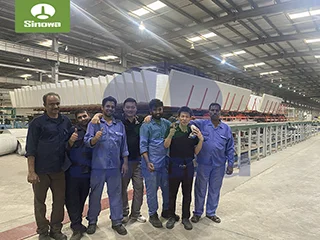
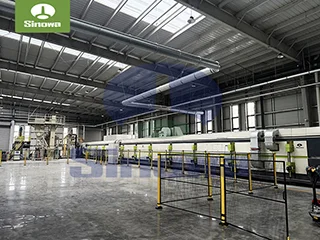
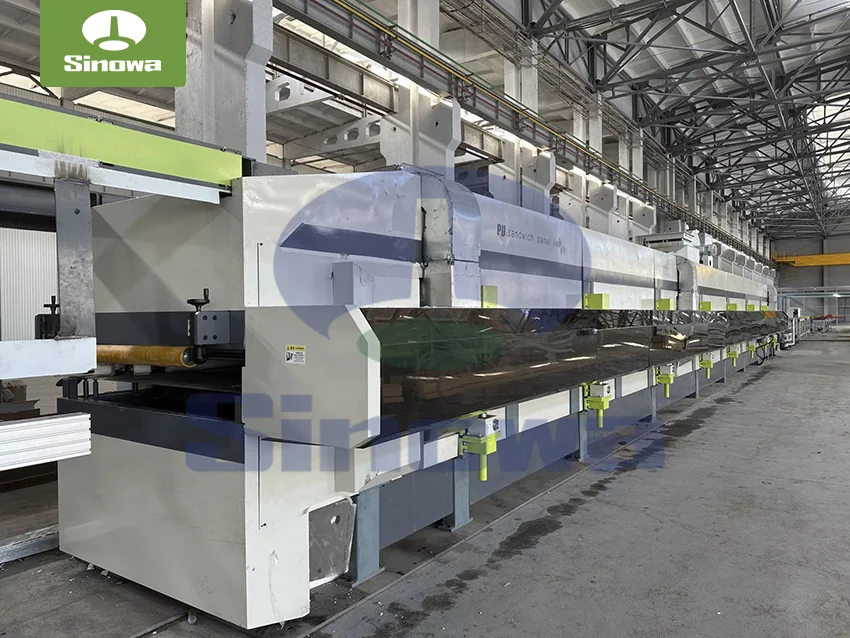
 sandwich panel line
The fundamental design concept of a polyurethane sandwich panel manufacturing line centers on continuous composite molding technology, which differs from intermittent molding equipment in terms of production continuity and process integration. The entire production system takes continuous flat surface materials as the outer protective layers and uses polyurethane foam as the core thermal insulation and filling layer. Through precise chemical raw material metering, uniform foaming, constant-temperature composite pressing, and continuous curing treatment, the line completes the integrated molding of surface layers and core materials in an uninterrupted production flow. The overall structural layout of the manufacturing line follows a linear production sequence, with each functional unit closely connected to avoid material transmission delays and process discontinuity. Every mechanical module in the line is adjusted to match the production speed and process parameters of adjacent units, forming a highly coordinated automated production chain that minimizes manual intervention and reduces the instability caused by human operation.
The complete polyurethane sandwich panel manufacturing line consists of multiple interconnected functional modules, each undertaking independent production tasks while maintaining synchronous operation. The primary functional units include surface material unwinding systems, surface pretreatment mechanisms, chemical raw material storage and metering systems, high-precision foaming and material distribution equipment, constant-temperature composite pressing units, continuous curing tunnels, trimming and cutting mechanisms, as well as finished product conveying and stacking devices. Auxiliary supporting systems such as temperature control circuits, pressure regulation components, and automatic lubrication structures are also embedded in each module to guarantee the long-term stable operation of mechanical equipment. Every component of the production line is designed based on fluid mechanics, thermodynamics, and material mechanics principles to adapt to the physical changes of polyurethane raw materials during chemical reactions and the composite bonding process between surface materials and foam cores.
The surface material unwinding system serves as the starting terminal of the entire production line, responsible for continuously providing coiled surface materials for panel production. Common surface materials applicable to the production line include metal color plates, non-metal decorative plates, and anti-corrosion flat plates, all of which are stored in roll form to adapt to continuous feeding requirements. Each unwinding unit is equipped with an independent damping adjustment structure and a deviation correction sensing device. The damping structure stabilizes the discharging tension of coiled materials to prevent material deformation, wrinkling, or stretching during the unwinding process, while the deviation correction device monitors the material transmission trajectory in real time and automatically fine-tunes the feeding angle to ensure that the surface materials remain in a horizontal and centered conveying state. For production lines requiring double-sided composite molding, two sets of unwinding devices are configured to supply upper and lower surface materials respectively, and the transmission speeds of the two sets of equipment are synchronized through a unified servo control system to avoid position misalignment between the upper and lower plates.
Following the unwinding process, the surface materials enter the pretreatment mechanism to complete surface cleaning and structural shaping. During the storage and transportation of coiled materials, fine dust, oil stains, and oxide layers inevitably adhere to the surface, which would weaken the bonding strength between the surface material and polyurethane foam without thorough removal. The pretreatment unit is fitted with high-pressure air dedusting components and soft friction cleaning structures. The high-pressure air flow blows away floating particles on the material surface, and the soft friction components remove stubborn attachments without scratching the surface of the plates. In addition, some production lines are equipped with edge trimming and bending auxiliary structures in the pretreatment stage. These structures perform micro-bending treatment on the edges of flat plates according to the preset panel specification standards, forming enclosed edge structures for subsequent composite molding, which enhances the overall structural tightness and edge compression resistance of finished sandwich panels. After pretreatment, the surface materials are smooth, clean, and structurally shaped, creating optimal bonding conditions for the foaming composite process.
The chemical raw material storage and metering system is the core functional module that determines the foaming quality of polyurethane cores. Polyurethane foam is formed by the chemical reaction between two main raw materials: polyether resin and curing agent, supplemented by trace additives such as foaming agents and stabilizers. This system is composed of sealed raw material tanks, filter components, frequency conversion metering pumps, and flow monitoring sensors. The raw material tanks adopt an insulated sealing structure to isolate external temperature interference and prevent raw material deterioration caused by temperature fluctuation and air oxidation. Each raw material tank is correspondingly equipped with an independent frequency conversion metering pump driven by a servo motor. The rotating speed of the metering pump can be accurately adjusted through an electronic control system to control the output flow of raw materials, ensuring that various raw materials are mixed in the optimal reaction proportion. Built-in high-precision flow sensors transmit real-time flow data to the central control terminal, and the system automatically corrects flow deviations to keep the raw material mixing ratio within a stable error range, avoiding foaming defects such as uneven bubble holes and insufficient curing caused by unreasonable proportioning.
After precise metering, the raw materials are transported to the foaming and material distribution equipment for mixing and uniform spraying. The foaming equipment adopts a high-pressure mixing structure, where multiple groups of raw materials are injected into the mixing chamber at a constant pressure to achieve turbulent flow mixing. This mixing method enables the molecular-level fusion of different raw materials, accelerating the initiation of chemical cross-linking reactions. The mixed raw materials are quickly transported to the mobile material distribution mechanism, which moves horizontally along the width direction of the lower surface material at a uniform speed. In the moving state, the mixed liquid raw materials are evenly sprayed on the surface of the lower plate. The spraying range and material distribution density are dynamically adjusted according to the preset panel thickness parameters. The uniform distribution of raw materials effectively prevents local accumulation or shortage of materials, ensuring that the thickness and density of the polyurethane foam core are consistent throughout the panel. The whole foaming and distributing process is completed in a closed space to avoid the volatilization of chemical raw materials and reduce the impact of external air flow on the foaming reaction.
The composite pressing unit undertakes the key task of bonding the upper and lower surface materials with the polyurethane foam core. After the liquid raw materials are sprayed on the lower plate, the upper surface material is accurately covered through a guiding roller structure, and the initially combined plate body is sent into the constant-temperature pressing area. The pressing unit is composed of upper and lower symmetric pressing roller sets and a sealed heating chamber. The internal temperature of the heating chamber is stably maintained within a reasonable temperature range required for polyurethane curing. Under the dual action of constant temperature and uniform pressure, the liquid foam raw materials undergo continuous foaming and expansion. The pressure generated by foam expansion enables the raw materials to fully fill the gap between the two layers of surface materials, and the moderate mechanical pressure applied by the pressing rollers eliminates internal voids. Meanwhile, the constant-temperature environment accelerates the cross-linking reaction of polyurethane molecules, enhancing the bonding force between the foam core and the surface materials. The pressure and temperature parameters in the pressing area are intelligently linked with the production speed. When the line running speed changes, the system automatically adjusts the pressure value and heating temperature to adapt to the reaction time required for foaming and curing, ensuring the bonding firmness of composite structures.
The continuous curing tunnel is an extended thermal insulation structure arranged behind the pressing unit, aiming to complete the deep curing and molecular stabilization of polyurethane foam. Although the panel initially forms a composite structure after pressing, the internal chemical reaction of the foam is not completely finished, and the molecular structure is unstable. Without continuous heat preservation and curing, the finished panel is prone to deformation, shrinkage, and decreased insulation performance in the later stage. The interior of the curing tunnel is divided into multiple temperature gradient areas. The temperature gradually decreases from the inlet to the outlet of the tunnel, which conforms to the natural cooling rule of chemical reactions and avoids structural cracks caused by excessive temperature difference. The tunnel is equipped with a circulating hot air system to make the internal temperature distribution uniform without local overheating. The running speed of the conveying track inside the tunnel is synchronized with the front-end production units to ensure that each panel obtains sufficient curing time. After passing through the curing tunnel, the internal molecular reaction of the polyurethane foam is completely terminated, and the overall structure of the panel becomes compact and stable, with fixed physical properties such as hardness, thermal conductivity, and compression resistance.
The trimming and cutting mechanism is responsible for finishing and fixed-length cutting of cured semi-finished panels. During the continuous composite molding process, the edges of the panel will produce irregular residual materials and unbonded burrs due to the spreading range of foaming raw materials and the alignment error of surface materials. The trimming unit is equipped with high-speed rotating cutting tools, which symmetrically trim the two side edges of the panel to make the edge lines flat and neat. The trimmed waste materials are automatically collected through a conveying pipeline for centralized recycling and processing, improving the comprehensive utilization rate of raw materials. The fixed-length cutting device uses intelligent positioning sensors to identify the conveying distance of the panel. When the panel reaches the preset length standard, the cutting tool quickly cuts the panel vertically. The cutting speed matches the production line conveying speed to realize non-stop dynamic cutting, avoiding production interruption caused by static cutting and effectively improving production continuity. All cutting components are made of wear-resistant alloy materials to adapt to long-term high-frequency cutting operations and maintain cutting flatness.
The final stage of the production process is finished product conveying and stacking. The cut standard panels are transported to the sorting platform through a low-speed conveying belt. The platform is equipped with a surface detection device to conduct preliminary visual inspection on the appearance of the panels, identifying obvious defects such as surface scratches, edge gaps, and uneven thickness. Panels that meet the production standards are automatically stacked by a mechanical stacking device. The stacking mechanism adjusts the stacking spacing and arrangement mode according to the panel size and weight to prevent extrusion deformation between stacked panels. Defective products are separately conveyed to the reprocessing area through a shunt pipeline for manual inspection and secondary processing. The entire finished product processing link minimizes manual contact, reducing surface contamination and collision damage of panels, and the neatly stacked finished products are convenient for subsequent packaging, transportation, and warehousing management.
In addition to the main production units, the auxiliary control system of the polyurethane sandwich panel manufacturing line plays an irreplaceable supporting role in stable production. The central electronic control system integrates all mechanical modules of the production line, realizing one-stop parameter setting, operation monitoring, and fault alarm. Operators can adjust production parameters such as raw material proportioning, conveying speed, heating temperature, and cutting size through the human-computer interaction interface. The system records real-time operating data of each unit and generates production data reports, which is convenient for production personnel to track the production status and optimize process parameters. The temperature control auxiliary system adopts circulating heat conduction oil for heating, with uniform heat transfer and small temperature fluctuation, which can accurately control the temperature difference of each thermal processing unit within a narrow range. The pressure regulation system uses hydraulic and pneumatic combined structures to maintain stable pressing force, avoiding pressure fluctuation caused by mechanical vibration. Moreover, the production line is equipped with a sound insulation and dust removal structure to reduce mechanical operation noise and prevent dust diffusion, improving the on-site production environment.
In terms of production process control, polyurethane sandwich panel manufacturing lines have strict technical requirements for environmental conditions and parameter matching. The ambient temperature of the production workshop needs to be kept within a moderate range to prevent the viscosity of chemical raw materials from changing drastically due to excessive temperature difference, which would affect the foaming effect. The air humidity in the workshop should also be controlled, because excessive moisture will react with polyurethane raw materials and generate redundant bubbles, reducing the compactness of the foam core. In the raw material processing link, the stirring speed and mixing time of the mixing chamber need to be matched with the discharging speed to ensure that the raw materials are always in the optimal reaction state during spraying. In the composite pressing link, the matching degree between pressure value and panel thickness is crucial. Excessive pressure will cause the foam core to be overly compressed and reduce thermal insulation performance, while insufficient pressure will lead to poor bonding between layers and easy delamination of panels.
Daily maintenance and regular inspection are essential to extend the service life of polyurethane sandwich panel manufacturing lines and maintain stable production quality. Daily maintenance work includes cleaning residual raw materials on the surface of conveying rollers and cutting tools, checking the tightness of connecting parts of each mechanical module, and supplementing lubricating oil for rotating and transmission components to reduce mechanical friction loss. The sealing performance of raw material transportation pipelines needs to be inspected every day to prevent raw material leakage and waste. Regular maintenance covers deep maintenance such as calibrating metering pump accuracy, detecting sensor sensitivity, and cleaning the internal dust of the curing tunnel. Worn cutting tools and aging sealing parts should be replaced regularly to avoid production quality fluctuations caused by component aging. In addition, the electronic control system needs regular data backup and circuit inspection to prevent circuit failures from causing production line shutdowns. Scientific maintenance management can effectively reduce equipment failure rates, lower production and maintenance costs, and ensure the long-term stable operation of the production line.
Polyurethane sandwich panels produced by automated manufacturing lines have excellent comprehensive performance and are widely used in multiple industrial and construction fields. In the building construction industry, these panels serve as wall and roof enclosure materials for prefabricated buildings, owing to their light weight and convenient installation, which effectively shortens the construction cycle. In the cold chain storage industry, panels with high-density foam cores are used to build constant-temperature storage warehouses, relying on their low thermal conductivity to reduce internal and external heat exchange and maintain stable storage temperature. In addition, the panels are also applied in industrial purification workshops, transportation vehicle carriage manufacturing, and outdoor anti-corrosion enclosure engineering. Different application scenarios put forward differentiated requirements for panel thickness, surface material type, and foam density, and the flexible parameter adjustment function of modern manufacturing lines can meet the personalized production needs of various specifications of panels.
With the continuous progress of industrial manufacturing technology, polyurethane sandwich panel manufacturing lines are constantly evolving towards automation, energy saving, and intelligence. The upgraded production lines adopt more precise servo transmission systems to improve the synchronization accuracy of each production unit and further reduce product dimensional errors. In terms of energy consumption optimization, the heating system adopts waste heat recovery technology to collect residual heat from the curing tunnel and pressing area and reuse it for raw material preheating, effectively reducing energy consumption. The intelligent detection technology is gradually popularized in production lines. Through embedded optical sensing and thickness detection components, the system realizes real-time monitoring of panel density, flatness, and bonding strength, and automatically adjusts process parameters to eliminate defective products in the production process. Meanwhile, the structural design of the production line pays more attention to environmental protection, adopting closed raw material circulation structures to reduce the volatilization of chemical gases and minimize the impact of production on the external environment.
In the future development of the composite material industry, polyurethane sandwich panel manufacturing lines will further integrate digital management and modular design concepts. The digital management system will realize the interconnection of production data, inventory data, and quality inspection data, forming a traceable production management system. The modular structural design enables the production line to quickly replace functional modules, adapt to the switching production of different types of sandwich panels, and improve the flexibility of production equipment. In addition, with the continuous innovation of new environmental protection raw materials, the production line will be compatible with more low-carbon and low-pollution polyurethane raw materials, realizing green and low-carbon production. The continuous upgrading and optimization of manufacturing lines will further expand the application scope of polyurethane sandwich panels and promote the sustainable development of the composite material manufacturing industry.
To sum up, the polyurethane sandwich panel manufacturing line is a highly integrated automated production system combining mechanical transmission, chemical reaction control, and intelligent monitoring technology. From raw material feeding to finished product stacking, each production link has rigorous process logic and technical standards. The reasonable structural layout, precise parameter control, and scientific maintenance management jointly ensure the high efficiency and high quality of panel production. With the growing market demand for energy-saving and environmental protection composite materials, the technological upgrading of polyurethane sandwich panel manufacturing lines will continue to advance, providing more reliable production equipment support for the construction, cold chain, and industrial manufacturing industries, and creating greater application value for the modern composite material industry.
https://www.cnsinowa.com/sandwich-panel-machines/polyurethane-sandwich-panel-manufacturing-line.html