 sandwich panel line
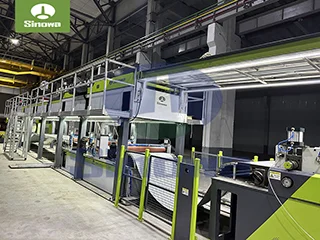
The entire operation logic of the PU sandwich panel production line revolves around continuous, streamlined, and high-precision manufacturing, covering complete processes from raw material pretreatment and molding to foaming compounding, curing shaping, fixed-length cutting, and finished product sorting. The front-end working module of the production line focuses on the pretreatment and profiling of surface layer materials, which are mostly metal coiled materials with excellent toughness and weather resistance suitable for outdoor and long-term industrial use. The coiled materials are stably unwound through automatic unwinding equipment, eliminating material tension deviation and winding deformation that may occur during manual feeding. After unwinding, the materials pass through multi-group leveling and roller forming structures, which gradually calibrate flatness and fold the edges into standardized profiles. This process ensures that the surface plates maintain consistent thickness and structural regularity, laying a solid foundation for subsequent composite bonding and on-site installation. Meanwhile, the production line is equipped with precise edge trimming and surface cleaning units to remove burrs, oxide layers, and surface impurities generated during rolling, maximizing the bonding tightness between the surface layer and the core material and avoiding delamination and cracking of panels during long-term warehouse use.
The foaming and composite bonding stage constitutes the core functional part of the entire PU sandwich panel line, determining the thermal insulation performance, structural strength, and overall stability of finished panels. Polyurethane composite raw materials, composed of two-component chemical materials, are transported to the high-pressure metering and mixing system through precision delivery devices. The system strictly controls the mixing ratio and flow rate of raw materials through electronic calibration technology, ensuring uniform mixing of the two components without local proportion deviation. Well-mixed liquid polyurethane materials are evenly injected between the upper and lower surface plates through a circulating injection structure. In a closed and temperature-controlled processing environment, the liquid materials undergo rapid chemical reaction, continuous expansion, and dense foaming, fully filling the gap between the two surface layers and forming a microcellular and uniform foam core structure. This integral foaming and bonding method realizes chemical fusion between the core material and surface plates, rather than simple physical adhesion, effectively improving the overall structural integrity of the panels. For industrial warehouses that require long-term load resistance, wind pressure resistance, and frequent internal environment adjustment, this integrated composite structure can avoid core material hollowing, plate separation, and local deformation caused by temperature changes and external pressure impacts.
After the completion of foaming and preliminary compounding, the semi-finished panels enter the double-belt pressing and curing system for fixed molding and performance stabilization. The double-belt laminating structure provides continuous and uniform pressure covering the entire panel surface, effectively limiting excessive expansion of the foam core and ensuring consistent thickness and flatness of each batch of panels. The internal temperature of the curing system is maintained within a constant and reasonable range through automatic temperature adjustment modules, which accelerates the complete curing and shaping of polyurethane foam, promotes the solidification of the bonding interface, and locks the physical and chemical properties of the panels. The whole curing process adopts segmented temperature control and linear speed matching design. With the forward movement of the conveyor belt, the panels complete gradual temperature rise curing and constant temperature shaping, avoiding internal stress concentration caused by sudden temperature changes. This precise curing process enables the finished panels to have stable dimensional tolerance, uniform core density, and excellent overall flatness, which is crucial for the seamless assembly of large-area warehouse wall and roof structures. Panels with stable dimensions can effectively reduce assembly gaps during on-site construction, improving the airtightness and overall structural consistency of warehouse buildings.
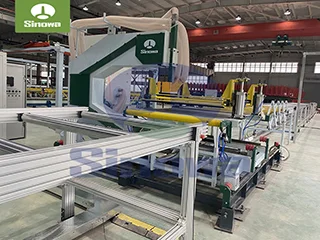
Subsequent processing links of the polyurethane sandwich panel production line include automatic cooling, fixed-length cutting, and finished product conveying and sorting. The initially cured panels pass through the circulating cooling area to complete natural stress relief and dimensional stabilization, eliminating subtle deformation that may occur during high-temperature curing. After cooling, the panels are accurately cut into standard lengths according to preset parameter settings. The cutting equipment adopts high-speed and stable cutting technology to ensure smooth and burr-free cutting sections, facilitating later butt joint and installation. The cut finished panels are automatically transported to the terminal sorting platform through the conveying system, realizing orderly stacking and arrangement. The whole process from raw material feeding to finished product output is continuously automated, with no excessive manual intervention required, which not only greatly improves production efficiency but also maintains consistent product quality of each batch, avoiding quality fluctuations caused by manual operation errors. For large-scale warehouse construction projects that require massive standardized building materials, the high-efficiency continuous production capacity of the production line can stably supply qualified panels and meet the progress requirements of centralized construction.
PU sandwich panels produced by professional production lines have highly adaptable performance characteristics for industrial warehouse application scenarios, covering thermal insulation, weather resistance, structural safety, and construction practicability. In terms of thermal insulation performance, the closed-cell microcellular structure of polyurethane foam core can effectively block heat conduction and air convection, creating a stable internal temperature environment for warehouses. For logistics warehouses, cold chain storage warehouses, and industrial production warehouses with constant temperature storage requirements, this excellent thermal insulation effect can significantly reduce the energy consumption of internal temperature regulation equipment, maintain long-term stable indoor temperature, and avoid goods quality problems caused by excessive temperature fluctuation. Meanwhile, the dense foam core structure has good sound insulation and noise reduction effects, which can isolate external environmental noise and internal equipment operation noise, improving the overall working environment of the warehouse and meeting the environmental control needs of modern industrial storage spaces.
In terms of structural performance, the composite structure of metal surface layer and PU foam core gives the panels excellent mechanical properties. The metal surface layer provides strong tensile strength, impact resistance, and surface wear resistance, while the foam core disperses external pressure and bending force, enabling the panels to withstand certain wind pressure, snow load, and external impact. This structural advantage allows the panels to adapt to different regional climatic environments, whether it is strong wind weather in coastal areas or low-temperature freezing weather in northern areas, they can maintain stable structural state without deformation, damage, or performance attenuation. In addition, the overall light weight of PU sandwich panels greatly reduces the self-weight of warehouse buildings, effectively lowering the load-bearing pressure on the main steel structure of the warehouse, reducing the structural design difficulty and construction cost of the building foundation, and improving the overall safety and service life of the warehouse.
The polyurethane sandwich panel line flexible parameter adjustment capability further expands the application scope of finished panels in industrial warehouse construction. By adjusting raw material formula, foaming density, panel thickness, and surface layer specifications, the production line can produce customized panels for different warehouse functional requirements. Thickened high-insulation panels can be used for special cold storage and constant-temperature warehouses to enhance extreme temperature resistance; high-density core panels with enhanced structural strength are suitable for warehouse roof structures that need to bear snow load and external impact; lightweight standard panels are widely used in warehouse exterior walls, partition walls, and auxiliary enclosure structures. This flexible production mode enables a single production line to meet the diversified material needs of different types of industrial warehouses, realizing multi-scene and multi-functional product coverage and improving the comprehensive utilization value of production equipment.
In terms of construction and application advantages, PU sandwich panels produced by continuous production lines adopt standardized modular design, with unified specifications and precise sizes. On-site construction only requires assembly and fixing, eliminating complex processes such as on-site welding, painting, and thermal insulation laying required for traditional building materials. The simplified construction process greatly shortens the construction cycle of warehouse projects, improves construction efficiency, and reduces on-site construction labor input and construction waste generation. At the same time, the smooth and flat surface of the panels has good anti-fouling and weather resistance, which can resist the erosion of rainwater, dust, and industrial corrosive gases. The panels are easy to clean and maintain in daily use, reducing the later maintenance cost of warehouse buildings. For industrial warehouses that require long-term continuous operation and low maintenance frequency, this low-cost and high-durability advantage significantly improves the economic benefits of building operation.
With the continuous upgrading of industrial warehouse construction standards and the increasing demand for energy-saving and environmentally friendly industrial buildings, the technological optimization of PU sandwich panel machine is also advancing in the direction of intelligence, high efficiency, and energy conservation. Modern production lines adopt integrated electronic control systems to realize centralized regulation of feeding, mixing, foaming, pressing, curing, and cutting processes. The system can monitor production parameters in real time, automatically adjust operating speed and process parameters according to production requirements, and realize early warning and correction of abnormal production conditions, further improving production stability and product qualification rate. In terms of energy saving and environmental protection, the optimized raw material mixing and injection structure reduces raw material waste, and the closed production process avoids the volatilization and leakage of chemical materials during production, realizing clean and low-consumption production. The produced PU sandwich panels, as energy-saving and recyclable green building materials, conform to the development trend of modern industrial green construction and can effectively reduce the overall energy consumption and carbon emission level of warehouse buildings.
In practical industrial warehouse engineering applications, the matching degree between production line manufacturing technology and building usage demand directly determines the comprehensive quality of warehouse buildings. The standardized and precise manufacturing mode of the polyurethane sandwich panel machine solves the problems of inconsistent performance, uneven specifications, and unstable quality of manually produced composite panels. The integrated molding process ensures the long-term structural stability and performance durability of the panels, enabling warehouse buildings to maintain good enclosure performance, thermal insulation effect, and structural safety during decades of service. Whether it is a large-scale logistics distribution warehouse, a factory raw material storage warehouse, a finished product turnover warehouse, or a special industrial storage space, PU sandwich panels produced by professional continuous production lines can provide reliable building material support, helping industrial warehouses achieve safer, more energy-saving, more efficient, and more durable operation.
In conclusion, the continuous PU sandwich panel production line as a professional and efficient manufacturing system for industrial warehouse building materials, integrates precise process control, automated continuous production, and diversified product customization functions. It provides high-quality, high-performance, and high-adaptability composite panel products for industrial warehouse construction through standardized and streamlined production links. Its technical advantages in structural molding, performance optimization, and efficient production perfectly fit the core demands of modern industrial warehouses for safety, energy saving, environmental protection, and efficient construction. With the continuous development of the industrial logistics industry and the continuous upgrading of industrial building standards, the PU sandwich panel production line will continue to play an important role in the field of warehouse supporting manufacturing, providing solid technical and product support for the standardized construction and long-term stable operation of various industrial warehouse facilities.
https://www.cnsinowa.com/sandwich-panel-machines/pu-sandwich-panel-line-for-industrial-warehouse.html