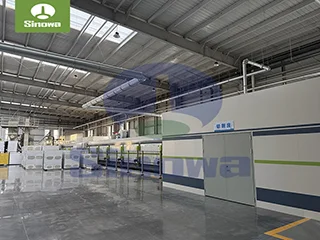
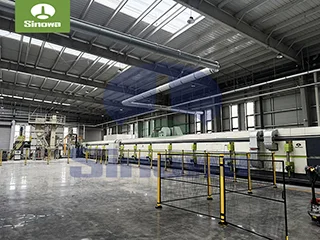
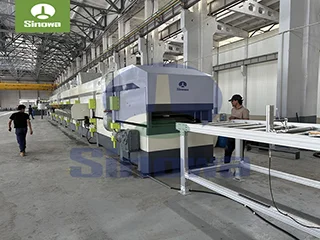
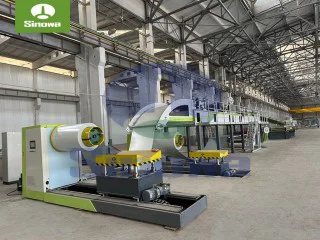
 sandwich panel line
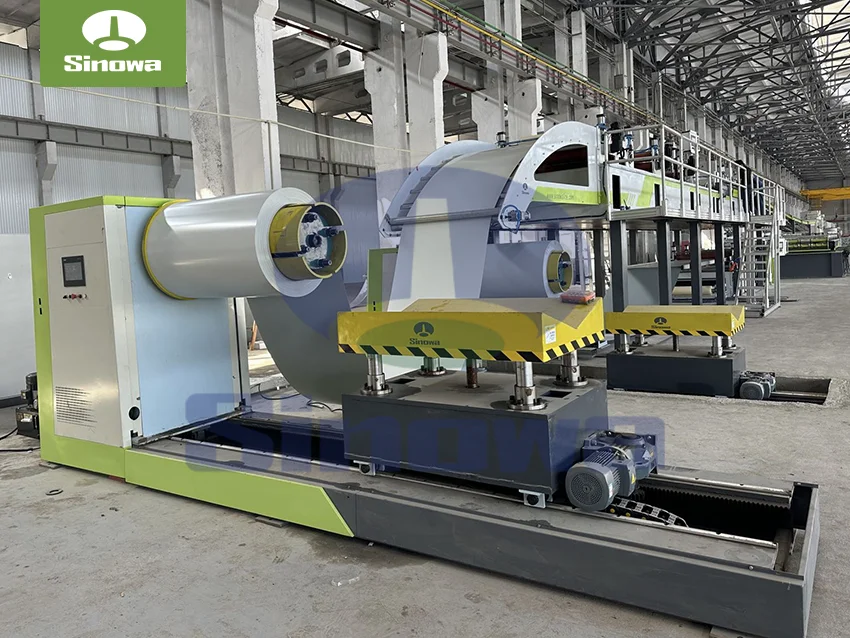
The overall operation logic of the PU sandwich panel production line follows a continuous linear manufacturing process, with each functional module closely connected and dynamically coordinated to ensure uninterrupted material transmission and orderly process iteration. The entire production flow starts with the unwinding and leveling of upper and lower surface facing materials, which can be metal sheets, color-coated plates, or other decorative and protective substrates with stable mechanical properties. Before formal composite forming, the surface materials undergo preliminary cleaning and tension adjustment to eliminate surface impurities and material bending stress, ensuring that the subsequent composite process can maintain complete flatness and bonding consistency. After surface material preparation, the high-precision foaming and pouring system uniformly sprays the proportioned polyurethane raw material between the upper and lower facing layers. The polyurethane raw material undergoes rapid chemical reaction after mixing, starting uniform foaming and expansion to form a dense closed-cell foam core structure, which undertakes the core thermal insulation, shock absorption, and structural connection functions of the sandwich panel.
As the most critical core forming equipment in the polyurethane sandwich panel production line, the double belt press undertakes the key process of foam curing, composite bonding, and panel thickness shaping. Different from traditional single-pressure lamination equipment, the double belt press adopts a dual-parallel circulating belt structure, which can wrap the upper and lower surfaces of the initially formed sandwich panel in an all-round manner and apply continuous and uniform static pressure across the entire panel width and length. This omnidirectional pressure control mode completely avoids the local pressure deviation and thickness difference caused by intermittent pressing in traditional processes, ensuring that the polyurethane foam core can fully expand and fill every gap between the two facing materials. During the pressing process, the internal temperature of the double belt press is accurately regulated within a stable range suitable for PU foam polymerization and curing. The constant-temperature heating environment accelerates the molecular cross-linking reaction of polyurethane, enabling the foam core to complete curing and forming stably within the set time, and form a firm integrated bonding structure with the upper and lower facings without delamination or hollowing.
The structural design of the double belt press fully considers the diversity of sandwich panel production specifications. By adjusting the gap between the upper and lower belts, the system can adapt to panel production of different thicknesses, while the adjustable running speed of the circulating belts matches the foaming reaction speed of different polyurethane formulations. The internal guide and limit structure of the press ensures that the surface materials will not deviate or shift during the high-speed continuous conveying process, maintaining the straightness and dimensional accuracy of the finished panel. In addition, the heat insulation and heat preservation structure configured inside the press effectively reduces internal heat loss, not only improving the uniformity of the internal curing temperature field but also optimizing the overall energy consumption level of the production process. The long-term stable operation of the double belt press eliminates the problem of inconsistent curing degrees between the edge and the middle of the panel, which is common in traditional production processes, and greatly improves the overall structural uniformity and mechanical stability of the sandwich panel.
After completing constant-temperature curing and primary forming in the double belt press, the high-temperature panel is immediately transported to the cooling tunnel for graded heat dissipation and stress stabilization treatment, which is an indispensable post-forming process link to ensure the final quality of the product. The newly formed PU sandwich panel will retain a high internal temperature after curing, and the internal molecular structure of the foam core is in an unstable state with obvious residual thermal stress. If the panel is directly cut, stacked or packaged without cooling treatment, the residual stress will be gradually released in the subsequent storage and use process, resulting in panel warping, surface unevenness, dimensional shrinkage and other quality defects, and even affecting the bonding firmness of the core material and the surface layer in severe cases. The cooling tunnel is specially designed to solve this problem, realizing slow and uniform heat dissipation of the panel through a scientific heat exchange system, and gradually stabilizing the internal structure of the foam core.
The cooling tunnel adopts a combined heat dissipation mode of forced air cooling and auxiliary balanced heat conduction, abandoning the inefficient natural cooling method and the rapid cooling mode that easily causes structural cracking. The interior of the tunnel is equipped with multi-group symmetric air supply units and flow guide structures, which can form a uniform circulating air flow field inside the closed tunnel body. This air flow field can evenly act on the upper, lower and side surfaces of the continuously moving panel, ensuring that the temperature of all parts of the panel decreases synchronously without local temperature difference. The internal cooling space is designed in a segmented graded temperature reduction structure, which realizes the transition from medium-temperature slow cooling to low-temperature constant-temperature heat dissipation. This gradual cooling process fully adapts to the molecular stabilization law of polyurethane foam, effectively releases the internal curing stress of the panel, fixes the finalized dimensional structure, and avoids structural damage caused by rapid temperature change.
The coordinated operation of the double belt press and cooling tunnel constitutes the core quality control system of the entire PU sandwich panel line, forming a closed-loop process of high-temperature curing forming and constant-temperature cooling shaping. The double belt press ensures the structural compactness, bonding strength and dimensional uniformity of the panel during the high-temperature forming stage, while the cooling tunnel locks the forming effect through scientific heat dissipation, eliminates potential quality hazards caused by residual stress, and greatly improves the weather resistance and structural stability of the finished panel. The seamless connection between the two equipment modules realizes continuous non-stop production, avoiding product quality fluctuations caused by intermediate material transfer and process interruption, and significantly improving production efficiency and product yield.
Compared with traditional polyurethane sandwich panel line that lack integrated cooling systems or adopt simple pressing structures, this integrated production line has obvious comprehensive advantages in product performance and production efficiency. In terms of product quality, the panels produced by this process have more uniform core density, higher overall flatness, and more stable bonding performance between the core material and the surface layer. The closed-cell foam structure formed by sufficient curing and stable cooling has excellent thermal insulation performance, low thermal conductivity, and stable heat preservation effect in long-term use. At the same time, the panels effectively avoid post-production deformation and size deviation, ensuring the assembly accuracy and sealing effect in on-site construction, which is particularly suitable for high-standard application scenarios such as cold storage insulation, clean workshop enclosure, and high-rise building exterior wall thermal insulation.
In terms of production efficiency and operational economy, the fully continuous automated production mode of the sandwich panel line reduces manual intervention links, realizes synchronous coordination of material feeding, foaming, pressing, curing, cooling and conveying, and greatly improves the continuous production capacity of the production line. The precise temperature and pressure control system optimizes the utilization rate of polyurethane raw materials, reduces material waste caused by insufficient foaming or excessive expansion, and lowers the comprehensive production cost. The efficient heat preservation structure of the double belt press and the energy-saving circulating heat dissipation design of the cooling tunnel effectively reduce the overall energy consumption of production, realizing energy-saving and environmentally friendly manufacturing while ensuring product quality stability.
The process flexibility of the polyurethane sandwich panel line also enables it to meet the diversified production needs of the market. By adjusting the operating parameters of the double belt press, including pressing pressure, curing temperature and conveying speed, and matching the cooling gradient and operating speed of the cooling tunnel, the line can produce PU sandwich panels with different thicknesses, densities and surface specifications. Whether it is thin lightweight panels for building interior decoration or thick high-strength insulation panels for industrial cold chain equipment, the system can complete stable forming and high-quality production. The finished panels maintain consistent structural performance and dimensional accuracy in different specification productions, with strong product compatibility and market adaptability.
In practical industrial production applications, the collaborative working mechanism of the double belt press and cooling tunnel also greatly reduces the defective rate of finished products. Traditional production equipment is prone to problems such as partial incomplete curing, uneven foam expansion, and large residual stress, leading to a large number of defective products in the subsequent cutting and use process. The integrated sandwich panel machine solves these industry pain points through precise whole-process control: the double belt press realizes full coverage of pressure and temperature in the curing stage to ensure sufficient and uniform reaction of the foam core; the graded cooling of the cooling tunnel stabilizes the internal structure of the panel, making the mechanical properties and dimensional stability of the finished panel reach a high level. The improved product qualification rate not only reduces the loss of raw materials and production time, but also improves the market competitiveness of finished building materials.
With the continuous upgrading of the prefabricated construction industry and the increasing demand for high-efficiency energy-saving building materials, the performance requirements for PU sandwich panels are becoming increasingly stringent in terms of thermal insulation, structural stability, durability and assembly performance. This advanced sandwich panel manufacturing line with double belt press and cooling tunnel provides a reliable technical guarantee for the iterative upgrading of sandwich panel products. Its continuous, precise and intelligent production characteristics adapt to the large-scale and high-quality development trend of the modern building material industry, and can continuously output high-performance PU sandwich panels suitable for various complex application scenarios.
In conclusion, the PU sandwich panel line integrating double belt press and cooling tunnel represents the mature and advanced production technology in the field of polyurethane composite panel manufacturing. The double belt press undertakes precise curing and composite forming, while the cooling tunnel completes structural stabilization and quality locking. The organic combination of the two core processes realizes the optimization and upgrading of the entire production process, effectively improving the production efficiency, product quality and production economy of PU sandwich panels. As a key equipment for modern energy-saving building material production, this sandwich panel machinery will continue to play an important role in promoting the high-quality development of prefabricated buildings, cold chain logistics, industrial plant construction and other fields, and provide stable and reliable material support for the realization of energy-saving and low-carbon development in the construction industry.
https://www.cnsinowa.com/sandwich-panel-machines/pu-sandwich-panel-line-with-double-belt-press-and-cooling-tunnel.html