 sandwich panel line
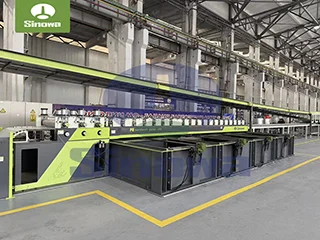
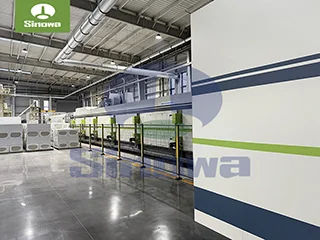
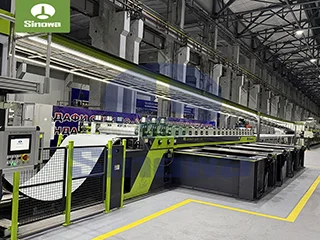
The overall structural layout of the heavy-duty PU sandwich panel production line follows a linear continuous production logic, with each functional module closely connected and coordinated to eliminate production gaps and ensure uninterrupted batch manufacturing. The entire production system covers raw material unwinding, surface pretreatment, roll forming, precise chemical mixing and pouring, high-pressure composite lamination, constant-temperature curing, fixed-length cutting, surface finishing, and automatic stacking, forming a closed-loop production system with high automation and low manual intervention. Every structural component of the sandwich panel production line is reinforced and optimized for long-term high-load operation, effectively resisting mechanical fatigue and structural deformation caused by prolonged continuous production, which is the key reason why it can maintain stable production quality and efficient output in long-cycle industrial manufacturing scenarios.
The front-end unwinding and feeding module serves as the starting point of the entire production process, undertaking the continuous supply of upper and lower surface base materials for sandwich panels. This module is equipped with multi-station unwinding structures that can adapt to different types of metal coiled materials commonly used in industrial building panels, realizing synchronous and stable feeding of double-layer surface materials. The built-in tension control system of the feeding mechanism can dynamically adjust the material transmission tension in real time according to production speed and material specifications, effectively avoiding material deviation, wrinkling, and stretching deformation during the feeding process. Before formal forming, the sandwich panel line is equipped with an independent surface pretreatment process section, which thoroughly removes surface dust, oil stains, and oxide attachments on the base materials. This pretreatment link is indispensable, as it eliminates potential factors that weaken the bonding performance between the surface material and the PU foam core layer, laying a solid foundation for the overall structural firmness and service life of the finished panels.
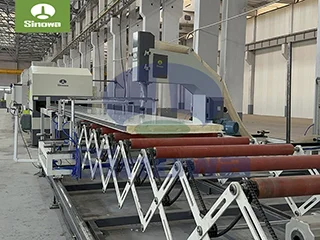
Following the pretreatment process, the base materials are accurately conveyed to the roll forming module, a core functional unit that shapes the flat coiled materials into standardized industrial panel profiles. The heavy-duty roll forming system adopts multi-group tandem rolling stations with high-precision roller sets, which conduct gradual bending, pressing, and shaping on the materials. This progressive forming method avoids instantaneous stress damage to the base materials, ensuring the uniformity and consistency of the panel profile structure. The roller components are manufactured with high rigidity and wear resistance, capable of adapting to long-term rolling forming of high-thickness and high-hardness base materials for industrial buildings. Meanwhile, the forming module supports flexible adjustment of forming parameters, enabling rapid switching between different panel profile specifications and structural styles, which greatly improves the production diversity of the entire line and meets the customized profile requirements of various industrial building envelope panels.
The PU foam mixing and pouring unit is the most critical core part of the heavy-duty polyurethane sandwich panel production line, directly determining the thermal insulation performance, structural density, and bonding stability of the finished sandwich panels. This unit adopts a high-pressure dynamic mixing structure, which fully blends the two core chemical raw materials of polyurethane, polyol and isocyanate, together with auxiliary foaming components, in a closed mixing chamber. The precision flow control system accurately calibrates the proportion of each raw material in real time, ensuring that the mixed polyurethane liquid has uniform reaction activity and stable foaming density. Different from ordinary production lines, the heavy-duty pouring system optimizes the liquid distribution structure, enabling the polyurethane raw materials to be evenly injected and spread between the upper and lower formed surface materials without local accumulation or sparse distribution. This uniform pouring mode ensures that the foam core layer of each panel maintains consistent thickness and density across the entire area, avoiding partial hollowing, uneven hardness, and inconsistent thermal insulation effect that often occur in ordinary production processes.
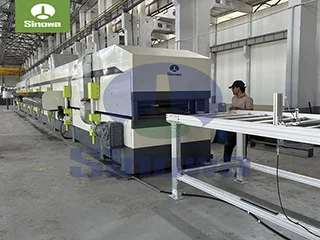
After the completion of foam pouring, the semi-finished panels enter the high-pressure lamination and constant-temperature curing section, which is the key link to realize the integral composite molding of sandwich panels. The heavy-duty lamination mechanism is equipped with an integral rigid frame structure, which provides uniform and stable pressure for the composite panel body, enabling the polyurethane foam to fully expand and fill the gap between the double-layer surface materials under constant pressure conditions. The internal temperature control system of the curing section maintains a stable and reasonable reaction temperature environment, accurately matching the foaming and curing reaction cycle of polyurethane materials. Under the dual action of constant pressure and constant temperature, the polyurethane foam completes foaming, solidification, and cross-linking reaction stably, and forms a strong molecular bonding structure with the inner surface of the base materials. This integrated composite process eliminates the risk of delamination and peeling between the core layer and the surface layer, endowing the industrial panels with excellent overall structural strength and anti-stripping performance, which can withstand external wind pressure, temperature difference deformation, and mechanical extrusion in complex industrial building environments.
The length of the curing section of the heavy-duty PU sandwich panel line is scientifically optimized according to the foaming reaction characteristics of high-performance polyurethane materials, ensuring that the foam core layer achieves complete curing and stable structural performance before leaving the molding section. Insufficient curing will lead to unstable internal structure of the panel, easy deformation in later use, and reduced thermal insulation performance, while the optimized curing process of the heavy-duty line completely solves this problem and realizes one-time integral molding of high-quality panels. During the curing process, the production line's real-time monitoring system continuously tracks the operating parameters of pressure, temperature, and transmission speed, automatically adjusting parameter deviations to ensure that each batch of panels is produced under consistent process conditions and maintain highly unified product quality.
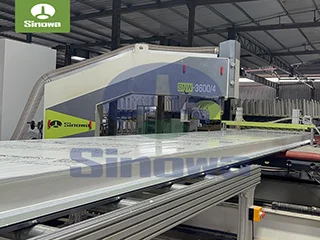
After completing curing and integral molding, the continuous long-strip panel materials are conveyed to the precision cutting and finishing module. Equipped with a high-speed tracking and cutting mechanism, this module can perform fixed-length cutting according to customized dimensional requirements, realizing seamless tracking and cutting during the continuous transmission of panels without stopping production. The cutting tool adopts high-precision wear-resistant components, which ensure smooth and flat panel cutting sections without burrs, collapses, or uneven cuts, eliminating the need for secondary manual trimming. In addition, the finishing section also completes edge trimming and surface protection treatment of the panels, removing tiny residual materials generated during the production process and further optimizing the appearance and structural precision of the finished panels. The automated cutting and finishing system features high dimensional accuracy, effectively ensuring that the length and edge specifications of each finished panel meet the precise construction standards of industrial buildings.
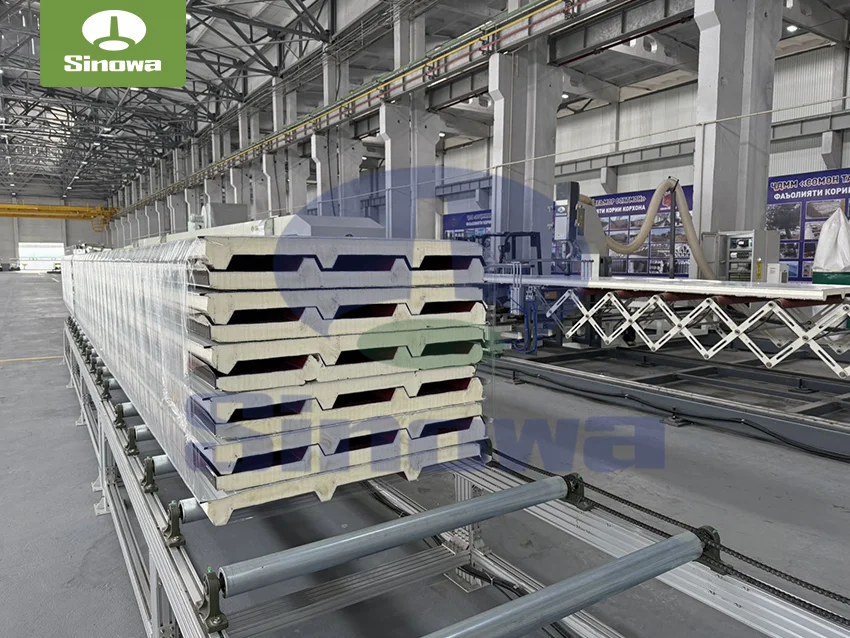
The final stage of the production process is automatic conveying, cooling, stacking, and finished product output. The newly produced panels have residual curing temperature, and the independent cooling conveying section accelerates the uniform heat dissipation of the panels, stabilizing the internal structural performance of the foam core layer and avoiding structural deformation caused by rapid temperature change. The fully automatic stacking mechanism accurately stacks the qualified finished panels in order according to fixed specifications, realizing orderly collection of finished products and greatly reducing manual handling and stacking work. The entire output process is highly automated, which not only improves production efficiency but also avoids surface scratches, structural damage, and stacking irregularities caused by manual operation, effectively protecting the finished product quality.
The core advantages of heavy-duty polyurethane sandwich panel line is fully reflected in their industrial adaptability and product performance advantages, making them the preferred production equipment for high-standard industrial building panels. In terms of production stability, the overall reinforced mechanical structure of the equipment can adapt to 24-hour continuous high-load operation, with extremely low failure rate and stable production rhythm, which is very suitable for large-scale centralized production needs of industrial building materials. In terms of product performance control, the precise raw material proportioning, uniform foaming and curing process enable the produced PU sandwich panels to have ultra-low thermal conductivity, excellent thermal insulation and heat preservation effects, which can effectively reduce the energy consumption of industrial plant temperature regulation and meet the energy-saving and environmental protection design requirements of modern industrial buildings.
In terms of structural performance, the integrally molded composite structure makes the panels have high overall rigidity and good load-bearing and wind-resistant performance. The panels can adapt to various complex industrial building scenarios such as large-span factory workshops, warehouse enclosures, industrial purification workshops, and low-temperature storage buildings. Different from ordinary decorative sandwich panels, industrial building panels produced by heavy-duty lines have stronger environmental adaptability, capable of resisting extreme temperature changes, ultraviolet erosion, and humid and corrosive industrial environments, maintaining stable structural and thermal insulation performance for a long time and extending the service life of building envelope structures.
In terms of production flexibility, although the equipment is positioned for heavy-duty industrial production, it retains flexible parameter adjustment functions. By adjusting the rolling forming parameters, PU foaming density, curing time, and cutting dimensions, the PU sandwich panel machine can manufacture industrial panels with different thicknesses, profiles, and performance parameters, covering diversified product needs from conventional thermal insulation enclosure panels to high-strength load-bearing industrial panels. This flexible production feature enables a single production line to meet the supporting panel production needs of multiple types of industrial buildings, greatly improving the utilization rate of production equipment and reducing the comprehensive production cost of enterprises.
In terms of operational energy consumption and environmental protection, the optimized process design of the heavy-duty polyurethane sandwich panel machine effectively reduces energy loss in the production process. The closed foaming system avoids the overflow and waste of chemical raw materials, and the full reaction of polyurethane raw materials reduces the generation of residual waste. The entire production process realizes clean and low-consumption manufacturing, conforming to the green production development trend of the modern building materials industry. At the same time, the high automation level of the equipment reduces manual operation links, lowers the error rate caused by human factors in the production process, and further improves the yield and consistency of finished products.
With the continuous upgrading of modern industrial building standards, the market demand for high-performance, long-life, and energy-saving industrial building panels is constantly increasing, which also promotes the continuous technological optimization of heavy-duty PU sandwich panel production machinery. The equipment is gradually developing towards higher automation intelligence, more precise process control, and stronger production compatibility, continuously improving the comprehensive performance of produced industrial panels. As a key manufacturing equipment in the field of industrial building materials, the heavy-duty PU sandwich panel production line provides reliable technical and equipment support for the construction of high-quality, energy-saving, and durable modern industrial buildings, and occupies an indispensable core position in the industrial building material manufacturing industry.
https://www.cnsinowa.com/sandwich-panel-machines/heavy-duty-pu-sandwich-panel-production-line-for-industrial-building-panels.html