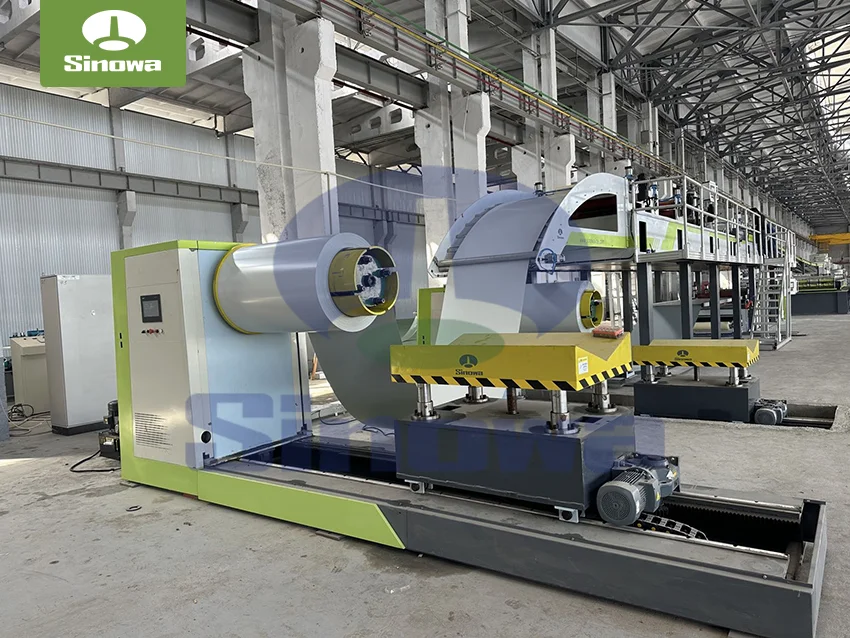
Following the surface material pretreatment stage, the roll forming process shapes the flat coiled materials into customized section structures that meet different application requirements. The roll forming unit consists of multiple groups of precision arranged forming rollers with gradual pressing design, which can slowly bend and shape the surface materials without damaging the structural integrity and surface flatness of the materials. By adjusting the operating parameters of the roller groups, the polyurethane sandwich panel production line can process surface materials of different thicknesses and mold various edge structures such as plug-in edges, lap joints and hidden buckle edges, adapting to the installation and assembly requirements of different engineering scenarios. The whole forming process is completed in a continuous rolling state, ensuring that the formed surface materials have consistent dimensional tolerance and structural uniformity in the full-length range, avoiding the local deformation and size deviation that are easy to appear in single-piece stamping forming.
The continuous PU foaming and high-pressure mixing system constitutes the core functional module of the sandwich panel production line, which directly determines the internal structure, density uniformity and thermal insulation performance of the sandwich panel core layer. Polyurethane foaming relies on the chemical cross-linking reaction between two main raw material components, and the PU sandwich panel production line adopts a fully automatic precision batching and high-pressure mixing mode to replace traditional manual proportioning and low-pressure stirring. The system precisely controls the feeding rate and proportion of different raw material components through servo metering units, ensuring that the raw material ratio always maintains the optimal reaction state during continuous production. After high-speed and high-pressure mixing in the professional mixing chamber, the liquid PU raw materials form a homogeneous mixed solution without particle agglomeration and component stratification, which provides a stable material basis for uniform foaming reaction.
The uniformly mixed liquid PU materials are continuously and quantitatively sprayed on the surface of the lower facing material through an oscillating gantry spraying mechanism. The spraying system features wide coverage and uniform material distribution, which can accurately adjust the spraying width, thickness and moving speed according to the preset panel core layer thickness parameters. In the spraying process, the liquid materials are evenly paved on the continuously moving lower plate surface, without local accumulation or missing spraying areas. With the synchronous operation of the conveyor system, the upper and lower facing materials carrying the liquid PU mixture enter the closed composite molding section together, where the PU materials begin to undergo rapid physical foaming and chemical curing reactions. In the relatively closed and constant-temperature molding space, the foaming materials expand evenly in all directions, fully fill the gap between the upper and lower surface materials, and form a dense and fine cellular structure inside the core layer.
The continuous double-belt lamination and constant-temperature curing system is a key link to realize the integrated composite forming of sandwich panels. During the foaming and curing process, the upper and lower double belts apply stable and uniform pressure to the composite plate body, which can effectively limit the excessive expansion of foaming materials and ensure the consistency of the core layer thickness and overall plate flatness. The internal temperature of the lamination section is kept within a constant optimal reaction range through the circulating temperature control system, which accelerates the cross-linking and curing speed of polyurethane materials and shortens the forming cycle. The continuous pressure maintaining and temperature holding environment enables the foaming reaction to proceed fully and stably, making the cellular structure of the PU core layer uniform and compact, and forming a firm and seamless bonding interface between the core layer and the upper and lower surface materials. This integrated molding method completely avoids the common defects of uneven core density, inconsistent plate thickness and easy delamination in batch intermittent production.
With the continuous operation of the conveyor system, the initially cured integral plate body gradually moves out of the lamination molding section and enters the cooling and shaping stage. Although the PU foam core layer has completed the basic curing and forming reaction in the lamination section, the internal material temperature is still high, and the structural stability and mechanical performance have not reached the optimal state. The cooling conveyor unit adopts segmented natural air cooling and auxiliary heat dissipation structures, which slowly and evenly dissipates the internal heat of the plate body without causing rapid temperature change that leads to structural deformation. Through a certain length of cooling transportation, the internal stress of the plate body is fully released, the core layer structure is further stabilized, and the bonding strength between the core layer and the surface materials is continuously improved, ensuring that the finished panel can maintain stable structural performance in subsequent cutting, stacking and use processes.
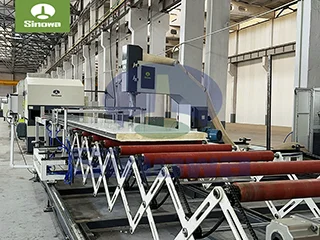
After full cooling and shaping, the continuous long-strip integral plate body enters the automatic fixed-length cutting process. The cutting unit adopts high-precision servo tracking and flying cutting technology, which can complete fixed-size cutting in the moving state of the plate body without stopping the PU sandwich panel line. The system can flexibly set the cutting length according to different user requirements, and the cutting tool maintains high cutting precision and flatness, ensuring neat and burr-free cutting sections without plate deformation or core layer collapse. The automatic counting and cutting function realizes the standardized output of finished panels of unified specifications, and effectively improves the dimensional consistency of batch products compared with manual positioning and cutting methods.
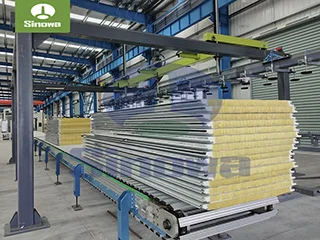
The final stage of the production process includes finished product sorting, automatic stacking and auxiliary finishing. The cut single panels are transported to the sorting platform through the conveyor system, where the equipment automatically identifies qualified products and eliminates individual defective products with abnormal appearance or size. Qualified finished panels are automatically stacked by the stacking unit in an orderly manner according to standardized stacking specifications, which not only saves manual handling labor, but also avoids panel surface scratches, deformation and stacking irregularities caused by manual operation. The whole production process from raw material feeding to finished product stacking is fully automated and connected in a continuous flow line mode, with no intermediate material storage and transfer links, greatly simplifying the production process and improving the overall production continuity and stability.
The core advantages of the continuous PU foaming process are fully reflected in product performance stability and production process optimization. In terms of product quality, the precise batching, uniform spraying and constant-pressure curing environment enable the PU foam core layer to form a uniform and closed cellular structure, which endows the sandwich panel with excellent and stable thermal insulation performance. The seamless composite bonding structure formed by continuous foaming and lamination makes the combination of the core layer and surface materials firmer, effectively resisting the problems of delamination and cracking caused by temperature change and external force extrusion in long-term use. In terms of production efficiency, the uninterrupted continuous operation mode eliminates the standby, debugging and feeding waiting time of intermittent production, greatly improves the unit time output of the polyurethane sandwich panel line, and is more suitable for large-scale and centralized industrial production.
In terms of production adaptability, the continuous PU foaming production line has strong flexible production capacity. By adjusting the raw material batching parameters, foaming spraying amount and lamination spacing, it can produce sandwich panels with different core layer thicknesses and different density grades, meeting the thermal insulation and mechanical strength requirements of different application scenarios. Whether it is thin-sized decorative insulation panels for building exterior walls or thick high-insulation panels for cold storage and low-temperature workshops, the PU sandwich panel machine can complete efficient and standardized production through parameter adjustment. In addition, the automated control system of the production line can monitor the key parameters such as raw material ratio, foaming temperature, lamination pressure and running speed in real time during the production process, and automatically adjust the parameter deviation within the allowable range, realizing intelligent control of the production process and further reducing the rate of defective products.
Compared with the traditional batch-type PU sandwich panel production process, the continuous foaming process has obvious advantages in product consistency and production cost control. Batch production is limited by intermittent operation, and the reaction temperature, material filling degree and curing time of each batch of products are prone to slight differences, resulting in fluctuations in the thermal insulation performance and mechanical strength of different batches of panels. In contrast, the continuous production line maintains a stable and consistent production environment and process parameters all the time, so all finished products have highly unified structural parameters and performance indicators. At the same time, the continuous production mode reduces the waste of raw materials caused by repeated equipment debugging and material replacement in intermittent production, and the high automation level reduces the dependence on manual labor, realizing effective control of comprehensive production costs.
In practical industrial production applications, the continuous PU foaming sandwich panel manufacturing line also shows excellent operational stability and low maintenance characteristics. The mechanical structure of the production line is designed for long-term continuous operation, with stable transmission and precise execution of each functional unit, which can adapt to long-hour uninterrupted production work. The modular design of the equipment facilitates daily inspection and maintenance, and the key functional components have good wear resistance and stability, reducing equipment failure rates and downtime losses. The mature and reliable continuous foaming process also reduces the probability of product quality problems caused by process fluctuations, improving the overall yield and production efficiency of the production line.
With the continuous upgrading of modern building energy-saving standards and industrial insulation requirements, the market demand for high-performance PU sandwich panels is constantly improving, and the continuous PU foaming production process has become the mainstream development direction of the sandwich panel manufacturing industry. This production mode integrates material science, precision mechanical transmission, automatic control technology and chemical reaction optimization technology, realizing the organic combination of high efficiency, high quality and low consumption in sandwich panel production. The produced continuous foaming PU sandwich panels have the characteristics of light weight, high strength, excellent thermal insulation, good weather resistance and convenient installation, and have broad application prospects in modern industrial plants, public buildings, cold chain storage facilities, clean workshops and other fields. In the future, with the further optimization of automation and intelligent technology, the continuous PU foaming production line will achieve more refined process control and more flexible production capacity, providing more reliable high-performance composite panel products for the construction and thermal insulation industry.


Any Questins About Continuous Sandwich Panel Production Lines or Other Products
Email us with inquiries or use our contact infomations