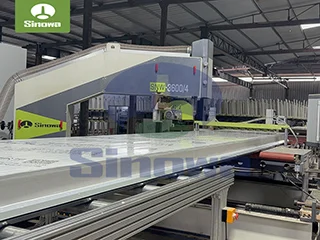
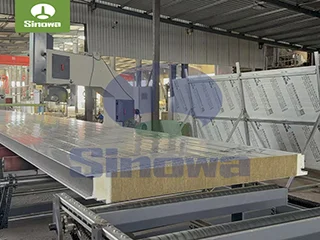
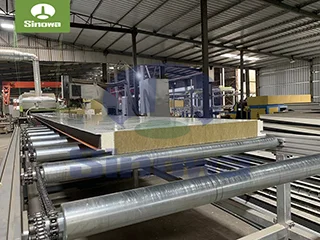
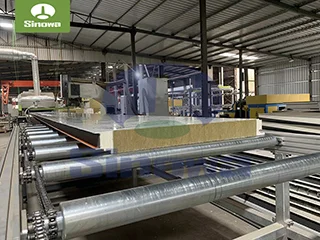
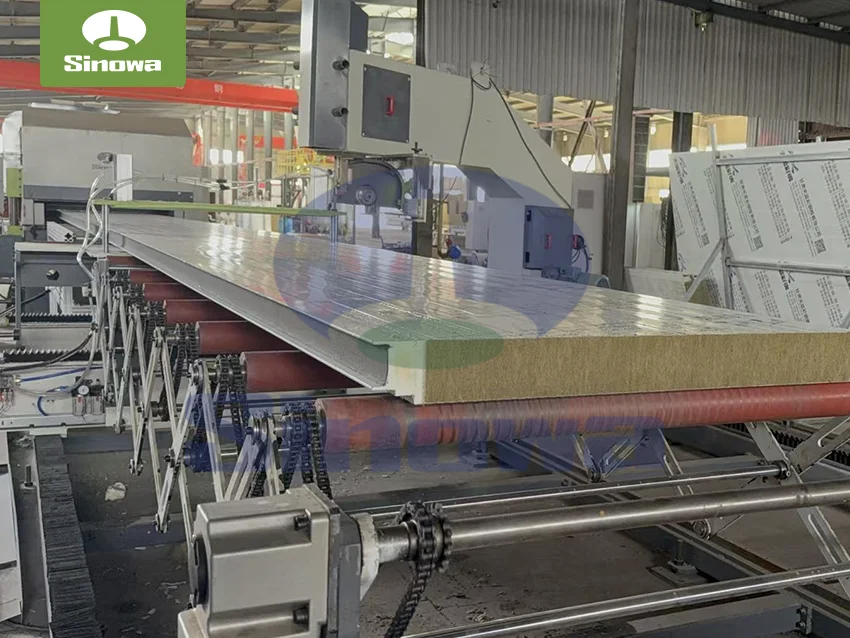
 sandwich panel line
The overall structural design of the polyurethane sandwich panel production line follows the principles of modularization and integration, realizing seamless connection of each production link from raw material input to finished product output. The entire system is composed of multiple functional units with independent operating logic and coordinated operation, covering raw material unwinding, surface plate forming, rock wool core material arrangement, polyurethane mixing and foaming, edge sealing treatment, high-pressure lamination, constant temperature curing, cooling shaping, precision fixed-length cutting and automatic stacking. Each functional unit is equipped with independent adjustment and control modules, which can adapt to the production requirements of panels with different thicknesses, widths and structural specifications, and maintain stable operating efficiency in long-term continuous production. The mechanical structure of the production line focuses on operational stability and structural durability, with key transmission and pressing components made of high-strength materials, which can resist structural deformation caused by long-term load operation and ensure the dimensional accuracy of finished panels in mass production.
Raw material pretreatment and feeding is the initial key link of the entire production process, which directly determines the uniformity and structural stability of subsequent composite molding. For the metal surface materials used for panel surface layers, the polyurethane sandwich panel line is equipped with automatic unwinding and leveling devices, which can smoothly release coiled metal sheets and complete precise leveling and fine shaping through multi-group roller pressing structures. This process eliminates the internal stress of the coiled material and the surface unevenness generated during storage and transportation, ensuring that the surface of the formed panel is flat and smooth with uniform texture. At the same time, the production line is equipped with a professional dust removal and cleaning structure near the feeding area, which can effectively remove surface dust, impurities and fine particles on the metal sheet, providing a clean bonding foundation for subsequent adhesive composite processing and avoiding bonding defects caused by foreign matter.
In terms of core material supply, the polyurethane sandwich panel machine supports the automatic feeding and orderly arrangement of high-density rock wool strips. The rock wool core material, as the main functional layer of the sandwich panel, undertakes the core performance of fire resistance, heat insulation and sound insulation. The automatic feeding system can evenly distribute rock wool fibers according to the set density and arrangement rules, avoid local hollowing, sparse density or overlapping accumulation of core materials, and ensure that the internal structure of each panel is uniform and consistent. In order to solve the problem of floating fiber pollution in the rock wool processing process, the production line is equipped with a targeted fiber collection structure near the core material laying area, which can collect scattered fine fibers in real time, maintain the cleanliness of the production environment, and prevent fiber residues from affecting the operation accuracy of subsequent equipment and the bonding quality of panels.
Polyurethane mixing, foaming and edge sealing treatment is the most distinctive core process of this rock wool sandwich panel production line, and it is also a key process that distinguishes traditional single rock wool sandwich panel production equipment. The polyurethane raw materials are composed of two groups of polymer materials, which need to be stored in a constant temperature environment in advance to avoid performance changes such as crystallization and viscosity fluctuation caused by temperature difference. The production line adopts a high-precision proportional mixing system to realize uniform mixing of polyurethane raw materials according to scientific proportions. Through high-pressure jet foaming technology, the mixed raw materials complete rapid chemical reaction and micro-foaming in a closed environment, forming a uniform and fine closed-cell structure. This foaming structure can effectively fill the gaps around the rock wool core material and form a compact edge sealing structure at the edge of the panel.
The polyurethane edge sealing process perfectly makes up for the structural defects of traditional rock wool panels with loose edges and poor air tightness. The integrated edge sealing structure formed by in-situ foaming and bonding can closely connect the rock wool core material and the metal surface plate, enhance the overall structural tightness of the panel, and effectively prevent the penetration of air, moisture and dust. At the same time, the polyurethane material has excellent bonding performance, which can form a high-strength composite interface with rock wool fibers and metal surfaces, avoiding delamination, cracking and other quality problems that are easy to occur in the long-term use of panels. The foaming amount and edge sealing range of polyurethane can be intelligently adjusted according to different panel specifications, realizing flexible production of panels with different edge widths and structural requirements.
The lamination composite process is a decisive link for the overall molding and structural strength of the panel. After the completion of core material laying and polyurethane edge sealing foaming, the semi-finished panel enters the continuous lamination unit. The rock wool sandwich panel line adopts a double-belt constant pressure lamination structure, which can apply uniform and stable pressure on the upper and lower surfaces of the panel. The spacing between the upper and lower conveyor belts can be accurately adjusted according to the preset panel thickness, ensuring that the pressure acting on the panel is evenly distributed in the whole width and length range. This uniform pressure treatment can completely eliminate the internal voids of the composite layer, make the rock wool core material, polyurethane bonding layer and metal surface plate closely integrated, and form an integral composite structure with high structural stability.
Cooperating with the constant pressure lamination process, the constant temperature curing system provides a stable temperature environment for the rapid curing and molding of polyurethane materials and adhesives. The curing area adopts a fully enclosed constant temperature design, which can maintain a stable temperature range in the working area, accelerate the polymerization and curing reaction of polyurethane polymer materials, and shorten the molding cycle of panels. Moderate constant temperature curing can not only significantly improve the bonding strength between layers, but also make the internal molecular structure of the polyurethane bonding layer more stable, avoiding performance attenuation caused by incomplete curing reaction. After curing, the bonding interface of the panel presents high compactness and toughness, which can resist structural changes caused by external temperature changes and mechanical extrusion.
The cooling and shaping process after curing is crucial to stabilize the dimensional accuracy and structural performance of the panel. The high-temperature semi-finished panels after curing will have slight thermal expansion stress. The rock wool sandwich panel machine is equipped with an efficient circulating cooling system, which adopts uniform air cooling to gradually reduce the temperature of the panels to room temperature. The gradual cooling mode can avoid structural deformation, warping and surface wrinkling caused by rapid temperature difference change, fully release the internal stress of the composite structure, and fix the overall shape and size of the panel. After cooling and shaping, the internal structure of the panel tends to be stable, and the indexes of flatness, straightness and thickness uniformity reach the standard requirements, laying a foundation for subsequent precision processing.
The final stage of production is precision fixed-length cutting and automatic stacking and finishing. The continuous PU sandwich panel production line is equipped with a high-speed tracking cutting unit, which can realize non-stop dynamic cutting in the continuous production state. The system can accurately set the cutting length according to the production demand, and the cutting tool adopts high-precision structural design to ensure smooth and flat cutting sections without burrs, cracks and edge collapse defects. The cut panels are automatically transported to the stacking platform through the conveying system, and the automatic stacking device orderly arranges the finished panels according to the fixed specification, which reduces manual handling errors and labor intensity, and improves the neatness and efficiency of finished product collection. The whole process from feeding to finished product stacking realizes continuous automatic operation, with few manual intervention links, which effectively reduces the impact of human factors on product quality.
The rockwool PU sandwich panel line has outstanding technical advantages in production performance and product quality control. In terms of production efficiency, the continuous operation mode breaks through the bottleneck of low output of traditional intermittent production equipment, realizes uninterrupted material processing and molding, greatly improves the unit time output, and is suitable for large-scale batch production orders. In terms of product quality stability, the full-process automatic control system realizes precise regulation of key parameters such as feeding volume, mixing ratio, lamination pressure, curing temperature and cutting size, which makes the performance and size of each batch of panels highly consistent and effectively reduces the rate of defective products.
In terms of product performance optimization, the composite structure formed by rock wool and polyurethane gives full play to the respective performance advantages of the two materials. The rock wool core material provides excellent fire resistance, high temperature resistance and sound insulation performance, which can effectively block the spread of flame and reduce noise transmission. The polyurethane edge sealing and bonding layer provides excellent thermal insulation, moisture resistance and structural bonding performance, making up for the defects of poor thermal insulation and easy moisture absorption of rock wool edges. The panels produced by this integrated process have the comprehensive advantages of fire prevention, heat insulation, sound insulation, moisture resistance and high structural strength, and their overall service performance is far better than that of single-structure sandwich panels.
In terms of production flexibility, the modular adjustable design of the continuous PU sandwich panel line enables it to adapt to diversified production demands. By adjusting the operating parameters of each unit, the equipment can produce panels with different thicknesses, widths and surface specifications, and can meet the personalized production requirements of special-shaped panels for partial architectural design. The equipment has strong compatibility with raw materials, and can adapt to different density grades of rock wool core materials and conventional metal surface materials, with wide raw material adaptability and low production matching cost.
The panels produced by the rock wool PU sandwich panel production line have extremely wide application scenarios in modern construction engineering. In the field of industrial plants and warehouse buildings, these panels are used for wall and roof enclosure structures, which can effectively isolate external high temperature and cold air, reduce building energy consumption, and at the same time meet the fire safety requirements of industrial buildings and avoid fire spread risks. In cold storage and constant temperature storage buildings, the excellent thermal insulation and air tightness of the panels can maintain the stable internal temperature of the building, reduce the operating load of refrigeration equipment, and achieve the effect of energy saving and consumption reduction.
In high-standard functional buildings such as clean rooms, laboratories and pharmaceutical production workshops, the smooth surface, compact structure and dust-free performance of the panels can meet the strict hygiene and environmental control standards. The closed edge sealing structure can prevent dust and bacteria from hiding in the gaps, and has good corrosion resistance and cleaning resistance, which is very suitable for high-cleanliness working environments. In addition, the panels are also widely used in public buildings such as exhibition halls, stadiums and commercial buildings, as well as temporary engineering buildings, relying on their light weight, high strength, convenient installation and long service life, effectively shortening the construction cycle and reducing the overall construction cost of the project.
From the perspective of industrial development, the rock wool PU sandwich panel machine conforms to the development trend of green and efficient modern building material manufacturing. The whole production process adopts low-consumption and low-pollution processing technology, with effective collection and treatment of waste fibers and residual materials, which reduces environmental pollution in the production process. The finished panels are energy-saving and environmentally friendly building materials, which can reduce the energy consumption of building operation throughout the life cycle and meet the green building evaluation standards. With the continuous upgrading of the construction industry's requirements for building energy conservation, fire safety and environmental protection, the market demand for high-performance composite sandwich panels is increasing day by day, and the intelligent and continuous production equipment represented by this production line has become an important support for the high-quality development of the building material industry.
In the actual production and operation process, the structural stability and intelligent control level of the sandwich panel production line also ensure the continuity and safety of production. The equipment is equipped with perfect operation protection and fault monitoring functions, which can monitor the operating state of each unit in real time, timely find and adjust abnormal parameters, avoid equipment failure and production quality problems caused by parameter deviation. The simple and standardized operation logic reduces the professional threshold for equipment operation and maintenance, and is convenient for enterprises to carry out daily production management and equipment maintenance. Long-term production practice shows that the production line has stable operation, low failure rate and high production efficiency, and can create stable economic benefits for production enterprises while ensuring product quality.
In conclusion, the rock wool PU sandwich panel line as an advanced integrated production equipment for composite building panels, integrates multiple advanced processing technologies, realizes the efficient and standardized production of high-performance rock wool polyurethane composite panels through scientific process design and structural configuration. Its excellent production efficiency, stable product quality and flexible production capacity make it occupy an important position in the field of modern building material manufacturing. With the continuous progress of construction technology and the continuous improvement of building performance standards, this type of sandwich panel machinery will continue to be optimized and upgraded, providing more high-quality and reliable enclosure material solutions for all kinds of modern buildings, and promoting the innovative development and iterative upgrading of the entire building energy-saving material industry.
https://www.cnsinowa.com/sandwich-panel-machines/rock-wool-pu-sandwich-panel-line.html