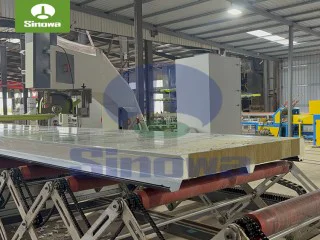
sandwich panel line
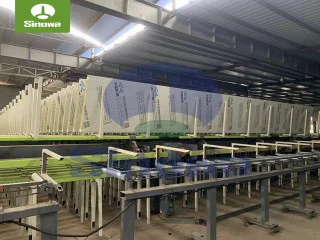
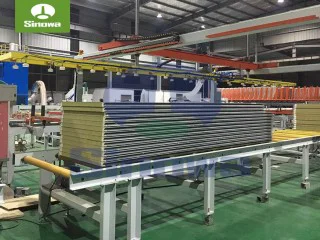
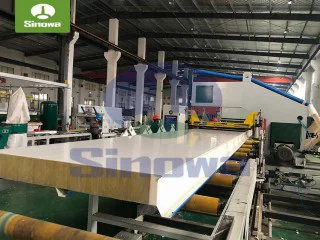
The overall structural design of the glasswool roof sandwich panel production line follows the logic of continuous assembly line operation, with all functional units arranged in a linear sequence to complete raw material processing, composite molding, curing treatment, and finished product cutting in an uninterrupted flow. The entire production system can be divided into several core functional modules, including a raw material feeding system, surface material pretreatment unit, core material processing mechanism, composite pressing system, constant temperature curing channel, cooling shaping device, fixed-length cutting mechanism, and finished product conveying and stacking unit. Each module maintains an independent mechanical control system while realizing synchronous linkage through a centralized control system, which effectively avoids production stagnation caused by mismatched operating speeds of individual equipment. The layout of the production line fully considers the rationality of material transportation, minimizing the transfer distance of semi-finished products and reducing unnecessary mechanical friction and material loss during the production process. In addition, the external structure of the production line is equipped with closed protective baffles, which can reduce dust diffusion generated during glasswool processing and maintain a clean and stable production environment.
Raw material preparation and feeding constitute the initial stage of the entire production process, determining the basic quality of the finished sandwich panels. The main raw materials required for production include metal surface sheets, glasswool core materials, and high-viscosity environmental adhesives. The metal surface sheets used for roof panels usually have excellent weather resistance and surface flatness, and the feeding system adopts an automatic unwinding structure to place coiled metal sheets on the feeding support. The unwinding mechanism is equipped with a tension adjustment device to keep the metal sheet in a flat and taut state during transmission, preventing wrinkles or deformation caused by uneven stress. The glasswool core material is transported by a special conveyor belt, with a thickness calibration device installed at the feeding inlet to screen and trim raw glasswool materials that do not meet the thickness specifications, ensuring the uniformity of the core material size. The adhesive feeding part adopts a sealed quantitative conveying structure, which can stably transport the mixed adhesive raw materials to the gluing unit. Before formal feeding, all raw materials need to go through simple impurity removal treatment to eliminate hard particles and sundries that may affect the bonding effect, laying a solid foundation for subsequent composite processing.
Surface material pretreatment is a key process to enhance the bonding firmness between metal sheets and glasswool core materials. Although the surface of metal sheets looks smooth, there are tiny oxide layers and oil stains generated during rolling processing, which will reduce the adhesion of adhesives if not removed. The pretreatment unit is equipped with high-pressure dust removal equipment and surface polishing components. The dust removal device uses high-speed airflow to sweep away floating dust and fine particles on the metal surface, while the polishing component performs micro-grinding on the bonding side of the metal sheet to form a rough and uniform textured surface. This physical treatment method effectively increases the contact area between the metal sheet and the adhesive, improving the long-term bonding stability of the composite structure. After polishing treatment, the metal sheet will pass through an air-drying channel to remove residual fine dust generated during polishing, ensuring that the surface remains dry and clean before gluing. The entire pretreatment process operates at a constant running speed, matching the transmission frequency of the subsequent gluing process to avoid material accumulation and backlog.
Gluing and core material laying are the intermediate links that determine the composite performance of sandwich panels. The glass wool sandwich panel production line adopts a rolling gluing process to uniformly coat the environmental adhesive on the inner surface of the upper and lower metal sheets. Compared with traditional spraying gluing, rolling gluing can control the adhesive coating thickness more accurately, avoiding quality problems such as hollow bonding or adhesive overflow caused by uneven glue application. The gluing roller is made of corrosion-resistant special materials, with adjustable roller gap to adapt to different adhesive viscosity and coating thickness requirements. After the gluing operation is completed, the glasswool core material is accurately laid between the two layers of metal sheets through an automatic positioning mechanism. The core material laying device is equipped with a lateral correction function to ensure that the glasswool core material is completely aligned with the metal sheet in the horizontal direction, preventing lateral deviation that affects the overall flatness of the finished panel. At this stage, the preliminary composite structure of the metal sheet, adhesive, and glasswool core material is formed, and the semi-finished product is continuously transported to the pressing unit for further compression and bonding.
The composite pressing system is the core equipment for realizing the integral molding of sandwich panels. This unit is composed of multiple groups of upper and lower pressing rollers arranged at equal intervals, with the roller gap precisely adjusted according to the preset thickness parameters of the roof panels. When the semi-finished composite material passes through the pressing area, the pressing rollers apply uniform and stable vertical pressure to eliminate tiny gaps between the metal sheet, adhesive, and glasswool core material. The pressure value is kept within a reasonable range to avoid excessive compression that damages the porous internal structure of glasswool, which would weaken thermal insulation and sound absorption performance. The surface of the pressing rollers is processed with anti-stick coating to prevent residual adhesive from adhering to the equipment and affecting subsequent pressing quality. During the pressing process, the synchronous transmission technology is adopted to ensure that the running speed of each group of pressing rollers is consistent, so as to avoid shear deformation of the semi-finished panel caused by speed difference. After continuous rolling and pressing, each layer of materials is closely bonded to form an integrated preliminary molded plate.
Constant temperature curing is an essential process to accelerate adhesive solidification and enhance structural stability. The curing channel of the roof sandwich panel line is a fully enclosed thermal insulation space, with internal temperature evenly distributed by circulating heating components. The temperature inside the curing channel is maintained within a stable medium-temperature range, which can activate the molecular activity of the adhesive and speed up the cross-linking reaction between adhesive molecules. This curing method not only shortens the adhesive drying time but also makes the bonding layer more compact and durable. The length of the curing channel is designed according to the production line operating speed, ensuring that the semi-finished panels can obtain sufficient curing time during the transmission process. Inside the channel, flexible limit baffles are installed on both sides to prevent the semi-finished panels from shifting laterally due to thermal expansion. Meanwhile, the ventilation system in the curing channel can discharge a small amount of volatile gas generated during adhesive curing, maintaining the safety and stability of the internal processing environment.
Cooling shaping and fixed-length cutting processes ensure the dimensional accuracy and surface flatness of finished panels. The high-temperature semi-finished panels exiting the curing channel contain internal thermal stress, which may cause thermal expansion and deformation if directly processed. The cooling unit adopts an air-cooling heat dissipation mode, using uniform low-speed airflow to take away surface and internal heat of the panels. The gradual cooling method effectively releases the internal stress of the composite material, avoiding warping or bending of the panels after molding. After cooling to room temperature, the panels are transmitted to the cutting mechanism. The cutting system is equipped with high-precision sensing components, which can automatically measure the panel length and trigger the cutting tool when reaching the preset size. The cutting tool adopts a high-speed hard alloy blade, which can complete smooth cutting without generating burrs or cracks on the metal surface. For roof panels with special edge requirements, the production line can also complete edge trimming and bending integration processing at this stage to meet the installation matching needs of building roofs.
The final stage of production includes finished product inspection, conveying, and stacking. After cutting and trimming, the finished glasswool roof sandwich panels will pass through an automatic detection area. The detection system uses infrared sensing technology to check the surface flatness, bonding integrity, and dimensional deviation of the panels, eliminating defective products with empty bonding, surface scratches, or unqualified sizes. Qualified finished panels are transported to the stacking area through a low-noise conveyor belt. The automatic stacking manipulator arranges the panels neatly according to the specified stacking standards, with flexible anti-collision gaskets placed between stacked panels to prevent surface abrasion during storage and transportation. The entire post-processing stage realizes unmanned automatic operation, which greatly improves the tidiness of finished product storage and facilitates subsequent packaging and transportation work.
In actual production operation, the intelligent control system plays a vital role in ensuring the stable operation of the glasswool roof sandwich panel production machine. The centralized control panel integrates all operation parameters of each functional module, including transmission speed, gluing amount, pressing pressure, curing temperature, and cutting size. Operators can adjust production parameters in real time according to raw material characteristics and production requirements. The system is equipped with an automatic early warning function; when abnormal conditions such as equipment jamming, raw material shortage, or parameter deviation occur, the system will send prompt signals and automatically suspend relevant operations to avoid equipment damage and mass production of defective products. In addition, the data recording function can store daily production parameters and output data, providing reliable data support for subsequent production optimization and process improvement.
Compared with manual intermittent production equipment, the continuous glass wool roof sandwich panel machine has prominent advantages in production efficiency and product performance consistency. The integrated assembly line design realizes seamless connection of all production links, greatly reducing manual intervention and shortening the single-panel production cycle. The standardized parameter control mode avoids quality differences caused by human operation errors, making the thermal insulation performance, structural strength, and surface flatness of each batch of finished panels maintain a stable level. From the perspective of production cost control, the automatic raw material feeding and quantitative gluing technology effectively reduces raw material waste, while the closed production structure lowers dust pollution and energy consumption, conforming to the energy-saving and environmentally friendly development trend of the modern manufacturing industry.
Glasswool roof sandwich panels produced by this professional production line have excellent comprehensive performance, making them widely applicable in diverse building scenarios. The porous internal structure of glasswool endows the panels with low thermal conductivity, which can effectively block external heat transfer and reduce the energy consumption of building temperature regulation. Meanwhile, the fibrous structure of glasswool has outstanding sound absorption and noise reduction capabilities, which can weaken the transmission of external noise and improve the indoor acoustic environment. The metal surface layer has good weather resistance and compression resistance, enabling the panels to adapt to harsh outdoor environments such as strong wind, rain erosion, and sunlight exposure. In addition, the overall lightweight feature of the panels reduces the bearing load of building roofs, lowering the construction difficulty and foundation construction cost. These performance advantages make the panels suitable for large industrial workshops, logistics warehouses, stadiums, and temporary movable buildings.
With the continuous progress of building industrialization and green manufacturing technology, the glass wool sandwich panel production machine is also evolving toward higher intelligence, energy saving, and diversification. At present, many production lines are being optimized in terms of energy utilization efficiency, adopting more energy-saving heating components and variable-frequency transmission motors to reduce power consumption during long-term operation. In terms of functional expansion, the improved production lines can realize the switching production of panels with different thicknesses and surface coatings, meeting the personalized customization needs of different construction projects. In addition, the dust removal and waste gas treatment devices of the production line are constantly upgraded to further reduce the impact of the production process on the external environment and realize cleaner production.
In conclusion, the glasswool roof sandwich panel manufacturing line is a highly integrated and automated composite material manufacturing system, which organically combines mechanical transmission, chemical bonding, constant temperature curing, and intelligent detection technologies. From raw material pretreatment to finished product stacking, every production link follows standardized and streamlined operating procedures to steadily output high-quality roof sandwich panels. Driven by the booming construction industry, this type of production line will continue to carry out technological innovations in structural optimization, intelligent control, and energy conservation and emission reduction. It will not only provide reliable material guarantees for the construction of high-performance modern buildings but also inject continuous impetus into the long-term development of the green composite building material industry. As the market requirements for building thermal insulation and environmental protection performance become increasingly stringent, the application scope and technical maturity of the glasswool roof sandwich panel production line will be further improved, bringing more economic and social value to the construction manufacturing field.
https://www.cnsinowa.com/sandwich-panel-machines/glasswool-roof-sandwich-panel-production-line.html