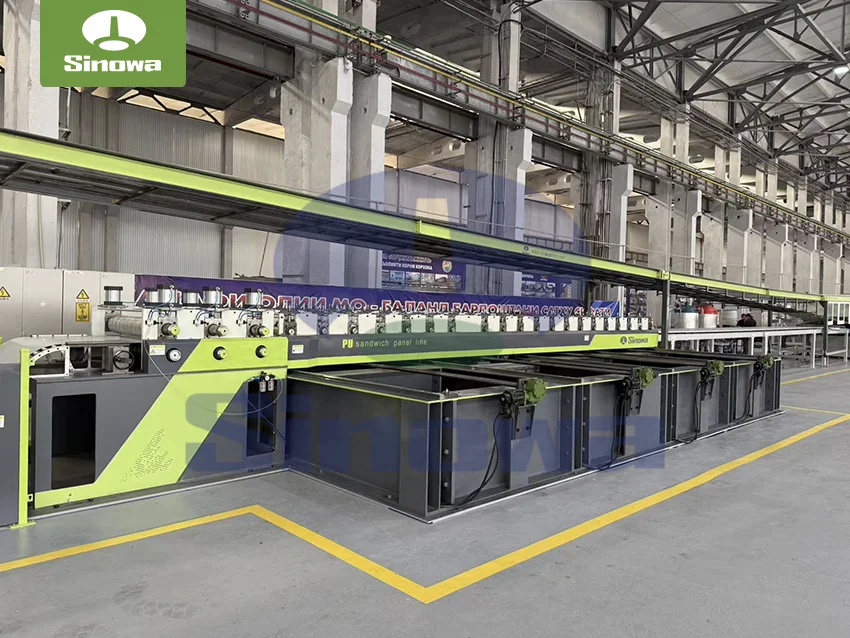
 sandwich panel line
The operational logic of the foam core sandwich panel line is built on the scientific compounding and bonding principle of multi-layer materials. Different from traditional manual or semi-mechanical panel manufacturing methods, the automated line achieves unified control of material feeding, surface treatment, foam forming, composite pressing, curing shaping, and fixed-length cutting through coordinated operation of multiple functional modules. The core manufacturing principle lies in filling the gap between two groups of surface materials with evenly distributed foam materials, completing foaming expansion and solidification bonding under constant temperature and pressure conditions, and forming an integrated composite structure with high strength, excellent thermal insulation, and stable overall performance. The system can adapt to different foam core materials and surface materials by adjusting operational parameters, realizing flexible production of diversified sandwich panel products to meet the differentiated usage demands of various application scenarios.
The complete production workflow of the PU foam production line starts with the feeding and pre-treatment of surface materials. Metal coiled materials or other plate surface materials are placed on the automatic unwinding equipment, which realizes stable and uniform material output through hydraulic tension control. In this stage, the system eliminates material wrinkles, deformation, and uneven stress generated during coiling and storage through precise leveling and straightening processes. Meanwhile, the surface of the base material is cleaned and polished to remove dust, oil stains, and oxide layers, creating a clean and flat bonding interface for subsequent composite processing. Some production lines are equipped with preheating devices, which heat the surface materials to a stable temperature range according to process requirements. This pre-treatment step effectively enhances the adhesion between the surface material and foam core layer, avoiding degumming and delamination of panels caused by temperature difference and surface impurities in subsequent use, and greatly improving the overall structural durability of finished products.
Following the surface material pre-treatment process is the core foam material proportioning and pouring stage, which determines the thermal insulation performance, structural uniformity, and dimensional stability of the final sandwich panels. For liquid foaming raw materials, the production line adopts high-precision metering and mixing systems to proportion different chemical components in strict accordance with process ratios. The fully enclosed mixing structure ensures full fusion and uniform reaction of raw materials, avoiding local uneven density and inconsistent foaming degree caused by insufficient mixing. The mixed foam liquid is evenly poured on the flat bottom surface material through a mobile pouring device, which can adjust the pouring speed, flow rate, and coverage range in real time according to the preset panel thickness and width parameters. For granular foam core materials, the system adopts automatic material distribution and paving equipment to spread the pre-treated foam particles evenly and compactly between the upper and lower surface materials, ensuring no hollow gaps or accumulation defects inside the core layer.
Laminating pressing and constant temperature curing are the key molding links of the entire production process, directly affecting the bonding strength and overall flatness of sandwich panels. After the foam material is laid, the upper and lower surface materials with the intermediate foam core layer enter the double-belt pressing system synchronously. The pressing equipment maintains stable and uniform pressure distribution in the entire width range of the panel through mechanical hydraulic adjustment, which not only promotes the full combination of foam and surface materials but also limits the free expansion range of foam, ensuring the consistency of panel thickness and flatness. During the pressing process, the constant temperature curing system provides a stable thermal environment for foam reaction and solidification. With the cooperation of temperature gradient control and circulating heat conduction structure, the foam material completes uniform expansion, pore forming, and curing molding inside the closed pressing space. This process eliminates the internal stress of the panel, makes the bonding interface between layers tighter, and enables the foam core layer to form a uniform and dense pore structure, thus endowing the panel with stable thermal insulation, sound insulation, and compression resistance.
After completing curing and preliminary molding, the continuous long-strip panel enters the trimming and fixed-length cutting stage. The automated trimming device performs precise edge trimming on both sides of the panel to remove irregular excess materials generated during edge foaming and pressing, ensuring that the overall width of the panel meets the standard specification and the edge section is flat and neat. Subsequently, the high-precision cutting system carries out fixed-length cutting according to the preset product size parameters. The cutting equipment adopts stable mechanical transmission and positioning technology, which can complete fast and smooth cutting without generating burrs, cracks, or deformation on the panel section. The entire cutting process is synchronously linked with the front-end continuous production speed, realizing non-stop continuous cutting and effectively improving the overall production continuity. After cutting, the finished panels are transported to the temporary storage platform through the conveying system, and unqualified products generated in the production process are automatically screened and eliminated through real-time parameter detection.
The final stage of the production process covers cooling shaping, automatic stacking, and finished product conveying. The newly cut panels still retain residual temperature after high-temperature curing, so the system is equipped with a circulating cooling device to cool the panels evenly at a constant speed. Gradual cooling treatment can effectively avoid panel deformation, warping, and internal structural changes caused by rapid temperature drop, further stabilizing the mechanical properties and dimensional accuracy of finished products. After full cooling and shaping, the automatic stacking equipment neatly stacks the qualified panels according to fixed specifications, realizing orderly arrangement of finished products. The entire post-processing process is automated without manual intervention, which not only improves production efficiency but also avoids surface scratches, corner damage, and stacking irregularities caused by manual operation, ensuring the appearance quality and packaging uniformity of finished panels.
The excellent performance of the foam sandwich panel production line stems from the scientific coordination of multiple functional subsystems. The intelligent control system serves as the core brain of the entire production line, adopting integrated program control technology to realize unified scheduling and real-time monitoring of all links including material feeding, proportioning, foaming, pressing, curing, and cutting. Operators can set production parameters through a simple operation interface, and the system can automatically adjust the operating speed, material ratio, pressure value, and temperature parameters according to different production requirements. Meanwhile, the real-time monitoring function can capture abnormal data such as unstable material supply, excessive temperature deviation, and abnormal pressure in the production process, and trigger automatic adjustment or prompt reminder functions to ensure the stability and standardization of the production process.
The material transmission system of the sandwich panel line adopts synchronous transmission design, with all transmission equipment maintaining matched operating speed to avoid material stretching, accumulation, and dislocation caused by speed difference. The high-precision transmission structure ensures the linearity and stability of panel operation in the production process, laying a foundation for the dimensional accuracy of finished products. In addition, the foaming system of the production line has excellent adaptive adjustment capabilities. It can adjust the foaming density and pore structure of the core layer according to different usage environments of the panels, producing lightweight panels with high flexibility or high-strength panels with compact structure to adapt to diverse application needs such as building enclosure, thermal insulation engineering, and industrial equipment protection.
Compared with traditional discrete production equipment, the integrated foam sandwich panel production machine has prominent advantages in production efficiency and product quality stability. The continuous assembly line production mode realizes uninterrupted operation of multiple processes, greatly shortening the single-panel production cycle and significantly improving unit time output. All production parameters are controlled by unified programs, which avoids product quality differences caused by manual operation errors. The produced sandwich panels have consistent thickness, uniform core density, stable bonding strength, and excellent overall structural uniformity. At the same time, the automated production mode effectively reduces manual operation links, lowers labor input and operational error rates, and improves the overall economic benefits of production while ensuring product quality.
In terms of production safety and environmental protection, the modern foam sandwich panel machine has optimized structural design and process configuration. The fully closed foaming and curing space reduces the volatilization and leakage of raw material components in the production process, realizing clean and environmentally friendly production. The equipment is equipped with perfect safety protection structures and linkage protection devices, which can automatically stop operation in case of equipment failure or abnormal operation, effectively avoiding production safety risks. In addition, the production line has low energy consumption in the operation process, and the optimized temperature control and power transmission design reduce invalid energy consumption, realizing energy-saving and efficient production operation.
With the continuous upgrading of building energy-saving standards and industrial composite material technology, the foam sandwich panel manufacturing line is constantly developing towards higher automation, higher precision, and stronger flexibility. The optimized structural design enables the equipment to adapt to more types of surface and core materials, realizing the integrated production of multi-specification and multi-type composite panels. The intelligent parameter self-learning and adaptive adjustment functions further improve the production accuracy and product qualification rate. As the core equipment for the production of energy-saving and environmental protection building materials, the foam sandwich panel production line provides reliable technical and equipment support for the popularization and application of lightweight, thermal insulation, and high-strength composite panels in the construction industry, cold storage engineering, industrial plant construction, and other fields, and plays an important role in promoting the lightweight and energy-saving development of the modern building industry.
https://www.cnsinowa.com/sandwich-panel-machines/foam-sandwich-panel-production-line.html






