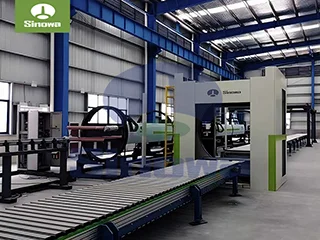
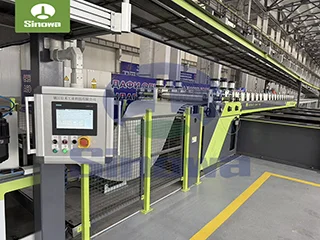
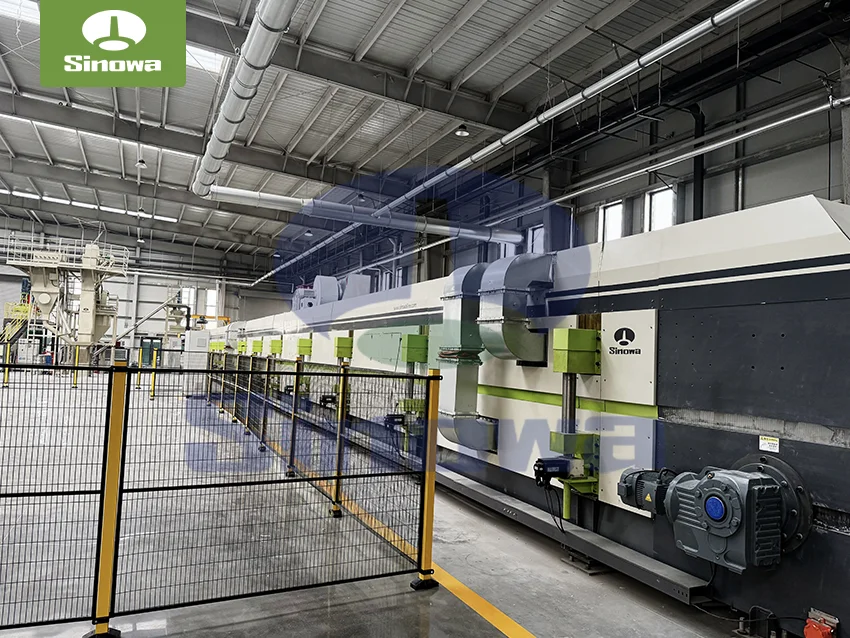
 sandwich panel machine
The overall operational logic of the continuous sandwich panel production line follows a linear and continuous production rhythm, with each functional module closely connected and synchronized in operation to ensure the seamless transition of materials from raw material state to finished panel products. The entire production process starts with the feeding of surface and core layer raw materials, followed by surface pretreatment, roll forming, adhesive coating or foam injection, multi-layer compounding, constant temperature pressure curing, fixed-length cutting, edge trimming, cooling shaping and automatic stacking. Every link is equipped with adaptive adjustment mechanisms to cope with different material specifications and structural design requirements of panels, realizing flexible production of diversified sandwich panel products. The core design concept of the equipment lies in unifying continuous production efficiency with precise product quality control, solving the problems of low efficiency, inconsistent product performance and high labor cost existing in traditional batch-type sandwich panel production modes.
The complete composition of the continuous sandwich panel line includes multiple collaborative functional modules, each undertaking independent production tasks while maintaining precise operational synchronization. The front-end raw material feeding module is responsible for the stable supply of metal surface materials and core insulation materials. For metal surface raw materials in coil form, the system is equipped with automatic unwinding and leveling structures, which can release coiled metal sheets at a constant speed and eliminate the internal stress and surface wrinkles of metal materials through multi-group leveling rollers, ensuring the flatness and dimensional stability of the surface materials entering the subsequent forming process. The unwinding structure adopts hydraulic buffer and speed regulation design to avoid material tension fluctuation and fracture caused by sudden start and stop, providing continuous and stable material supply for the whole production line.
Following the feeding module is the roll forming system, which is a key functional unit that shapes the flat metal sheet into the required plate profile. This system consists of dozens of groups of precision arranged forming rollers with graded forming design. The flat metal sheet undergoes gradual bending, pressing and shaping through roller groups of different shapes and gaps, and finally forms standard plate structures with specific edge folds, corrugations or flat surfaces. The graded forming mode effectively avoids the structural damage and surface crack of metal materials caused by one-time excessive deformation, ensuring the structural strength and surface finish of the formed metal plate. The gap and operating speed of each roller group can be adaptively adjusted according to the thickness and material characteristics of different metal sheets, meeting the forming requirements of various surface material specifications.
In parallel with the forming process of surface materials, the core material conveying and processing module operates synchronously to complete the pretreatment and fixed-position feeding of insulation core materials. For rigid core materials such as mineral wool and rock wool, the module is equipped with automatic cutting, sorting and positioning devices, which can cut whole core material plates into uniform sizes matching the surface plates, and accurately convey them to the laminating area to ensure no gaps, misalignment or deviation between the core material and upper and lower surface materials. For flexible foam core materials formed by liquid reaction, the system is equipped with precise metering and mixing units, which can proportionally mix different liquid raw materials according to the set process parameters, and evenly inject the mixed foam liquid into the gap between the upper and lower metal surface materials through high-precision pouring structures. This synchronous feeding and processing mode ensures the consistency of core material distribution in each panel, laying a foundation for the uniform thermal insulation and structural performance of finished products.
The adhesive coating system is an indispensable intermediate functional unit in the continuous production process, responsible for building a stable bonding interface between the surface material and the core material. The system adopts uniform spraying or roller coating modes to coat high-performance adhesive materials on the inner surfaces of upper and lower metal plates and the contact surfaces of core materials. The coating thickness, coating range and coating uniformity are precisely controlled by automatic control components to avoid excessive adhesive overflow or local missing coating. Reasonable adhesive coating treatment can significantly enhance the bonding strength between the metal surface and the insulation core, prevent delamination, bulging and cracking of panels in long-term use, and improve the overall structural stability and service life of composite panels. The system can adjust coating parameters in real time according to different core material types and production speed requirements to adapt to the bonding process needs of different composite structures.
The laminating and pressing system is the core component that determines the composite quality of sandwich panels, undertaking the key tasks of multi-layer material fitting, pressure maintaining and preliminary shaping. After the upper and lower formed metal plates and the intermediate core material are accurately butted and assembled, the whole plate body enters the double-belt laminating and pressing structure. The system uses flexible and high-strength conveyor belts to wrap the upper and lower surfaces of the composite plate, and applies continuous and uniform static pressure through the adjustable pressure structure. The pressure value is kept within the optimal process range to ensure that the adhesive layer is fully spread and the core material is closely fitted with the surface material, without causing excessive compression deformation of the lightweight insulation core material. The whole pressing process maintains continuous and stable pressure output, avoiding local pressure difference leading to inconsistent bonding tightness, so that each section of the continuously produced panel can obtain uniform composite effect.
Matching with the pressing system is the constant temperature curing system, which provides a stable temperature environment for adhesive solidification and foam core material reaction forming. The curing area adopts closed thermal insulation structure and multi-point temperature sensing and feedback devices, which can monitor the temperature of different positions in the curing cavity in real time and carry out dynamic temperature adjustment. For solid core material composite panels relying on adhesive bonding, constant temperature can accelerate the rapid solidification of adhesives and improve bonding efficiency and strength. For liquid foaming composite panels, the stable temperature field can ensure the full and uniform foaming reaction of foam raw materials, form a fine and closed-cell internal structure, and optimize the thermal insulation and mechanical properties of the foam core. The setting of curing temperature and curing distance is matched with the production speed of the whole line, ensuring that the plate completes sufficient curing and shaping during the continuous conveying process, and meets the structural strength requirements before entering the subsequent cutting process.
After curing and shaping, the continuous integrated plate body enters the finishing and processing stage, which mainly includes edge trimming, fixed-length cutting and surface finishing. The edge trimming device can trim the irregular edges on both sides of the continuously formed plate to ensure the consistent width of the plate and neat and smooth edge sections, eliminating residual burrs and uneven structures generated in the forming and compounding process. The fixed-length cutting system adopts non-stop dynamic cutting technology, which can complete accurate cutting according to the preset plate length specifications while the plate is continuously conveyed. The cutting tool has high precision and wear resistance, which can realize flat and smooth cutting sections without damaging the surface coating and internal core structure of the plate. This non-stop cutting mode avoids the production interruption caused by traditional static cutting, effectively improving the overall continuity and production efficiency of the production line.
Subsequently, the finished plates after cutting and trimming enter the cooling and shaping area to complete the final structural stabilization. The plates after high-temperature curing have certain residual temperature and slight structural stress, and the natural cooling or forced air cooling structure can gradually reduce the plate temperature to room temperature, release internal stress, and avoid plate deformation, warping and size deviation after stacking. The cooled plates have stable overall structure, uniform size and qualified surface quality, and can enter the final automatic stacking and finishing link. The automatic stacking system can orderly stack the finished plates according to the set quantity and arrangement mode, realizing automatic collection of finished products, reducing manual handling and stacking errors, and improving the neatness and delivery efficiency of finished products.
The outstanding advantages of the continuous sandwich panel making machine in industrial production are mainly reflected in production efficiency, product consistency, production cost and production flexibility. In terms of production efficiency, the fully continuous non-intermittent production mode realizes the integrated operation of feeding, forming, compounding, curing and cutting, with no idle time in the production process, and the unit time output is far higher than that of intermittent production equipment. The highly automated operation mode greatly reduces the demand for manual operation, only requiring a small number of operators to carry out parameter monitoring and equipment maintenance, effectively reducing labor costs and human error interference in the production process.
In terms of product quality control, the continuous production system adopts unified parameter setting and synchronous operation control, and the pressure, temperature, speed and feeding amount in each production link are kept in a stable and controllable range. This makes the thickness, bonding strength, flatness and overall structural performance of each batch of finished panels highly consistent, avoiding the quality fluctuation of products caused by manual operation differences and intermittent equipment parameter changes in traditional production modes. The precise processing and compounding process ensures that the finished panels have excellent overall flatness, neat edge size, stable internal structure, and no common quality problems such as hollowing, delamination and uneven thickness, which greatly improves the qualified rate of products.
In terms of production flexibility, the continuous sandwich panel production machine can adapt to the production of multiple types of sandwich panel products by adjusting process parameters and replacing individual functional components. It can match with different core materials including foam insulation materials and rigid inorganic insulation materials, and can produce panels of different thicknesses, lengths, widths and surface profile specifications. This multi-functional production capability enables a single production line to meet the diversified product needs of different application scenarios, avoiding the need to purchase multiple sets of equipment for different products, and effectively reducing the equipment investment cost and factory space occupation of production enterprises.
In terms of operational stability and energy conservation, the modern continuous sandwich panel manufacturing machine is equipped with intelligent energy-saving control systems and fault self-detection functions. The equipment can automatically adjust the operating power and heating energy consumption according to the actual production speed and material demand, avoiding long-term high-power idle operation and reducing unnecessary energy consumption. At the same time, the real-time monitoring system can track the operating state of each module of the equipment, timely detect abnormal conditions such as material blockage, parameter deviation and component failure, and send early warning prompts, which is convenient for operators to troubleshoot and maintain, reducing equipment failure rate and production downtime, and improving the continuous and stable operation capability of the production line.
The products produced by continuous sandwich panel machinery have extremely wide application value in modern industrial and construction fields, relying on their lightweight, high strength, thermal insulation, sound insulation and weather resistance characteristics. In the building construction industry, such composite panels are used for the construction of factory workshops, warehouse buildings, temporary engineering buildings and large venue enclosure structures. The lightweight characteristics of the panels can reduce the self-weight of the building structure, reduce the load pressure of the foundation and main body, and the excellent thermal insulation performance can effectively reduce the energy consumption of building temperature regulation, meeting the energy-saving and environmental protection requirements of modern green buildings.
In the cold chain logistics and refrigeration engineering industry, continuous produced sandwich panels become the preferred material for cold storage walls, top plates and partition structures. The uniform and dense internal insulation structure of the panels effectively blocks heat transfer, maintains the low-temperature stability of the internal environment of the cold storage, and reduces the operating energy consumption of refrigeration equipment. At the same time, the integrated composite structure has good air tightness and moisture resistance, which can avoid the condensation and frosting phenomenon inside the cold storage caused by air and moisture penetration, and improve the operational stability and service life of cold chain equipment.
In addition, such panels are also widely used in special industrial fields such as transportation equipment manufacturing, agricultural breeding facilities and environmental protection engineering. In the manufacturing of mobile equipment such as carriages and container houses, the lightweight and high-strength characteristics of the panels can reduce the overall weight of the equipment and improve the structural stability and service comfort. In agricultural greenhouses and breeding houses, the thermal insulation and wind resistance performance of the panels can build a stable internal temperature environment, reduce the impact of external climate changes on agricultural breeding environments, and improve the efficiency of agricultural production. In environmental protection and purification engineering, the smooth surface, dust-proof and corrosion-resistant characteristics of the panels meet the clean environment requirements of purification workshops and industrial dust-free workshops.
With the continuous upgrading of industrial manufacturing technology and the continuous improvement of market requirements for building energy conservation and industrial lightweight materials, the continuous sandwich panel maufacturing line is also developing towards higher automation, higher precision, more energy conservation and stronger intelligence. The traditional single fixed parameter production mode is gradually replaced by intelligent adjustable production mode. The new generation of equipment integrates data collection, operation analysis and automatic parameter optimization functions, which can automatically match the optimal production process parameters according to different raw material characteristics and product specifications, realizing adaptive intelligent production.
In terms of energy-saving and environmental protection optimization, the updated continuous sandwich panel equipment optimizes the heating system and material utilization structure, reduces the waste of raw materials in the production process, and realizes the recycling of partial residual materials. The closed production environment reduces the volatilization of chemical materials and dust pollution, making the production process more in line with modern industrial environmental protection standards. At the same time, the optimized mechanical structure reduces the operating friction and vibration noise of the equipment, improves the operating stability of the equipment, and reduces the loss of mechanical components, extending the overall service life of the equipment.
In terms of production precision improvement, the latest equipment adopts higher-precision transmission components and sensing detection devices, realizing more accurate control of plate thickness, size deviation and bonding uniformity. The dynamic real-time detection system can automatically detect the dimensional accuracy and surface quality of finished panels in the production process, automatically screen unqualified products, and synchronously adjust production parameters to correct quality deviations, realizing closed-loop quality control from production to detection. This intelligent quality control mode further improves the overall yield and product stability of continuous production.
In terms of market application prospects, with the rapid development of infrastructure construction, new energy industry, cold chain logistics and prefabricated building industry, the market demand for high-quality composite sandwich panels is continuously growing, which also drives the continuous innovation and popularization of continuous sandwich panel production equipment. As a high-efficiency and low-consumption automated production equipment, it solves the pain points of low efficiency, high cost and unstable quality in the traditional panel production industry, and provides reliable equipment support for the large-scale and standardized development of the composite panel industry.
In practical industrial application, the operational stability and production capacity of the continuous sandwich panel plant directly determine the production benefit and product competitiveness of panel manufacturing enterprises. Scientific equipment operation management and regular maintenance can effectively maintain the high-efficiency operation state of the production line. Daily maintenance mainly includes the cleaning of material conveying and forming components, the inspection of transmission tension and pressure parameters, the calibration of temperature control system and the lubrication of mechanical moving parts. Timely maintenance and parameter calibration can avoid equipment aging and parameter deviation caused by long-term continuous operation, ensure the long-term stable output of high-quality products of the equipment, and reduce the comprehensive production cost of enterprises.
To sum up, the continuous sandwich panel production machinery as a core automated production equipment in the field of composite material manufacturing, realizes the continuous, efficient and standardized production of sandwich panels through the collaborative operation of multiple functional modules. It has irreplaceable advantages in improving production efficiency, stabilizing product quality, reducing production costs and realizing flexible production. With the continuous progress of industrial technology and the continuous expansion of downstream application markets, the equipment will continue to iterate and upgrade in the direction of intelligence, energy conservation and high precision, providing more powerful technical support for the high-quality development of prefabricated buildings, energy-saving insulation materials and related industrial fields, and playing an increasingly important role in modern industrial manufacturing and infrastructure construction.
https://www.cnsinowa.com/sandwich-panel-machines/continuous-sandwich-panel-machines.html