 sandwich panel machine
The entire operation logic of the rigid PU sandwich panel production line follows a systematic and streamlined production sequence, with each production link closely connected and mutually coordinated to achieve uninterrupted assembly line operation. The initial stage of production focuses on surface material preparation and pretreatment, which lays a fundamental foundation for the bonding quality and surface flatness of finished sandwich panels. The equipment is compatible with various coil-shaped surface materials, and the automatic unwinding device steadily releases raw material coils at a constant speed. Equipped with an automatic coil splicing structure, the machine can complete the connection between new material coils and residual material coils without shutting down the production line, effectively eliminating production downtime caused by material replacement and greatly improving overall production continuity. After unwinding, the surface materials will pass through multi-stage leveling and cleaning units, which can smooth out tiny deformations on the material surface and remove dust, oil stains, and other impurities. This pretreatment process optimizes the surface roughness of the materials, creating excellent bonding conditions for the subsequent composite process and avoiding hollowing and separation between the surface layer and foam core caused by surface contamination.
Following the surface material pretreatment process is the roll forming stage, which endows the flat surface materials with standardized structural profiles to meet the assembly and structural strength requirements of different application scenarios. The roll forming unit consists of multiple groups of precision rolling stands arranged in an orderly sequence. Driven by synchronous transmission systems, the rolling shafts operate stably and uniformly, gradually bending and pressing the flat sheet materials into preset geometric profiles through progressive rolling. The structural design of the rolling stands ensures uniform stress on the surface materials during the forming process, effectively preventing material cracking, uneven deformation, and thickness deviation. The flexible parameter adjustment function allows the equipment to adapt to surface materials of different thicknesses and widths, realizing rapid switching of panel profile specifications and meeting the diversified production demands of different wall and roof panel types. After forming, the upper and lower surface materials are accurately conveyed to the composite molding station through a precise servo conveying system, maintaining consistent spacing and parallelism to prepare for foam injection and composite lamination.
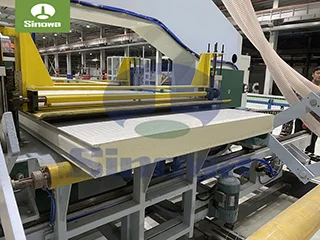
The polyurethane foaming and injection system serves as the core functional module of the rigid sandwich panel production line, directly determining the thermal insulation performance, structural compactness, and service life of finished sandwich panels. This system adopts a high-precision dynamic mixing structure, which fully blends the two-component liquid polyurethane raw materials in strict proportion through automatic metering devices. The precision metering technology ensures the accurate matching of raw material ratios, avoiding performance defects such as insufficient foaming, excessive expansion, or uneven curing caused by proportion deviation. After full mixing, the liquid polyurethane mixture is evenly injected between the upper and lower formed surface materials through a multi-point uniform injection structure. The liquid material undergoes rapid chemical reaction, expansion, and gelation in the closed composite space, gradually filling the entire gap between the surface layers to form a dense and uniform rigid foam core. The whole foaming process is dynamically controlled according to production speed and panel thickness, realizing adaptive adjustment of foaming density and expansion range, which ensures that the foam core has no voids or cracks and maintains stable structural uniformity in all parts of the panel.
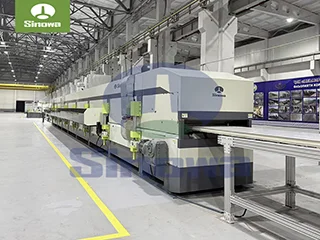
The double-belt pressing and curing system is a key unit to realize integral composite molding and fixed-size shaping of sandwich panels. After the foam material is injected, the upper and lower surface materials and the intermediate foam core enter the constant-temperature double-belt pressing mechanism together. The high-strength synchronous belt structure clamps the composite materials stably and moves forward at a constant speed. The internal heating system provides stable and uniform temperature conditions for the curing reaction of polyurethane foam, which accelerates the gel molding and solidification of the foam core. The temperature distribution in the curing zone is highly uniform, which prevents local overheating or insufficient curing, ensuring that the foam core maintains consistent hardness, density, and bonding strength. The length setting of the curing zone fully matches the production line speed, providing sufficient reaction time for the complete curing of polyurethane materials. In the later stage of curing, the equipment is equipped with a targeted cooling area, which uses air cooling or water cooling structures to gradually reduce the temperature of the formed panels, effectively inhibiting the secondary expansion of foam materials and ensuring the dimensional stability and structural firmness of finished panels after molding.
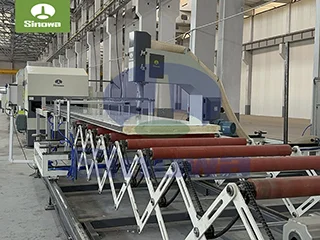
The precision cutting and trimming stage realizes the fixed-length molding and edge finishing of continuous composite panels. The rigid PU sandwich panel line adopts a flying saw cutting system driven by a high-precision servo motor, which can complete synchronous cutting during the continuous operation of the production line without stopping the line or reducing speed. The servo control system can accurately identify and adjust the cutting length according to preset parameters, realizing precise fixed-length cutting of panels with different specification requirements. The cutting tool has high hardness and wear resistance, which can ensure smooth and flat cutting sections without burrs, deformation, or material damage. Meanwhile, the edge trimming device can trim the redundant materials on both sides of the panels to ensure the consistency of the overall width of finished products. The intelligent detection module in the cutting unit can monitor the cutting precision and panel flatness in real time, automatically correcting tiny deviations in the production process to ensure that the dimensional error of finished panels is controlled within a minimal range and meets the standards of industrial and architectural applications.
The final stage of the production process is automatic conveying, turnover and stacking, which realizes the intelligent finishing of finished products and improves the efficiency of subsequent storage and transportation. The cut fixed-length panels are stably conveyed to the stacking station through the roller conveying system. The automatic turnover device can adjust the placement direction of the panels according to production requirements, realizing orderly stacking of single or double-sided panels. The intelligent stacking system can automatically count and stack finished products according to preset stacking height and quantity standards, realizing unattended automatic operation. This automated post-processing mode greatly reduces manual intervention, avoids panel surface scratches, deformation, and stacking irregularities caused by manual operation, and effectively improves the neatness and uniformity of finished product stacking, providing convenient conditions for subsequent packaging, transportation and on-site construction.
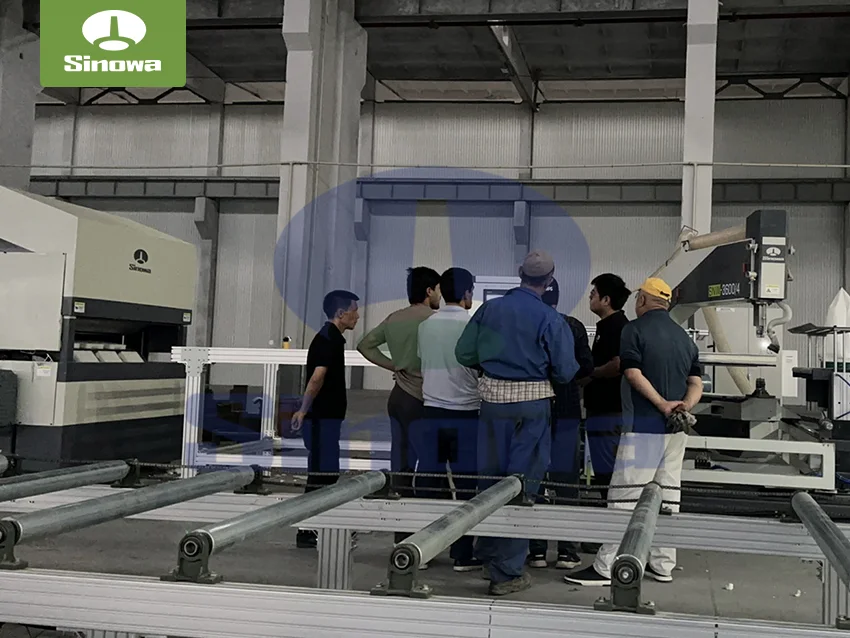
The overall performance advantages of the rigid foam PU sandwich panel machine are mainly reflected in high automation, stable production quality, strong production flexibility and low operating cost. The entire production line adopts a centralized intelligent control system, which integrates the operation parameters of all functional units including feeding, forming, foaming, pressing, cutting and stacking. Operators can complete parameter setting, operation monitoring and fault detection through a simple and intuitive operation interface. The system realizes the synchronous linkage of all production links, effectively avoiding production failures caused by asynchronous coordination between different units. The highly automated production mode greatly reduces labor input, lowers the dependence on manual operation technology, and realizes standardized and normalized production operations. In terms of quality stability, the full-process mechanical and intelligent control replaces traditional manual adjustment, eliminating product quality differences caused by human factors, and ensuring that the thermal insulation performance, structural strength and dimensional accuracy of each batch of panels remain stable.
In terms of production flexibility, the equipment has strong adaptability to meet the diversified production needs of the market. By adjusting the operating parameters of the rolling forming unit, foaming metering system and cutting system, the production line can quickly switch between panels of different thicknesses, widths and profile structures. It can adapt to the production of building wall panels, roof panels, cold storage insulation panels and industrial equipment enclosure panels, realizing multi-purpose production of one line and effectively improving the utilization rate of production equipment. In terms of energy consumption and operation stability, the equipment adopts optimized structural design and energy-saving control technology. The heating and power systems can automatically adjust the operating power according to the production load, reducing invalid energy consumption in the production process. The transmission and pressing structures are made of high-strength and wear-resistant materials, which reduce equipment wear and failure rate during long-term continuous operation, extend the service life of the equipment, and reduce daily maintenance and operating costs for enterprises.
The finished panels produced by this professional production line have excellent comprehensive performance, which perfectly matches the high-standard use requirements of modern engineering. The polyurethane rigid foam core formed by precise foaming process has a closed-cell structure, which brings excellent thermal insulation and heat preservation performance, effectively reducing heat transfer and achieving significant energy-saving effects for buildings and cold chain facilities. The integral composite molding process makes the surface layer and the foam core closely bonded as a whole, with high bonding strength, no delamination or peeling after long-term use, and excellent structural stability and wind resistance. At the same time, the lightweight characteristics of the sandwich panels reduce the overall load of buildings and equipment, which is conducive to simplifying the construction process and shortening the construction cycle. In addition, the standardized production process makes the finished panels have uniform specifications and good assembly performance, which can realize rapid assembly and installation on the construction site, greatly improving the construction efficiency of the project.
With the continuous upgrading of modern construction concepts and industrial manufacturing standards, the market demand for high-performance insulation composite panels is constantly improving, which also promotes the continuous technological optimization and functional upgrading of polyurethane sandwich panel production line. Modern equipment design pays more attention to the integration of intelligence and environmental protection. The intelligent monitoring system can realize real-time collection and analysis of production data, including production speed, raw material consumption, product qualification rate and other information, helping enterprises realize refined production management. The optimized foaming system reduces the waste of raw materials, improves the utilization rate of polyurethane raw materials, and avoids material waste and environmental pollution caused by excessive feeding. The low-noise operation design and closed production structure also optimize the production environment, meeting the environmental protection and safety production requirements of modern processing factories.
In practical industrial application scenarios, rigid polyurethane sandwich panel line has become core equipment supporting the development of many industries. In the field of industrial factory buildings and public buildings, the high-efficiency and continuous production capacity of the equipment can meet the large-scale supply demand of building insulation enclosure materials, providing high-quality lightweight and energy-saving building materials for modern steel structure buildings. In the cold chain logistics and low-temperature storage industry, the high-precision foaming technology of the equipment ensures the ultra-low thermal conductivity of the panel core material, providing reliable thermal insulation guarantee for cold storage, freezing warehouses and constant-temperature storage facilities. In addition, the equipment also provides stable and standardized supporting materials for special fields such as clean workshops, industrial equipment insulation and temporary engineering buildings, showing strong market adaptability and application value.
In conclusion, the PU rigid foam sandwich panel production machine, with its integrated design, automated operation, stable production performance and flexible production capacity, has realized the standardized, large-scale and high-quality production of polyurethane rigid foam sandwich panels. Its perfect and streamlined production process covers all links from raw material processing to finished product output, effectively ensuring the excellent physical properties and dimensional accuracy of finished panels. With the continuous progress of manufacturing technology and the increasing demand for energy-saving and environmental-friendly building materials, this type of production equipment will continue to carry out technological innovation in intelligence, energy saving and high efficiency, and provide more reliable and efficient production solutions for the composite insulation panel manufacturing industry, while continuously empowering the high-quality development of the modern construction and industrial insulation fields.
https://www.cnsinowa.com/sandwich-panel-machines/pu-rigid-foam-sandwich-panel-machine.html