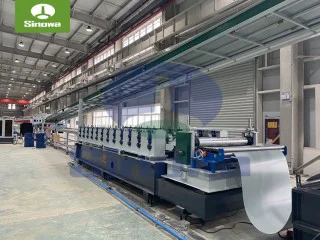
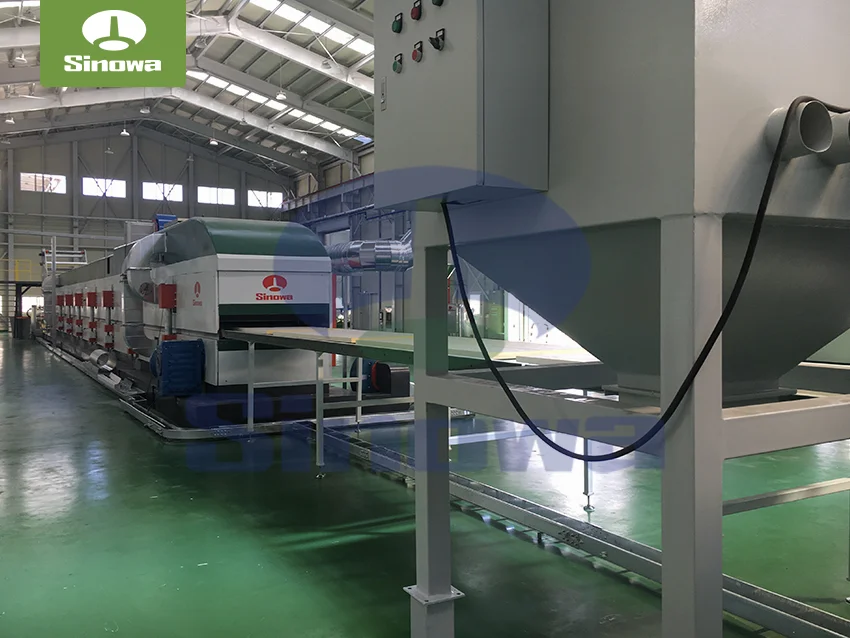
 sandwich panel line
The overall structural design of the automatic insulation board production line follows the principles of modularization, integration, and intelligent linkage, consisting of multiple interlocking functional units that operate in precise coordination to complete the entire board forming process. Each functional module is independently responsible for a specific production procedure while maintaining real-time data interaction and synchronous operation with other modules, ensuring the continuity and stability of the entire production process. The core functional modules cover raw material pretreatment and batching system, automatic conveying system, high-precision mixing and foaming system, continuous laminating and forming system, constant-temperature curing system, precise cutting and trimming system, automatic cooling and shaping system, as well as finished product sorting and stacking auxiliary systems. All modules are regulated by a centralized intelligent control system, which uniformly adjusts operating parameters, monitors production status, and optimizes operational logic, enabling the production line to adapt to the manufacturing requirements of different types of insulation boards through parameter adjustment.
Raw material processing and batching constitutes the initial and foundational link of the entire production process, directly determining the basic performance and quality stability of finished insulation boards. This functional unit is specially designed for the physical and chemical characteristics of different insulation raw materials, including powdery inorganic materials, granular fillers, liquid polymer raw materials, foaming agents, flame retardants, and adhesive auxiliaries. The system is equipped with fully automatic metering and dosing devices, which adopt high-precision sensing and quantitative control technologies to complete accurate proportioning of various raw materials according to preset production formulas. In the processing stage of solid raw materials, the device integrates impurity removal, screening, and uniform mixing functions to eliminate oversized particles and impurity substances mixed in raw materials, ensuring the uniformity and purity of raw material components. For liquid raw materials, the system realizes sealed storage and constant-temperature preservation, avoiding raw material deterioration, component volatilization, or performance changes caused by temperature fluctuations and external contamination. All batching processes are completed in a closed environment, which not only ensures the accuracy of material proportioning but also effectively reduces material waste and dust emissions, meeting the requirements of clean production.
After the completion of raw material batching, the automatic conveying system precisely transports the proportioned raw materials to the subsequent processing links in a synchronous and quantitative manner. This system adopts customized conveying structures according to different material forms, including screw conveying for powdery and granular materials and sealed pipeline conveying for liquid materials. The entire conveying process realizes fully automated continuous feeding without manual auxiliary operation, and the conveying speed and feeding volume can be dynamically adjusted in real time according to the operating speed of the subsequent production links, maintaining the material supply rhythm consistent with the production progress. The built-in anti-blocking and uniform feeding design of the conveying equipment effectively avoids material accumulation, uneven feeding, and pipeline blockage problems that often occur in traditional production processes. Meanwhile, the closed conveying mode isolates raw materials from the external environment, preventing external dust and impurities from mixing into the production raw materials and further guaranteeing the purity and stability of production materials throughout the process.
The mixing and foaming unit is the core functional module that determines the thermal insulation performance and internal structural uniformity of insulation boards, serving as the key procedure for transforming raw materials into board core base materials. After being transported to the mixing chamber, the proportioned raw materials undergo high-speed and homogeneous mixing through professional mixing components. The mixing system adopts optimized stirring structural design and adjustable stirring speed parameters, which can fully fuse solid fillers, liquid base materials, and functional auxiliaries at the molecular level, eliminating local component unevenness and material stratification. For foam-type insulation board production, the mixing process is synchronized with controllable foaming reactions. By precisely regulating the mixing temperature, stirring time, and material reaction ratio, the foaming agent can undergo stable and uniform chemical reactions, generating fine and closed bubble structures inside the material. The entire foaming process is carried out in a sealed and temperature-controlled environment, avoiding the influence of external temperature, humidity, and air flow on the foaming effect. Through precise process control, the bubble diameter, bubble density, and closed-cell rate of the board core can be kept within a stable range, laying a solid foundation for the finished product’s low thermal conductivity, high compression resistance, and excellent thermal insulation performance.
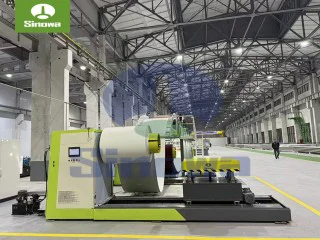
Subsequent to the completion of material mixing and preliminary foaming, the continuous laminating and forming system starts to execute the board shaping process, which is a key link to determine the appearance flatness, structural thickness, and overall regularity of insulation boards. This system can automatically complete the laying and fitting of surface protective layers on both sides of the foamed core material. The surface layer materials are automatically unreeled, flattened, and preprocessed by the equipment to remove wrinkles, tension unevenness, and surface impurities, ensuring the flatness of the surface layer before fitting. In the laminating process, the core material in the foaming state is evenly covered by the upper and lower surface layers, and the integrated composite structure is formed through synchronous pressure bonding. The pressure of the laminating equipment is uniformly distributed across the entire board width, effectively avoiding problems such as local depressions, bulges, and inconsistent board thickness. The equipment supports flexible adjustment of forming pressure and spacing, enabling adaptive production of insulation boards with different thickness specifications. The continuous laminating design realizes uninterrupted composite forming of long-strip boards, greatly improving production continuity compared with intermittent mold pressing production methods and effectively enhancing overall production efficiency.
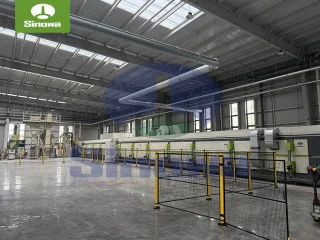
The constant-temperature curing system acts as the core guarantee for the solidification and structural stability of composite insulation boards, responsible for completing the material curing, gelling, and structural shaping processes after laminating and forming. The system adopts an enclosed double-belt curing structure with multi-stage temperature zoning control, which can form a stable and adjustable temperature field inside the curing chamber. According to the material curing characteristics and production process requirements, the internal temperature of the curing system is divided into preheating zone, constant-temperature curing zone, and slow cooling shaping zone, realizing staged and precise temperature control. In the preheating stage, the composite board is evenly heated to activate the internal molecular reaction of the material and promote the tight bonding between the core material and the surface layer. In the constant-temperature curing stage, the material completes sufficient cross-linking and curing reactions to form a solid and stable overall structure, eliminating internal structural looseness and material deformation risks. In the slow cooling stage, the board temperature is gradually reduced to avoid structural cracks and internal stress concentration caused by rapid temperature change. The entire curing process operates synchronously with the front-end forming process, realizing continuous feeding and continuous curing, and ensuring the consistency of the curing degree of each batch of boards.
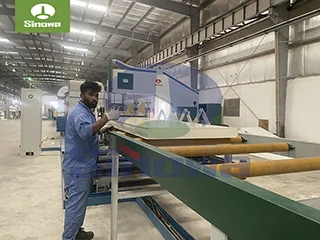
After completing curing and primary shaping, the insulation board enters the precise cutting and trimming link to realize fixed-length sizing and edge finishing of continuous boards. The automatic cutting system is equipped with high-precision sensing and positioning devices, which can automatically detect the running speed and length of the board body and complete fixed-length cutting in real time according to preset dimensional parameters. The cutting tool adopts high-hardness and wear-resistant structural design, with smooth and flat cutting sections, no burrs, no material chipping, and high dimensional accuracy of finished boards. The edge trimming mechanism on both sides of the insulation panel production line can automatically trim the irregular edges generated in the forming process, ensuring that the overall width of the board is uniform and the edges are neat. All cutting and trimming parameters can be adjusted through the central control system, supporting flexible switching of different board length and width specifications. The cutting process realizes non-stop continuous cutting, avoiding production pause caused by sizing operation, further improving the continuous production capacity of the entire line. Meanwhile, the system is equipped with a waste recycling device, which can uniformly collect and process the trimmed leftover materials, realizing resource recycling and reducing production waste.
The cooled and sized insulation boards will go through a further cooling and shaping process to completely eliminate internal residual stress and ensure the long-term dimensional stability of finished products. The automatic cooling system adopts circulating air cooling or water cooling heat exchange technology, which evenly takes away the residual heat on the surface and inside of the board through uniform air flow or circulating medium. Compared with natural cooling, the forced cooling mode has higher cooling efficiency and more uniform cooling effect, which can effectively prevent board deformation, warping, and shrinkage caused by uneven heat dissipation. The cooling speed and cooling temperature can be adjusted intelligently according to the thickness and material characteristics of the board, ensuring that the board is completely shaped while avoiding performance damage caused by excessive cooling. After cooling and shaping, the flatness, thickness uniformity, and structural stability of the insulation board reach the standard requirements of finished products, laying the foundation for subsequent sorting and storage.
The final stage of the production process is automatic sorting, stacking and auxiliary finishing processing. The finished insulation boards that have passed cooling and sizing are automatically transported to the stacking station through the conveying system. The intelligent stacking device can automatically complete board arrangement, positioning and stacking according to preset stacking specifications, realizing neat and standardized stacking of finished products. The stacking speed and stacking height can be adjusted adaptively according to production efficiency and storage requirements. The entire stacking process does not require manual handling, which effectively reduces the labor cost of finished product sorting and avoids product damage and pollution caused by manual handling. For products requiring surface protection treatment, the thermal insulation panel production line can be equipped with automatic film covering and wrapping auxiliary mechanisms, which complete surface protection and sealed packaging of finished boards in one step, facilitating subsequent transportation, storage and on-site construction application. After the completion of stacking and packaging, the finished products are automatically output from the production line, realizing the full-process automated operation from raw material input to finished product output.
The core advantage of the automatic insulation sandwich panel machine lies in its highly intelligent and integrated control system, which is the brain of the entire production equipment operation. The centralized control platform integrates data collection, parameter adjustment, operation monitoring, fault early warning and data statistics functions, realizing full-process digital management of production. All operating parameters of each functional module, including batching ratio, mixing speed, curing temperature, conveying speed, cutting size and stacking parameters, can be uniformly set and adjusted through the control interface. The system supports real-time collection of production data, automatically records the operating status of the equipment and product production parameters, and forms production data files, which is convenient for production quality traceability and process optimization. In the production process, the intelligent monitoring system can real-time detect abnormal equipment operation, parameter deviation and material supply faults, and automatically trigger early warning prompts and protective shutdown procedures when abnormal conditions occur, effectively avoiding equipment failure expansion and batch product quality problems. Meanwhile, the control system has a self-adaptive adjustment function, which can fine-tune local process parameters according to subtle changes in raw material characteristics and production environment temperature and humidity, ensuring the long-term stability of production quality.
In terms of production performance, the automatic insulation board manufacturing line has obvious advantages over traditional production equipment in production efficiency and product quality consistency. The fully continuous production mode completely breaks the efficiency bottleneck of intermittent production, greatly improves the effective production time of equipment, and realizes large-scale and high-yield production. The whole-process automated precision control eliminates the quality differences between products caused by manual operation errors, making the thermal insulation performance, dimensional accuracy, surface flatness and structural stability of each batch of finished boards highly consistent. The production line can stably produce insulation boards with uniform bubble structure, high bonding strength between layers, low water absorption rate and excellent weather resistance, and the comprehensive performance of finished products is more stable and reliable. In addition, the automated production process optimizes the material utilization rate to the greatest extent. The precise batching and closed conveying design reduces material loss in the production process, and the recycling of trimming waste further improves the utilization rate of raw materials, realizing energy-saving and efficient production.
In terms of operational safety and environmental protection performance, the automatic insulation panel manufacturing line has carried out comprehensive optimized design. All key production links are closed operating structures, which effectively isolates dust, volatile substances and process waste gas generated in the production process, reduces the impact on the production environment and operator health, and meets modern industrial clean production standards. The equipment is equipped with perfect safety protection devices, including overload protection, emergency stop protection, anti-clamping protection and over-temperature protection, which can effectively avoid mechanical failure and safety accidents in the production process. The automated operation mode reduces the number of on-site operators, reduces the risk of personnel injury, and improves the overall safety level of production. At the same time, the optimized process design reduces energy consumption in the production process. The intelligent temperature control and speed regulation system can automatically adjust energy output according to production load, avoid ineffective energy consumption, and realize energy-saving production. The centralized waste collection and treatment device realizes standardized treatment of production waste, reducing environmental pollution pressure.
The automatic insulation board production line also has excellent production flexibility and compatibility, which can meet the diversified production needs of the market. By adjusting production formulas and process parameters, the same production line can complete the production of different types of insulation boards, including organic foam insulation boards, inorganic fiber composite insulation boards and composite sandwich insulation boards. The equipment parameters can be quickly switched and adjusted, realizing flexible conversion of products with different thicknesses, sizes and performance indicators, which can well adapt to the personalized and diversified order requirements in the construction, industrial manufacturing and energy industries. The modular structural design of the sandwich panel production line also facilitates equipment maintenance and later upgrading. Each functional module is independently installed and debugged, which is convenient for daily maintenance, component replacement and equipment transformation, reducing the maintenance cost and downtime loss of production equipment. The stable mechanical structure and mature process technology ensure the long-term continuous and stable operation of the production line, with low failure rate and long service life, creating stable economic benefits for production enterprises.
In the context of the rapid development of the global energy-saving building industry, the application value and market significance of automatic insulation board production lines are increasingly prominent. Building energy conservation is a key part of global energy consumption reduction and green low-carbon development, and high-quality insulation board materials are indispensable core materials for building exterior wall thermal insulation, roof heat insulation, and indoor temperature regulation. At the same time, in the fields of industrial equipment thermal insulation, pipeline heat preservation, cold chain transportation and new energy equipment thermal insulation, the demand for high-performance insulation boards is also increasing year by year. The traditional manual and semi-automatic production modes are difficult to meet the market's requirements for large output, high precision and stable quality of insulation materials. The popularization and application of automatic insulation board production lines have completely solved the pain points of low production efficiency, unstable product quality and high labor cost in the traditional industry, promoted the standardized and large-scale development of the insulation material manufacturing industry, and provided high-quality and reliable material support for the development of the downstream energy-saving and environmental protection industry.
With the continuous progress of industrial intelligent manufacturing technology, the automatic insulation board production line is also developing in the direction of higher intelligence, higher efficiency and more green environmental protection. The continuous upgrading of sensing technology, data analysis technology and automatic control technology makes the production line's process control more precise and intelligent, and the production quality and operation efficiency are further improved. The optimized environmental protection process design continues to reduce energy consumption and pollutant emissions in the production process, realizing a more green and low-carbon production mode. In the future, with the further improvement of global energy-saving policies and the continuous expansion of the insulation material market scale, automatic insulation board making lines will become the standard configuration of the insulation material manufacturing industry, continue to promote the technological upgrading and industrial progress of the thermal insulation material industry, and make important contributions to the development of green buildings and energy-saving and emission reduction causes in various countries.
https://www.cnsinowa.com/sandwich-panel-machines/automatic-insulation-board-production-line.html