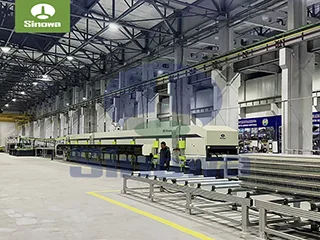
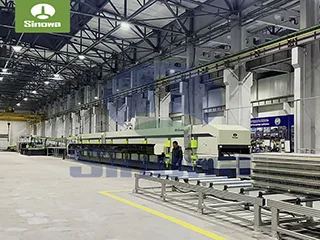
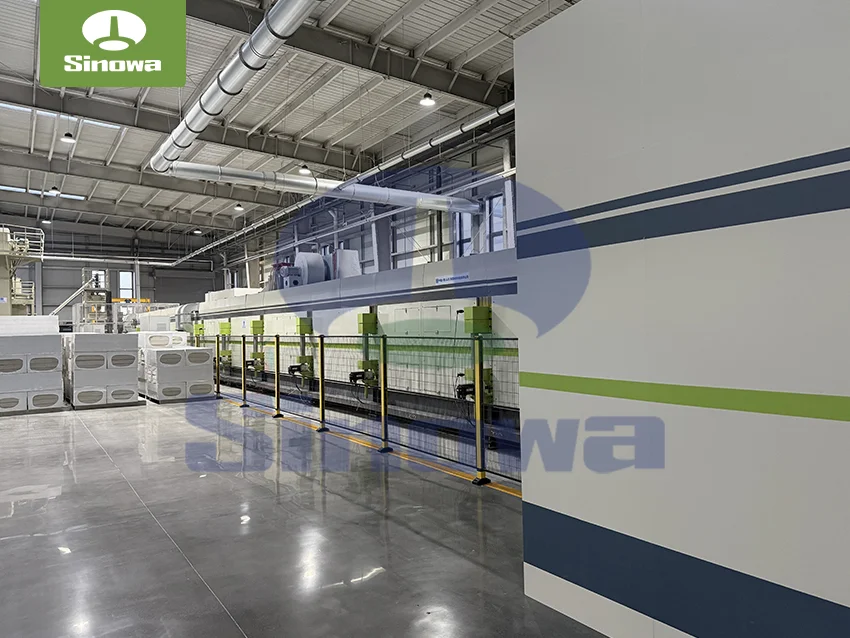
 sandwich panel line
A complete foam PU sandwich panel line is a highly coordinated automated production system composed of multiple interconnected functional units, which operates synchronously under unified central control without manual intervention in core production links. Unlike scattered single processing machines, all functional modules of the line are matched in operating speed, transmission rhythm and working temperature to ensure seamless connection between upstream and downstream processes. The entire production system can be divided into front-end surface material processing unit, middle-end high-pressure foaming and laminating unit, constant-temperature curing unit, rear-end fixed-length cutting and finishing unit, as well as auxiliary material circulation and waste recovery supporting units. Each unit undertakes independent processing tasks while maintaining dynamic speed matching, avoiding production defects such as foam unevenness, surface layer wrinkling and panel delamination caused by asynchronous operation.
The front-end surface material processing module is responsible for pretreatment of upper and lower surface plates that form the outer protective layer of sandwich panels. Most mainstream production lines adapt to flexible metal coil materials as panel surface layers, which feature high mechanical strength, strong weather resistance and good bonding compatibility with polyurethane foam core materials. At the initial stage of production, coil unwinding equipment releases continuous metal sheet materials stably, and an automatic material splicing structure is equipped inside the unwinding module to connect new coil materials with residual materials of exhausted coils without stopping the sandwich panel production line. This non-stop material switching design effectively eliminates production downtime caused by coil replacement and greatly improves overall production continuity. After unwinding, raw metal sheets will go through multi-group leveling roller sets to eliminate subtle surface bending, indentation and internal stress generated during coil winding. Meanwhile, surface cleaning assemblies remove dust, oil stains and oxide attachments on sheet surfaces, because residual impurities will directly reduce the bonding force between metal surface layers and polyurethane foam core, leading to hidden dangers of interlayer peeling in long-term use of finished panels. Subsequently, continuous roll forming equipment processes flat metal sheets into customized groove profiles, lap joints and edge sealing structures according to design requirements of wall panels, roof panels and cold storage special panels. The profiled structure not only improves the overall bending resistance and structural stability of finished sandwich panels, but also realizes tight occlusion between adjacent panels during on-site installation, enhancing overall airtightness and thermal insulation effect of building enclosure structures.
The middle foaming and composite laminating unit is the most critical core part of the entire foam PU sandwich panel production line, which determines the foaming uniformity, core density stability and interlayer bonding strength of finished panels. Polyurethane foam is formed by the chemical reaction between two liquid raw materials: combined polyether and isocyanate. The sandwich panel machine adopts precision metering pumping systems to deliver two liquid raw materials to the high-pressure mixing head at a stable and accurate proportional flow rate. Precise ratio control is the primary premise for qualified foam production: deviation of raw material proportion will cause incomplete chemical reaction, resulting in problems such as soft foam core, poor dimensional stability after curing, or excessive foam brittleness and easy cracking under external pressure. Inside the closed high-pressure mixing head, two liquid materials are fully mixed through high-speed impact and turbulence, realizing uniform fusion without material stratification. The uniformly mixed liquid polyurethane raw materials are continuously and evenly sprayed onto the surface of the lower profiled metal sheet through a wide-range spraying nozzle. The spraying width and material output can be adjusted in real time according to the designed thickness and width of target panels to avoid local material accumulation or blank areas.
Immediately after foam spraying, the upper profiled metal sheet is closed with the lower sheet through a guiding roller group, wrapping the uncured liquid polyurethane foam tightly between two surface layers. Then the three-layer composite structure consisting of upper metal sheet, liquid foam core and lower metal sheet enters the double-track crawler laminating conveyor. The crawler conveyor maintains constant clamping pressure and stable linear transmission speed throughout the process, restricting the free expansion range of polyurethane foam during chemical reaction. Polyurethane materials will undergo rapid chain expansion, foaming and curing reactions after mixing, and constant pressure limitation ensures consistent overall thickness of finished panels and uniform internal foam pore structure. Uncontrolled free foaming will lead to irregular panel thickness and uneven internal pore distribution, greatly reducing thermal insulation performance and structural uniformity of panels. The internal temperature of the crawler laminating section is kept within a constant temperature range through circulating heating systems, providing stable reaction temperature conditions for polyurethane foaming and curing. Temperature fluctuation in this link will affect foaming reaction speed: excessive temperature accelerates local reaction and causes internal residual stress, while insufficient temperature leads to incomplete curing and slow molding speed.
Following the laminating and preliminary curing process, the composite panels enter the independent constant-temperature curing channel for deep curing treatment. Although the polyurethane foam completes basic molding and bonding in the crawler laminating section, internal chemical reactions still continue slowly. The long constant-temperature curing channel maintains mild and stable ambient temperature to promote thorough completion of residual chemical reactions inside the foam core, eliminate internal stress generated during foaming and lamination, and further enhance the bonding firmness between foam core and metal surface layers. Sufficient deep curing effectively avoids post-production deformation, warping or interlayer separation of panels caused by residual internal stress during storage, transportation and later use. The length of the curing channel and the overall transmission speed of the polyurethane sandwich panel production line are designed synchronously to match the complete curing cycle of polyurethane foam, realizing one-time continuous molding without secondary manual curing or standing processing.
After completing full curing and shaping, continuous long-strip composite panels enter the rear-end finishing and cutting unit. The automatic tracking cutting system synchronizes with the running speed of the PU sandwich panel machine to realize dynamic fixed-length cutting without line stopping. Compared with static cutting equipment that requires production halt, dynamic online cutting maintains uninterrupted production rhythm and improves overall production efficiency. The cutting tool adopts high-precision cold cutting mode, which will not generate high temperature to damage the cutting end face structure of polyurethane foam core, ensuring flat and neat panel end faces without foam collapse or edge cracking. After cutting, finished panels are transmitted to automatic edge trimming and deburring assemblies to remove tiny burrs and residual foam residues on cutting edges, optimizing the overall appearance quality of panels and avoiding assembly obstacles in later building construction. Finally, qualified finished panels are automatically stacked by mechanical stacking devices, and the whole process from raw material coil input to finished panel stacking is completed in a fully automated closed production line with minimal manual operation participation only for routine equipment inspection and parameter monitoring.
In the industrial manufacturing field of insulated sandwich panels, polyurethane sandwich panel line is mainly divided into continuous foam PU sandwich panel line and intermittent discontinuous production lines, and the structural design and process logic of continuous production lines applied in mainstream large-scale manufacturing scenarios have obvious competitive advantages. Intermittent production lines adopt separate foaming and pressing processes, with independent feeding, foaming, pressing and cutting stations working intermittently. Each panel needs independent material distribution, pressing and curing, resulting in discontinuous production rhythm, lower daily output and larger fluctuation of finished product quality. In contrast, continuous foam PU sandwich panel lines integrate all processing procedures into one closed circulating assembly line, realizing seamless connection of all processes. The integrated production mode not only improves single-line production capacity by multiple times, but also ensures consistent reaction temperature, pressure, material ratio and transmission speed of each batch of panels, realizing highly unified dimensional accuracy, foam density, thermal insulation performance and bonding strength of all finished products. For large-volume, long-term standardized procurement demands from construction engineering, cold chain logistics and industrial plant projects, continuous foam PU sandwich panel lines are more suitable for centralized and stable mass production.
The process parameter adjustment capability of foam polyurethane sandwich panel machine directly determines the performance diversity of finished panels, enabling one production line to manufacture multi-specification panels adapting to different application scenarios. By adjusting raw material metering ratio, foaming pressure, curing temperature and transmission speed, manufacturers can flexibly change the core foam density of sandwich panels. Low-density foam core panels feature lighter overall weight and superior thermal insulation performance, which are widely used in exterior wall enclosure structures and roof systems of civil prefabricated buildings, reducing overall building load while meeting building energy-saving insulation requirements. High-density foam core panels have enhanced compressive strength and impact resistance, suitable for cold storage floors, industrial workshop partition walls and building components requiring high mechanical load-bearing capacity. In addition, the production line can match different surface layer materials besides conventional metal sheets, including color-coated plates, galvanized sheets and aluminum alloy sheets, and adjust surface layer profiling shapes freely to produce wall panels, roof panels, cold storage special panels and purification workshop panels with different installation structures. This flexible production adaptation enables a single set of production equipment to cover multi-scene market demands and reduce equipment investment costs for panel manufacturers.
With the global promotion of carbon neutrality goals and stricter building energy-saving codes, the upgrading direction of foam continuous PU sandwich panel line is gradually focused on intelligent operation optimization and green production upgrading. In terms of intelligent upgrading, modern production lines are equipped with full-process real-time monitoring systems, which collect operating data including raw material flow, mixing pressure, curing temperature, line speed and clamping pressure in real time. The system automatically compares collected data with standard process parameters, and conducts closed-loop automatic adjustment once parameter deviation is detected, avoiding manual parameter adjustment errors. Remote monitoring function is also integrated into mainstream new-generation lines, allowing equipment managers to check production operating status, view historical production data and adjust process parameters remotely, realizing unattended intelligent operation of production lines during non-night shift periods. Meanwhile, intelligent fault diagnosis modules can early identify potential abnormalities such as pump pressure fluctuation, transmission chain deviation and material blockage, and send early warning signals in advance to reduce unexpected equipment shutdown time and maintenance costs.
In terms of green and low-carbon production optimization, foam continuous PU sandwich panel production line is constantly optimizing raw material utilization rate and reducing production waste in recent years. Traditional production lines have inevitable residual foam materials at panel cutting positions, while optimized production lines adopt accurate material spraying calculation models to match foam output with actual panel cavity volume completely, minimizing redundant foam raw materials. Supporting waste foam recovery units are configured at the cutting section to collect residual foam fragments generated during edge trimming and cutting. Collected foam wastes can be reprocessed into auxiliary thermal insulation filling materials for secondary industrial use, realizing recycling of production wastes and reducing raw material waste and industrial solid waste discharge. Besides, the heating system of curing and laminating sections is upgraded to heat recovery circulating structures, which recover waste heat generated during foaming chemical reactions to supplement heating demand of curing channels, reducing overall power consumption of production lines and lowering carbon emission in the panel manufacturing process.
The popularization and technological iteration of foam PU sandwich panel making machine also play a vital role in promoting the development of the entire prefabricated construction and cold chain industry. Prefabricated buildings rely on factory-produced standardized building components to realize rapid on-site assembly, shortening construction cycle by more than half compared with traditional cast-in-place construction modes. Stable and efficient production capacity supported by advanced foam PU sandwich panel lines ensures sufficient supply of high-performance enclosure panels for prefabricated buildings, promoting the large-scale promotion of modular buildings, temporary emergency shelters and mobile integrated houses. In the cold chain logistics industry, low-temperature storage warehouses require building materials with ultra-high thermal insulation and moisture-proof performance to reduce refrigeration energy consumption. Sandwich panels produced by professional foam PU production lines have closed-cell foam structures with extremely low water absorption rate, effectively isolating external heat and humid air, cutting long-term refrigeration operating costs of cold storage. In addition, these panels are also applied to industrial plant enclosures, noise reduction wall structures and clean workshop partition systems, relying on the dual advantages of thermal insulation and sound insulation brought by polyurethane foam core materials.
Looking ahead, the future development of foam PU sandwich panel production machine will further integrate digital twin technology and more precise micro-control foaming technology. Digital twin systems will build virtual simulation models consistent with physical production lines, simulate the whole foaming and composite process in advance, predict product quality defects under different parameter combinations, and optimize production parameters before formal mass production, further improving finished product yield. Micro-precise foaming control technology will realize micron-level adjustment of foam pore structure, breaking through the performance bottleneck of existing polyurethane foam panels, and developing ultra-thin high-strength sandwich panels applicable to special engineering scenarios such as high-altitude buildings and lightweight vehicle compartment structures. Meanwhile, with the upgrading of environmental protection requirements, production lines will be further optimized to reduce volatile organic compound emissions during polyurethane foaming reactions, realizing cleaner and environmentally friendly whole-process production.
In conclusion, the foam PU sandwich panel manufacturing line is a systematic automated manufacturing equipment that integrates mechanical transmission, chemical reaction control, constant temperature thermal management and intelligent digital monitoring. It realizes efficient, stable and standardized batch production of polyurethane foam sandwich panels through collaborative operation of multiple functional units. Driven by global energy-saving policies and the booming prefabricated construction market, this type of production line is continuously upgraded in intelligence, production efficiency and green manufacturing performance. As the core manufacturing equipment of high-performance thermal insulation composite building materials, foam PU sandwich panel machinery will continue to support the high-quality development of green construction, cold chain logistics and modular building industries worldwide, and create greater economic and environmental value in the process of global industrial low-carbon transformation.
https://www.cnsinowa.com/sandwich-panel-machines/foam-pu-sandwich-panel-line.html