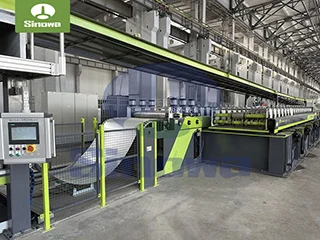
sandwich panel line
The basic structural composition of the composite PU sandwich panel line covers multiple interconnected functional modules, each undertaking independent processing tasks while maintaining synchronous operation rhythm. The raw material feeding module serves as the starting point of the entire production process, mainly responsible for the orderly release and preliminary leveling of surface sheet materials. Common surface raw materials include various metal sheets with smooth and flat surfaces, which are rolled and stored in coil form to adapt to continuous feeding requirements. This module is equipped with adjustable tension control components to maintain uniform feeding speed of the sheet, preventing surface wrinkles, stretching and deformation caused by uneven tension during material transportation. Meanwhile, the chemical raw material supply unit matched with the feeding module realizes the sealed storage and quantitative delivery of polyurethane reaction raw materials. These liquid chemical raw materials need to be stored in independent containers with constant temperature adjustment functions to maintain stable molecular activity, which lays a foundation for uniform foaming reaction in the subsequent process.
After completing raw material feeding, the sheet will enter the surface pretreatment area for refined processing, which is a key link to ensure the bonding firmness between the surface layer and the foam core layer. In this area, the production line adopts physical treatment methods to remove dust, oil stains and oxide layers on the sheet surface, and carries out micro-texture treatment on the smooth surface to enhance the adsorption capacity between the sheet and polyurethane foam. Different from simple cleaning procedures, the pretreatment process focuses on improving the surface roughness of the sheet without damaging the surface protective layer, so as to avoid degumming and delamination of the composite panel in long-term use. The running speed of the pretreatment equipment keeps synchronous with the feeding speed of the coil material, and the surface quality of the sheet is monitored in real time through embedded sensing components to eliminate unqualified base materials before entering the composite molding stage, reducing the defective rate of finished products from the source.
The foaming and mixing module is the technological core of the composite PU sandwich panel line, determining the internal structure, density and thermal insulation performance of the panel core layer. The production line adopts a high-precision metering and mixing structure to transport two or more polyurethane raw materials to the mixing chamber in an accurate proportion. Under the action of mechanical stirring, the raw materials undergo sufficient physical mixing and chemical reaction to generate uniform foaming colloid. The mixing speed and material ratio can be adjusted according to the production requirements of different panels, so as to change the foaming density and pore structure of the core layer. In the continuous production state, the mixed foaming colloid is evenly sprayed on the surface of the lower sheet that moves at a constant speed. The spraying width and thickness are precisely controlled by the flow control valve to ensure the consistency of the core layer thickness of each section of the panel. The whole foaming process is carried out in a closed space to avoid the interference of external temperature and air flow on the foaming reaction, ensuring that the internal bubble structure of the polyurethane foam is dense and uniform.
Subsequently, the sheet coated with foaming colloid enters the composite lamination area, where the upper and lower surface sheets are accurately aligned and laminated to form a preliminary sandwich structure. The lamination unit is composed of multiple groups of adjustable pressure rollers, which can apply uniform vertical pressure to the composite blank. The pressure value is dynamically adjusted according to the thickness and hardness of the sheet and the viscosity of the foam colloid, so as to eliminate internal bubbles generated during lamination and make the foam fully fit with the sheet. The gap between the pressure rollers is precisely calibrated to control the overall thickness of the composite panel, and the horizontal levelness of the rollers is guaranteed to avoid thickness deviation on both sides of the panel. In this process, the initial bonding strength between the foam core and the surface sheet is formed by physical pressure, and the primary shaping of the sandwich structure is completed, which provides structural conditions for the subsequent curing reaction.
The constant temperature curing channel is an indispensable heating and forming unit in the production line, which promotes the complete chemical cross-linking reaction of polyurethane foam through stable temperature environment. The internal temperature of the curing channel is distributed in a gradient manner, with the temperature rising gradually from the inlet to the middle section and keeping constant in the later section. This temperature distribution mode can prevent the surface of the foam from curing too fast to form a hardened film, which would hinder the internal gas discharge and cause hollow defects inside the panel. The thermal insulation structure is adopted on the outer wall of the curing channel to reduce heat loss and maintain the stability of the internal temperature field. The composite blank moves forward at a constant speed in the channel, and the curing time is controlled by adjusting the running speed to ensure that the polyurethane foam completes foaming, expansion and solidification reactions. After curing, the internal molecular structure of the foam tends to be stable, forming a rigid closed-cell structure, which endows the panel with excellent thermal insulation and compression resistance.
After high-temperature curing, the composite panel will enter the cooling and shaping area to complete the temperature reduction and structural stabilization process. The cooling system adopts combined air cooling and water cooling modes to realize gradual heat dissipation of the panel. Excessively fast cooling will cause inconsistent shrinkage of the surface sheet and internal foam, resulting in structural stress and warping deformation of the panel; while excessively slow cooling will reduce production efficiency. Therefore, the cooling speed is intelligently matched with the curing temperature to ensure that the internal and external temperature of the panel decreases synchronously. During the cooling process, the panel still maintains a flat conveying state under the constraint of the conveying track, and the slight residual stress generated in the curing stage is gradually released to further optimize the flatness and dimensional stability of the finished panel.
The fixed-length cutting and post-processing module is the final processing link of the entire production line, realizing the segmentation and finishing of continuous composite panels. According to the customized size requirements, the intelligent cutting system automatically locates and cuts the panels, and the high-speed cutting tool ensures smooth and neat cutting sections without burrs and cracks. After cutting, the edge trimming device polishes and shapes the four sides of the panel to eliminate sharp edges and surface burrs generated during cutting. Some production lines are also equipped with simple stacking and packaging auxiliary structures, which can neatly arrange the cut finished panels to facilitate subsequent transportation and storage. In addition, the online detection system installed at the end of the production line conducts real-time sampling inspection on the thickness, flatness, bonding strength and surface appearance of the finished products, and automatically marks the unqualified products to realize the separation of high-quality products and defective products.
Compared with intermittent molding processing equipment, the composite PU sandwich panel line has prominent technical and production advantages in industrial application. In terms of production efficiency, the continuous assembly line structure realizes uninterrupted feeding, foaming, curing and cutting, greatly shortening the single-panel molding cycle and realizing large-scale batch production. In terms of product quality control, the whole production process is completed in a closed and controlled environment, and parameters such as temperature, pressure and material ratio are dynamically monitored, which effectively reduces the influence of human operation errors and ensures the consistency of panel performance. The polyurethane foam produced by this continuous process has a closed-cell rate of more than ninety percent, giving the panel low thermal conductivity and excellent heat and cold insulation effects. At the same time, the tight composite structure between the foam core and the surface sheet improves the overall tensile strength and bending resistance of the panel, making it not easy to delaminate and damage during long-term use.
In terms of application adaptability, the composite PU sandwich panel line has flexible production adjustment capabilities. By replacing different types of surface sheets and adjusting production parameters, the line can manufacture panels suitable for diverse usage scenarios. Panels with metal surface layers are widely used in industrial factory buildings, temporary buildings and exterior wall insulation structures due to their weather resistance and corrosion resistance; lightweight smooth surface panels are applied to internal purification spaces such as medical workshops and food processing workshops, relying on their easy-to-clean and dust-proof characteristics; thickened foam core panels are commonly used in cold storage and constant-temperature warehouses to build low-temperature heat preservation spaces. The adjustable thickness range of the finished panels is wide, which can meet the structural strength and thermal insulation requirements of different building envelopes and industrial equipment.
From the perspective of energy consumption and environmental protection, the modern composite PU sandwich panel line has been optimized in energy utilization and waste treatment. The circulating heating structure of the curing channel reduces redundant heat loss, and the quantitative feeding mode of chemical raw materials avoids raw material overflow and waste. The foaming reaction process does not produce harmful residual substances, and the leftover materials generated in the cutting process can be uniformly recycled and reprocessed to improve the comprehensive utilization rate of raw materials. In addition, the fully enclosed production space reduces the diffusion of trace volatile substances generated in the production process, optimizing the on-site production environment and meeting the basic environmental protection requirements of modern industrial production.
With the continuous upgrading of industrial manufacturing technology, the intelligent degree of composite PU sandwich panel line is also constantly improving. The emerging production lines are equipped with centralized control systems, which can integrate and adjust all operation parameters of each functional module. Production personnel can monitor the operating status of the equipment, material consumption and product qualification rate through the visual operation interface, and remotely adjust parameters such as feeding speed, foaming ratio and curing temperature. The fault self-diagnosis function embedded in the system can identify abnormal noise, temperature deviation and material blockage in the equipment in real time, and send early warning signals to avoid equipment failure and large-scale defective product accumulation. The intelligent transformation not only reduces the labor demand of the production line, but also improves the accuracy and stability of production control.
In the future development trend, the composite PU sandwich panel line will further develop towards high efficiency, energy saving and personalized customization. On the basis of maintaining continuous production capacity, the equipment will optimize the internal structural layout to reduce floor space and improve the integration of functional modules. The new temperature control and pressure sensing components will improve the parameter control accuracy, so that the internal pore structure and bonding state of the panel can reach a more ideal level. Meanwhile, in response to the diversified material demands of the market, the production line will strengthen the compatibility of multi-type raw materials, realize the rapid switching production of different surface materials and modified polyurethane foams, and expand the application boundary of composite panels. Driven by the demand for energy-saving buildings and lightweight industrial materials, the composite PU sandwich panel line will continue to iterate and upgrade, providing more reliable and efficient production support for the composite material manufacturing industry, and playing an increasingly important role in promoting the high-quality development of the construction and industrial manufacturing fields.
https://www.cnsinowa.com/sandwich-panel-machines/composite-pu-sandwich-panel-line.html