sandwich panel line
The overall structural composition of the composite sandwich panel production line follows a sequential production logic, with each functional unit closely connected and mutually coordinated to form an uninterrupted production loop covering raw material processing to finished product output. The front-end part of the entire system focuses on raw material preparation and pretreatment, which lays a solid foundation for subsequent composite molding. Metal coil raw materials used for panel surface layers are placed on stable uncoiling equipment, which achieves uniform and low-tension material feeding through mechanical damping and speed regulation structures. This steady feeding mode effectively avoids material deformation, wrinkling or uneven stress caused by sudden tension changes, ensuring the flatness and structural uniformity of the metal surface layer in subsequent processing. Meanwhile, the supporting leveling and trimming devices in the front-end unit further optimize the surface state of metal materials, removing edge burrs and correcting subtle structural deviations generated during coil production, making the surface materials meet the precise dimensional and flatness requirements of composite processing.
In parallel with metal surface material pretreatment, the core material processing unit independently completes the fine treatment of rock wool raw materials, which is the key link to determine the internal performance of sandwich panels. Bulk rock wool raw materials undergo fixed-length cutting, sorting and layered arrangement through professional processing equipment, realizing standardized shaping of core materials. During the processing, the equipment adjusts the arrangement density and fiber direction of rock wool according to the structural design requirements of composite panels, effectively optimizing the internal structural compactness of the core layer. Reasonable fiber arrangement not only enhances the overall compression resistance and structural stability of the rock wool core material, but also maximizes the thermal insulation and sound absorption characteristics inherent to rock wool materials. Moreover, the core material conveying system adopts a stable limiting and positioning structure, which can accurately transport the shaped rock wool core material to the composite station, ensuring the alignment accuracy between the core layer and the upper and lower metal surface layers, and avoiding structural offset that may affect the overall performance of the panel.
Adhesive application is an indispensable intermediate process in the composite molding of sandwich panels, and the composite sandwich panel line is equipped with an automatic and uniform gluing system to ensure the bonding quality between the core layer and surface layers. The system controls the adhesive output and coating thickness through precise mechanical calibration, achieving full coverage and uniform distribution of adhesive on the bonding surface of metal plates and rock wool core materials. Compared with manual gluing, the automated gluing process eliminates the problems of uneven glue thickness, missing coating or excessive glue accumulation, which effectively improves the bonding firmness between layers. The stable adhesive coating state enables the rock wool core material and metal surface layers to form an integrated whole after composite pressing, preventing layer separation, peeling and other quality defects in long-term use. At the same time, the gluing speed is dynamically matched with the overall operating speed of the rock wool sandwich panel production line, realizing synchronous operation of gluing and material conveying, and maintaining the continuity and efficiency of the entire production process.
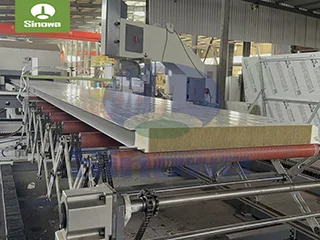
The composite pressing and curing stage is the core procedure for the final molding of sandwich panels, determining the overall structural strength and dimensional stability of finished products. The rock wool sandwich panel line is equipped with a long-size constant-pressure pressing and curing integrated unit, which provides continuous and uniform pressure for composite materials. In the closed pressing and curing area, the upper and lower metal surface layers and the middle rock wool core material are tightly compounded as a whole under stable pressure. The length of the curing area is scientifically matched with the operating speed of the rock wool sandwich panel machine, ensuring that each section of the composite panel stays in the curing space for sufficient time to complete the adhesive curing reaction. This controlled curing process enables the adhesive to form a stable bonding structure, so that the composite panel obtains reliable structural strength, and will not deform, warp or delaminate during subsequent transportation, cutting and installation. The pressure control system maintains constant pressure output throughout the curing process, avoiding structural differences of panels caused by pressure fluctuation, and realizing consistent quality of batch products.
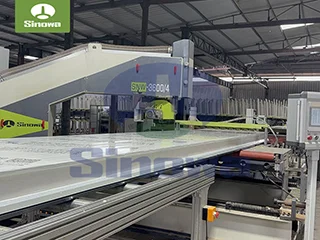
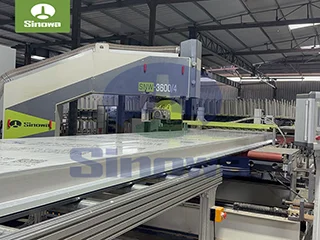
After completing composite curing and preliminary molding, the continuous long-strip panel enters the precision post-processing stage, which mainly includes fixed-length cutting, edge trimming and surface finishing. The intelligent cutting system of the rockwool sandwich panel production line can accurately set the cutting size according to production demands, and complete fixed-length cutting of continuous panels through high-precision cutting components. The cutting process features smooth incision and no material collapse, ensuring the dimensional accuracy and edge flatness of single panels. The subsequent edge trimming device further polishes and corrects the panel edges, removing residual burrs and irregular structures generated by cutting, making the appearance and dimensional parameters of finished panels more standardized. In addition, the surface finishing unit can fine-tune the surface flatness of the panels and clean surface dust and residual impurities, optimizing the overall appearance quality of finished products and laying a foundation for subsequent on-site construction and installation.
The automated control system runs through the entire operation process of the composite rock wool sandwich panel line, serving as the intelligent core to ensure efficient and stable production. The system integrates speed regulation, parameter monitoring, fault early warning and synchronous operation control functions, realizing unified scheduling and coordinated operation of all functional units. Operators can set production parameters such as panel size, operating speed and pressing pressure through the centralized control terminal, and the system will automatically adjust the operating state of each equipment unit to achieve standardized production. In the production process, the real-time monitoring module continuously collects operating data of each link, including material feeding speed, gluing volume, pressing pressure and curing time. Once abnormal parameter fluctuation or equipment operation failure occurs, the system will trigger early warning prompts and automatically adjust operating parameters or stop equipment operation as needed, effectively avoiding batch quality problems and equipment failure losses. The highly automated control mode reduces manual intervention links, lowers the impact of human operation errors on product quality, and significantly improves production stability and consistency.
The process layout and equipment design of the composite rock wool sandwich panel production line endow the produced panels with excellent comprehensive performance and wide application adaptability. The integrated composite structure of metal surface layer and rock wool core material combines the mechanical advantages of metal materials and the functional characteristics of rock wool materials. The metal surface layer provides high structural strength, impact resistance and weather resistance for the panel, enabling the product to adapt to complex outdoor and indoor construction environments and resist external pressure, wind and rain erosion and mechanical impact. The rock wool core material, as the functional core of the panel, delivers outstanding thermal insulation, fire resistance and sound insulation performance. The porous fiber structure of rock wool can effectively block heat transfer, reducing building energy consumption and achieving excellent thermal insulation and temperature regulation effects. At the same time, the inherent non-combustible characteristics of rock wool materials greatly improve the fire resistance level of the panel, which can effectively block the spread of flames and heat flow in case of fire, improving the overall fire safety of buildings. In terms of sound insulation, the dense fiber gap structure of rock wool can absorb and isolate sound waves, reducing noise transmission and creating a quiet and comfortable building internal environment.
In terms of production efficiency and economic benefits, the continuous and automated operation mode of the rock wool board production line greatly optimizes the production process and reduces production costs. The integrated production process from raw material feeding to finished product output realizes one-time molding of composite panels, eliminating multiple intermediate handling and processing links in traditional production, shortening the production cycle significantly. The high degree of automation reduces labor demand, lowers labor operation costs and improves production efficiency per unit time. At the same time, the precise parameter control of the sandwich panel manufacturing line reduces raw material waste in the production process, improves the utilization rate of metal plates, rock wool and adhesives, and further optimizes the overall production cost. The standardized batch production mode ensures stable and consistent product quality, reduces the rate of defective products and rework costs, and improves the comprehensive economic benefits of production and manufacturing.
In practical industrial production and engineering application scenarios, the composite rock wool sandwich panel making machine has strong production flexibility and can meet the diversified production demands of the market. By adjusting the operating parameters of the equipment, the rockwool board production line can manufacture sandwich panels with different thicknesses, sizes and structural specifications, covering the production demands of building exterior wall insulation, interior partition, roof thermal insulation, industrial plant enclosure and other different scenarios. The panels produced by this line feature light overall weight, convenient transportation and installation, and good structural compatibility. Compared with traditional building thermal insulation and enclosure materials, rock wool sandwich panels have lighter weight under the same thermal insulation and fire protection performance, which can reduce the self-weight load of buildings, simplify the construction process, shorten the construction cycle of engineering projects, and reduce the difficulty of on-site construction operations.
With the continuous upgrading of modern building energy conservation, fire safety and green environmental protection requirements, the composite rock wool sandwich panel production machinery is also constantly optimized and improved in process and equipment performance. The current production line focuses more on green production and energy-saving optimization in the design process, effectively reducing energy consumption and resource waste in the production process through optimized equipment transmission structure and process layout. The efficient adhesive curing process reduces the emission of harmful substances in the production process, and the whole production process meets the requirements of green and environmentally friendly building material manufacturing. In addition, the continuous improvement of automation and intelligent level further enhances the production precision and stability of the equipment, enabling the performance indicators of finished panels to be more stable and reliable, and better adapting to the increasingly stringent quality requirements of modern construction projects for building enclosure and thermal insulation materials.
In conclusion, the composite rock wool sandwich panel line as an efficient, stable and flexible professional manufacturing system, integrates multiple advanced processing technologies and automated control technologies, and realizes standardized, large-scale and high-quality production of rock wool composite sandwich panels. Its scientific process layout, precise equipment operation and perfect production logic ensure the excellent mechanical properties, thermal insulation performance, fire resistance and sound insulation performance of finished products. With the continuous development of the construction industry towards energy conservation, environmental protection and high safety, the rock wool sandwich panel production equipment will continue to play an important role in the field of building material manufacturing, providing reliable product support and efficient production solutions for modern building enclosure, thermal insulation and fire protection engineering, and promoting the iterative upgrading and high-quality development of the entire lightweight building material industry.
https://www.cnsinowa.com/sandwich-panel-machines/composite-rock-wool-sandwich-panel-line.html