sandwich panel line
The fundamental advantage of the rock wool sandwich panel continuous production line lies in its seamless integration of multiple processes, eliminating the inefficiencies of traditional intermittent production and ensuring a smooth flow from raw material input to finished product output. At the heart of its operation is a sophisticated control system that coordinates the work of various components with high precision. Typically, the production process begins with the uncoiling of surface materials, which are usually metal coils such as color steel sheets or aluminum sheets. The uncoiling unit, equipped with hydraulic control and automatic centering functions, ensures stable and uniform feeding of the metal coils, preventing deviations that could affect the subsequent forming quality. This stability is particularly crucial because the surface materials serve as both the structural support and protective layer of the sandwich panels, requiring consistent flatness and dimensional accuracy from the initial stage.
Following uncoiling, the metal sheets enter the roll forming unit, a key part of shaping the surface profile. The roll forming process uses a series of sequentially arranged rollers to gradually bend the flat metal sheets into the desired cross-sectional shape, such as corrugated, trapezoidal, or other customized profiles. The rollers are designed with precise contours, and the forming speed is adjustable to match different material thicknesses and profile complexities. Advanced production lines adopt a cassette-type or rail-wheel design for the roll forming unit, allowing for quick replacement of roller sets to produce different types of panels, thereby enhancing production flexibility. This adaptability is essential in meeting the diverse needs of construction projects, where panels of varying shapes and sizes may be required for walls, roofs, or partitions.
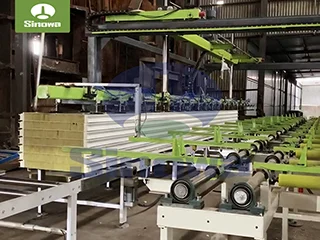
Parallel to the processing of surface materials is the preparation of the rock wool core, the core component that endows the sandwich panels with their insulating and fire-resistant properties. The rock wool core is typically made from basalt, diabase, or other natural rock materials, which are melted at high temperatures and then fibrosis through a centrifugal process. The rock wool supplying system on the production line is responsible for cutting, trimming, and conveying the rock wool core to the lamination area. This system includes lifting devices, precision cutting equipment, and turning conveyors that adjust the thickness and width of the rock wool core according to the panel specifications. To ensure the uniformity of the core material, the system is equipped with automatic monitoring devices that detect and correct any deviations in thickness, preventing inconsistencies that could compromise the panel's thermal insulation performance. Additionally, dust collection devices are integrated into the rock wool processing section to minimize dust emissions, creating a cleaner and safer production environment.
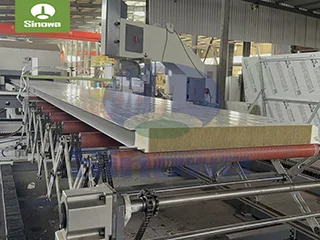
The lamination and bonding process is where the surface materials and rock wool core are combined to form the sandwich structure. Before lamination, the metal sheets undergo preheating in a hot air circulating furnace, which raises their temperature to an optimal level for adhesive curing. This preheating step is critical for enhancing the bonding strength between the metal sheets and the rock wool core, ensuring long-term structural stability of the panels. The adhesive application system then sprays a uniform layer of adhesive onto the inner surfaces of the upper and lower metal sheets. Advanced production lines use bidirectional spraying technology, ensuring full coverage of the adhesive and avoiding weak bonding points. The rock wool core, after being cut to size, is then fed between the two preheated and adhesive-coated metal sheets, and the entire assembly enters the double belt lamination unit. This unit applies uniform pressure to the assembly, pressing the three layers tightly together, while maintaining a constant temperature to facilitate the curing of the adhesive. The double belt system, composed of high-temperature-resistant and wear-resistant belts, ensures consistent pressure distribution across the entire panel width, preventing warping or uneven bonding.
After lamination and initial curing, the continuous panel blank moves to the cutting section, where it is trimmed to the required length and width. The cutting unit typically employs a three-axis vertical cutting or band saw cutting system, which can perform non-stop cutting during production, ensuring continuous operation and high efficiency. The cutting parameters, such as length and width, are controlled by a digital servo system, allowing for precise adjustments with minimal error margins. This precision is essential for ensuring that the finished panels meet the exact dimensions required for construction, reducing waste and improving installation efficiency. Some advanced production lines also include a slitting function, which allows for the production of multiple panels of smaller width from a single continuous blank, further enhancing production flexibility.
The final stages of the production process include cooling, stacking, and packaging. The cut panels are first cooled in an air cooling system to stabilize their structure and ensure complete curing of the adhesive. After cooling, the panels are automatically conveyed to the stacking unit, which arranges them neatly into stacks of a predetermined height. The stacking unit uses hydraulic lifting and positioning technology, ensuring gentle handling of the panels to avoid surface damage. Finally, the stacked panels are wrapped in plastic film by the packaging unit, providing protection against dust, moisture, and scratches during transportation and storage. The entire production process, from uncoiling to packaging, is fully automated, with minimal manual intervention, reducing the risk of human error and improving production efficiency.
One of the most notable advantages of the rock wool sandwich panel continuous production line is its high efficiency. Compared to traditional intermittent production methods, continuous production lines can operate continuously for long periods, significantly increasing output. The production speed typically ranges from 3 to 8 meters per minute, and can be adjusted according to the panel thickness and forming requirements. Based on 250 working days per year and 10 working hours per day, a single production line can achieve an annual output of up to 800,000 square meters, meeting the large-scale supply needs of construction projects. This high efficiency is further enhanced by the automatic coil changing function in the uncoiling unit, which allows for the replacement of metal coils without stopping production, minimizing downtime.
Energy efficiency and environmental friendliness are also key features of modern rock wool sandwich panel continuous production lines. These lines adopt advanced frequency conversion vector technology and energy-saving motors, which reduce power consumption by up to 40% compared to older models. The preheating system uses efficient heat circulation technology, maximizing heat utilization and reducing energy waste. Additionally, the integration of dust collection devices in the rock wool processing section and the use of eco-friendly adhesives minimize environmental pollution, aligning with global sustainability trends. The production process also generates minimal waste, as the cutting scraps can be recycled and reused, further reducing the environmental impact.
The high degree of automation and intelligent control of the production line not only improves efficiency but also ensures consistent product quality. The entire production process is monitored and controlled by a central computer system, which collects data from various sensors installed throughout the line, such as temperature sensors, pressure sensors, and thickness sensors. This real-time monitoring allows for immediate adjustments to any deviations, ensuring that each panel has uniform thickness, consistent bonding strength, and precise dimensions. The man-machine interface of the control system is user-friendly, allowing operators to set production parameters, monitor production status, and troubleshoot issues with ease. With only 5 to 8 operators required to manage the entire line, labor costs are significantly reduced, making the production process more cost-effective.
The versatility of the rock wool sandwich panel continuous production line is another important advantage. By adjusting production parameters and replacing certain components, the line can produce a wide range of rock wool sandwich panels with different specifications, such as varying thicknesses (30 to 200 mm or more for cold storage panels), widths (600 to 1200 mm), and surface profiles. Some production lines can even be configured to produce panels with different core materials, such as polyurethane or glass wool, by adding or modifying specific units. This versatility allows manufacturers to meet the diverse needs of different construction scenarios, from industrial warehouses that require high fire resistance to cold storage facilities that demand superior thermal insulation.
The rock wool sandwich panels produced by these continuous lines find applications in a wide range of construction projects. In industrial construction, they are commonly used for the walls and roofs of factories, warehouses, and workshops, providing excellent thermal insulation and fire protection, which helps to reduce energy consumption for heating and cooling and enhance workplace safety. In commercial construction, they are used in shopping malls, office buildings, and hotels, where their sound absorption properties help to create a quiet and comfortable environment. In residential construction, especially in prefabricated housing, rock wool sandwich panels are favored for their quick installation, light weight, and energy-saving performance, helping to shorten construction periods and improve living comfort. They are also used in special applications such as fire isolation belts, clean rooms, and livestock breeding facilities, where their unique properties meet specific functional requirements.
Looking to the future, the rock wool sandwich panel continuous production line is expected to undergo further technological innovations to meet the evolving needs of the construction industry. One key trend is the integration of artificial intelligence (AI) and big data analytics into the control system. AI algorithms can analyze production data in real time, predict potential equipment failures, and optimize production parameters to improve efficiency and product quality. Big data analytics can also help manufacturers better understand market demand, enabling them to adjust production plans more effectively. Another trend is the development of more eco-friendly production technologies, such as the use of bio-based adhesives and the integration of renewable energy sources (e.g., solar power) into the production process, further reducing the environmental footprint of the production line.
Additionally, there is a growing focus on improving the flexibility and customization capabilities of the production line. With the increasing demand for personalized building designs, manufacturers need production lines that can quickly switch between different panel types and specifications. This will drive the development of more modular and flexible production equipment, allowing for faster changeovers and shorter production lead times. Furthermore, advancements in material science may lead to the development of new types of rock wool core materials with enhanced properties, such as higher thermal insulation efficiency, better mechanical strength, and lower weight, and the production line will need to be adapted to process these new materials.
In conclusion, the rock wool sandwich panel continuous production line is a sophisticated and efficient piece of equipment that plays a vital role in the modern construction materials industry. Its seamless integration of multiple processes, high efficiency, energy-saving features, and consistent product quality make it an indispensable tool for manufacturing high-performance rock wool sandwich panels. As the construction industry continues to prioritize sustainability, safety, and efficiency, the production line will continue to evolve, incorporating new technologies and innovations to meet changing market demands. Whether in industrial, commercial, or residential construction, the rock wool sandwich panels produced by these lines will remain a key material, contributing to the development of greener, safer, and more efficient buildings.
https://www.cnsinowa.com/sandwich-panel-machines/rock-wool-sandwich-panel-continuous-production-line.html