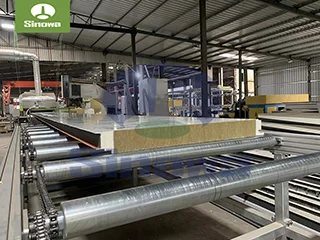
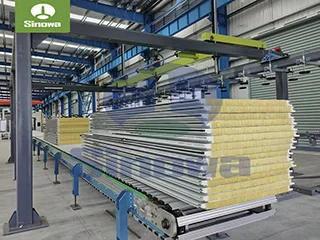
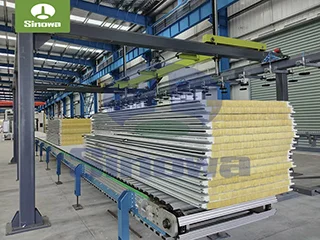
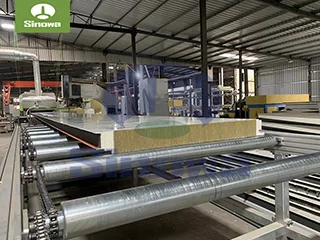
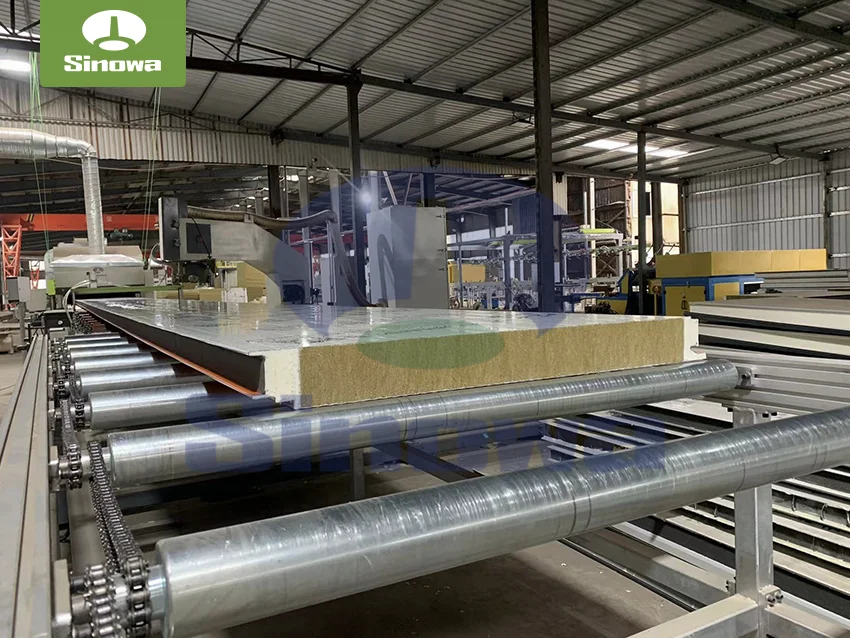
 sandwich panel line
The rock wool sandwich panel production line for curtain wall systems is a complex and highly integrated automated production system, consisting of multiple functional modules that work together to complete the transformation from raw materials to finished products. The core components of the production line mainly include raw material preparation equipment, rock wool fiber forming equipment, core material processing equipment, metal panel forming equipment, bonding and compounding system, edge sealing system, cutting system, cooling and solidification system, stacking and packaging system, as well as intelligent control system. Each module undertakes specific tasks and is closely connected to ensure the continuity and stability of the production process. The raw material preparation equipment is responsible for processing natural rocks such as basalt and serpentinite, which are the main raw materials of rock wool, through crushing and grinding to obtain particles with uniform particle size and stable composition. This step is the foundation of ensuring the performance of rock wool core materials, as the purity and particle size of raw materials directly affect the quality of subsequent rock wool fibers. The rock wool fiber forming equipment melts the processed raw materials at high temperatures (usually above 1400℃) to form a molten state, and then uses centrifugal force or air blowing technology to draw the molten material into fine rock wool fibers. During this process, appropriate binders and water repellents are added to enhance the bonding strength and water resistance of the fibers.
The metal panel forming equipment is used to process metal coils such as color steel plates or aluminum plates into metal panels of specific shapes and sizes through uncoiling, leveling, roll forming and other processes. The surface of these metal panels can be subjected to special coating treatments according to actual needs to improve their corrosion resistance and weather resistance, so as to adapt to different outdoor environments. The bonding and compounding system is a key part of the rock wool sandwich panel line, which accurately applies high-performance adhesives to the metal panels and then composites them with the processed rock wool core materials. The edge sealing system, usually using polyurethane foaming technology, fills the edges of the composite panels to effectively prevent water vapor from penetrating into the core materials, avoid reducing the performance of rock wool due to moisture absorption, and at the same time enhance the overall thermal insulation effect of the panels. The cutting system uses advanced follow-up sawing or milling technology to cut the continuously formed composite panels into finished products of specified lengths according to production requirements. The cooling and solidification system accelerates the solidification of adhesives and edge sealing materials to ensure the bonding strength and dimensional stability of the panels. Finally, the stacking and packaging system automatically stacks the finished products and packages them to protect the panels from damage during transportation and storage. The intelligent control system runs through the entire production process, realizing real-time monitoring and precise adjustment of parameters such as temperature, pressure, and speed, ensuring the stability of product quality and improving production efficiency.
The production process of rock wool sandwich panels for curtain wall systems is a sophisticated and rigorous process, which can be roughly divided into six main stages: raw material preparation, rock wool core material production, metal panel processing, composite forming, edge sealing and post-processing, and quality inspection. Each stage has strict technical requirements and operational standards. In the raw material preparation stage, high-purity natural rocks are selected as the main raw materials for rock wool, and after crushing, grinding and screening, rock particles that meet the requirements are obtained. These particles need to have uniform particle size and no impurities to ensure the stability of the melting process. At the same time, metal coils for manufacturing metal panels are also inspected and pretreated to remove surface oil stains and rust, ensuring the bonding effect between the metal panels and the adhesives. In the rock wool core material production stage, the prepared rock particles are sent to a high-temperature furnace for melting. Under the action of high temperature, the rock particles are completely melted into a liquid state. Then, the molten liquid is sprayed out through a centrifugal spinneret, and under the action of high-speed airflow, it is drawn into continuous and fine rock wool fibers. During the fiber formation process, a certain amount of binder (usually phenol-formaldehyde resin) and water repellent are evenly sprayed on the fibers to make the fibers bond to each other and have good water resistance. The fibers with additives are then collected by a cotton collector to form a loose rock wool felt, which is then compressed and cured to obtain a rock wool core material with a certain density and strength. The density of the rock wool core material for curtain wall systems is usually between 100kg/m³ and 150kg/m³ to ensure sufficient structural strength and thermal insulation performance.
In the metal panel processing stage, the metal coils are first uncoiled by an uncoiler, and then leveled by a leveling machine to eliminate the internal stress of the metal sheets and ensure the flatness of the panels. The leveled metal sheets are then sent to a roll forming machine, which bends the metal sheets into specific cross-sectional shapes (such as corrugated or flat) according to the design requirements of the curtain wall system. Some sandwich panel production line can also perform surface coating or film covering on the metal panels to further improve their corrosion resistance and scratch resistance. In the composite forming stage, the processed rock wool core material and metal panels are transported to the composite machine through a conveying system. The composite machine first applies a uniform layer of adhesive on the inner surface of the metal panels. The amount and uniformity of the adhesive application directly affect the bonding strength between the metal panels and the rock wool core material. Then, the rock wool core material is accurately placed between the upper and lower metal panels, and under the action of pressure and temperature, the three are tightly bonded together to form a composite board blank. The pressure and temperature during the composite process need to be precisely controlled. Excessive pressure may damage the rock wool core material, while insufficient pressure will lead to poor bonding; improper temperature will affect the curing effect of the adhesive.
The edge sealing and post-processing stage is crucial to improving the overall performance of the rock wool sandwich panels. After composite forming, the board blanks are sent to the edge sealing machine, and polyurethane foam is injected into the edges of the boards through high-pressure injection technology. The polyurethane foam expands and cures quickly, tightly wrapping the edges of the rock wool core material, forming a dense and waterproof seal. This not only effectively blocks the invasion of rainwater and water vapor, avoids the problem of reduced performance of rock wool due to moisture absorption, but also enhances the overall rigidity and thermal insulation effect of the panels by cutting off the cold and heat bridge. After edge sealing, the board blanks are sent to the cutting machine for fixed-length cutting. The cutting machine uses high-precision cutting tools to ensure that the size of the finished products meets the design requirements, and the cutting surface is flat and free of burrs. Finally, the finished products are cooled, sorted, stacked and packaged. The packaging usually uses moisture-proof and wear-resistant packaging materials to protect the panels from damage during transportation and storage. The quality inspection stage runs through the entire production process. From the inspection of raw materials to the sampling inspection of semi-finished products in each production link, and then to the comprehensive inspection of finished products, strict quality control standards are implemented. The inspection items mainly include the density, compressive strength, thermal conductivity, water resistance, bonding strength and appearance quality of the rock wool core material. Only products that pass all inspection items can leave the factory.
The rockwool sandwich panel production line for curtain wall systems has obvious technical characteristics, mainly reflected in high automation, precise process control, strong adaptability and environmental protection. With the continuous development of industrial automation technology, modern rock wool sandwich panel machine has realized full-process automation from raw material feeding to finished product packaging. The intelligent control system can monitor various parameters in the production process in real time, such as the temperature of the high-temperature furnace, the speed of the centrifugal spinneret, the amount of adhesive application, the pressure of the composite machine, etc., and make precise adjustments according to the preset parameters. This not only improves production efficiency, reduces manual operation errors, but also ensures the consistency and stability of product quality. The production line can adjust production parameters according to different product specifications and performance requirements, realizing flexible production. For example, it can produce rock wool sandwich panels of different thicknesses, densities and sizes to meet the needs of different curtain wall system designs. At the same time, the production line can also match different types of metal panels and adhesives according to customer needs, further expanding the application range of products.
In terms of environmental protection, the modern rock wool sandwich panel production machinery has adopted a series of environmental protection technologies and measures to reduce the impact on the environment. During the production process of rock wool, the waste gas generated is treated by dust removal and desulfurization equipment to meet the emission standards; the waste water is recycled after treatment, reducing water resource consumption; the waste materials generated during the production process, such as leftover materials and defective products, can be recycled and reused, improving the utilization rate of raw materials and reducing solid waste emissions. In addition, the rock wool core material itself is an environmentally friendly and renewable material. Its main raw material is natural rock, which is rich in resources and non-toxic and harmless. It will not release harmful gases when exposed to fire, and can be recycled after the service life, in line with the concept of green building and sustainable development.
Quality control is an important part of the operation of the rock wool sandwich panel manufacturing machine for curtain wall systems, which directly determines the performance and safety of the products applied in the curtain wall system. A complete quality control system covers every link from raw material procurement to finished product delivery. In terms of raw material control, strict inspection standards are formulated for natural rocks, metal coils, adhesives and other raw materials. Only raw materials that meet the standards can enter the production link. For example, the natural rocks used to produce rock wool need to be inspected for chemical composition and purity to ensure that the produced rock wool fibers have excellent fire resistance and thermal insulation performance; the metal coils need to be inspected for thickness, surface quality and corrosion resistance to ensure the durability of the metal panels. In the production process control, key links such as rock wool fiber forming, composite bonding and edge sealing are monitored and sampled. For example, during the rock wool fiber forming process, the fiber diameter and length are sampled and tested to ensure that the fiber structure is uniform and the slag ball content is within the allowable range; during the composite bonding process, the bonding strength between the metal panels and the rock wool core material is tested to avoid problems such as delamination and degumming.
For the finished products, a comprehensive performance test is carried out. The main test items include fire resistance, thermal insulation performance, sound insulation performance, compressive strength, water resistance and dimensional accuracy. The fire resistance test verifies whether the rock wool sandwich panel can maintain its structural integrity and fire insulation performance under high temperature conditions; the thermal conductivity test measures the thermal insulation effect of the panel, which is an important indicator to evaluate the energy-saving performance of the curtain wall system; the sound insulation performance test ensures that the panel can effectively block external noise and improve the indoor acoustic environment; the compressive strength test and water resistance test ensure the structural stability and durability of the panel in practical applications. In addition, the appearance quality of the finished products is also inspected, including whether the surface of the panel is flat, whether there are scratches, bubbles and other defects, and whether the cutting edge is neat. Through strict quality control, the rock wool sandwich panels produced can meet the technical requirements of the curtain wall system and ensure the safety and reliability of the building.
The rock wool sandwich panel manufacturing line for curtain wall systems plays an irreplaceable role in the construction industry, and its significance is mainly reflected in promoting the development of green buildings, improving the safety performance of buildings, and improving the efficiency of construction projects. With the increasing emphasis on energy conservation and environmental protection in the construction industry, green building has become the mainstream development trend. The rock wool sandwich panels produced by this production line have excellent thermal insulation performance, which can effectively reduce the energy consumption of buildings in heating and cooling, and help realize the energy-saving goals of buildings. At the same time, rock wool is an environmentally friendly and non-toxic material that does not produce harmful gases when burned, which is in line with the environmental protection requirements of green buildings. In terms of building safety, the rock wool sandwich panel has excellent fire resistance, which can effectively block the spread of fire and buy valuable time for fire fighting and personnel evacuation. For high-rise buildings and large-scale commercial complexes, the use of rock wool sandwich panels in the curtain wall system can significantly improve the fire safety level of the building. In addition, the rock wool sandwich panel has the characteristics of light weight and high strength, which can reduce the overall load of the building, reduce the cost of the building structure, and at the same time improve the seismic performance of the building.
In terms of improving the efficiency of construction projects, the rock wool sandwich panels produced by the production line have the advantages of standardized production and easy installation. Due to the high degree of automation of the sandwich panel making machine, the finished products have uniform specifications and stable quality, which can be directly installed on the construction site without secondary processing. This not only shortens the construction period, but also reduces the difficulty of on-site construction and the labor intensity of construction personnel. Compared with traditional building materials, the installation efficiency of rock wool sandwich panels can be increased by more than 60%, which greatly improves the progress of construction projects. For example, in the renovation project of the exterior wall of a commercial complex, the use of rock wool sandwich panels instead of traditional ceramic tiles can shorten the construction period from 3 months to 45 days, allowing the project to open earlier and generate economic benefits.
Looking to the future, with the continuous advancement of construction technology and the continuous upgrading of market demand, the rock wool board production line for curtain wall systems will face new development opportunities and challenges. In terms of technology, the production line will tend to be more intelligent and precise. With the application of technologies such as the Internet of Things, big data and artificial intelligence, the production line will realize more refined management and control, and can predict and diagnose potential problems in the production process in advance to further improve production efficiency and product quality. In terms of product innovation, the production line will develop towards producing rock wool sandwich panels with higher performance. For example, developing rock wool core materials with lower thermal conductivity to further improve the energy-saving effect of the product; developing metal panels with better corrosion resistance and weather resistance to adapt to more harsh environmental conditions; developing composite panels with multiple functions such as sound insulation, heat insulation, and radiation protection to meet the diverse needs of different buildings.
In terms of environmental protection, the production line will further optimize the production process and adopt more environmentally friendly technologies and materials to reduce energy consumption and pollutant emissions. For example, using more efficient energy-saving equipment to reduce energy consumption in the production process; developing environmentally friendly adhesives to replace traditional adhesives that may have environmental pollution risks; improving the recycling rate of waste materials to realize the circular utilization of resources. At the same time, with the continuous expansion of the application field of curtain wall systems, the production line will also develop towards diversification, producing rock wool sandwich panels suitable for different application scenarios such as industrial plants, hospitals, schools, and data centers to meet the specific needs of different industries.
In conclusion, the rock wool sandwich panel production line for curtain wall systems is an important part of the modern construction industry. It integrates multiple technologies such as machinery, automation and materials, and realizes the efficient and high-quality production of rock wool sandwich panels through sophisticated production processes and strict quality control. The rock wool sandwich panels produced by the production line have the advantages of excellent fire resistance, thermal insulation, sound insulation and light weight, which provide a reliable material guarantee for the curtain wall system and promote the development of green buildings and safe buildings. In the future, with the continuous innovation of technology and the continuous upgrading of market demand, the rock wool sandwich panel production line for curtain wall systems will continue to develop and improve, making greater contributions to the sustainable development of the construction industry.
https://www.cnsinowa.com/sandwich-panel-machines/rock-wool-sandwich-panel-production-line-for-curtain-wall-system.html