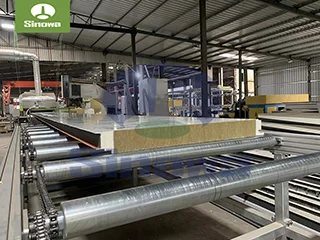
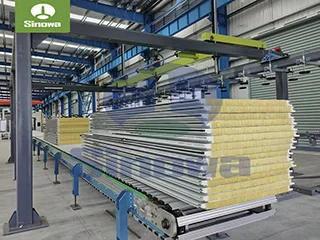
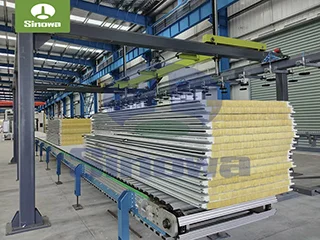
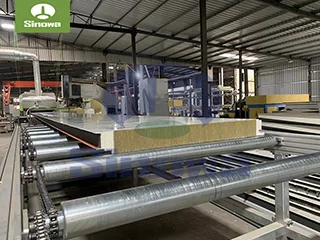
sandwich panel line
The Mineral Wool Panel Line is a complete set of mechanical equipment specifically designed for the production of mineral wool boards. Mineral wool boards, generally referring to mineral wool decorative sound-absorbing boards, are made primarily from granular cotton (mainly made from slag wool) with the addition of other additives, and are formed through high-pressure steam extrusion and cutting. They do not contain asbestos and possess excellent properties such as fire resistance, sound absorption, thermal insulation, and heat insulation, making them widely used in interior ceiling and wall decoration in buildings.
The Mineral Wool Panel Line typically consists of multiple systems, including the raw material preparation system, melting system, fiberizing system, cotton collecting device, binder and dustproof oil spraying system, curing oven, cutting and processing system, packaging and warehousing system, etc. These systems work together to complete the entire production process from raw materials to finished products.
Raw material preparation system: responsible for the crushing, screening, storage, metering, mixing, feeding, and conveying of raw materials, providing qualified raw materials for the melting system.
Melting system: Feed raw materials into the melting furnace for melting to form a high-temperature melt. The melting furnace typically adopts forms such as a cupola, tank furnace, or electric furnace.
Fiber-forming system: Utilizing equipment such as centrifuges to centrifuge high-temperature melt into mineral wool fibers.
Cotton collecting device: Collects mineral wool fibers produced by the fiber forming system to form a fiber cotton layer.
Binder and dustproof oil spraying system: Spray a certain amount of binder and dustproof oil onto the fiber cotton layer to enhance the bonding strength between fibers and dustproof performance.
Curing oven: The fibrous cotton layer sprayed with adhesive and dustproof oil undergoes curing treatment to form a stable structure.
Cutting and processing system: The cured mineral wool board undergoes cutting, embossing, finishing, and other processing treatments to meet the needs of different customers.
Packaging and Warehousing System: Pack the processed mineral wool boards and store them in the warehouse.
Characteristics of Mineral Wool Panel Line
High degree of automation: Modern Mineral Wool Panel Lines typically adopt automated assembly line operations, significantly enhancing production efficiency.
Reasonable process layout: The layout of various systems in the Mineral Wool Panel Line is reasonable and compact, reducing material transportation and energy consumption.
Product quality stability: The Mineral Wool Panel Line adopts advanced production processes and quality control measures to ensure stable and reliable product quality.
High customizability: Some manufacturing enterprises can provide personalized assembly line customization services according to customer needs.
Mineral wool panel lines represent a fundamental category of modern building envelope and interior construction materials, engineered by combining inorganic mineral fiber core substrates with durable outer facing layers through integrated composite bonding and forming processes. Unlike traditional single-layer insulation materials that only focus on basic thermal regulation functions, mineral wool panels produced through professional panel production lines integrate diversified structural mechanical properties, multi-dimensional physical stability, and comprehensive functional protection attributes into a single integrated component, making them indispensable core materials for contemporary industrial construction, commercial architectural design, public infrastructure development, and high-standard residential renovation projects. The core value of the entire mineral wool panel production and application system lies in the scientific classification of structural performance according to different building stress conditions, environmental adaptation requirements, and long-term service cycle demands, and the targeted matching of corresponding structural types of panels to specific construction scenarios, so as to balance structural safety, long-term durability, functional practicality, and construction convenience throughout the entire life cycle of buildings. The inherent material characteristics of mineral wool raw materials, including inorganic composition, natural non-combustibility, excellent sound absorption and heat insulation potential, lay a solid foundation for the basic performance of finished panels, while the structural design optimization in the production line processing process directly determines the mechanical bearing capacity, deformation resistance, connection stability, and overall structural coordination ability of the panels in actual building assembly and long-term operation.
The structural performance classification of mineral wool panel line products is fundamentally based on the core mechanical stress characteristics and structural load-bearing design standards formed during the production and composite molding process, which can be divided into three core categories with distinct functional positioning and structural design logic, namely load-bearing structural mineral wool panels, rigid enclosure structural mineral wool panels, and flexible assembly structural mineral wool panels. Each structural performance category has unique internal core density configuration, composite layer bonding process, edge sealing and connection structural design, and overall mechanical deformation resistance parameters, and these structural differences directly derive differentiated application directions and suitable building use scenarios, avoiding the performance mismatch and structural safety risks caused by the blind application of single-type mineral wool panels in complex construction environments. Load-bearing structural mineral wool panels are the most mechanically robust type in the entire product line, designed and produced with a focus on long-term static load bearing, dynamic impact resistance, and uniform pressure dispersion performance, and the internal mineral wool core of such panels adopts high-density fiber compression molding technology in the production process, with a compact internal fiber arrangement structure and strong internal cohesion force between fiber layers. The composite outer layers on both sides are made of high-toughness and high-strength base materials with good tensile and bending resistance, and the bonding interface between the outer layer and the mineral wool core adopts high-strength integrated composite processing technology to ensure that there is no delamination, cracking, or relative displacement between the core material and the outer layer under long-term load conditions. In terms of structural mechanical performance, this type of panel can withstand continuous uniform surface pressure and local concentrated impact load, with excellent compressive deformation resistance and bending structural stability, and will not produce permanent structural deformation or performance attenuation under the action of building dead weight, external wind pressure, snow load, and conventional mechanical extrusion during long-term use.
The internal structural optimization design of load-bearing structural mineral wool panels also takes into account the uniform transmission of structural stress and the overall coordination of force bearing. The production line adopts continuous integral molding processing instead of segmented splicing production, which ensures the continuity and integrity of the internal fiber structure of each panel and avoids structural weak points such as stress concentration at segmented joints. The edge part of the panel is reinforced with integral sealing and edge-locking structural treatment in the production process, which not only improves the overall structural rigidity of the edge area that is prone to stress concentration but also enhances the connection firmness and overall assembly stability between multiple panels after on-site installation. Due to these excellent structural performance characteristics, load-bearing structural mineral wool panels are mainly used in building parts that require both long-term load-bearing support and comprehensive functional protection, including large-span industrial factory roof enclosure structures, industrial plant load-bearing partition walls that need to bear equipment auxiliary load and structural vibration, multi-story building equipment interlayer enclosure and load-bearing separation components, and outdoor large-area building roof panels that need to resist harsh natural weather load such as strong wind and heavy snow. In large industrial production bases and manufacturing workshops, these panels not only undertake the basic enclosure and thermal insulation functions of the building roof and wall but also bear the temporary load of later maintenance and construction personnel and equipment, as well as the long-term fatigue load caused by equipment operation vibration, relying on their stable structural performance to maintain the long-term safe and stable operation of the building envelope without frequent maintenance and replacement.
Rigid enclosure structural mineral wool panels are the most widely used conventional type in the panel line product system, with structural performance design focused on rigid shaping stability, overall enclosure rigidity, and environmental deformation adaptability, balancing moderate mechanical performance and universal functional applicability. Compared with load-bearing structural panels, the mineral wool core density of rigid enclosure structural panels is moderately configured according to conventional building enclosure needs, maintaining good basic structural rigidity while retaining the excellent thermal insulation and sound absorption inherent advantages of mineral wool materials. The composite bonding process of the panel is optimized for conventional building enclosure stress characteristics, ensuring that the panel maintains stable overall shape and structural integrity under conventional building service conditions, with strong resistance to conventional external temperature deformation, slight wind pressure impact, and daily environmental erosion. The structural design of this type of panel focuses more on the overall enclosure sealing performance and assembly coordination performance, with standardized edge connection structures reserved during production, which can realize rapid assembly and seamless splicing between panels on the construction site, forming a continuous and complete building enclosure structure with good overall structural tightness and anti-permeability performance. Although the rigid enclosure structural mineral wool panels do not have super-heavy load-bearing capacity, their structural rigidity is sufficient to resist conventional building external environmental loads, avoid panel bulging, deformation, or cracking caused by temperature difference changes and slight external force impact, and maintain the long-term flat and stable appearance of the building wall and roof surface.
The application scope of rigid enclosure structural mineral wool panels covers most conventional commercial buildings, public service facilities, and general industrial and civil building enclosure scenarios, becoming the mainstream structural type for building exterior walls, interior partition walls, and conventional roof insulation enclosure. In commercial office buildings, shopping malls, exhibition halls, and other public buildings, these panels are used for exterior wall thermal insulation and enclosure decoration integrated structures, relying on their rigid structural stability to maintain the long-term flat and beautiful appearance of the building facade, while providing good thermal insulation, sound insulation, and fire protection functions to improve the indoor comfort and safety of the building. In schools, hospitals, community service centers, and other public welfare infrastructure, rigid enclosure structural mineral wool panels are used for internal functional partition walls and exterior wall enclosure structures, with stable structural performance ensuring that the partition walls do not deform or crack under long-term use, and creating a quiet and safe indoor activity and working environment through excellent sound absorption and fire isolation effects. In general small and medium-sized factory buildings, warehouse storage buildings, and logistics distribution centers, such panels are used for wall and conventional roof enclosure, meeting the basic structural stability needs of buildings while realizing fast construction and cost-effective building envelope construction, adapting to the construction cycle and long-term use requirements of conventional industrial and storage buildings.
Flexible assembly structural mineral wool panels are a specialized structural type optimized and upgraded for special building space needs, temporary building facilities, and later building renovation and expansion scenarios in the panel line product system, with structural performance design focused on assembly flexibility, lightweight structural characteristics, convenient disassembly and reusability, and local structural deformation adaptability. The internal mineral wool core of flexible assembly structural panels adopts lightweight flexible fiber uniform distribution design, with moderate structural rigidity and good bending and deformation resistance within a certain range, and the outer composite layer adopts lightweight and high-toughness flexible fit materials, which can adapt to slight structural deformation of the building main body without panel cracking or structural damage. The biggest structural feature of this type of panel lies in the modular and lightweight overall structural design and the quick disassembly and assembly connection structure. The production line processes the panels into standardized small-specification modular units, with simple and fast connection structures reserved at the edges, which do not require complex professional construction equipment and complicated bonding and fixing processes during on-site installation, and can realize rapid assembly, disassembly, and relocation reuse. The structural performance of flexible assembly structural mineral wool panels does not pursue high load-bearing capacity and ultra-high rigid rigidity, but focuses on the structural coordination ability with the flexible deformation of the building main body and the convenience of repeated assembly and disassembly, meeting the temporary and flexible use needs of special building spaces.
Flexible assembly structural mineral wool panels are widely used in temporary construction facilities, mobile office spaces, building interior temporary partition projects, old building renovation and functional space adjustment, and short-term use special building enclosure scenarios. In construction site temporary office rooms, temporary dormitories, and temporary construction command centers, these panels can be quickly assembled into complete wall and roof enclosure structures, providing basic thermal insulation, sound insulation, and safety protection functions for temporary buildings, and can be quickly disassembled and transferred to other construction sites for reuse after the completion of the construction project, reducing construction waste and improving material utilization efficiency. In large exhibition activities, temporary exhibition booths, and temporary activity venues, flexible assembly structural mineral wool panels are used for space partition and temporary enclosure, adapting to the rapid layout and temporary use needs of different activity spaces, with lightweight structural design not causing additional load pressure on the building main body, and flexible structural performance adapting to the rapid adjustment and change of space layout. In old residential building renovation, office space functional adjustment, and factory internal production area reconstruction projects, such panels are used for local interior partition and partial enclosure renovation, without large-scale demolition and reconstruction of the original building structure, relying on flexible assembly structural characteristics to realize rapid construction renovation, reducing the impact on the normal use of the building and shortening the renovation construction cycle.
Beyond the core structural performance classification and basic application orientation, the comprehensive structural matching advantage of mineral wool panel line products in building construction also lies in the good compatibility between different structural types of panels and various building main body structures, as well as the long-term structural stability adaptation to different climatic and environmental conditions. All structural types of mineral wool panels are produced through standardized integrated production lines, with stable product structural performance and consistent size accuracy, which can be perfectly matched with steel structure main bodies, concrete main bodies, and mixed building main bodies of different materials, realizing effective connection and overall structural coordination between panels and building main bodies. In high-temperature and high-humidity climatic areas, the structural bonding performance and internal fiber structure of mineral wool panels will not be affected by humid and hot environments, without moisture absorption deformation, mildew corrosion, or structural performance attenuation; in low-temperature and cold wind areas, the panels have good low-temperature structural toughness, without brittle cracking or structural damage under the action of low-temperature freezing and strong wind impact, maintaining stable structural and functional performance throughout the year. At the same time, the inorganic structural characteristics of mineral wool core materials make all types of panels have natural fire isolation and high-temperature resistance structural stability, will not burn or produce toxic smoke in case of building fire, and can maintain the integrity of structural enclosure for a certain period of time, providing reliable safety guarantee for building fire prevention and personnel evacuation.
With the continuous upgrading of modern building construction concepts and the increasing diversification of building functional needs, the structural performance optimization and application scope expansion of mineral wool panel line products are also constantly advancing. The structural design of mineral wool panels is gradually developing towards high integration, lightweight high strength, and intelligent adaptation, further balancing mechanical structural performance, functional protection performance, and green environmental protection performance. Different structural performance types of mineral wool panels will still be based on their respective core structural advantages, deeply applied in all fields of modern building construction, from large-scale industrial facilities and high-rise commercial buildings to public service infrastructure and temporary flexible construction projects. By reasonably selecting mineral wool panels with matching structural performance types according to the actual stress conditions, environmental characteristics, and use cycle needs of different building parts, construction projects can achieve scientific coordination between building structural safety, long-term durability, and comprehensive functional performance, promote the high-quality and sustainable development of modern building envelope construction, and create safer, more comfortable, and more efficient building space environments for various production, office, and living activities.
https://www.cnsinowa.com/sandwich-panel-machines/mineral-wool-panel-line.html