sandwich panel line
The entire production workflow starts with the automatic unwinding and feeding stage of surface materials. The system is equipped with a dual-station unwinding structure to adapt to the synchronous feeding of upper and lower layer surface materials, which can stably release coiled metal or non-metal facing materials. The unwinding module is equipped with precise tension adjustment devices, which can maintain constant material tension during the continuous unwinding process, effectively avoiding material deviation, wrinkling or stretching deformation caused by uneven tension. Before entering the molding process, the surface materials will go through automatic surface pretreatment procedures, including dust removal and surface smoothing treatment. These treatments remove surface impurities and oil stains on the facing materials, greatly improving the bonding tightness between the surface materials and the PU foam core material in the subsequent compounding process, and laying a solid foundation for the overall structural stability and durability of the finished sandwich panels. The feeding speed and material spacing of this stage are intelligently linked with the operating speed of the subsequent production modules, realizing dynamic matching of front and rear processes and avoiding material accumulation or supply interruption.
After completing feeding and pretreatment, the surface materials enter the continuous roll forming module, which is composed of multiple groups of precision rolling units arranged in an orderly sequence. Through gradual rolling and bending processing, the flat surface materials are precisely shaped into the preset panel profile structure. Each rolling unit is equipped with fine-tuning mechanisms to adjust the rolling gap and pressure, ensuring that the forming size and radian of the materials are consistent each time. The guided transmission structure made of high-strength and wear-resistant materials ensures smooth material operation without jitter or deviation, maintaining high dimensional accuracy of the formed surface materials. This continuous roll forming process replaces the traditional single-piece stamping forming method, realizing uninterrupted continuous processing of coiled materials, which not only significantly improves production efficiency but also ensures the uniformity and consistency of the surface profile of each batch of panels, avoiding the size differences easily generated in intermittent processing modes.
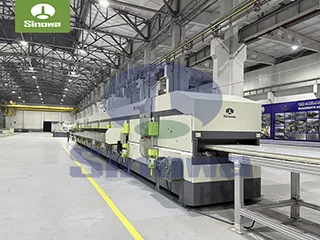
The PU foaming and core material compounding stage is the core link that determines the thermal insulation performance and structural strength of sandwich panels. The automatic sandwich panel production line is equipped with a high-precision automatic batching and injection system for polyurethane raw materials, which can accurately mix multiple liquid chemical raw materials according to the set proportion. The fully enclosed mixing structure prevents external impurities from mixing in and avoids raw material volatilization loss, ensuring the uniformity and stability of the mixed PU material. The mixed liquid PU material is evenly injected between the upper and lower formed surface materials through a precise injection port. With the advancement of the conveyor system, the liquid PU material undergoes uniform foaming and expansion under the set temperature and pressure environment, gradually filling the entire gap between the two layers of surface materials. In the enclosed thermal insulation curing channel, the PU material completes chemical cross-linking reaction, realizing rapid foaming, shaping and solidification, and forming an integrated composite structure with the upper and lower surface materials. The internal temperature gradient and conveying speed of the curing channel are scientifically matched with the panel thickness and production speed, which can effectively control the foaming density and curing degree of the PU core material, ensuring that the core material has uniform texture, no hollow holes or uneven foaming, and maximizing the thermal insulation, sound insulation and shock resistance of the panel.
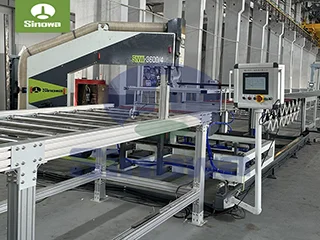
The integrated cutting system is a key functional module that realizes the fixed-length forming and finished product output of continuous sandwich panels, and it is also an important embodiment of the full automation of the PU sandwich panel production line. Different from traditional independent cutting equipment that requires manual positioning and auxiliary operation, the cutting system of this production line is deeply synchronized with the front-end continuous molding and curing process, realizing real-time tracking, automatic positioning and fixed-length cutting of panels in operating state. The system adopts a high-speed precision cutting structure with a dust absorption device, which can complete smooth cutting of panels without generating a large amount of dust and debris, maintaining a clean production environment. The intelligent sensing module can monitor the operating speed and real-time position of the continuous panel in real time, and automatically adjust the cutting rhythm and cutting position according to the preset panel length parameters, realizing dynamic synchronous cutting of moving panels without stopping the PU sandwich panel line. This non-stop cutting mode completely avoids the production efficiency loss caused by frequent start-stop of equipment in traditional intermittent production, and greatly improves the overall production continuity.
The cutting system supports flexible setting of multiple cutting parameters, which can adapt to the cutting processing of sandwich panels with different thicknesses, widths and lengths. Whether it is conventional standard-sized panels or customized special-sized products, the system can complete accurate cutting through parameter adjustment, with extremely high cutting flatness and dimensional accuracy. The cutting edge of the processed panel is smooth and flat without burrs, cracks or extrusion deformation, eliminating the need for secondary trimming and polishing processes, simplifying the production process and saving processing time and labor costs. In addition, the system is equipped with an automatic error correction function, which can automatically identify and correct slight position deviations of panels during operation, effectively avoiding defective products caused by cutting position errors and improving the yield rate of finished products. After the cutting operation is completed, the finished panels are quickly separated from the continuous base material and transmitted to the subsequent cooling and sorting station through the fast conveying device matched with the cutting system.
After cutting, the finished panels enter the automatic cooling and shaping stage. Although the PU core material has completed the curing reaction in the thermal insulation channel, the panel still retains a certain temperature, and natural cooling is required to stabilize the internal structure and overall flatness of the panel. The automatic cooling system adopts a uniform air cooling mode, which forms a circulating air flow around the conveyed panels to realize balanced and rapid heat dissipation of the upper and lower surfaces of the panels. This uniform cooling method can effectively prevent panel deformation, warping or internal stress concentration caused by uneven heat dissipation, further optimize the flatness and structural stability of finished panels, and ensure that the performance indicators of each panel are consistent. The cooling speed and air volume can be adjusted intelligently according to the panel thickness and production speed, ensuring that the panels reach the optimal storage and packaging state after cooling.
The final stage of the entire production process is automatic stacking and finishing. The cooled qualified panels are automatically conveyed to the stacking station, and the intelligent stacking device completes orderly stacking of panels according to the set number and arrangement mode. The stacking mechanism runs stably and accurately, which can avoid collision and friction damage between panels, protect the surface integrity of finished products. After stacking is completed, the system can cooperate with the subsequent packaging mechanism to complete automatic film wrapping and sealing protection of the panel stack, forming finished products that can be directly stored and transported. The whole process from raw material feeding to finished product packaging is completed on one continuous sandwich panel production line, realizing fully automated closed-loop production, with no manual participation in the intermediate links, which greatly reduces the labor intensity of workers and the human error rate in the production process.
The full automatic PU sandwich panel line with cutting system has outstanding technical advantages in production stability and intelligent control. The entire production process is uniformly controlled by a centralized intelligent control system, which can realize one-key setting and real-time adjustment of all process parameters including feeding speed, rolling pressure, PU batching ratio, curing temperature, cutting length and stacking quantity. The system is equipped with a real-time data monitoring function, which can dynamically display the operating status of each module, production progress and product parameter indicators, helping production managers grasp the production situation in real time. When abnormal conditions such as material blockage, parameter deviation or equipment jitter occur in a certain link, the system will automatically trigger early warning and perform self-protection shutdown, effectively avoiding equipment failure expansion and mass production of defective products, and improving the safety and stability of long-term continuous operation of the equipment.
In terms of production performance, this integrated polyurethane sandwich panel production line achieves a perfect balance between high efficiency and high quality. The continuous uninterrupted production mode greatly improves the hourly output of panels, and the synchronized operation of all modules avoids process waiting and equipment idle time. The precise parameter control system ensures that the foaming density, bonding strength, dimensional accuracy and surface flatness of each batch of panels are kept within a stable range, realizing standardized and standardized production of products. The PU sandwich panels produced by this line have excellent overall performance, with tight bonding between layers, uniform internal structure, good thermal insulation and sound insulation effects, high structural strength and strong compression resistance, which can adapt to various complex application environments. Compared with traditional production equipment, the integrated design of the cutting system saves the space and equipment investment of independent cutting equipment, reduces the transfer links of semi-finished products, shortens the production cycle, and further improves the production efficiency and economic benefits of the production line.
This automated production equipment has a wide range of application values in the field of modern construction and industrial manufacturing. The produced PU sandwich panels are widely used in the enclosure structures of industrial plants, cold storage buildings, logistics warehouses, clean workshops and temporary construction facilities. Its excellent thermal insulation performance can effectively reduce the energy consumption of building temperature regulation, and its lightweight and high-strength characteristics can reduce the overall load of buildings, shorten the construction cycle and reduce construction costs. At the same time, the diversified adjustable production parameters of the continuous PU sandwich panel line enable it to produce panels with different thermal insulation grades and structural specifications, which can meet the differentiated needs of different application scenarios for building enclosure materials. In addition, the fully enclosed production process of the equipment reduces the volatilization of raw materials and the generation of production waste, which conforms to the development trend of energy conservation and environmental protection in modern industrial production, and realizes green and efficient production while ensuring production efficiency and product quality.
With the continuous upgrading of the construction industry's requirements for building material performance and production standardization, the full automatic PU sandwich panel making line with integrated cutting system has become an indispensable core equipment in the lightweight building material industry. Its highly automated operation mode, precise production control capability and stable product output quality effectively make up for many deficiencies of traditional production processes. The integrated design of molding, foaming, curing and cutting simplifies the production process, improves the degree of production integration, and provides a reliable equipment guarantee for large-scale, high-efficiency and standardized production of PU sandwich panels. In the future, with the continuous innovation of industrial intelligent manufacturing technology, this continuous PU sandwich panel production line will further develop towards higher intelligence, stronger flexibility and better energy-saving performance, continuously empowering the high-quality development of the modern construction material manufacturing industry.
https://www.cnsinowa.com/sandwich-panel-machines/full-automatic-pu-sandwich-panel-making-line-with-cutting-system.html