sandwich panel line
The fundamental design logic of a polyurethane sandwich panel production line originates from the inherent physical and chemical properties of polyurethane raw materials. Polyurethane, a polymer compound synthesized through the polymerization reaction of isocyanate and polyol compounds, exhibits unique foam-forming characteristics under specific temperature, pressure, and catalytic conditions. During the foaming and curing process, polyurethane materials can form dense and uniform microporous structures, which endow finished panels with low thermal conductivity, high structural compactness, and outstanding shock resistance. A standardized PU panel line is systematically structured to precisely control every reaction variable throughout the material forming process, eliminating the instability factors caused by manual intervention in intermittent production modes. Unlike discrete processing equipment that completes single production steps independently, the continuous production mode of PU panel lines realizes uninterrupted material transportation, reaction molding, and performance shaping, effectively ensuring the consistency of panel thickness, density, surface flatness, and internal structural uniformity in large-batch production.
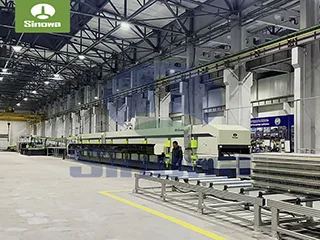
A complete polyurethane sandwich panel line consists of multiple interconnected functional modules, each undertaking independent production tasks while maintaining precise collaborative linkage to form an integrated closed-loop production system. The raw material feeding and pretreatment module serves as the initial starting point of the entire production flow, responsible for the storage, filtering, temperature regulation, and proportional mixing of core raw materials including polyurethane combined materials, auxiliary foaming agents, and catalytic additives. In this module, specialized storage containers are used to separately store different liquid raw materials, and constant-temperature circulation devices maintain the raw materials at a stable temperature range to avoid chemical activity fluctuations caused by ambient temperature changes. Precision metering devices are configured to accurately control the feeding ratio of various raw materials, as even minor deviations in the proportion of isocyanate and polyol will directly affect the foaming density, curing speed, and mechanical strength of finished panels. Before formal mixing, the raw materials will undergo fine filtration to remove tiny impurities generated during storage and transportation, preventing impurity particles from forming structural defects inside the panels and reducing the overall product quality.
Following the pretreatment process, the raw material mixing and pouring module takes over the subsequent production procedures, acting as the core functional unit that determines the uniformity of polyurethane foam materials. The mixing equipment adopts high-speed swirling mixing structures to achieve instantaneous and homogeneous fusion of different liquid raw materials. During the mixing process, moderate mechanical stirring force accelerates the molecular fusion reaction of polymer compounds, while avoiding excessive stirring that may introduce redundant air bubbles. After sufficient mixing, the composite polyurethane material is evenly poured onto the surface of the base plate through a linear pouring system. The pouring speed and discharge range are dynamically adjusted according to the preset panel thickness and width parameters, ensuring that the liquid raw materials can cover the base plate evenly without accumulation or sparse distribution. This module is equipped with real-time flow monitoring components to feed back material discharge data to the central control system, realizing closed-loop adjustment of the pouring process and maintaining the stability of material usage in each production cycle.
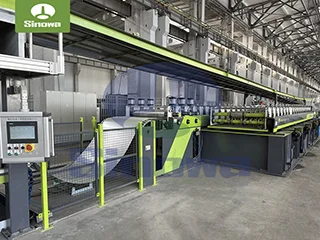
The surface material unwinding and composite pressing module is an essential component for shaping the layered structure of PU panels. Most finished PU panels adopt a sandwich composite structure, with metal or non-metal flat plates as the upper and lower surface layers and polyurethane foam as the intermediate thermal insulation and support layer. This module is mainly composed of automatic unwinding racks, tension control assemblies, and preliminary pressing structures. The unwinding racks are used to install coiled surface raw materials, achieving continuous and smooth material output through mechanical transmission structures. The tension control system precisely balances the stretching tightness of surface materials during transportation, effectively preventing material wrinkling, deformation, or offset caused by uneven tension. Before formal composite pressing, the surface materials will undergo simple surface leveling and dedusting treatment to remove floating impurities on the surface, enhancing the bonding tightness between the surface layer and the intermediate foam layer. When the liquid polyurethane material is poured on the lower base plate, the upper surface material is automatically covered by the transmission structure, and the preliminary pressing structure applies gentle uniform pressure to complete the initial fitting of the three-layer structure.
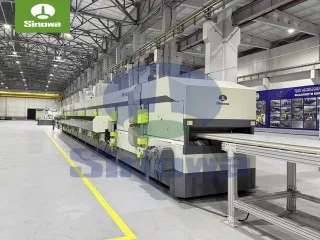
The constant-temperature curing and shaping module constitutes the key functional area for the chemical reaction and solidification molding of polyurethane materials. After preliminary composite pressing, the semi-finished panels are continuously transported into an insulated curing channel through a horizontal transmission system. The internal space of the curing channel maintains a stable constant-temperature environment, providing optimal reaction conditions for the foaming, expansion, and molecular cross-linking curing of polyurethane materials. In the early stage of entering the curing channel, the liquid polyurethane material undergoes rapid foaming expansion, gradually filling the gap between the upper and lower surface layers and forming a dense microporous foam structure. With the extension of the curing time, the polymer molecular chains complete cross-linking and solidification, transforming from a liquid viscous state into a solid stable state and forming an integrated composite structure with the surface plates. The internal temperature of the curing channel is graded and regulated, with different temperature intervals set to adapt to the reaction heat release characteristics of polyurethane materials at different curing stages. This graded temperature control method avoids local overheating that may cause internal cracking of the foam or uneven density distribution, effectively optimizing the internal structural stability of finished panels.
Subsequent to the curing and shaping process, the fixed-length cutting and edge trimming module completes the dimensional standardization processing of semi-finished panels. Driven by high-precision servo transmission structures, the cured continuous long panels are stably transported to the cutting station. The central control system presets standard dimensional parameters, and high-sensitivity sensing components monitor the real-time transportation distance of the panels to trigger automatic cutting actions. The cutting equipment adopts sharp high-hardness cutting blades to ensure smooth and burr-free cutting sections, avoiding material edge damage and structural delamination. After cutting, the edge trimming device carries out fine polishing and trimming on the four sides of the panels to eliminate irregular bulges and residual materials generated during the foaming and cutting processes. This standardized processing procedure ensures that the length, width, and flatness of each finished panel meet unified production standards, facilitating subsequent stacking, transportation, and on-site installation operations.
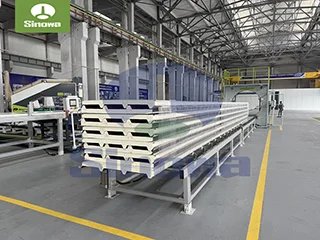
The final stage of the entire production flow is the inspection, stacking, and packaging module, which undertakes quality screening and finished product storage tasks. Automatic detection devices are installed at the end of the sandwich panel production line to conduct non-destructive testing on finished panels, covering multiple performance indicators such as surface flatness, internal compactness, bonding firmness, and dimensional deviation. Panels with surface scratches, internal hollowing, edge delamination, or unqualified dimensions will be automatically screened out and transported to the reprocessing area. Qualified finished panels are transported to the stacking station through the transmission system, and mechanical stacking equipment neatly arranges the panels according to fixed stacking specifications to avoid extrusion deformation caused by messy accumulation. During the packaging link, protective films and wrapping materials are used to seal the surface and edges of the panels, preventing surface abrasion and moisture erosion during transportation and storage. The entire post-processing process realizes automated unmanned operation, reducing manual handling errors and improving the overall delivery efficiency of finished products.
The widespread industrial application of PU sandwich panel machine stems from the unique comprehensive performance advantages of polyurethane composite panels. In the field of industrial building construction, these panels serve as ideal enclosure materials for factory workshops, cold storage warehouses, and temporary engineering buildings. The microporous foam structure of polyurethane endows the panels with excellent thermal insulation and heat preservation performance, which can effectively reduce the energy consumption of temperature-controlled buildings and maintain stable internal ambient temperature. Meanwhile, the composite structure formed by the surface rigid plate and intermediate foam gives the panels high compressive strength and bending resistance, enabling them to withstand external wind pressure and mechanical impact without permanent deformation. In addition, the smooth surface of the panels is convenient for daily cleaning and maintenance, meeting the high hygienic requirements of food processing workshops, pharmaceutical production workshops, and purification laboratories.
In the transportation equipment manufacturing industry, PU panels are widely applied in the compartment manufacturing of refrigerated transport vehicles, insulated carriages, and special engineering vehicles. The lightweight characteristic of polyurethane materials effectively reduces the overall self-weight of transportation equipment, helping to lower energy consumption during transportation. The stable thermal insulation performance can maintain the low-temperature storage environment inside refrigerated carriages for a long time, reducing the temperature fluctuation range of transported goods. Moreover, the composite panels have good vibration damping and noise reduction capabilities, which can buffer the vibration generated during vehicle operation and reduce internal and external noise transmission, optimizing the internal operating environment of transportation equipment. Benefiting from the flexible production characteristics of PU panel lines, panels with different thicknesses and structural strengths can be customized according to the usage scenarios of different transportation equipment to meet differentiated manufacturing requirements.
In the field of new energy and chemical industrial facilities, PU panels play an important role in equipment insulation and pipeline protection. Many chemical production equipment and storage tanks require stable external thermal insulation layers to reduce the heat exchange efficiency between the equipment and the external environment and avoid chemical reaction fluctuations caused by temperature changes. The corrosion-resistant and weather-resistant properties of optimized PU composite panels enable them to maintain stable structural performance in harsh environments such as high humidity and chemical vapor corrosion for a long time. In addition, the flame-retardant modified polyurethane materials can effectively inhibit the spread of flames, improving the overall safety level of industrial facilities. The continuous production mode of PU panel lines can stably supply large quantities of standardized industrial insulation panels, meeting the large-scale material demand of industrial construction projects.
The core technological advantages of modern polyurethane sandwich panel machine is reflected in automation control, production stability, energy consumption optimization, and environmental protection performance. In terms of automation control, the entire production line adopts a centralized intelligent control system to realize integrated management of raw material feeding, parameter adjustment, equipment operation, and finished product detection. Operators can monitor the real-time operating status of each functional module through the human-computer interaction interface, and remotely adjust production parameters such as raw material ratio, curing temperature, and cutting size. The system is equipped with an automatic early warning mechanism, which can quickly identify abnormal operating conditions such as raw material blockage, temperature deviation, and transmission jamming, and trigger protective shutdown actions to avoid equipment damage and material waste.
In terms of production stability, the continuous production structure of the PU panel line eliminates the intermittent standby links of traditional batch production equipment. The coordinated operation of all modules realizes non-stop material transportation and processing, greatly improving production efficiency. The precision metering and constant-temperature control technology effectively suppresses the fluctuation of raw material reaction conditions, ensuring that the density, thermal conductivity, and bonding strength of each batch of finished panels remain within a stable fluctuation range. Compared with semi-automatic production equipment, the continuous production line reduces manual intervention links, lowers the quality deviation rate caused by human operation errors, and improves the overall yield of products.
In terms of energy consumption optimization, modern PU sandwich panel machinery adopts energy-saving heating structures and heat circulation utilization technologies. The heat generated during the curing reaction of polyurethane materials is collected and reused through the heat circulation system, reducing the external energy supply required for constant-temperature curing. The transmission motors of each functional module are equipped with frequency conversion energy-saving devices, which automatically adjust the operating power according to the production operating status, avoiding invalid energy consumption caused by no-load operation. In addition, the optimized structural design reduces the heat loss of the curing channel and raw material storage area, further improving the comprehensive energy utilization efficiency of the production line.
In terms of environmental protection performance, the upgraded PU sandwich panel production equipment optimizes the raw material mixing and pouring process to reduce the volatilization of trace organic substances during material reaction. The closed raw material storage and transportation structure avoids raw material leakage and environmental pollution. The residual materials generated during the cutting and trimming process are collected uniformly through the recycling system, and the recycled materials are processed secondarily for auxiliary production, realizing the efficient utilization of production resources. Compared with traditional panel production processes, the production process of PU panel lines does not generate a large amount of industrial wastewater and solid waste, which conforms to the development trend of green industrial production.
Scientific daily operation and standardized maintenance management are crucial to prolonging the service life of PU panel lines and maintaining stable production efficiency. In the daily operation process, operators need to complete pre-production inspection work in strict accordance with the operating specifications, including checking the residual amount of raw materials, the tightness of connecting pipelines, the sensitivity of sensing components, and the operating flexibility of transmission structures. Before formal production, a short-time empty machine test operation is required to observe whether there is abnormal noise, vibration, or parameter deviation in each module, and formal production can be carried out only after confirming that all equipment indicators are normal. During the production process, the operating parameters should not be adjusted arbitrarily to avoid chemical reaction disorders of raw materials and equipment operation failures caused by parameter mutations.
Regular equipment maintenance is divided into daily maintenance, weekly maintenance, and seasonal maintenance. Daily maintenance mainly includes cleaning the residual materials on the surface of the equipment, wiping the sensing detection components, checking the sealing performance of the raw material pipelines, and replenishing lubricating oil for the transmission bearings to ensure the flexible operation of mechanical structures. Weekly maintenance focuses on fastening the connecting bolts of each module, calibrating the precision metering device and cutting positioning system, detecting the temperature uniformity of the curing channel, and cleaning the dust and impurities inside the heat circulation pipeline. Seasonal maintenance requires comprehensive shutdown inspection, including checking the aging degree of sealing parts, testing the operating performance of the control circuit, maintaining the heat preservation structure of the curing channel, and replacing severely worn mechanical accessories. Hierarchical maintenance management can effectively eliminate potential equipment faults, reduce the frequency of sudden shutdowns, and maintain long-term stable operating efficiency of the production line.
In addition to daily maintenance, fault diagnosis and emergency disposal capabilities are also essential for the stable operation of PU sandwich panel manufacturing line. Common minor faults in the production line include raw material pipeline blockage, unstable tension of surface materials, slight temperature deviation of the curing channel, and burrs on cutting sections. These minor faults can be eliminated through parameter resetting, pipeline dredging, and blade polishing. For medium and high-level faults such as motor overload operation, circuit signal failure, and structural jamming, the system will automatically trigger an alarm and shut down the equipment. Professional maintenance personnel need to conduct targeted troubleshooting according to the fault prompt information, and carry out maintenance and replacement after cutting off the power supply to ensure the safety of the maintenance process. After the fault is repaired, a test run must be carried out to confirm that all indicators return to normal before resuming formal production.
Looking at the current global industrial development trend, PU sandwich panel production machine is evolving in the directions of intelligent upgrading, structural optimization, performance diversification, and low-carbon environmental protection. In terms of intelligent upgrading, the production line will be combined with digital twin technology to build a virtual simulation production system. Through real-time mapping of equipment operating status and material reaction process, the system can predict potential equipment faults and quality risks in advance, realizing predictive maintenance and intelligent quality control. The introduction of automated intelligent sorting and handling robots will further reduce manual participation, build a fully unmanned automated production workshop, and improve the overall intelligence level of the production system.
In terms of structural optimization, future PU sandwich panel line will adopt modular combined structural design. Each functional module is designed as an independent detachable unit, which is convenient for equipment transportation, installation, and later maintenance and transformation. The optimized transmission structure will reduce the mechanical vibration amplitude during operation, further improving the flatness and structural uniformity of finished panels. In addition, the miniaturized and compact structural design will reduce the floor area of the production line, lowering the site construction cost of manufacturing enterprises and improving the utilization rate of factory space.
In terms of product performance diversification, the upgraded production lines will support the customized production of multi-type composite panels. By adjusting raw material formulas and production process parameters, the production line can prepare flame-retardant, antibacterial, high-temperature resistant, and low-temperature resistant modified PU panels to adapt to more complex application scenarios. The composite structure of panels will also be innovated, realizing the integrated production of special-shaped panels and multi-layer heterogeneous composite panels to meet the personalized material needs of emerging industries such as new energy storage, aerospace auxiliary facilities, and marine engineering equipment.
In terms of low-carbon environmental protection development, PU sandwich panel production line will further optimize raw material formulas and production processes, develop low-volatile and environmentally friendly polyurethane composite raw materials, and reduce the emission of harmful substances in the production process. The waste material deep recycling technology will be popularized and applied to realize the regeneration and reuse of waste panels and production residues, improving the resource recycling rate. The energy-saving transformation of heating, transmission, and control systems will continue to be promoted to reduce unit energy consumption per product, gradually building a low-carbon and green production model that meets global environmental protection development requirements.
In conclusion, the PU panel production line as a mature and efficient continuous production system for polyurethane composite materials, integrates multiple disciplines such as polymer chemistry, mechanical transmission, intelligent control, and thermal energy engineering. Its complete production process covers raw material pretreatment, mixing pouring, composite pressing, constant-temperature curing, cutting trimming, and finished product inspection, realizing standardized, large-scale, and high-quality manufacturing of PU panels. Relying on its advantages of stable performance, wide adaptability, low comprehensive energy consumption, and environmental friendly production process, the products manufactured by PU panel lines have been widely used in construction, transportation, chemical industry, new energy, and other industrial fields. With the continuous progress of industrial manufacturing technology, the intelligent degree, structural rationality, and environmental protection level of PU panel lines will be further improved. Driven by technological innovation, this type of production line will continuously expand its application boundaries, provide high-quality lightweight composite panel materials for more industrial fields, and inject continuous power into the high-quality development of the global composite material manufacturing industry. For manufacturing enterprises, scientifically selecting, rationally operating, and standardly maintaining PU sandwich panel making machine is not only an important measure to improve production efficiency and product quality but also a key path to enhance market competitiveness and adapt to the changing trend of the global industrial market.
https://www.cnsinowa.com/sandwich-panel-machines/pu-panel-line.html