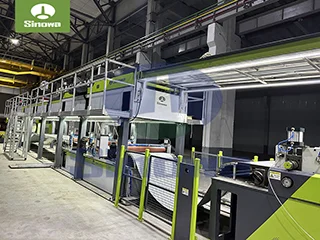
sandwich panel machine
The overall structural design of the PU sandwich siding panel machine follows the concept of modular integration and synchronous linkage, with each functional module precisely matched in operating speed and process rhythm to ensure the continuity and stability of the entire production process. The complete PU sandwich panel production line is composed of multiple core functional units, including a raw material unwinding and feeding unit, surface pretreatment unit, high-pressure foaming and material mixing unit, double-track laminating and molding unit, constant-temperature curing unit, fixed-length cutting unit and automatic conveying and stacking unit. Each module operates independently in function but maintains highly unified operational logic through the central control system, avoiding production defects such as uneven foaming, inconsistent bonding and dimensional deviation caused by asynchronous process links. The overall mechanical structure is designed with industrial durability in mind, adopting high-strength welded structural parts and wear-resistant transmission components to adapt to long-term continuous industrial production, reducing equipment failure rates and daily maintenance costs while ensuring long-term operational stability.
The raw material unwinding and feeding system is the starting link of the entire production process, responsible for stably conveying the surface base materials required for panel molding. This system is usually equipped with dual-station unwinding structures to simultaneously supply upper and lower surface materials, which can adapt to different types of coil raw materials such as color-coated metal sheets, galvanized sheets and lightweight aluminum composite sheets commonly used for building siding. Equipped with servo-driven deviation correction and positioning devices, the system can dynamically adjust the material conveying trajectory in real time during operation, effectively avoiding lateral deviation of coil materials during high-speed conveying. This precise positioning function ensures the consistency of the width and edge flatness of the finished siding panels, laying a foundation for the uniform compounding of subsequent core materials. In addition, the feeding system is matched with a tension control mechanism to maintain constant tension of the surface materials during conveying, preventing sheet deformation, wrinkling or stretching defects that may affect the flatness and structural stability of the final panels.
Following the feeding process, the surface pretreatment unit undertakes the key task of improving the bonding performance between the surface sheet and the PU foam core layer, which directly determines the structural durability and delamination resistance of the finished siding panels. During long-term storage and transportation, coil surface materials are prone to attaching oil stains, dust and oxide layers, which will form isolation layers between the surface layer and the foam core, leading to insufficient bonding strength and even delamination and peeling in later use. The pretreatment unit completes surface purification through high-pressure air cleaning and physical polishing, thoroughly removing surface attachments and impurities. Meanwhile, the integrated preheating device heats the surface materials to the optimal temperature range for foam bonding. Appropriate preheating can activate the surface molecular activity of the sheet material, accelerate the reaction bonding speed between the PU foam and the surface layer, and significantly improve the overall bonding fastness and weather resistance of the composite panel. This pretreatment process is an indispensable key link in high-quality panel production, effectively avoiding common quality problems of traditional composite panels such as easy delamination and poor aging resistance.
The high-pressure foaming and mixing unit is the core functional component that determines the thermal insulation performance and structural uniformity of PU sandwich siding panels, mainly responsible for the precise proportioning and uniform mixing of polyurethane foam raw materials. Polyurethane foam is formed by the chemical reaction of two liquid raw materials, and the accurate proportioning of the two components is the key to ensuring foam density, pore uniformity and structural stability. The system adopts precision metering pumps with stable output performance to deliver raw materials according to the set process ratio, realizing micro-level accurate flow control and avoiding performance differences caused by raw material proportion deviation. The raw materials are fully mixed through a high-speed dynamic mixing chamber, and the uniformly mixed liquid foam is continuously and evenly injected into the gap between the upper and lower pre-treated surface sheets. The entire foaming injection process adopts seamless continuous feeding, which ensures that the foam can fully fill the composite cavity without dead angles or gaps, forming a dense and uniform foam core layer. Reasonable foaming pressure and injection speed settings can adjust the foam expansion range and curing density, enabling the equipment to produce siding panels with different thermal insulation coefficients and structural hardness to meet the usage needs of different building scenarios.
The double-track laminating and molding unit is responsible for shaping the initial structure of the composite panel and controlling the overall thickness flatness of the product. After the PU foam liquid is injected, the upper and lower surface materials carrying the foam enter the double-track crawler pressing mechanism synchronously. The crawler structure adopts a fully enclosed and symmetric design, which can apply uniform and stable pressure on the upper and lower surfaces of the panel during the foam expansion and preliminary curing stage. This uniform pressure constraint can limit the free expansion of the foam, ensure that the foam core layer forms a consistent thickness and regular structure, and make the surface materials and the foam core layer closely bonded without gaps. The spacing of the double tracks can be adjusted flexibly according to the production specifications, adapting to the production of siding panels with different thickness ranges. At the same time, the track running speed is precisely synchronized with the foam reaction speed, matching the material conveying speed with the foam curing progress to avoid structural defects such as foam hollowing, surface bulging and uneven thickness caused by mismatched process speeds. The whole molding process realizes one-time composite molding, eliminating the need for secondary bonding and processing, and greatly improving the overall structural integrity of the panel.
The constant-temperature curing system plays a decisive role in stabilizing the physical properties of the finished panel. After preliminary lamination and molding, the PU foam is in the stage of continuous chemical reaction and structural curing, and a stable temperature environment is required to ensure complete reaction and uniform molding of the foam. The curing unit forms a sealed constant-temperature curing channel, which can maintain a stable internal temperature field and avoid the influence of external temperature changes on the foam curing effect. In the constant-temperature environment, the foam completes full foaming, solidification and structural stabilization, forming a closed-cell structure with high density and uniform pores. This standardized curing process can significantly improve the thermal insulation, sound insulation and compressive resistance of the PU core layer, while enhancing the bonding strength between the core layer and the surface material. Panels processed by constant-temperature curing have more stable dimensional accuracy, no post-production shrinkage or deformation, and can maintain stable physical performance in long-term outdoor use, adapting to complex outdoor weather conditions such as high temperature, low temperature and humidity alternation.
The fixed-length cutting and post-processing unit realizes the final shaping and finishing of continuous molded panels. After complete curing and molding, the long strip of continuous composite panel is conveyed to the cutting station through the synchronous conveying system. The high-precision cross-cutting mechanism automatically completes fixed-length cutting according to preset dimensional parameters, with smooth and flat cutting sections without burrs or collapses, ensuring the dimensional accuracy and edge integrity of each finished panel. The cutting speed is intelligently matched with the PU sandwich panel line operating speed, realizing non-stop continuous cutting, which effectively improves production efficiency without interrupting the continuous production process. After cutting, the finished panels are conveyed to the sorting and stacking station through the conveying device, and the automatic stacking mechanism neatly arranges the finished panels, which is convenient for subsequent packaging, transportation and storage. Some optimized equipment configurations are also equipped with surface protection film laminating functions, which can attach protective films to the panel surface after cutting to avoid surface scratches and pollution during transportation and installation, further improving the finished product quality.
The intelligent control system runs through the continuous PU sandwich panel line and is the core brain to ensure the efficient and stable operation of the equipment. The system adopts integrated programmable control logic, which can uniformly schedule and adjust the operating parameters of all functional modules such as feeding, foaming, pressing, curing and cutting. Operators can set production specifications, process parameters and operating speeds through the human-machine interaction interface, and the system will automatically complete synchronous adjustment of each link to realize fully automated unmanned production. In the production process, the control system can monitor key parameters such as raw material flow, foaming pressure, curing temperature, conveying speed and panel dimensional accuracy in real time. Once abnormal parameter fluctuations are detected, the system will automatically trigger early warning and fine-tune the parameters to ensure consistent and stable product quality. The data visualization function can record and store production data in real time, which is convenient for production process tracking, quality analysis and production efficiency optimization, providing reliable data support for standardized production management.
Compared with traditional intermittent panel production equipment, PU sandwich panel machine has obvious technical and production advantages in industrial application. First of all, the fully continuous integrated production mode greatly improves production efficiency, realizing uninterrupted mass production of panels and solving the problem of low output of traditional single-piece molding equipment. Secondly, the precise parameter control and synchronous linkage design eliminate manual operation errors, making the dimensional accuracy, structural compactness and performance consistency of finished panels far higher than those of manually assisted production products. In terms of product performance, the closed-cell PU foam formed by high-precision foaming and constant-temperature curing has excellent thermal insulation and heat preservation performance, which can effectively reduce building energy consumption. At the same time, the composite structure of metal surface layer and foam core layer endows the panel with lightweight, high strength, weather resistance and impact resistance, which is very suitable for building exterior wall decoration and thermal insulation engineering.
In terms of industrial adaptability, this type of equipment has strong flexible production capacity and can meet the diversified production needs of the market. By adjusting equipment parameters and matching different surface materials, it can produce siding panels suitable for different scenarios such as civil residential buildings, commercial buildings, industrial plants and temporary construction facilities. The produced panels integrate decoration, thermal insulation, sound insulation and waterproof functions, which can simplify the building exterior wall construction process, reduce construction cycle and labor costs, and improve the overall construction efficiency. In addition, the optimized mechanical structure design reduces material waste in the production process, and the full reaction of PU raw materials avoids raw material residue and pollution, which conforms to the energy-saving and environmentally friendly development trend of the modern construction industry.
With the continuous development of building industrialization and green building technology, the technical iteration of PU sandwich siding panel machines is also accelerating. Modern equipment is developing towards higher intelligence, higher precision and stronger energy-saving performance. The upgraded intelligent monitoring system can realize more refined process control, further improve product qualification rate and production stability. The optimized mechanical transmission structure reduces equipment energy consumption and operating noise, improving the overall energy-saving level of production. At the same time, the equipment’s adaptability to new environmental protection materials and new structural processes is constantly enhanced, which can support the production of more diversified high-performance composite siding panels and meet the increasingly stringent requirements of the construction industry for building energy conservation, environmental protection and structural safety.
In practical industrial production, the stable operation of PU sandwich siding panel machines is closely related to standardized operation and daily maintenance. Scientific equipment maintenance can effectively extend the service life of mechanical components and maintain long-term stable production accuracy. Daily maintenance mainly includes regular cleaning of material conveying and foaming components to avoid raw material residue accumulation affecting processing accuracy, regular inspection and lubrication of transmission parts to ensure flexible and stable equipment operation, and real-time calibration of metering and positioning devices to maintain production dimensional accuracy. Standardized operation management can avoid process parameter errors and equipment operation failures caused by human factors, ensuring long-term efficient and stable operation of the sandwich panel production line and providing continuous and reliable equipment support for large-scale and standardized production of building exterior wall siding panels.
In conclusion, the PU sandwich siding panel production machine as a highly integrated and automated professional production equipment, combines mechanical transmission, chemical foaming, constant-temperature curing and intelligent control technologies, realizing efficient, standardized and high-quality production of PU composite siding panels. Its excellent production stability, flexible production adaptability and efficient production capacity make it an important supporting equipment in the field of modern building energy-saving and exterior decoration materials. With the continuous advancement of green building policies and building industrialization, the market demand for high-performance composite siding panels will continue to expand, and the technical level and application scope of PU sandwich panel machine will be further improved and expanded, providing more powerful technical and equipment support for the high-quality development of the construction industry.
https://www.cnsinowa.com/sandwich-panel-machines/pu-sandwich-siding-panel-machine.html