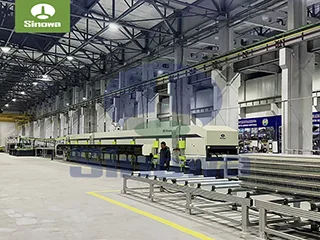
sandwich panel machine
The fundamental working principle of a PU sandwich panel production machine for low strength composite panels revolves around the continuous and automated assembly of three key layers: two outer facer sheets and a central PU foam core. The integration of these layers requires precise coordination between multiple components to achieve optimal bonding, uniform foam distribution, and consistent panel dimensions—all critical factors for low strength panels, which may lack the structural rigidity to compensate for manufacturing inconsistencies. The process begins with the preparation and feeding of the outer facer materials, which can vary depending on the intended application of the low strength composite panel. Common facer materials include thin metal sheets, fiber-reinforced plastics, paper-based composites, or non-woven fabrics, each selected for their compatibility with low strength cores and the desired end-use properties.
The uncoiling and feeding system is the starting point of the production line, responsible for unwinding large rolls of facer material and feeding them into the subsequent processing stages with minimal tension. For low strength composite panels, this system must operate with gentle handling to avoid damaging the relatively fragile facer materials, which may tear or deform under excessive force. The uncoilers are equipped with adjustable tension controls that can be fine-tuned based on the thickness and flexibility of the facer material, ensuring a smooth and consistent feed rate. Guide rollers and positioning devices further assist in aligning the facer sheets accurately, preventing misalignment that could lead to uneven foam distribution or poor bonding between layers.
Following the uncoiling stage, the facer sheets move through the roll forming section, where they are shaped into the desired profile. For low strength composite panels, the roll forming process is typically less aggressive than that used for high strength panels, as excessive bending or shaping could compromise the integrity of the facer material. The roll forming stands are arranged in tandem, with each set of rollers gradually bending the facer sheet into the intended shape—whether flat, corrugated, or custom-designed—without causing structural damage. The ability to adjust the roll forming parameters is crucial here, as different low strength applications may require varying profiles to enhance specific properties, such as rigidity or aesthetics, without increasing the overall strength of the panel.
Once the facer sheets are formed, they proceed to the foam injection and lamination zone, which is the heart of the PU sandwich panel production machine. This zone is responsible for mixing the PU foam components, injecting the mixture between the two facer sheets, and ensuring proper bonding as the foam expands and cures. For low strength composite panels, the PU foam core is formulated to provide lightweight insulation and cushioning rather than structural support, so the foam injection system must deliver a consistent density and distribution to maintain uniform panel performance. The foam mixing unit uses high-pressure impingement technology to combine the polyol and isocyanate components with precise metering, ensuring a homogeneous mixture that expands evenly between the facer sheets.
The foam injection process is synchronized with the movement of the facer sheets to ensure that the foam fills the entire gap between the layers without gaps or excess accumulation. For low strength panels, the gap between the facer sheets—determining the core thickness—is typically adjustable to meet varying insulation and thickness requirements. The injection nozzles are positioned to distribute the foam evenly across the width of the panels, and additional spreading devices may be used to ensure complete coverage. As the foam expands, it adheres to the inner surfaces of the facer sheets, creating a strong bond that holds the panel together. The curing of the foam is accelerated through controlled temperature and pressure conditions, with the production line equipped with heating elements or hot air circulation systems to maintain the optimal curing environment.
The double belt conveyor system plays a vital role in supporting the panel during the foam curing process, particularly for low strength composite panels that may lose shape if not properly supported. This system consists of two parallel belts that sandwich the panel from the top and bottom, applying uniform pressure to ensure the foam cures evenly and the panel maintains its flatness. The belts are made from durable, heat-resistant materials that can withstand the curing temperatures and prevent sticking to the foam core. The speed of the conveyor is synchronized with the overall production rate, allowing sufficient time for the foam to cure to the required hardness before the panel moves to the next stage. For low strength panels, the pressure applied by the double belt system is carefully calibrated to avoid compressing the foam core excessively, which would reduce its insulation properties and potentially damage the facer materials.
After the foam has cured sufficiently, the panel moves to the cutting section, where it is trimmed to the desired length and width. The cutting system for low strength composite panels must operate with precision to avoid fraying, cracking, or delamination of the panel edges. Common cutting technologies include circular saws, band saws, or CNC cutting machines, each selected based on the type of facer material and the required cut quality. The cutting process is automated, with sensors and positioning systems ensuring that each panel is cut to exact dimensions, minimizing waste and ensuring consistency across the production batch. For panels with custom shapes or cutouts, the cutting system can be programmed to handle complex designs, expanding the versatility of the production machine.
One of the key advantages of modern PU sandwich panel production machines for low strength composite panels is their high level of automation, which reduces the need for manual intervention and improves production efficiency. Automated control systems, often equipped with programmable logic controllers (PLCs) and touchscreen interfaces, allow operators to monitor and adjust every stage of the production process with precision. Parameters such as feed rate, roll forming pressure, foam density, curing temperature, and cutting dimensions can be set and modified through the control system, enabling quick changes between different panel specifications. This automation not only increases production output but also reduces the risk of human error, which is particularly important for low strength panels that are more susceptible to quality issues caused by inconsistent processing.
Versatility is another important feature of these production machines, as low strength composite panels are used in a wide range of applications with varying requirements. The ability to accommodate different facer materials, core thicknesses, and panel dimensions allows manufacturers to produce panels for diverse uses, from interior partition walls and ceiling panels to packaging materials and temporary structures. Some machines are also capable of integrating additional features, such as surface lamination with decorative films or the addition of reinforcement layers for specific applications, without compromising the low strength properties of the panel. This versatility makes the production machine a cost-effective investment for manufacturers looking to serve multiple market segments.
Energy efficiency is a growing concern in manufacturing, and PU sandwich panel production machines for low strength composite panels are designed with this in mind. The heating systems used for foam curing are optimized to minimize energy consumption, with insulation around the curing zone reducing heat loss. Additionally, the high-pressure foam mixing system operates with minimal waste, as the precise metering of components ensures that only the required amount of foam is produced. Some machines also feature energy recovery systems that capture and reuse heat generated during the curing process, further reducing operational costs. These energy-efficient design elements not only lower the environmental impact of production but also improve the overall profitability of manufacturing low strength composite panels.
The maintenance of PU sandwich panel production machines is crucial to ensuring consistent performance and longevity, especially when processing low strength materials that may leave residue or cause wear on components. Regular maintenance tasks include cleaning the foam injection nozzles and mixing chambers to prevent clogs, inspecting the roll forming rollers for wear and tear, lubricating moving parts to reduce friction, and calibrating the control system to maintain precision. The use of high-quality materials in the construction of the machine components also contributes to reduced maintenance needs, as durable parts are less likely to fail under continuous operation. Manufacturers often provide guidelines for routine maintenance, helping operators keep the machine in optimal condition and minimize downtime.
Low strength composite panels produced by these machines find applications in numerous industries, each benefiting from the unique properties of PU sandwich panels. In the construction industry, they are used for interior partitions, ceiling tiles, and temporary buildings, where lightweight construction and thermal insulation are prioritized over structural strength. The packaging industry utilizes low strength PU sandwich panels for protective packaging of fragile items, as the foam core provides excellent cushioning while the facer sheets offer structural stability. Additionally, these panels are used in the automotive industry for interior components, such as door panels and trunk liners, and in the furniture industry for lightweight cabinetry and decorative elements. The ability of the production machine to tailor panels to specific application needs makes it a valuable asset for manufacturers serving these diverse markets.
When selecting a PU sandwich panel production machine for low strength composite panels, several factors should be considered to ensure it meets the manufacturer’s requirements. The production capacity of the machine, measured in panels per hour or square meters per day, should align with the manufacturer’s output goals. The level of automation and ease of operation are also important, as they affect labor costs and the risk of production errors. Additionally, the machine’s flexibility to handle different materials and panel specifications is crucial for adapting to changing market demands. Durability and reliability, backed by responsive technical support, ensure that the machine can operate continuously with minimal downtime, maximizing productivity.
Advancements in technology continue to drive improvements in PU sandwich panel production machines for low strength composite panels. Innovations in foam formulation have led to the development of more environmentally friendly PU foams with lower volatile organic compound (VOC) emissions, aligning with global sustainability goals. Improvements in control systems have enhanced the precision of processing parameters, allowing for even greater consistency in panel quality. Additionally, the integration of digital technologies, such as IoT sensors and data analytics, enables real-time monitoring of the production process, predictive maintenance, and optimization of operational efficiency. These technological advancements are making low strength composite panel production more efficient, sustainable, and cost-effective.
In conclusion, PU sandwich panel production machines for low strength composite panels are specialized equipment that plays a critical role in meeting the demand for lightweight, insulated, and cost-effective composite materials. Through their automated processes, precise control systems, and versatile design, these machines enable manufacturers to produce high-quality panels efficiently and consistently. From the gentle handling of fragile facer materials to the uniform injection and curing of PU foam, every component of the machine is tailored to the unique requirements of low strength applications. As industries continue to prioritize sustainability, energy efficiency, and customization, these production machines will evolve further, incorporating new technologies to meet the changing needs of manufacturers and end-users alike. Whether used in construction, packaging, automotive, or furniture applications, low strength PU sandwich panels produced by these machines offer a practical and versatile solution for a wide range of needs.
https://www.cnsinowa.com/sandwich-panel-machines/pu-sandwich-panel-production-machine-for-low-strength-composite-panels.html