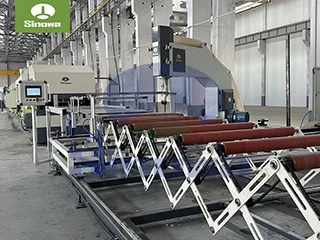
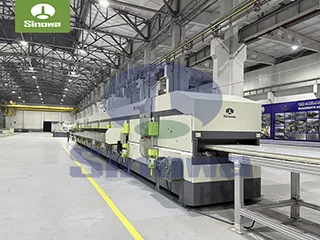
sandwich panel machine
The structural composition of insulation board production equipment varies significantly based on the type of insulation material being manufactured, but most systems share core functional modules that work in tandem to complete the production cycle. Raw material handling modules are fundamental, consisting of storage silos, conveying systems, and preprocessing units that prepare materials for subsequent processes. For example, systems processing mineral-based materials may include crushers and dryers to remove impurities and moisture, while polymer-based production lines feature mixers and homogenizers to blend resins, additives, and foaming agents. Core processing modules form the heart of the equipment, where the actual transformation of raw materials into insulation boards occurs—this may involve extrusion units, foaming stations, centrifugal fiberizers, or molding machines, depending on the production technology. Finishing modules, including cutting machines, trimming devices, cooling systems, and stacking equipment, ensure that the finished products meet precise dimensional specifications and are ready for packaging or further processing. Auxiliary systems such as temperature control units, pressure regulators, dust collection devices, and waste treatment systems are also integral to the structure, maintaining process stability and adhering to environmental standards.
Performance characteristics of insulation board production equipment are defined by factors such as precision control, production efficiency, versatility, and energy efficiency. Precision control capabilities determine the consistency of product properties, including thickness, density, thermal conductivity, and surface smoothness. Advanced systems integrate automated control technologies to regulate parameters such as temperature, pressure, material flow rate, and curing time with high accuracy, minimizing product variability. Production efficiency is measured by throughput—the volume of insulation boards produced per hour or shift—and is influenced by the equipment’s design for continuous or batch operation. Continuous production lines are typically more efficient for large-scale manufacturing, while batch systems offer greater flexibility for small-batch or custom products. Versatility refers to the equipment’s ability to adapt to different raw materials, product specifications, and insulation types, often achieved through interchangeable molds, adjustable process parameters, and modular components. Energy efficiency is an increasingly critical performance metric, with modern equipment incorporating heat recovery systems, low-energy motors, and optimized process designs to reduce energy consumption and operational costs. Additionally, reliability and ease of maintenance are key performance attributes, as downtime can significantly impact production schedules and profitability—equipment with robust construction and accessible components minimizes maintenance requirements and extends service life.
Insulation board production equipment can be categorized based on the type of insulation material it manufactures, as each material requires distinct processing technologies. One major category is equipment for polymer-based insulation boards, which includes systems for expanded polystyrene (EPS), extruded polystyrene (XPS), and polyurethane (PU) products. EPS production equipment follows a multi-stage process starting with pre-expanders that use steam to expand raw EPS beads to a predetermined density. These pre-expanded beads are then transferred to aging silos to stabilize moisture content and internal pressure before being fed into molding machines. The molding machines fill molds with the beads and apply steam to induce secondary expansion, fusion, and shaping, after which the formed boards are moved to drying chambers to remove excess moisture. Finishing steps involve precision cutting machines—such as multi-head gantry cutters or wire cutters—that trim the boards to exact dimensions. XPS production equipment, by contrast, utilizes extrusion technology centered on twin-screw extruders that melt and mix polystyrene resin with foaming agents, catalysts, and additives. The molten mixture is forced through a die to form a continuous sheet, which is then cooled and shaped by calibration tables with vacuum systems to ensure dimensional accuracy. Traction machines pull the sheet through the production line, and flying saws make transverse cuts to produce finished boards, with auxiliary systems for recycling scrap materials to improve material efficiency.
PU insulation board production equipment is available in continuous and batch configurations, with continuous lines being common for manufacturing sandwich panels with metal or polymeric facings. These lines feature unwinders that feed and join facing materials, which are then preprocessed through cleaning and drying units. The core foaming process occurs on a moving platform where a mixing head injects PU components—typically polyol and isocyanate—between the facings. Dual-belt presses control the board thickness, density, and flatness while promoting foam curing, and the boards pass through an aging zone to complete the curing process. Trimming machines remove excess foam from the edges, and tracking saws cut the panels to specified lengths before automated stackers arrange the finished products. Batch systems for PU insulation boards are used for custom shapes, pipe insulation, or small production runs, utilizing molds that are filled with foaming components and cured in ovens before demolding and finishing.
Another major category is equipment for mineral-based insulation boards, including rock wool and glass wool products. Rock wool production equipment begins with melting furnaces that heat basalt, slag, or other mineral raw materials to temperatures around 1500°C to form a molten liquid. This molten material is then fed into centrifugal fiberizers—typically four-roll systems—that spin at high speeds to convert the liquid into fine fibers. As the fibers are formed, binders and water repellents are sprayed onto them to enhance structural integrity and water resistance. The fibers are collected by a suction system onto a moving conveyor belt, forming a primary mat that is further processed by pendulum machines to create cross-layered fiber distribution, improving compressive strength and reducing stratification. Prepresses compact the mat to the desired thickness before it enters a curing oven, where high temperatures (200-250°C) activate the binder and set the board’s shape. After cooling, the continuous mat is cut into boards by longitudinal and transverse cutting machines, with optional laminating equipment to apply aluminum foil or glass fiber cloth facings for enhanced performance. Glass wool production equipment follows a similar process but uses furnaces to melt silica sand, soda ash, and limestone into glass liquid, which is converted into fibers via centrifugal or flame-blowing methods. The subsequent fiber collection, binding, curing, and cutting steps mirror those of rock wool production, with adjustments to process parameters to achieve the finer fiber diameters characteristic of glass wool.
Additional types of insulation board production equipment include systems for phenolic foam and rubber-plastic insulation boards. Phenolic foam production equipment shares similarities with PU systems but is adapted to handle phenolic resin components, which require specific mixing ratios and curing conditions. Continuous laminating lines for phenolic boards inject resin mixtures between facings and use heat and pressure to induce foaming and curing, while batch molding systems produce custom components. Rubber-plastic insulation board equipment—used for NBR or PVC-based products—involves internal mixers or open mills to blend raw materials, followed by extruders that melt and shape the mixture with foaming agents. The extruded sheets are cooled, trimmed, and cut to size, with winding equipment for flexible products or stacking systems for rigid boards.
The applications of insulation board production equipment are closely tied to the end uses of the insulation boards they manufacture, spanning construction, industrial, HVAC, refrigeration, and automotive sectors. Equipment for EPS and XPS boards is widely used in residential and commercial construction for wall insulation, roof insulation, and floor underlayment, as these materials offer excellent thermal insulation and moisture resistance. EPS production equipment also supports the manufacturing of packaging materials and decorative panels, while XPS systems are favored for projects requiring higher compressive strength, such as road bed insulation and foundation insulation. PU insulation board production lines cater to the construction industry’s demand for sandwich panels used in prefabricated buildings, cold storage facilities, and industrial warehouses, as well as refrigerated vehicles and shipbuilding applications where lightweight and high insulation performance are critical. Mineral wool production equipment serves construction and industrial markets, producing boards for fireproof partitions, acoustic insulation in commercial buildings, and high-temperature insulation in industrial furnaces, boilers, and power plants. Glass wool equipment is used to manufacture insulation for HVAC ducts, ceiling panels, and residential wall cavities, leveraging its superior acoustic and thermal properties.
In industrial settings, insulation board production equipment plays a vital role in manufacturing materials for energy conservation and process efficiency. For example, rock wool production lines supply insulation for industrial pipelines and equipment, reducing heat loss and improving operational efficiency. Phenolic foam equipment produces boards for high-temperature applications and fire-rated insulation, meeting strict safety standards in industrial and commercial buildings. Rubber-plastic insulation equipment caters to the HVAC and refrigeration industries, manufacturing flexible boards for duct insulation and pipe wrapping in air conditioning systems, refrigerators, and freezers. The versatility of modern insulation board production equipment allows manufacturers to adapt to evolving market demands, such as the growing need for eco-friendly materials—many systems can be modified to use renewable raw materials, low-VOC binders, and non-ozone-depleting foaming agents, aligning with global sustainability goals.
The evolution of insulation board production equipment is driven by advancements in materials science, automation technology, and environmental regulations. Modern systems increasingly integrate smart control technologies, such as PLC and DCS systems, to enable real-time monitoring and adjustment of process parameters, improving product quality and reducing waste. Energy-efficient designs, including heat recovery systems and variable-frequency drives, minimize the environmental footprint of production operations. Additionally, modular equipment designs allow manufacturers to expand or modify production lines as needed, enhancing flexibility and cost-effectiveness. As the demand for energy-efficient buildings and industrial processes continues to grow, insulation board production equipment will remain a critical component of the global insulation industry, supporting the development of high-performance, sustainable insulation solutions across diverse applications.
In summary, insulation board production equipment is a diverse and specialized category of machinery, with each type engineered to meet the unique processing requirements of different insulation materials. The structural design of these systems integrates raw material handling, core processing, and finishing modules, while performance is defined by precision, efficiency, versatility, and reliability. From polymer-based EPS, XPS, and PU boards to mineral-based rock wool and glass wool products, the equipment’s configuration dictates the properties of the final insulation material, which in turn determines its application in construction, industrial, HVAC, and refrigeration sectors. As sustainability and energy efficiency become increasingly important, the ongoing innovation in insulation board production equipment will continue to drive improvements in product performance, environmental compliance, and manufacturing efficiency, ensuring the industry’s ability to meet evolving global demands.
https://www.cnsinowa.com/sandwich-panel-machines/insulation-board-production-equipment.html